Lifestyle
Will they? Won't they? And … why do we care?


The chemistry between Janine (Quinta Brunson) and Gregory (Tyler James Williams) has simmered for three long seasons on Abbott Elementary.
Gilles Mingasson/Disney
hide caption
toggle caption
Gilles Mingasson/Disney
Last week Season 3 of Abbott Elementary came to an end, and the one thing every single viewer had predicted would happen since the premiere of the pilot episode finally did happen: Nerdy, awkward school teachers Janine (Quinta Brunson) and Gregory (Tyler James Williams) got together. For real, for real. To get there, it only took an untold number of gawky flirtations resulting in direct-to-camera looks of embarrassment, a drunken one-off kiss (in Season 2, during a work conference), and several spectacularly failed attempts at dating other people while denying or downplaying their romantic interests in one another.

Surely plenty of fans have found joy in the resolution of this long-delayed one true pairing; if so, I’m genuinely happy for you. But call me the “will they-won’t they?” grinch — I’m mostly just relieved the convoluted storyline can finally (hopefully!) be put to rest. The writers’ insistence on making them the Jim-and-Pam of Abbott has long been the least interesting element of this smart and consistently funny series, and as utterly charming as Brunson and Williams are, even they couldn’t keep the perpetually unresolved sexual tension between their characters from grating by Season 3. (The episode where Jacob and Gregory attempt to go on a double date and Gregory gets distracted by seeing Janine out with school district rep Manny might’ve been less tedious had it not been such a similar iteration of several earlier plotlines.)
Of course, this is TV Writing 101, one of the oldest tropes in the playbook. Some shows have found clever ways to mess around with it, as with the deeply intimate but platonic work relationship between 30 Rock’s Liz Lemon and Jack Donaghy — anyone actively rooting for them to be A Thing plucked that desire from thin air, because there was zero amorous chemistry popping off between those two. (The writers poked fun at this expectation all the time, as when the pair mistakenly married in Season 5.) Before being unceremoniously canceled, Happy Endings began with Alex and Dave’s broken engagement, which provided plenty of “will-they-won’t-they-get-back-together” fodder a la those classic Hollywood remarriage comedies like The Awful Truth.
Living Single actually managed to juggle two different versions of this trope in satisfying ways: the flirtatiously antagonistic Beatrice-and-Benedick vibes shared between corporate climbers Maxine and Kyle, and the goofy puppy love of TV’s original Awkward Black Couple, handyman Overton and office manager Synclaire. In both cases, the show confronted the simmering tensions early; Max and Kyle sleep together in Season 2, making their ongoing love-hate dynamic that much funnier throughout the rest of the series, and Overton and Synclaire make it official in Season 1, allowing them to explore other silly hurdles and milestones throughout their courtship.
It’s easy enough to imagine a version of Abbott that took a page out of 30 Rock, and gave us a fruitful platonic friendship with Janine and Gregory. But watching a lot of TV primes us “will-they” grinches for disappointment, because it seems we’re vastly outnumbered, or at least not as vocal in our annoyance as the champions are about their excitement. Law & Order: SVU fans have been rooting for Benson and Stabler to get together for 25 years, and recentlyalmost got their wish. And I’m already exhausted by the corner of social media that insists on ’shipping not only Carmy and Sydney on The Bear, but alsoJeremy Allen White and Ayo Edebiri, the real-life actors who portray them.
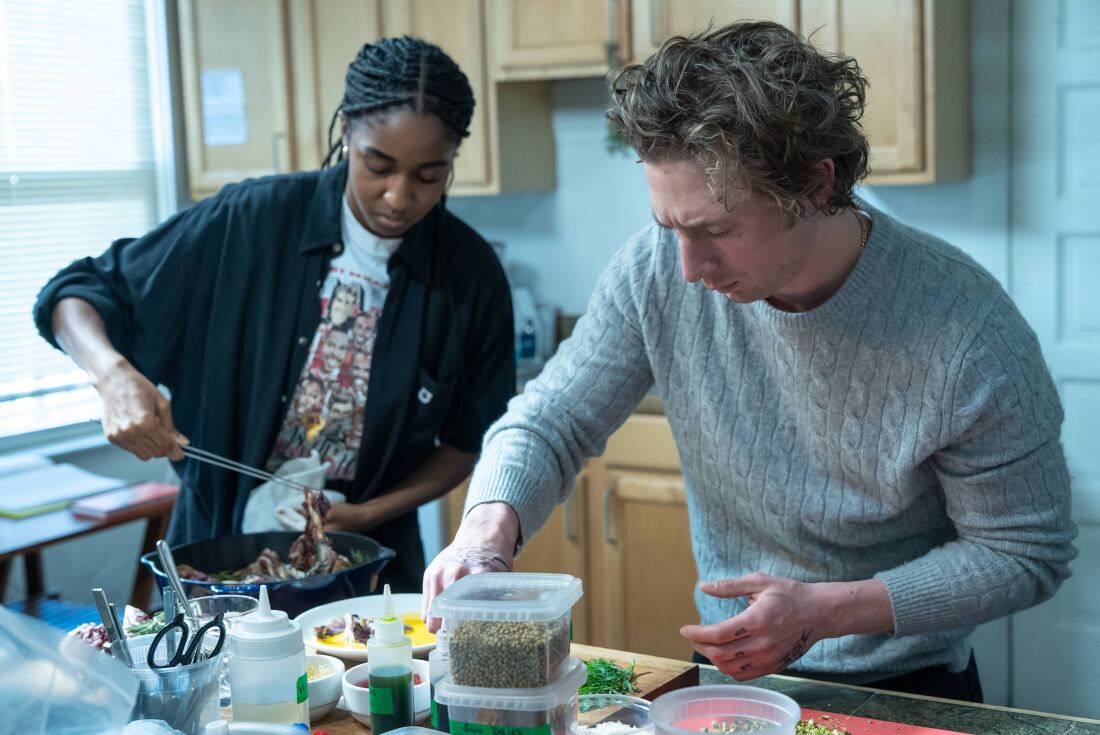
What’s cooking between Sydney (Ayo Ebebiri) and Carmy (Jeremy Allen White) in The Bear? Dinner.
Chuck Hodes/FX
hide caption
toggle caption
Chuck Hodes/FX
But if Janine and Gregory must be more than just friends, Abbott has the opportunity to inject the next season with some inspiring coupledom obstacles. They’re both richly drawn characters with distinct personalities and flaws, finding their way within the challenging and chaotic public-school ecosystem. It’s been delightful watching her learn how to more efficiently channel her do-gooder energy and him loosen up and accept that a job as principal is not in the cards just yet. Now that they’re both a little more confident in themselves, here’s hoping they follow in the footsteps of their Awkward Black Couple predecessors Overton and Synclaire, and the show opens them up to less hackneyed storylines together.
This piece also appeared in NPR’s Pop Culture Happy Hour newsletter. Sign up for the newsletter so you don’t miss the next one, plus get weekly recommendations about what’s making us happy.
Listen to Pop Culture Happy Hour on Apple Podcasts and Spotify.


In central London’s Waterloo Place, a life-size statue that emerged overnight in late April has been creating a stir. When I visited a few weeks after it was erected, local authorities had already set up protective barriers around it.
The installation — signed by the famed street artist Banksy — depicts a man in a suit hoisting a flag as he strides over a precipice. As he marches on, the flag blows backward to cover his face, leaving him unaware he’s only a step away from a perilous fall.
Set among grand monuments celebrating Britain’s past, the “flag man” takes on a particular visual irony at a time when the country — and much of the world — is debating its path forward.
Like many viewers there, I found myself wondering whether this statue is Banksy’s warning about the consequences of uncritical nationalism, or simply a reflection on human shortsightedness. Or, perhaps, it is just prompting us to ponder a broader question: What happens when devotion to a symbol prevents us from seeing what lies ahead?
Whatever the message, the work feels remarkably attuned to the current moment.
For more Far-Flung Postcards, click here.
Lifestyle
Wait, it’s a candle? Her beeswax fruit and veggie ones look so real, you’ll want to take a bite
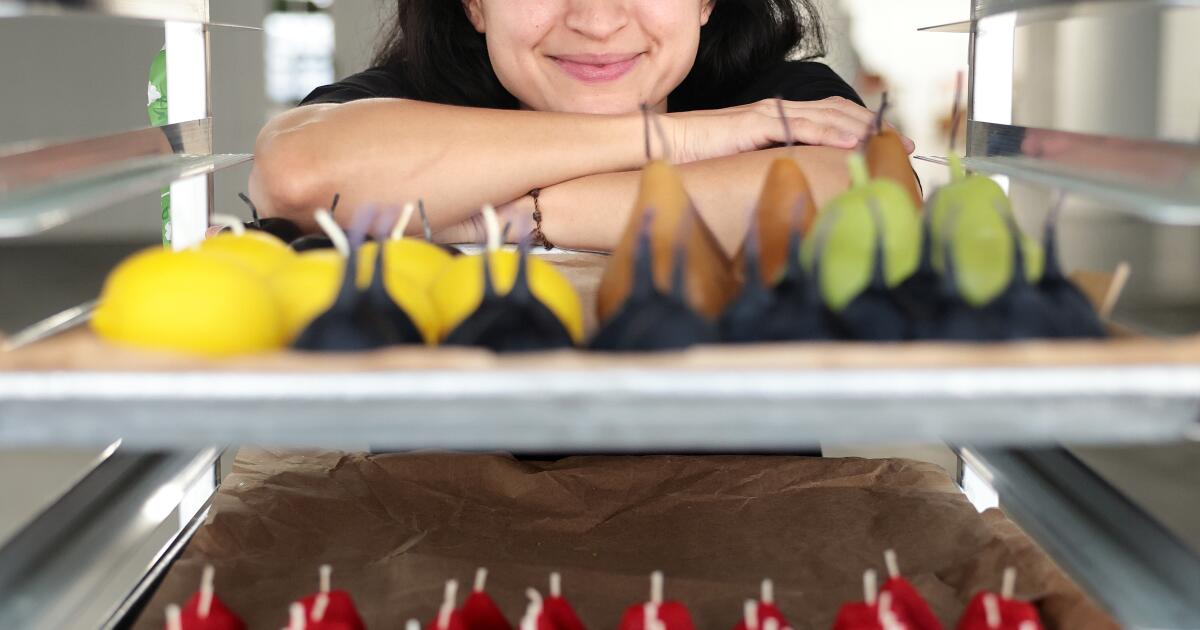
Jessica Gonzalez hustles behind her booth at the recent Renegade Craft Fair, frantically ringing up sales, answering questions and packaging her beeswax candles.
It’s hot on the grounds of the Los Angeles State Historic Park in April, but 35-year-old Gonzalez and her fiancé, Jordan Colindres, keep their cool as a crowd gathers to admire her Happy Organics candle collection, a homage to her family’s produce company in the Central Valley that looks like real fruits and vegetables.
“I love doing in-person events because it’s so fun to see people’s reactions,” she said a few months later. “It makes me feel good to see other people finding joy in my candles. They often say, ‘Oh, that’s really funny.’ And it is funny to have a cherry candle on top of your birthday cake.”

3

1. A staff member pulls a beeswax corn candle, $26, out of its mold at Happy Organics’ studio in downtown Los Angeles. 2. Each Beeswax Mixed Berry Birthday Candles set is cast from real mixed berries — strawberries, raspberries, blackberries, blueberries and cherries. A set of 10 is $30. 3. Bartlett green pears and heirloom tomatoes, $24 to $40.
Judging by the smiles and charmed looks on shoppers’ faces, her produce-inspired candles are less about illuminating rooms and more about sharing the joy she sought when she first started the company in 2018.
In this series, we highlight independent makers and artists, from glassblowers to fiber artists, who are creating original products in and around Los Angeles.
But then, it’s hard not to smile at the playfully elegant Bosc pears, puckered mandarins and green-and-purple asparagus taper candles which range in price from $12 to $40. Some are molded into corn on the cob, celery and rhubarb shapes. Others are made to look like mushrooms, figs, tomatoes and snap peas. The most popular are the small birthday candles shaped like raspberries, cherries and blackberries, packed in molded-pulp baskets just like you’d find at the grocery store or farmers market.

-
Share via
Gonzalez didn’t start out as a designer. The youngest of nine children, she was born in 1991 in Salinas and later moved to Merced, where she grew up on a 10-acre farm. She studied computer science at Mills College, then worked in tech consulting in the Bay Area and eventually became the CTO of an ag-tech company. When her mother, Angela, became ill in 2016, she returned to Merced to be with her family.
When her mom died suddenly soon after she moved home, Gonzalez left the tech industry. “I wasn’t connected with what I was doing,” she said. “I wanted to find something more meaningful; something I loved. I didn’t want my ego to keep me stuck in what I studied in college. I decided to let myself try new hobbies and passions and look for joy again.”
After her mother’s death, she began working with her father, Salvador, and her uncles at the family’s apiary, where they managed more than 30 hives. (Her grandfather was also a beekeeper in Michoacán, Mexico.) Soon, she began selling their raw honey at local farmers markets. In a heartbreaking turn, her father was diagnosed with cancer a year later, so she started making cannabis-infused honey, balms and chocolates to help ease his pain.
When she saw that the beeswax candles, which last significantly longer than paraffin candles, were selling faster than the honey, she decided to focus on making candles from the leftovers from her uncles’ hives.
She was only 25, but it was a turning point. “It was one of those moments where I felt like I needed to change my path,” she said. “I needed to change everything in my life.”

Jessica Gonzalez and her father Salvador on their family farm in Merced. (Gonzalez family)

Gonzalez at Happy Organics’ studio in downtown Los Angeles. (Christina House / Los Angeles Times)
When her father died in 2018, she inherited his bees and started Happy Organics, although she hadn’t planned on starting a business. After experiencing so much loss, making candles became a kind of therapy. “It felt great to work with my hands again, something I thought I’d never have time for,” she said.
Her oldest sister, Sonia Gonzalez, said Gonzalez reminds her a lot of their father, who reinvented himself many times over the years.


The nopal cactus is cast from a real nopal and hand-poured in 100% pure beeswax in the Los Angeles studio.
“He grew up as a village boy in the rural mountains of Michoacán, Mexico, and went on to work in restaurants, cut down Christmas trees and pick strawberries and broccoli in the fields of Salinas,” she wrote in an email. “From there, he started selling produce door-to-door, then at flea markets and eventually built his own produce distribution business from the ground up. As the youngest of nine kids from a working-class family, Jessica’s always been incredibly resourceful, responsible, and amazing at reinventing herself.”
Like a lot of millennials, Gonzalez taught herself how to make candles by watching YouTube videos. She started with hand-dipped tapers, working in the garage on the farm that helped her feel safe and connected to her parents. “It was a really nice environment to try something new and creative,” she said.
Inspired by her family’s produce, she cast real corn, strawberries and cherries in plaster, then made a silicone mold to create copies. Even when using the same mold, color can vary from batch to batch, and how it cools also affects the result. “That’s just how handmade things are,” she said. “There’s always some variation.”

Cherry molds make cherry candles at Happy Organics’ studio in downtown Los Angeles.

A variety of fruit and veggie candles.
When she moved to Los Angeles in 2023 to be with Colindres, her business took off. “L.A. is a great place to grow,” she said. “There’s so much opportunity here. When I go to a farmers market, I never know who I’ll meet.”
She sold her candles in person at craft shows, the Hollywood Farmers’ Market and most recently, during a residency at the P.F. Candle Co. showroom in Echo Park.

2

3

1. A staff member trims the wicks on a pair of carrot birthday candles, $22. 2. Gonzalez passes by shelves of candles at Happy Organics’ studio in downtown Los Angeles. 3. Asparagus taper candles, $30.
“I have a lot of respect for her as a fellow candle maker (making molds is not easy), but getting to know her story more and how her choice of foods and wax is reflective of her family’s history gave it so much meaning,” P.F. Candle Co. founder and creative director Kristen Pumphrey said in an email. “It’s been a tough couple of years for L.A. businesses, so we gotta stick together — there’s this wonderful sense of community hosting a local brand that’s so passionate about their work.”
As her business has expanded, her products are now available at Terrain, Joan’s on Third and the MoMA Design Store in addition to her website. She has also had to source beeswax from other vendors across the country to keep up with demand.
Kimberly Curtis, owner of Hide & Seek Vintage in Studio City, said Gonzalez’s strawberry and cherry birthday candles “flew off the shelves last year” during the holidays. “Our customers love them,” she added.

Gonzalez holds a cabbage candle.
Still, Gonzalez stays connected to her Central Valley roots. Everything she and her small team make in downtown Los Angeles is handmade and “takes time,” she said, describing the steps involved in crafting quality candles. Right now, her favorite is the Nopal Cactus candle, which she made using a clipping from an employee’s yard. While others help her with production, wholesale management and packaging, she focuses on sales, content and all-new product development.
When asked if she has advice for others who want to start their own business, Gonzalez admits she sometimes feels overwhelmed.

In 2013, Gonzalez and her family gathered at their Merced ranch to celebrate her parents’ anniversary.
(Gonzalez family)
“The biggest thing that has gotten me through the toughest spots is my why or my reason for starting,” she said. “I think that has to be really strong. That’s what brought me a lot of comfort when I felt like quitting: going back to the beginning and remembering why I started this.”
For Gonzalez, her reason is always close to her heart. “I wanted to feel connected to my parents in some way,” she said. “This was a good representation of my upbringing.”

The Kennedy Center, the facade of which remains covered with a tarp, is seen in Washington, DC, on June 28, 2026. A US federal judge asked on June 24 for an explanation for why a tarpaulin continues to cover the facade of the Kennedy Center where President Donald Trump’s name was recently removed. District Judge Christopher Cooper gave the board of trustees of the performing arts venue until the end of July to explain “the purpose for and status of the tarp and scaffolding that Defendants have erected on the front portico of the Center.”
ALEX WROBLEWSKI/AFP via Getty Images
hide caption
toggle caption
ALEX WROBLEWSKI/AFP via Getty Images
More than two weeks ago, President Trump’s name was removed from the Kennedy Center facade though it is still covered by a tarp and the legal battle continues.
On Monday, a U.S. Department of Justice filing on behalf of the Kennedy Center included some surprises. The document was submitted in response to issues raised by lawyers for ex-officio board member Rep. Joyce Beatty of Ohio who is suing to remove President Trump’s name from the center and stop its closure for renovations.
Among the revelations, the Kennedy Center admitted that, during a board meeting on December 18, 2025, Beatty had been “muted and prevented from speaking.” It was at that meeting that the board voted to add President Trump’s name to the center. The filing later acknowledges the congresswoman was “prevented from voicing her opposition.”
The John F. Kennedy Center for the Performing Arts is a living memorial to its namesake. The guidelines for how the theatre complex spends federal dollars are very specific. Among other rules, it states that “no additional memorials or plaques shall be designated or installed.” Beatty argues adding Trump’s name runs afoul of those rules and that any change requires approval from Congress.
According to one of Beatty’s filings, “There was no advance notice in the agenda that the Board would be considering a name change,” a statement the Kennedy Center now does not deny. The center admits that, prior to voting, there was “no discussion about potential risks or downsides of the vote to adopt a secondary name for the Center.” Nor was there a board discussion “about any potential conflict of interest that might result from the vote.”
The center’s lawyers previously contended that if Trump’s name were to be removed, it would “lose money from donors who support” him and “impede the Center’s fundraising efforts.”
Closing for renovations
Earlier this year, Trump announced on social media that the Kennedy Center would close for two years for renovations. He wrote that he made the decision after “a one year review” with “Contractors, Musical Experts, Art Institutions, and other Advisors and Consultants.”
But, according to the center’s lawyers, Trump’s announcement “was made without presenting any plans, analyses, timelines, or funding information to his cotrustees and without any Board vote.”
The Kennedy Center has long denied reporting by The Washington Post that ticket sales plummeted after President Trump became the Center’s board chair. In Monday’s legal filing, the Center admits that, by October 2025, “nearly half of the Center’s tickets were going unsold.”
-

 Detroit, MI10 minutes ago
5 Potential Landing Spots For Former Detroit Lions CB Terrion Arnold
-

 San Francisco, CA19 minutes ago
May 17 officially declared
-

 Dallas, TX25 minutes ago
Dallas City Hall named to World Monuments Fund’s ‘Irreplaceable America’ list – Lake Highlands
-

 Miami, FL32 minutes ago
Ex-con lists $138M in luxury penthouses, including Miami trophy condo
-

 Boston, MA35 minutes ago
Celtics reportedly trading Jaylen Brown to 76ers for Paul George, picks
-

 Denver, CO40 minutes ago
LeBron James to the Nuggets? Latest reports and betting odds
-

 Seattle, WA47 minutes ago
Residents and activists clash over plan to curb SEPA appeals at Seattle hearing
-

 San Diego, CA50 minutes ago
San Diego family celebrates UCSD graduation amid ICE fears

