Lifestyle
Splendid day trips you can take from Las Vegas — each less than a two-hour drive

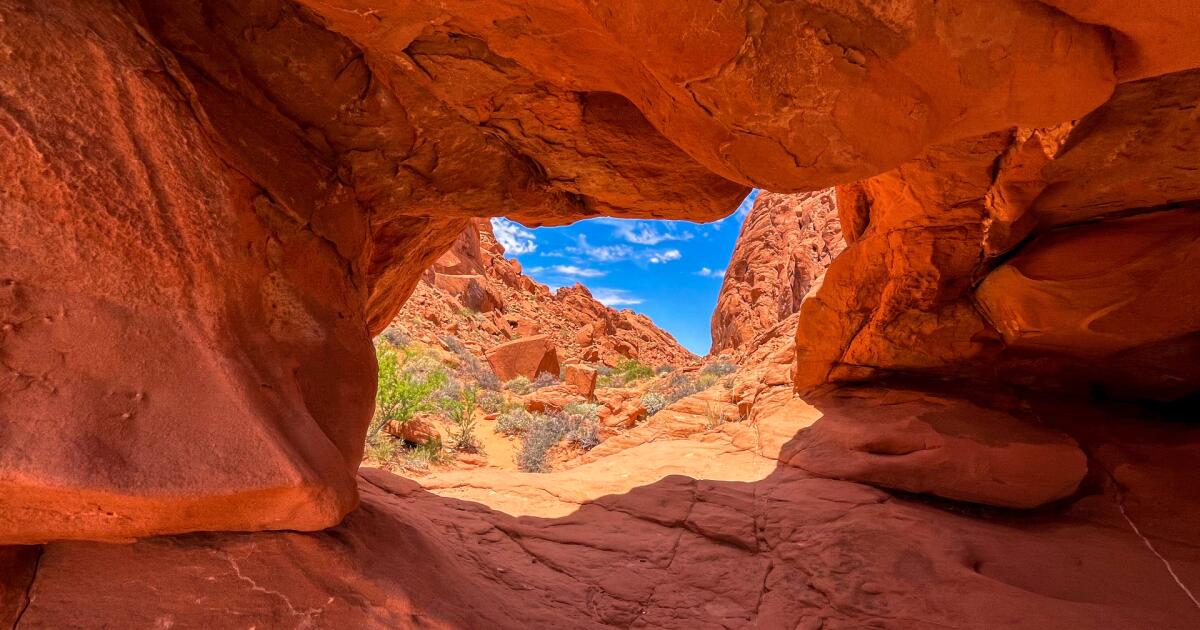
I have a new system for beating the casinos in Las Vegas: I don’t spend a penny on the slots, the tables or the sports books. Instead, I bet heavily on red and green.
Red rocks and green waters, that is. Hiking and kayaking.
I tested the system on a series of day trips last month. Though I slept three nights in a hotel on the Strip, I headed out of town every day.
First: Red Rock Canyon National Conservation Area. Later, Valley of Fire State Park and the Colorado River’s Black Canyon, where the waters of Emerald Cave eerily glow. Then a night of minor league baseball.
None of these adventures took me more than 60 miles from the Strip (a.k.a. Las Vegas Boulevard). Yet the psychological distance seemed enormous. Maybe it’s no surprise that many climbers and other outdoorsy types have moved to Las Vegas for the access it gives them to rocks, mountains and such.
You know that semi-vacant look on so many slot machine players’ faces? You don’t see that so much on the trail or the river, even when the path is uphill or the paddling is against the wind. And it’s tough to find a poker face in the Las Vegas Ballpark when management is staging an Elvis karaoke competition between innings.
Here’s a rundown.
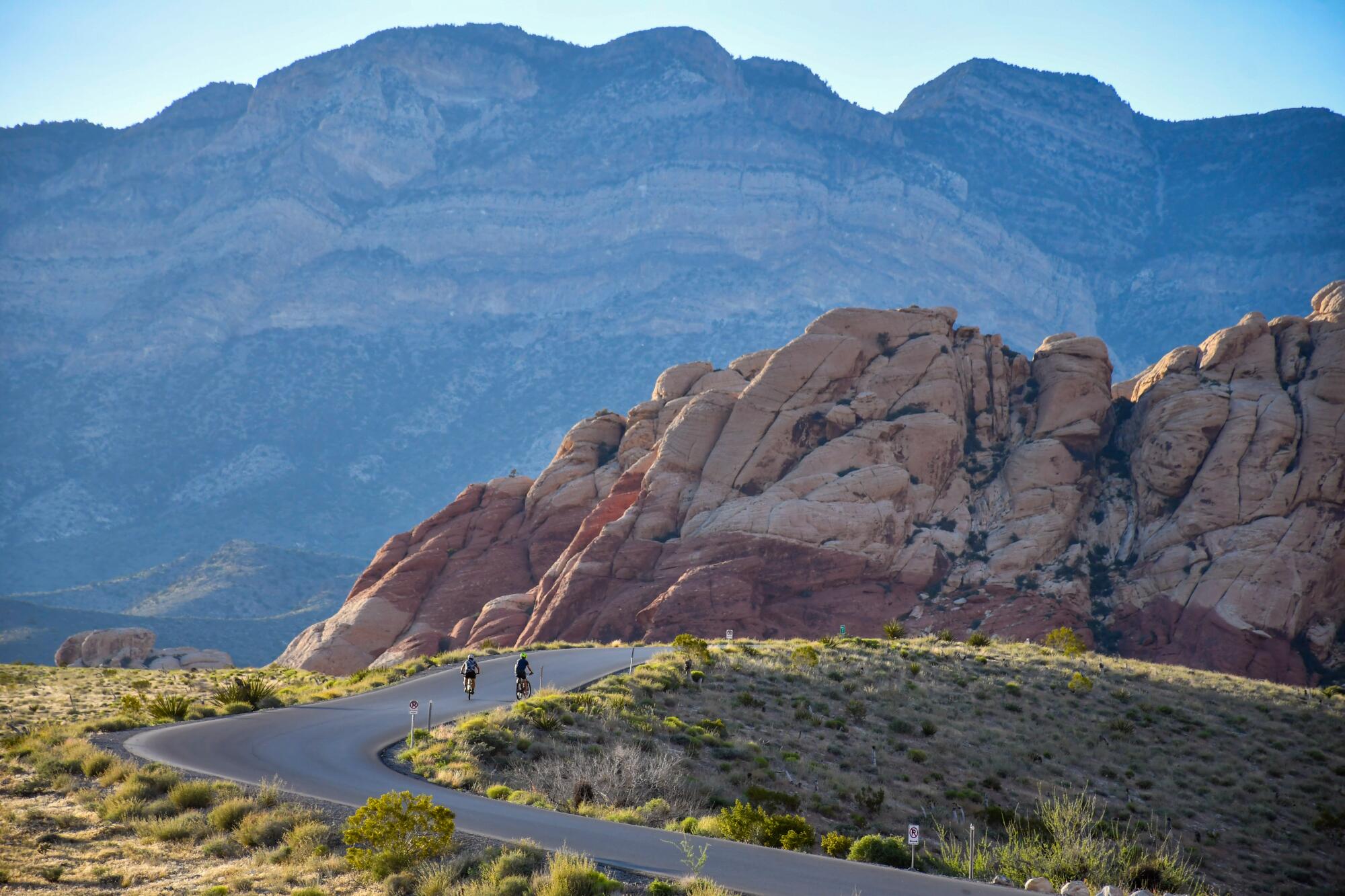
Red Rock Canyon National Conservation Area is near the Las Vegas suburb of Summerlin, about 15 miles from the Strip.
(Christopher Reynolds / Los Angeles Times)
Red Rock Canyon
Driving distance from the Strip: About 30 minutes from the Stratosphere tower.
What makes it great: You’ll have no trouble finding the scenery at the Red Rock Canyon National Conservation Area.
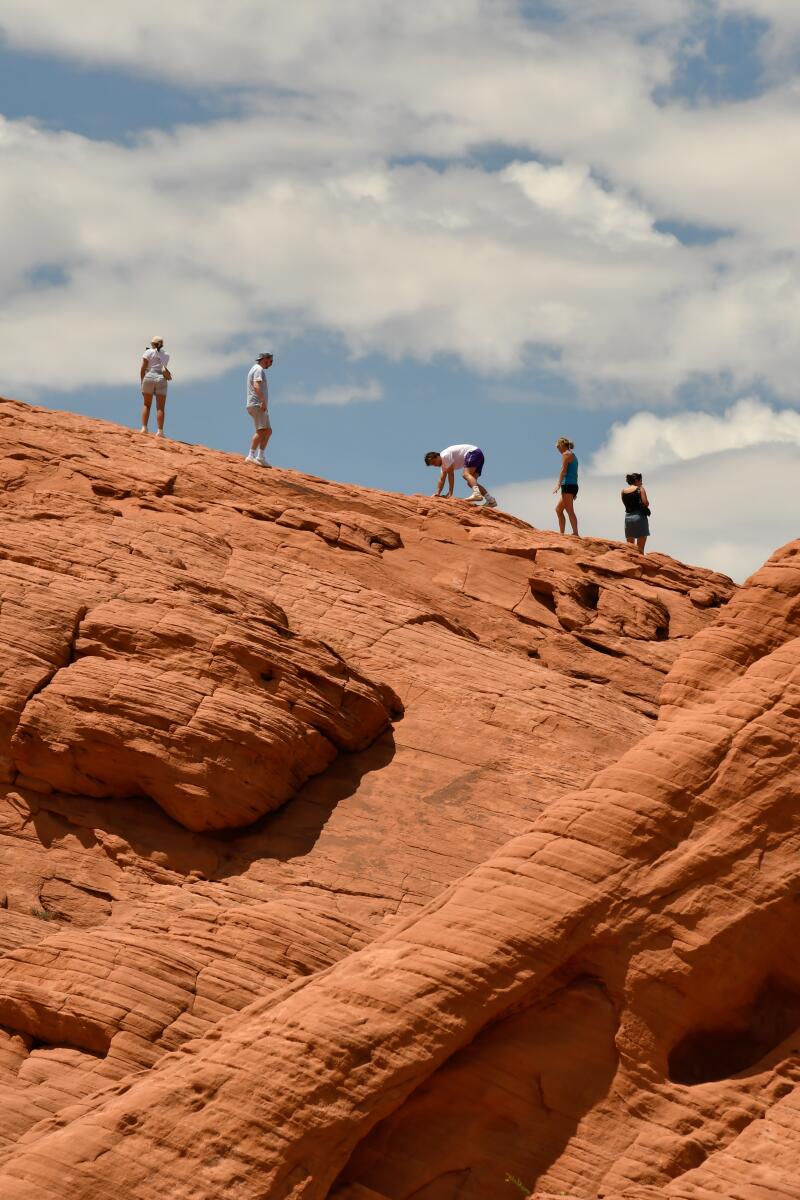
Solitude might take a little longer, because the canyon is immensely popular and only an 18- to 22-mile drive from the Strip, depending on your route. Once there, you can hike, bike or drive a 13-mile loop through a landscape of stacked and tumbled boulders, some fiery red, some chalky white, many so strangely striated that you may suspect they’ve been scrubbed with steel wool.
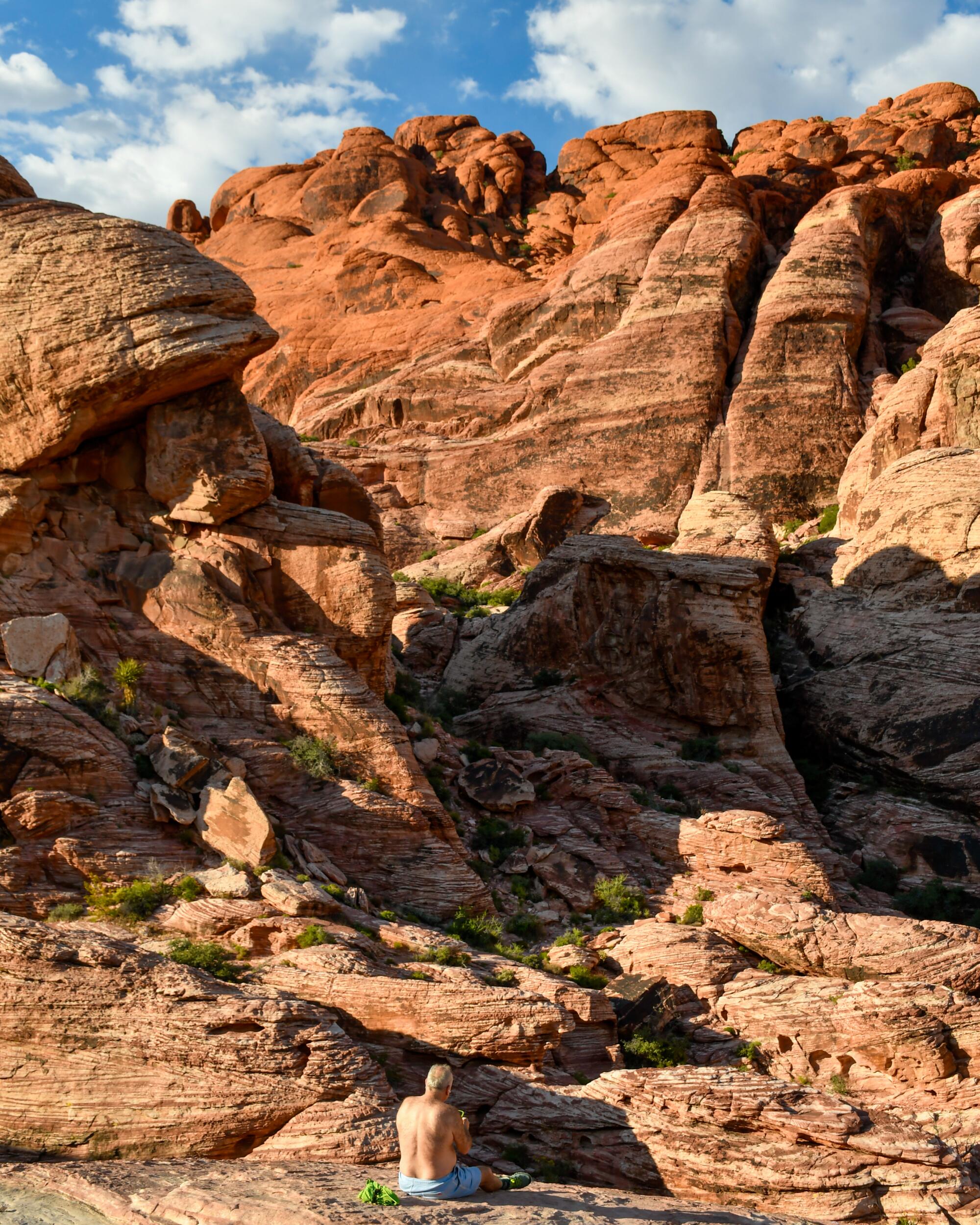
Red Rock Canyon Conservation Area near Summerlin offers hiking and biking opportunities.
(Christopher Reynolds / Los Angeles Times)
Many of the formations are Jurassic sand dunes that have been hardened to sandstone by time. You can drive between or hike on 16 trails threaded through the rocks, junipers and some Joshua trees too.
For drivers and cyclists, it’s a one-way route, with a speed limit of 35 mph, on a wonderfully smooth two-lane blacktop. For hikers, the trails range from 800 feet to 14 miles, easy to difficult, and there are more just beyond the loop.
If you go: Once you start driving the loop, you’ll almost immediately want to pull over because the scenery is so arresting. Don’t. It’s illegal. And the first parking lot, Calico Hills, comes up soon, followed by about 10 more in 13 miles. Most have restrooms.
I made my visit just before sunset. Early morning would be good too — you get dramatic light and avoid the worst of the heat.
In cooler months (Oct. 1 through May 31), you’ll need to book a timed reservation to drive through between 8 a.m. and 5 p.m. In summer, you don’t need a timed reservation, but you’ll still need to pay $20 per car (unless you have a national parks pass).
Black Canyon and Emerald Cave
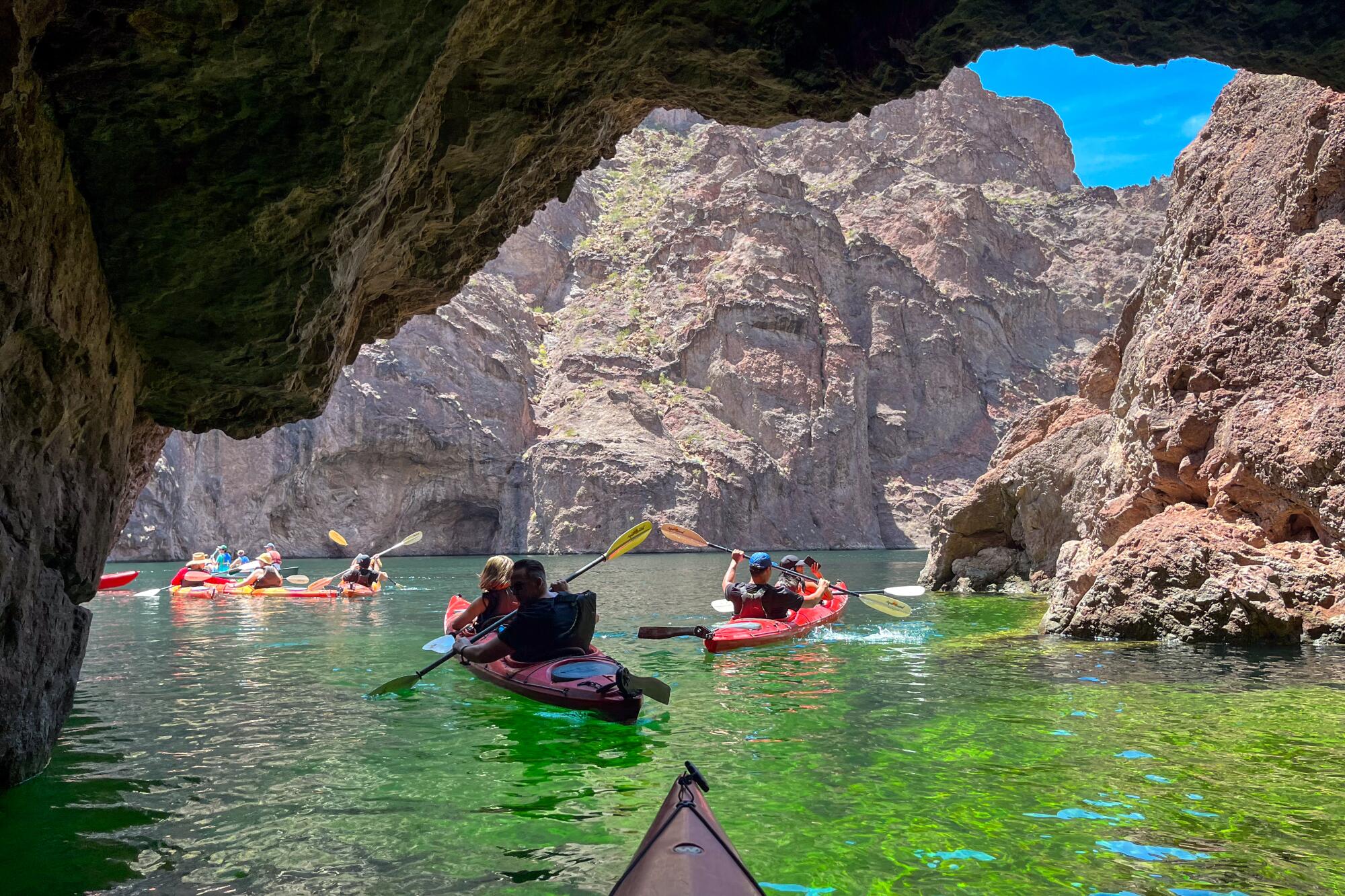
The Emerald Cave has become a favorite of Instagrammers.
(Christopher Reynolds / Los Angeles Times)
Driving distance from the Strip: About an hour and 15 minutes.
What makes it great: What if you flooded a red rock canyon and set multitudes of Nevadans and visitors loose on assorted watercraft? Lake Mead National Recreation Area, a 38-mile drive east of Vegas, is the lively answer to that question.
Most of the action is on the lake itself, which was created in 1936 by the construction of Boulder Dam (now Hoover Dam) along the Colorado River. But about 15 miles downriver from the dam, you’ll find Willow Beach and the Black Canyon Water Trail, a great place to kayak.
After a 60-mile drive southeast from the Strip, I was floating with a tour group in gentle waters (no rapids here) at the foot of 1,500-foot cliffs.
“Let’s go to Arizona,” our guide said — which simply meant paddling from one side of the river to the other.
I had signed on with Blazin’ Paddles, one of several kayak tour companies that paddle out of Willow Beach Marina on the Arizona side. The marina is about 15 miles downriver from the dam. Because it’s part of Lake Mead National Recreation Area, entrance is $25 per car.
There were dozens of kayakers in groups ahead of me, in part because paddling in a shady canyon is a pretty good way to spend a 95-degree day, in part because Instagram has made Emerald Cave a star.
The cave, a 2-mile paddle from Willow Beach, is only about the size of a two-bedroom apartment. But the way its waters glow green makes for great pictures. It’s the centerpiece of most half-day tours, and guides say they’ve fit as many as 23 kayaks in there at a time.
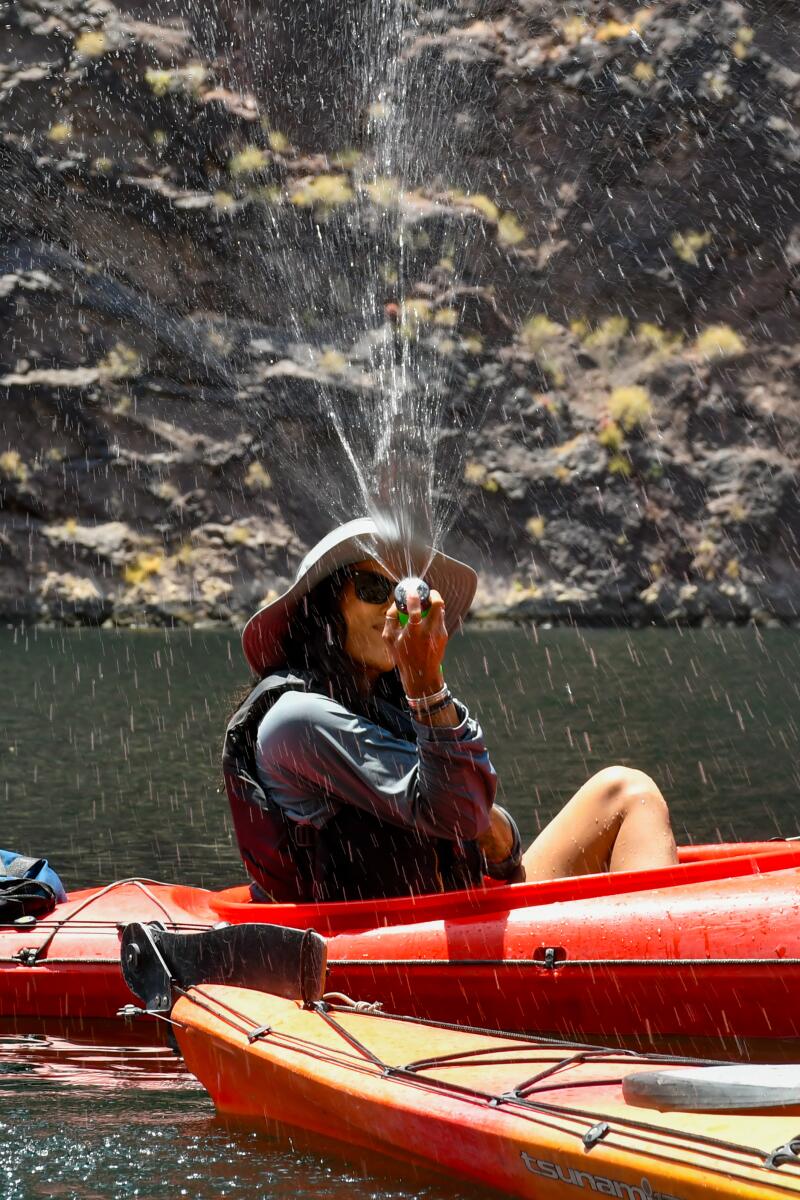
You can explore the Colorado River in an inflatable watercraft.
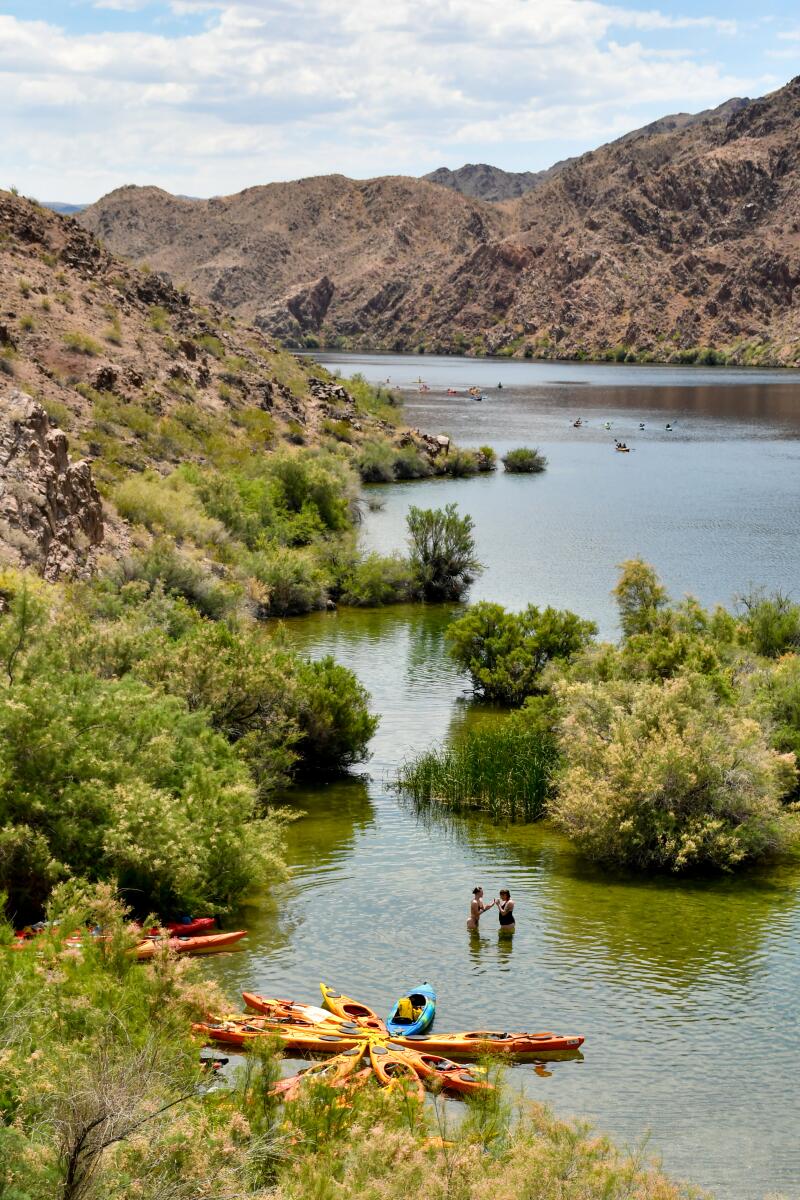
Kayak tours from Willow Beach explore the Colorado River. (Christopher Reynolds / Los Angeles Times)
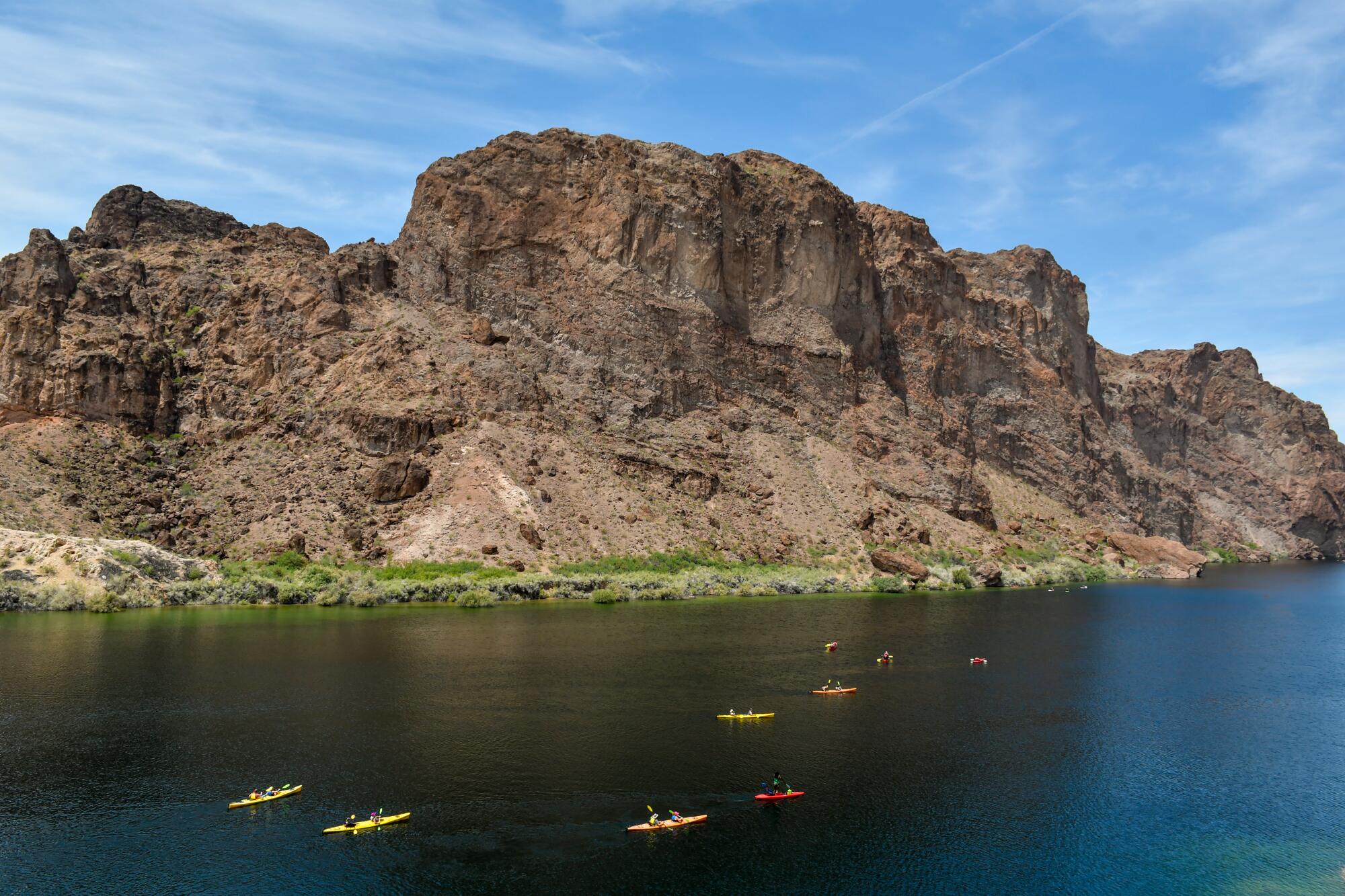
Mountain buttes rise above kayaks floating in the Colorado River’s Black Canyon, just below Hoover Dam.
(Christopher Reynolds / Los Angeles Times)
If your excursion is like mine, you’ll run into a traffic jam outside the cave and the wait will be about 45 minutes. Sometimes it’s over an hour, guides say.
But remember, you’ll be in a kayak beneath tall cliffs, keeping an eye out for desert bighorn sheep, possibly engaging in splash skirmishes with fellow paddlers. Life could be worse. And once you’re in the cave, the sight is memorable. If you’ve ever taken a rowboat into the Blue Grotto on the Italian isle of Capri, this cave’s interior will give you déja vù in another hue.
For the record, we wedged 17 kayaks and a canoe into the cave. And on the way back to the marina, we spotted a bald eagle.
Four miles of kayaking, with a cave in the middle and a stop to hop out for a view, is just about perfect for a three-hour excursion. I paid $110. (With shuttle bus service from the Strip, it’s $149.)
If you go: The best time for Emerald Cave photos is said to be midday, when I was there. But if you get there early or late, you’ll have less company.
There’s a store at Willow Beach Marina that sells snacks, sunblock, hats, water shoes, dry bags and boating and fishing supplies; open 7 a.m. to 5 p.m. daily in summer. There’s also a restaurant, Black Canyon Grill, open daily for lunch in summer; open Fridays to Sundays for most of March, April, May, September and October; and closed November to February.
You can also take a quick, free look at Hoover Dam (22 miles from Willow Beach) by parking in a free lot on the Arizona side of the river (parking is $10 on the Nevada side) and walking across the dam. Entry to the Visitor Center exhibits and observation deck is $10. There are also guided dam tours available, first come, first served. Boulder City, 6.5 miles from the dam, has several restaurants and antique shops.
Valley of Fire State Park
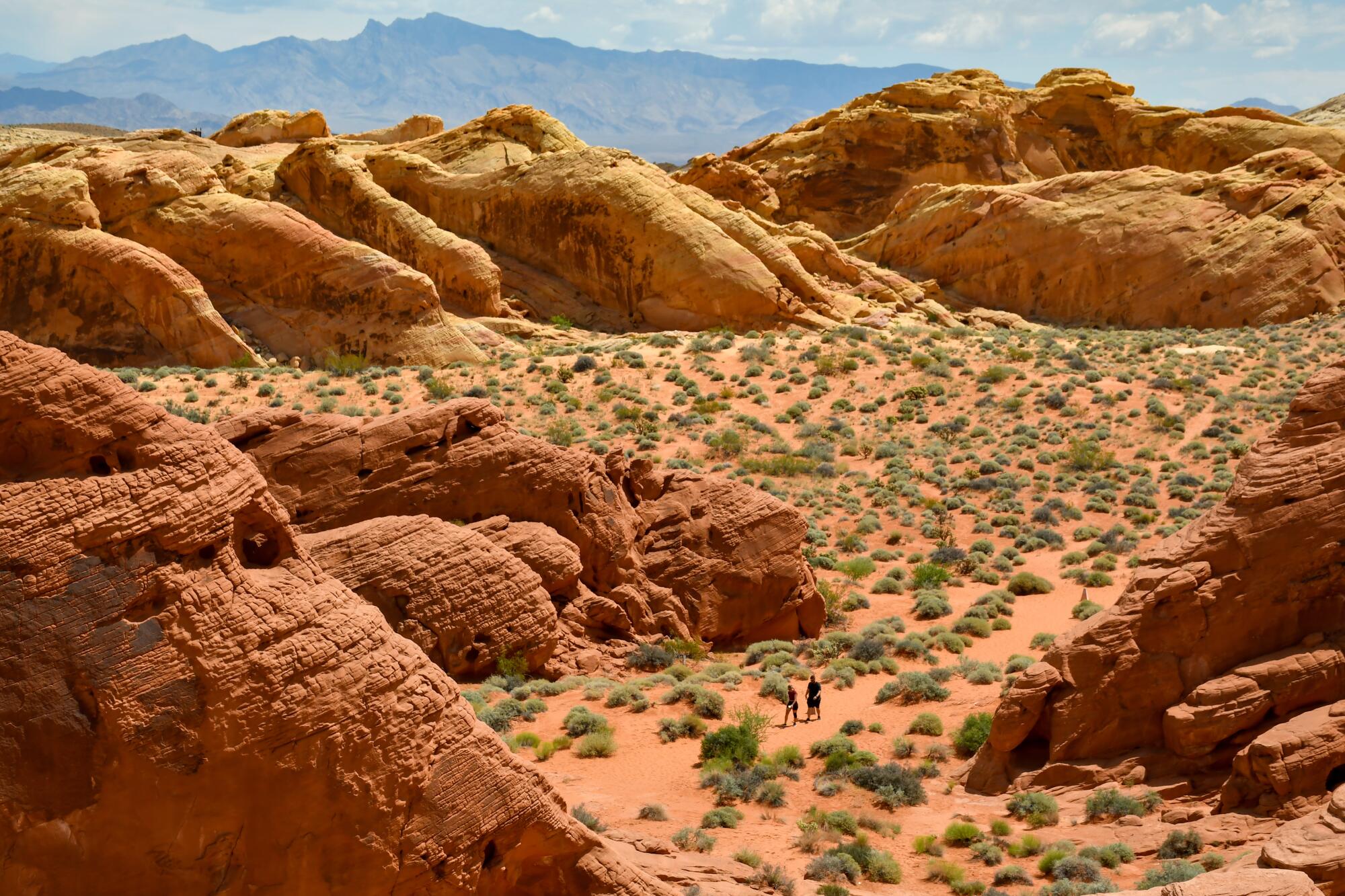
Valley of Fire State Park is about 45 miles northeast of Las Vegas.
(Christopher Reynolds / Los Angeles Times)
Driving distance from the Strip: About 55 minutes.
What makes it great: Even after I saw Red Rock Canyon, I didn’t fully understand how easily outback Nevada can pass for outback Utah. The Valley of Fire — about 55 miles northeast of the Strip — educated me further.
It also lured me into a few furnace-hot gullies and showed me miles of red sandstone, gray limestone, slot canyons and crazy-shaped boulders, all scattered on a desert floor that long ago was an ocean floor. Some boulders are decorated with petroglyphs older than all of our leading presidential candidates put together.
More specifically, because I read some signs, I can tell you that the petroglyphs are more than 2,000 years old, and also that a petroglyph is cut into stone; a pictograph is painted on stone.
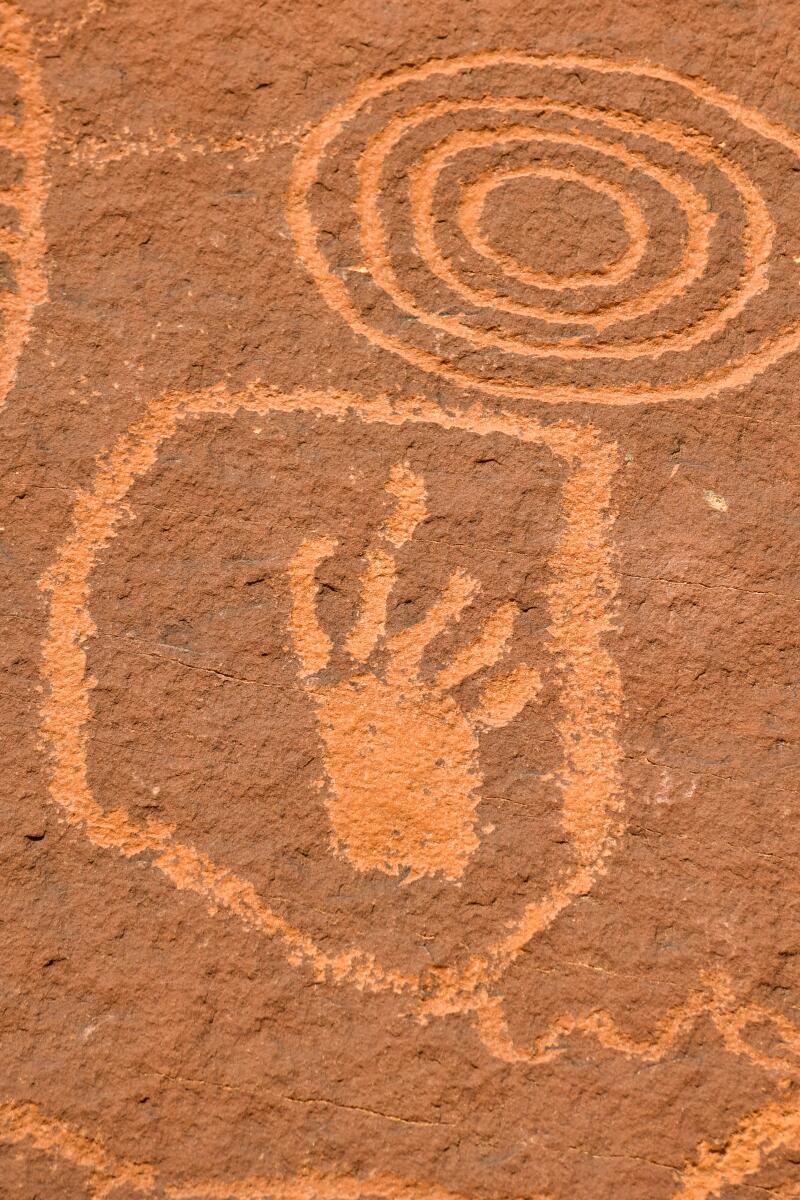
Petroglyphs at Valley of Fire State Park.
(Christopher Reynolds / Los Angeles Times)
Valley of Fire, Nevada’s first state park, has one through road, two campgrounds and several rock-climbing spots. But keep this place’s name in mind. It gets so hot (up to 120 degrees) that from May 15 to Sept. 30 this year, rangers have closed all trails longer than 1 mile.
Sticking within that limit, I wandered among the Beehives rock formations near the park’s western entrance and climbed the stairs to Atlatl Rock (where an ancient inscribed hand seems to be giving the finger to all who pass). I also walked the 0.7-mile Mouse’s Tank Trail and 1-mile Rainbow Vista trail, but it was close to 100 degrees, and the sandy path may give you that swimming-in-syrup sensation.
If you go: Park entrance is $10 per vehicle ($15 for out-of-state vehicles). The rangers’ 1-mile limit means that until October, nobody can hike the Fire Wave, Seven Wonders Loop or the White Domes Loop.
Still, it’s a thrill to follow White Domes Road north from the visitor center as it twists and squeezes between boulders.
The Moapa Valley town of Overton, 9 miles north of the park’s eastern entrance, is home to the Lost City Museum, created in the 1930s to showcase Native artifacts that long predate the creation of Lake Mead. On Overton’s Main Street, the Inside Scoop cafe has ice cream and makes a topnotch $8 tuna salad sandwich.
Aviators baseball in Las Vegas Ballpark
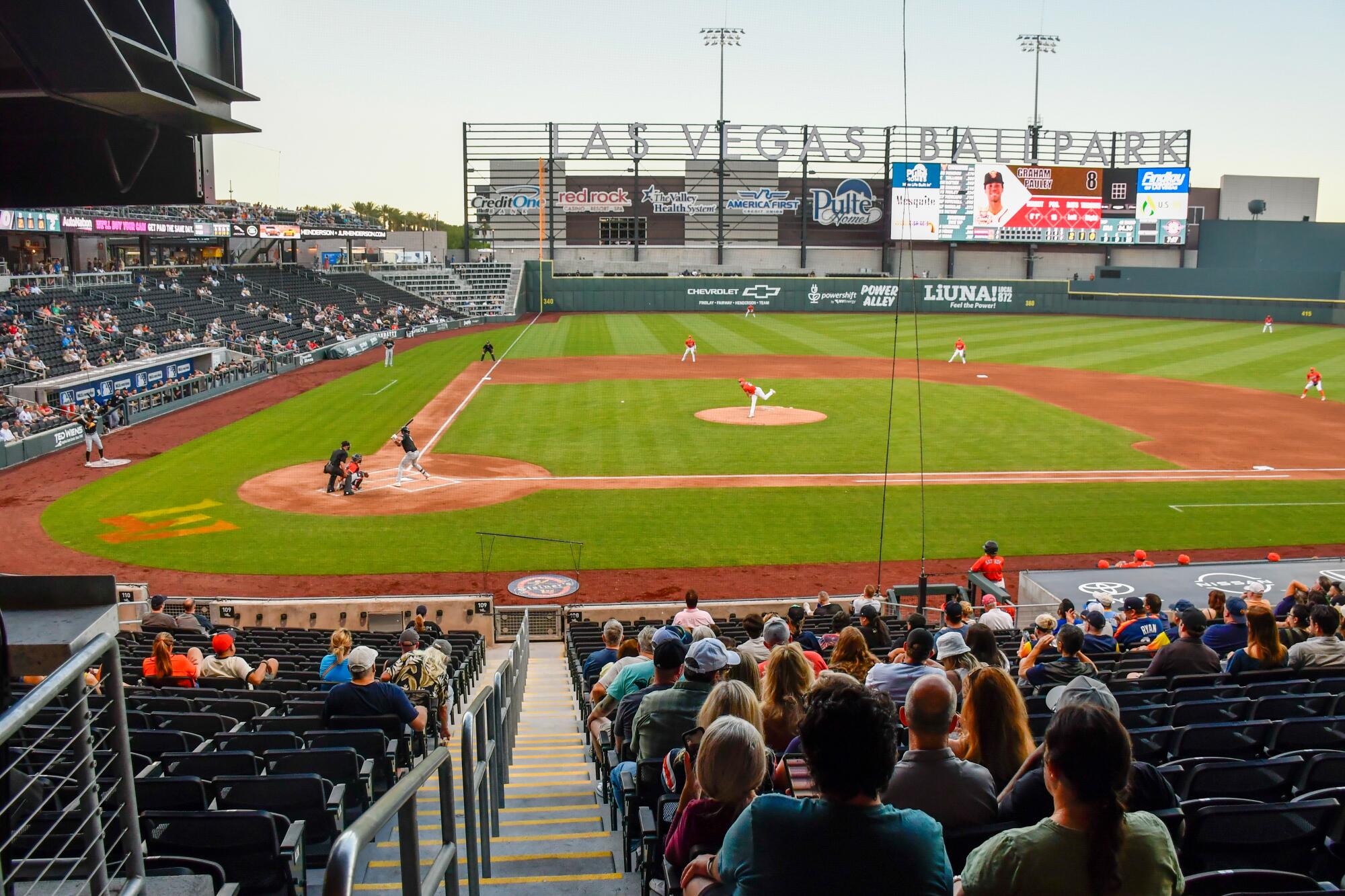
Las Vegas Ballpark, home to the minor-league Las Vegas Aviators, is in the Vegas suburb of Summerlin, about 12 miles west of the Strip.
(Christopher Reynolds / Los Angeles Times)
Driving distance from the Strip: About 25 minutes.
What makes it great: Strictly speaking, the Las Vegas Ballpark isn’t a full day trip, but this may be the most family-friendly of these excursions, so it needs to be here.
The ballpark, home to the AAA Aviators baseball team, stands in the Vegas suburb of Summerlin, about 15 miles from the Strip. You could spend all day in a casino and still make 7 p.m. game time. (Or you could head for the ballpark after exploring Red Rock Canyon, which is practically next door.)
Whenever you arrive, your blood pressure is likely to ease once you step in. It’s a gorgeous ballpark, completed in 2019 with a capacity of just 10,000, so it feels intimate. You can spread a blanket on the grassy berm overlooking right field, and there’s a good chance a local 15-year-old will be singing the national anthem.
But there’s also a bright, high-resolution scoreboard, a swimming pool beyond center field (yes, that costs extra) and food options that include tri-tip sandwiches and avocado chicken burritos.
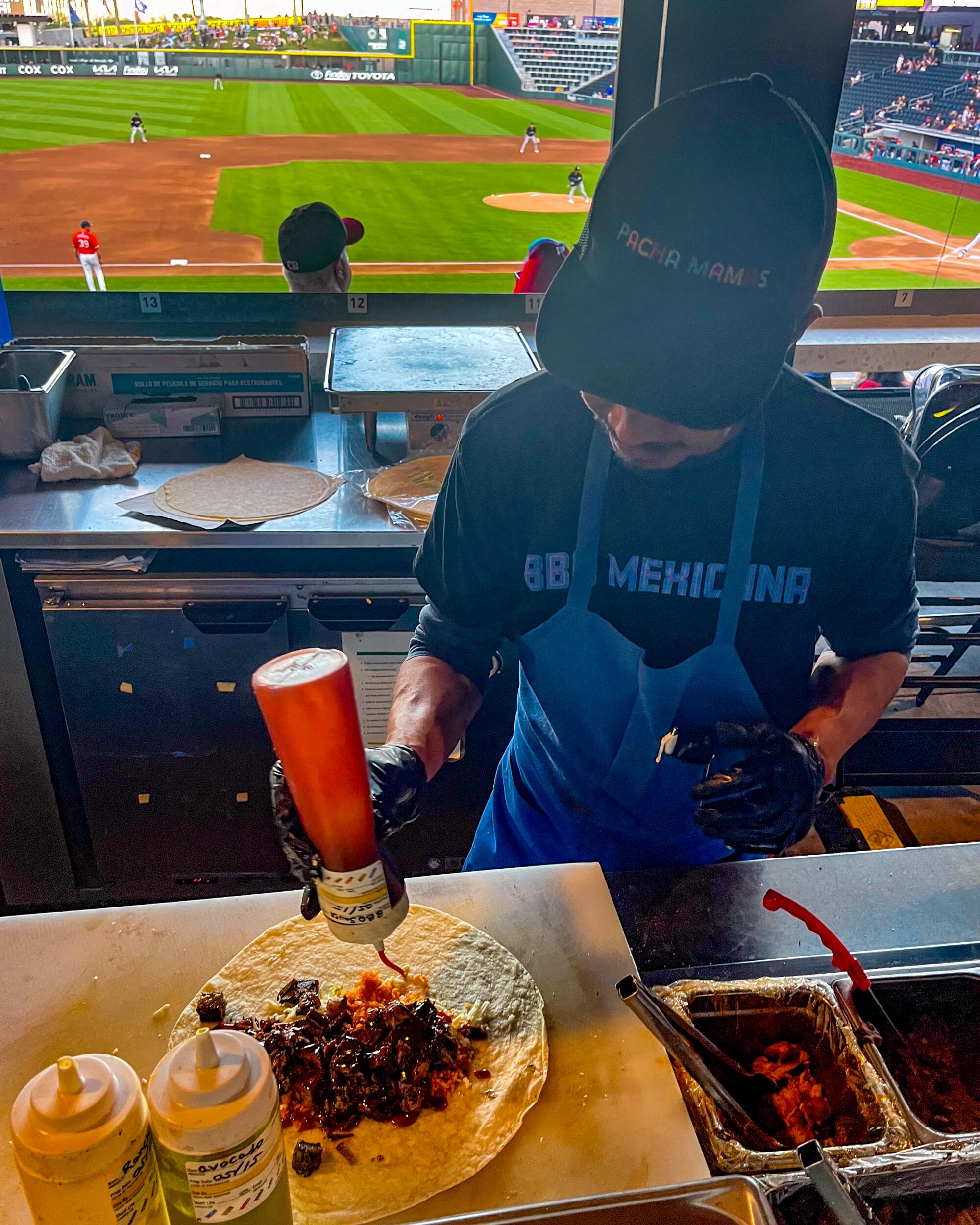
Food options include burritos and tri-tip at Las Vegas Ballpark.
(Christopher Reynolds / Los Angeles Times)
You can count on silly games between innings (including a cardboard airplane-throwing contest), brand ambassadors handing out merch and kids scrambling for foul balls. Beers start at $10, hot dogs at $6.50. (And there are cocktails, because Las Vegas.)
On the night I came, attendance was 5,042 people and 99 dogs (because it was bring-your-dog night).
Unless you’re a devotee of the El Paso Chihuahuas, Salt Lake Bees or Reno Aces, you won’t recognize any of these hopeful young players. But that will hardly matter — especially if (as I witnessed) the center fielder makes a leaping grab to save a 9-7 win for the home team.
If you go: Tickets start at $14 (for a spot on the berm in right field), but if you buy online in advance, the middleman fees will push that to about $20.
Las Vegas, a Dodgers farm team from 2001-08, is now a farm team for the Oakland Athletics. It’s a tad awkward that the Athletics have announced that they’ll be moving to Las Vegas in a few years. But for now, the Aviators are here and you can be too.
There are no slot machines in the ballpark and no sports betting area. In fact, the only casino with a prominent ad posted is nearby Red Rock Resort.
You can check the schedule to see when the Aviators are playing at home. The season runs through Sept. 22, and the AAA national championship game will be in the ballpark on Sept. 28.


In central London’s Waterloo Place, a life-size statue that emerged overnight in late April has been creating a stir. When I visited a few weeks after it was erected, local authorities had already set up protective barriers around it.
The installation — signed by the famed street artist Banksy — depicts a man in a suit hoisting a flag as he strides over a precipice. As he marches on, the flag blows backward to cover his face, leaving him unaware he’s only a step away from a perilous fall.
Set among grand monuments celebrating Britain’s past, the “flag man” takes on a particular visual irony at a time when the country — and much of the world — is debating its path forward.
Like many viewers there, I found myself wondering whether this statue is Banksy’s warning about the consequences of uncritical nationalism, or simply a reflection on human shortsightedness. Or, perhaps, it is just prompting us to ponder a broader question: What happens when devotion to a symbol prevents us from seeing what lies ahead?
Whatever the message, the work feels remarkably attuned to the current moment.
For more Far-Flung Postcards, click here.
Lifestyle
Wait, it’s a candle? Her beeswax fruit and veggie ones look so real, you’ll want to take a bite
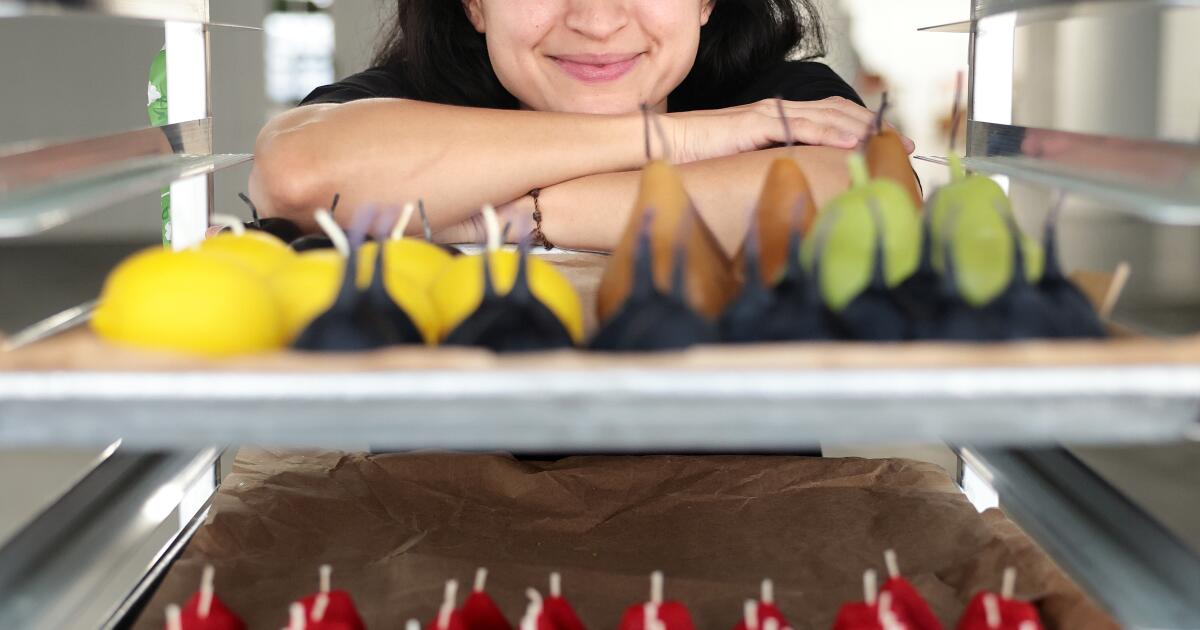
Jessica Gonzalez hustles behind her booth at the recent Renegade Craft Fair, frantically ringing up sales, answering questions and packaging her beeswax candles.
It’s hot on the grounds of the Los Angeles State Historic Park in April, but 35-year-old Gonzalez and her fiancé, Jordan Colindres, keep their cool as a crowd gathers to admire her Happy Organics candle collection, a homage to her family’s produce company in the Central Valley that looks like real fruits and vegetables.
“I love doing in-person events because it’s so fun to see people’s reactions,” she said a few months later. “It makes me feel good to see other people finding joy in my candles. They often say, ‘Oh, that’s really funny.’ And it is funny to have a cherry candle on top of your birthday cake.”

3

1. A staff member pulls a beeswax corn candle, $26, out of its mold at Happy Organics’ studio in downtown Los Angeles. 2. Each Beeswax Mixed Berry Birthday Candles set is cast from real mixed berries — strawberries, raspberries, blackberries, blueberries and cherries. A set of 10 is $30. 3. Bartlett green pears and heirloom tomatoes, $24 to $40.
Judging by the smiles and charmed looks on shoppers’ faces, her produce-inspired candles are less about illuminating rooms and more about sharing the joy she sought when she first started the company in 2018.
In this series, we highlight independent makers and artists, from glassblowers to fiber artists, who are creating original products in and around Los Angeles.
But then, it’s hard not to smile at the playfully elegant Bosc pears, puckered mandarins and green-and-purple asparagus taper candles which range in price from $12 to $40. Some are molded into corn on the cob, celery and rhubarb shapes. Others are made to look like mushrooms, figs, tomatoes and snap peas. The most popular are the small birthday candles shaped like raspberries, cherries and blackberries, packed in molded-pulp baskets just like you’d find at the grocery store or farmers market.

-
Share via
Gonzalez didn’t start out as a designer. The youngest of nine children, she was born in 1991 in Salinas and later moved to Merced, where she grew up on a 10-acre farm. She studied computer science at Mills College, then worked in tech consulting in the Bay Area and eventually became the CTO of an ag-tech company. When her mother, Angela, became ill in 2016, she returned to Merced to be with her family.
When her mom died suddenly soon after she moved home, Gonzalez left the tech industry. “I wasn’t connected with what I was doing,” she said. “I wanted to find something more meaningful; something I loved. I didn’t want my ego to keep me stuck in what I studied in college. I decided to let myself try new hobbies and passions and look for joy again.”
After her mother’s death, she began working with her father, Salvador, and her uncles at the family’s apiary, where they managed more than 30 hives. (Her grandfather was also a beekeeper in Michoacán, Mexico.) Soon, she began selling their raw honey at local farmers markets. In a heartbreaking turn, her father was diagnosed with cancer a year later, so she started making cannabis-infused honey, balms and chocolates to help ease his pain.
When she saw that the beeswax candles, which last significantly longer than paraffin candles, were selling faster than the honey, she decided to focus on making candles from the leftovers from her uncles’ hives.
She was only 25, but it was a turning point. “It was one of those moments where I felt like I needed to change my path,” she said. “I needed to change everything in my life.”

Jessica Gonzalez and her father Salvador on their family farm in Merced. (Gonzalez family)

Gonzalez at Happy Organics’ studio in downtown Los Angeles. (Christina House / Los Angeles Times)
When her father died in 2018, she inherited his bees and started Happy Organics, although she hadn’t planned on starting a business. After experiencing so much loss, making candles became a kind of therapy. “It felt great to work with my hands again, something I thought I’d never have time for,” she said.
Her oldest sister, Sonia Gonzalez, said Gonzalez reminds her a lot of their father, who reinvented himself many times over the years.


The nopal cactus is cast from a real nopal and hand-poured in 100% pure beeswax in the Los Angeles studio.
“He grew up as a village boy in the rural mountains of Michoacán, Mexico, and went on to work in restaurants, cut down Christmas trees and pick strawberries and broccoli in the fields of Salinas,” she wrote in an email. “From there, he started selling produce door-to-door, then at flea markets and eventually built his own produce distribution business from the ground up. As the youngest of nine kids from a working-class family, Jessica’s always been incredibly resourceful, responsible, and amazing at reinventing herself.”
Like a lot of millennials, Gonzalez taught herself how to make candles by watching YouTube videos. She started with hand-dipped tapers, working in the garage on the farm that helped her feel safe and connected to her parents. “It was a really nice environment to try something new and creative,” she said.
Inspired by her family’s produce, she cast real corn, strawberries and cherries in plaster, then made a silicone mold to create copies. Even when using the same mold, color can vary from batch to batch, and how it cools also affects the result. “That’s just how handmade things are,” she said. “There’s always some variation.”

Cherry molds make cherry candles at Happy Organics’ studio in downtown Los Angeles.

A variety of fruit and veggie candles.
When she moved to Los Angeles in 2023 to be with Colindres, her business took off. “L.A. is a great place to grow,” she said. “There’s so much opportunity here. When I go to a farmers market, I never know who I’ll meet.”
She sold her candles in person at craft shows, the Hollywood Farmers’ Market and most recently, during a residency at the P.F. Candle Co. showroom in Echo Park.

2

3

1. A staff member trims the wicks on a pair of carrot birthday candles, $22. 2. Gonzalez passes by shelves of candles at Happy Organics’ studio in downtown Los Angeles. 3. Asparagus taper candles, $30.
“I have a lot of respect for her as a fellow candle maker (making molds is not easy), but getting to know her story more and how her choice of foods and wax is reflective of her family’s history gave it so much meaning,” P.F. Candle Co. founder and creative director Kristen Pumphrey said in an email. “It’s been a tough couple of years for L.A. businesses, so we gotta stick together — there’s this wonderful sense of community hosting a local brand that’s so passionate about their work.”
As her business has expanded, her products are now available at Terrain, Joan’s on Third and the MoMA Design Store in addition to her website. She has also had to source beeswax from other vendors across the country to keep up with demand.
Kimberly Curtis, owner of Hide & Seek Vintage in Studio City, said Gonzalez’s strawberry and cherry birthday candles “flew off the shelves last year” during the holidays. “Our customers love them,” she added.

Gonzalez holds a cabbage candle.
Still, Gonzalez stays connected to her Central Valley roots. Everything she and her small team make in downtown Los Angeles is handmade and “takes time,” she said, describing the steps involved in crafting quality candles. Right now, her favorite is the Nopal Cactus candle, which she made using a clipping from an employee’s yard. While others help her with production, wholesale management and packaging, she focuses on sales, content and all-new product development.
When asked if she has advice for others who want to start their own business, Gonzalez admits she sometimes feels overwhelmed.

In 2013, Gonzalez and her family gathered at their Merced ranch to celebrate her parents’ anniversary.
(Gonzalez family)
“The biggest thing that has gotten me through the toughest spots is my why or my reason for starting,” she said. “I think that has to be really strong. That’s what brought me a lot of comfort when I felt like quitting: going back to the beginning and remembering why I started this.”
For Gonzalez, her reason is always close to her heart. “I wanted to feel connected to my parents in some way,” she said. “This was a good representation of my upbringing.”

The Kennedy Center, the facade of which remains covered with a tarp, is seen in Washington, DC, on June 28, 2026. A US federal judge asked on June 24 for an explanation for why a tarpaulin continues to cover the facade of the Kennedy Center where President Donald Trump’s name was recently removed. District Judge Christopher Cooper gave the board of trustees of the performing arts venue until the end of July to explain “the purpose for and status of the tarp and scaffolding that Defendants have erected on the front portico of the Center.”
ALEX WROBLEWSKI/AFP via Getty Images
hide caption
toggle caption
ALEX WROBLEWSKI/AFP via Getty Images
More than two weeks ago, President Trump’s name was removed from the Kennedy Center facade though it is still covered by a tarp and the legal battle continues.
On Monday, a U.S. Department of Justice filing on behalf of the Kennedy Center included some surprises. The document was submitted in response to issues raised by lawyers for ex-officio board member Rep. Joyce Beatty of Ohio who is suing to remove President Trump’s name from the center and stop its closure for renovations.
Among the revelations, the Kennedy Center admitted that, during a board meeting on December 18, 2025, Beatty had been “muted and prevented from speaking.” It was at that meeting that the board voted to add President Trump’s name to the center. The filing later acknowledges the congresswoman was “prevented from voicing her opposition.”
The John F. Kennedy Center for the Performing Arts is a living memorial to its namesake. The guidelines for how the theatre complex spends federal dollars are very specific. Among other rules, it states that “no additional memorials or plaques shall be designated or installed.” Beatty argues adding Trump’s name runs afoul of those rules and that any change requires approval from Congress.
According to one of Beatty’s filings, “There was no advance notice in the agenda that the Board would be considering a name change,” a statement the Kennedy Center now does not deny. The center admits that, prior to voting, there was “no discussion about potential risks or downsides of the vote to adopt a secondary name for the Center.” Nor was there a board discussion “about any potential conflict of interest that might result from the vote.”
The center’s lawyers previously contended that if Trump’s name were to be removed, it would “lose money from donors who support” him and “impede the Center’s fundraising efforts.”
Closing for renovations
Earlier this year, Trump announced on social media that the Kennedy Center would close for two years for renovations. He wrote that he made the decision after “a one year review” with “Contractors, Musical Experts, Art Institutions, and other Advisors and Consultants.”
But, according to the center’s lawyers, Trump’s announcement “was made without presenting any plans, analyses, timelines, or funding information to his cotrustees and without any Board vote.”
The Kennedy Center has long denied reporting by The Washington Post that ticket sales plummeted after President Trump became the Center’s board chair. In Monday’s legal filing, the Center admits that, by October 2025, “nearly half of the Center’s tickets were going unsold.”
-

 Los Angeles, Ca1 hour ago
Knife-wielding man rushes at LAPD officers in tense body cam video
-

 Detroit, MI2 hours ago
5 Potential Landing Spots For Former Detroit Lions CB Terrion Arnold
-

 San Francisco, CA2 hours ago
May 17 officially declared
-

 Dallas, TX2 hours ago
Dallas City Hall named to World Monuments Fund’s ‘Irreplaceable America’ list – Lake Highlands
-

 Miami, FL2 hours ago
Ex-con lists $138M in luxury penthouses, including Miami trophy condo
-

 Boston, MA2 hours ago
Celtics reportedly trading Jaylen Brown to 76ers for Paul George, picks
-

 Denver, CO2 hours ago
LeBron James to the Nuggets? Latest reports and betting odds
-

 Seattle, WA2 hours ago
Residents and activists clash over plan to curb SEPA appeals at Seattle hearing

