Business
The 2024 box office is terrible. But Imax's big-screen appeal is a bright spot


When Warner Bros. film executive Jeff Goldstein saw the huge sand dunes and expansive desert vistas of Denis Villeneuve’s first “Dune” movie, he thought to himself, “This was made for Imax.”
Same went for the sandworm sequences of the sequel, “Dune: Part Two,” a box office hit for the studio earlier this year that pulled in nearly 24% of its domestic box office revenue from Imax. The dystopian wasteland of this weekend’s big action tent pole, “Furiosa: A Mad Max Saga,” brings yet more fodder for the big screen format.
Imax’s giant screens are expected to account for a greater-than-typical share of the George Miller-directed prequel’s box office sales. (The film is tracking to gross more than $40 million domestically for the four-day weekend opening, according to analysts.)
“It immerses you, so you’re there,” said Goldstein, president of domestic distribution for Warner Bros. Pictures. “Audiences look at Imax as something special.”
As studios and exhibitors bemoan audiences’ slow return to movie theaters since the pandemic, Imax has been one of the few bright spots. This year’s box office is down 20% compared to last year, when pictures like “Fast X,” “Barbie” and “The Super Mario Bros. Movie” propelled ticket sales, and yet studios are clamoring to get onto Imax screens.
Audience behavior has now changed, and getting people out of their houses and back into theaters requires something special they can’t get at home. That put Imax in a fortuitous spot.
The 57-year-old Canadian company, which operates out of Playa Vista, is coming off one of its best years, with Christopher Nolan’s “Oppenheimer” helping to fuel overall global box office revenue — marking Imax’s second-highest grossing year in its history. Films shown on Imax are reaping bigger box office numbers, helped in part by higher ticket prices, and that’s a powerful allure for studios and filmmakers.
Next year, 13 Hollywood movies slated for release will be shot on Imax digital cameras or film, beating a previous record logged in 2021 when seven so-called filmed for Imax movies came out.
The company hopes its brand awareness eventually looms so large that viewers come to its screens first.
“Instead of saying, ‘What’s happening at the movies?,’ I want them to say, ‘What’s happening at Imax?’” said Imax Corp. Chief Executive Rich Gelfond.
For Imax’s part, its financial performance in the first fiscal quarter of 2024 beat expectations. The company’s net income totaled $3.3 million for the three-month period that ended March 31, up 33% from the previous year, though revenue decreased by about 9%, to $79.1 million. Shares of Imax are up about 10.9% so far this year.
“While there are exceptions like ‘Barbie,’ it is very, very difficult to be a blockbuster without being in Imax,” said Greg Foster, a former Imax Entertainment chief executive who now runs an entertainment consulting business.
Imax’s current mainstream success is what Gelfond and his business partners envisioned when they acquired the company in 1994. At the time, Imax was essentially a museum staple, albeit one that allowed viewers to immerse themselves in the latest nature film or science documentary.
The company adjusted its screens and sound systems to fit in commercial multiplex theaters, allowing its business to grow rapidly while limiting costs (Imax does not own theaters itself, but instead supplies its screening technology to cinema chains). Imax also developed technology to convert movies to Imax’s format to make it more economically attractive for filmmakers and benefited from the advent of digital film, which made it more cost effective.
By 2019, the company had seen year-over-year global box office growth for several years and expanded its global market share to spread its box office almost evenly among North America, China and the rest of the world.
Like its movie theater owner customers, Imax was hit hard by COVID-19 business shutdowns. But because the company has few assets and little debt, it was insulated in part from the financial fallout that the rest of the industry faced. The company used the time to update its technology, including a new laser projection system and sound system, worked on its marketing and leaned more into local language films, Gelfond said.
Now in a post-pandemic world, moviegoers want something premium and special for their time, and they’re willing to pay for it. That’s a bonus for Imax and so-called premium large-format screens operated by the theater chains.
“In an industry that is constantly re-evaluating its present and its future in terms of competing with new media and bringing back audiences, it’s Imax that has been at the heart of the conversation when we talk about sectors of the industry that have recovered,” said Shawn Robbins, founder of analysis site Box Office Theory. “It’s been a way for studios to have reliability in an often volatile theatrical market.”
Walt Disney Co. has leaned hard into Imax and other premium large formats.
Its marketing campaign for “Kingdom of the Planet of the Apes,” released earlier this month, prominently featured the Imax logo on billboards, bus stop signs and other advertisements. During opening weekend, 41% of the movie’s domestic box office came from premium large-format screenings, 13% of which was Imax, Disney said. Typically, a blockbuster that hasn’t been filmed on Imax cameras, like “Apes,” would do about 10% at the box office, Gelfond said.
As an industry, “we need to give audiences a terrific experience every time they go to see a movie,” said Tony Chambers, executive vice president and head of theatrical distribution for Walt Disney Studios. “Going to see a movie in premium large formats helps drive engagement and helps drive frequency.”
From 2022 to 2023, premium large formats made up 19% of Disney’s total domestic business; just before the pandemic, that total was 15%. Some of that came from 3-D screens, which have tapered off in popularity.
The company saw box office success with James Cameron’s 2022 sequel, “Avatar: The Way of Water,” which brought in $1.6 billion in revenue from premium large formats out of a total of $2.32 billion (About 11% of which came from Imax). Marvel’s “Guardians of the Galaxy Vol. 3” last year brought in 31% of its box office revenue from premium large formats.
Especially since the pandemic, there’s now more competition for people’s time and attention from streaming and social media, making it crucial for studios to give audiences a good reason to leave their couches.
“We need a way to cut through some of the clutter and make it clear to people that you cannot wait, you need to see this on the big screen,” Chambers said. “One of the ways to do that, from a marketing perspective, is to lean heavily into the premium large format.”
For a lot of people, he said, that means Imax. In fact, Imax executives bristle when people lump them with the other so-called PLFs, which include Dolby Cinema and ScreenX.
Imax box office makes up 13% of Warner Bros. overall domestic business, compared to an industry wide 5% to 7%, according to the studio. Industry wide, opening weekends are typically 10% to 12% Imax. But some are a bigger draw. The Imax share of “Dune: Part Two’s” domestic box office was 22%.
“It’s this whole notion of how do you hit critical mass,” Goldstein said. “Imax will help you get to critical mass faster.”
Imax’s future hinges on continued growth, especially internationally. As of 2023, the company had 1,772 screens across the globe, including its institutional theaters and museum screens, up slightly from the previous year.
The company also plans to expand, particularly into markets that it thinks are under-served, such as Australia and Japan.
“It has massive growth potential globally, and it’s certainly not at saturation in most of its global markets at this point,” said Alicia Reese, media and entertainment analyst at Wedbush Securities. “They should trade at a higher multiple given their growth potential.”

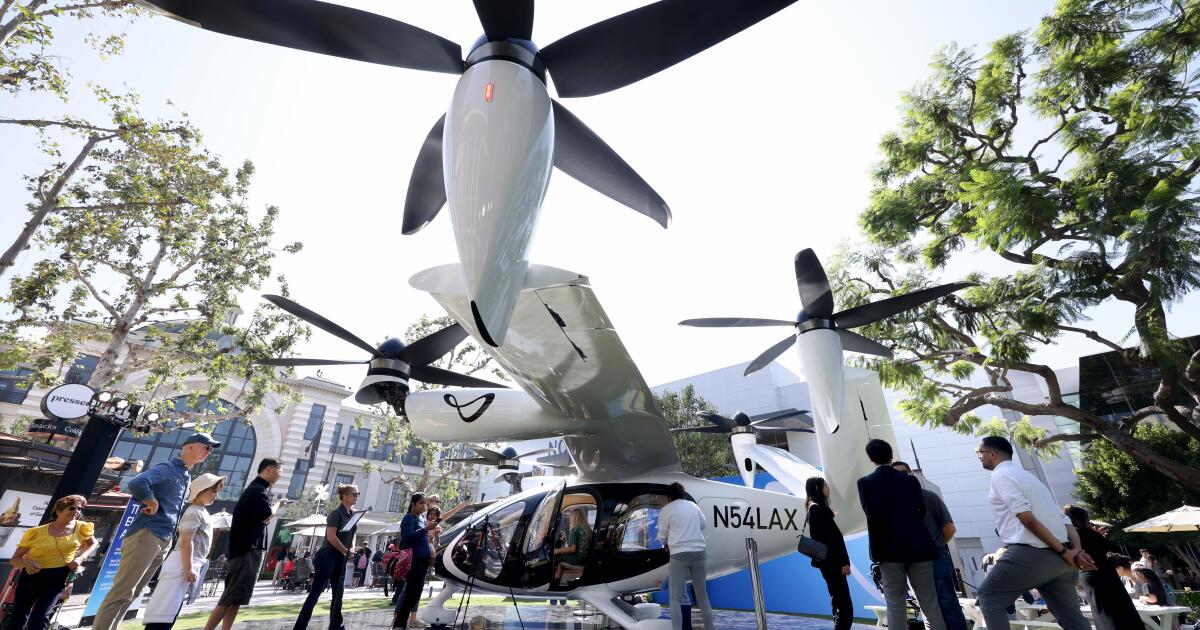
The race to bring air travel to the sky is heating up as Santa Cruz-based Joby Aviation and Toyota launch a joint venture to commercially produce air taxis.
The companies said in a news release Tuesday that they will work together on productivity, quality and costs and move toward mass production of Joby’s electric vertical takeoff aircraft. Joby and Toyota were first linked when Toyota made a nearly $400-million investment in the company in 2020. It has since increased its backing of the company to $900 million.
“It’s really meaningful for us to take on this challenge together with Joby, a partner that shares the same vision,” Toyota Chair Akio Toyoda said. “We believe this strengthened relationship is an important step forward in realizing the future mobility society.”
Joby‘s all-electric vertical takeoff vehicles are designed to hold four passengers and a pilot and can travel at up to 200 mph. The vehicle uses six tilting propellers to achieve vertical takeoff before switching to forward flight.
In February, Joby announced a partnership with Uber to start service in the United Arab Emirates this year, bringing on-demand air taxi rides to the country. It plans to expand to the U.S. after the completion of its final stage of Federal Aviation Administration testing.
Prior to its full FAA certification, Joby is hoping to launch early flight operations later this year as part of a White House program that will bring flights to several states, including New York, Texas and Arizona. Flights in California will not begin until after obtaining FAA certification.
Joby has been in a fierce battle to be the first with taxis in the sky with its Northern California competitor Archer Aviation. The two companies are involved in overlapping lawsuits, with Joby alleging corporate espionage against Archer, and Archer filing a suit alleging dubious ties to China that sparked an investigation into Joby by the U.S. International Trade Commission.
“Toyota has been by Joby’s side for nearly a decade, providing invaluable guidance and support as we built the foundation for manufacturing our aircraft,” JoeBen Bevirt, Joby’s chief executive and founder, said in the news release. “Together, we share a vision of making aerial mobility an everyday reality, and we look forward to delivering on that promise together.”
Joby Aviation’s shares, which have fallen more than 30% this year, climbed 3% on Tuesday to $8.92.
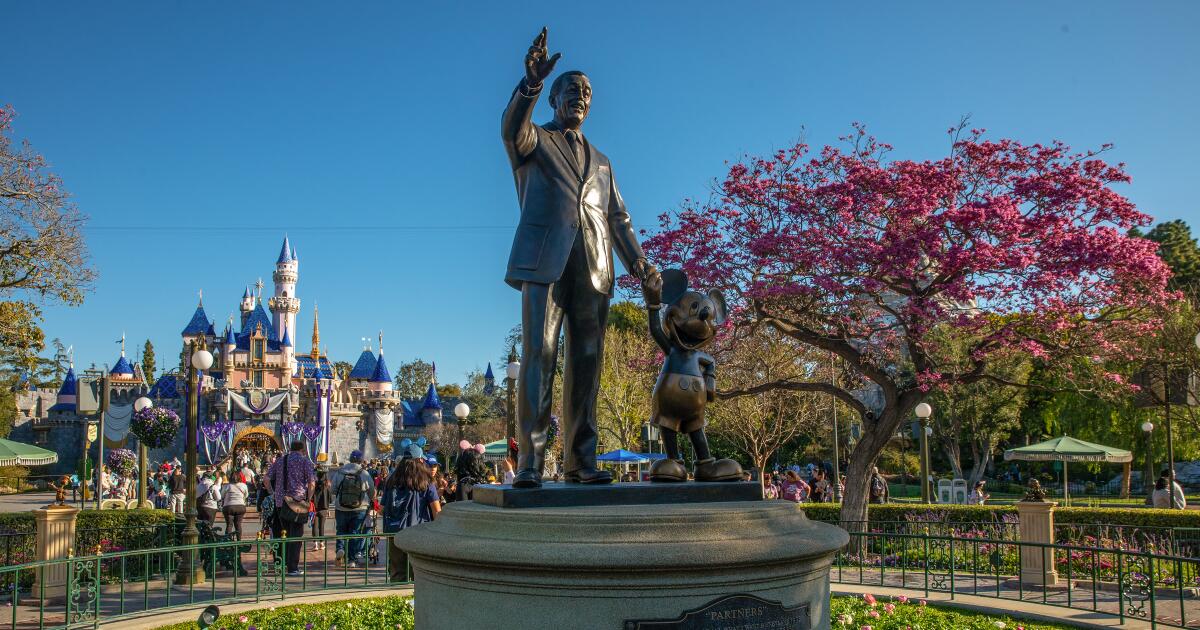
Disneyland Resort in Anaheim will offer $59 tickets for select evening admission to either theme park as part of a new promotion.
The one-day, one-park evening ticket offer will allow attendees to enter Disney California Adventure at 5 p.m. or Disneyland at 7 p.m. Park reservations are still required, as has been the case since the COVID-19 pandemic.
The offer only applies for admission from July 12 through Aug. 5 on Sundays to Wednesdays.
Disneyland Resort is commemorating its 70th anniversary through Aug. 9, and has introduced new shows and additions to rides as part of the occasion.
Walt Disney Co.’s theme parks and experiences business are a crucial boost to its finances, making up about 56% of the company’s operating income last fiscal year.
During the Burbank-based company’s most recent earnings call in May, Disney executives said attendance at its U.S.-based parks was down 1% compared with the prior year, a shift they attributed to “continued softness” in international visitations. However, the company said at the time that it was starting to move past those issues.
Disney’s experiences division reported $9.5 billion in revenue in that fiscal second quarter, up 7% compared with the same period a year ago, something executives said was due to higher guest spending domestically and more capacity on its cruise line.

An aging downtown office complex will be converted into apartments as part of an ambitious plan by local real estate companies to create 4,000 affordable housing units in Los Angeles.
The first project will be a $200-million makeover of the L.A. World Trade Center, a sprawling white elephant of an office complex on Figueroa Street built in the 1970s that will be turned into 512 apartments in one of the largest affordable housing conversions to date downtown.
Future projects being planned in the central city for delivery over the next five years will include other office-to-apartment conversions and new housing built from the ground up.
The 10-story World Trade Center, right, at Figueroa and Fourth streets in downtown Los Angeles, was built in the mid-1970s.
(Myung J. Chun / Los Angeles Times)
Behind the building campaign unveiled Monday are two of the region’s largest real estate companies, Jamison and Kennedy Wilson. Jamison is the city’s most prolific converter of offices to market-rate apartments and currently has a major makeover of a downtown office skyscraper underway for tenants who can pay top rents.
Kennedy Wilson, a real estate investment company based in Beverly Hills, owns Vintage Housing, which builds and operates affordable housing using tax credits and other state and federal financing to help fund it.
Vintage Housing and Jamison’s new affordable housing division, Arden Residential, will take on the campaign to build the housing where qualified tenants will pay rents below market rates.
Rents in the World Trade Center — which will be renamed Sky Castle when it opens in early 2028 — are expected to start at $937 for a one-bedroom unit. Some two- and three-bedroom units would rent for $1,100 and $1,300 per month, respectively, developers said.
Sky Castle will have shared amenities found in more expensive modern apartments, the developers said, such as a fitness center, resident lounge and co-working space. It already has six tennis courts on the roof, which may be converted to pickleball courts, Jamison Chief Executive Garrett Lee said.
The goal is to build higher quality affordable housing by using efficient construction methods Jamison has learned through building more than 8,000 market-rate apartments in the past, Lee said. The makeover of the World Trade Center will mark Jamison’s 15th conversion of an office building to housing.
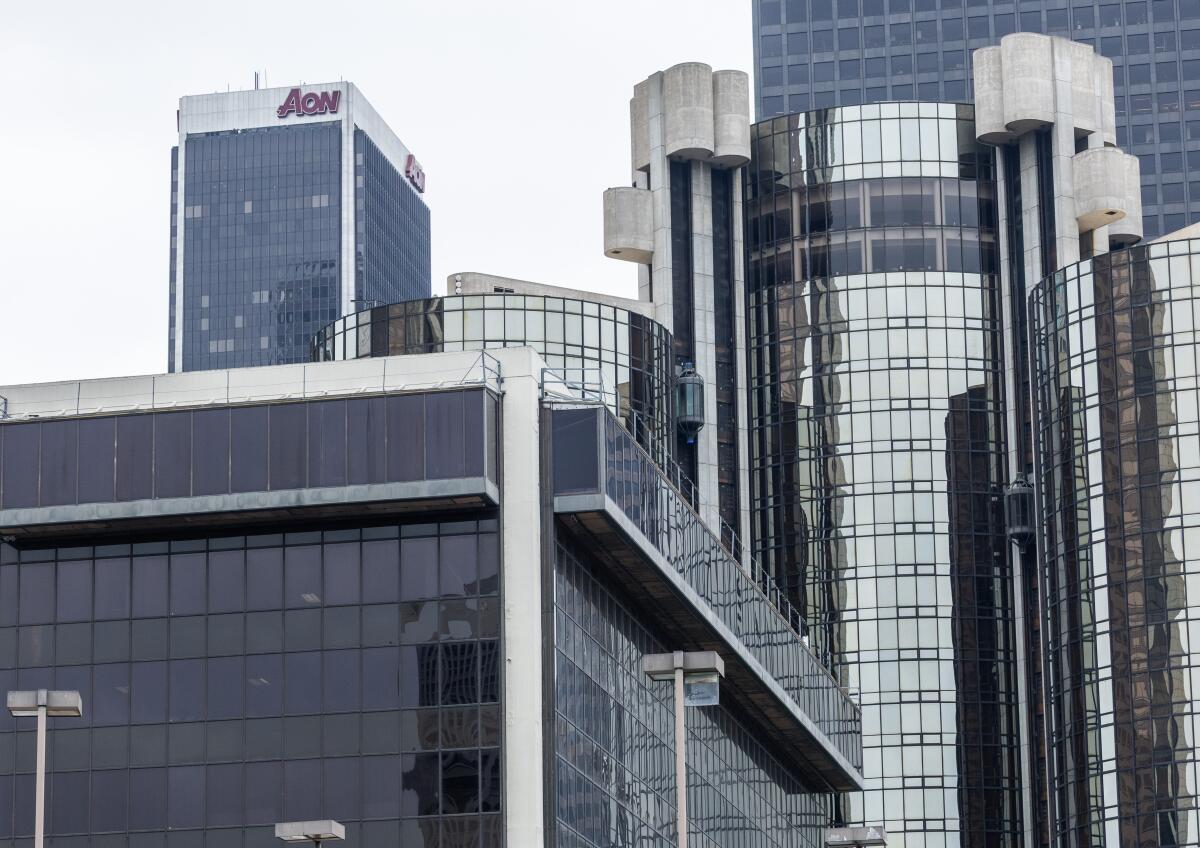
The plan to redevelop the L.A. World Trade Center, bottom left, is one of the largest affordable housing conversions to date downtown.
(Myung J. Chun / Los Angeles Times)
The 10-story World Trade Center was built in the mid-1970s to fanfare saying it would be home to international companies. In 1976, The Times described the center as a place to prepare for an overseas trip where visitors could get passports and visas, as well as exchange dollars for francs, marks, rubles and other currency. There was a language school and branches of U.S., Swiss and Japanese banks.
By the mid-1980s, the 400,000-square-foot office complex covering a city block at Figueroa and Fourth streets had lost its international flavor and was falling out of favor with corporate tenants who were moving into glossy new skyscrapers on Bunker Hill and in other locations.
The building has been cleared of remaining office tenants to allow work to begin in August, Lee said.
Kennedy Wilson is a nationwide operator of market-rate apartments that has also moved into building affordable housing in the last decade, said Nicholas Bridges, global head of capital markets at the company.
Building affordable, workforce housing “in almost all cases requires public subsidies,” Bridges said, and Kennedy Wilson has developed expertise in assembling “a cocktail of public financing sources” that includes low-income housing tax credits and tax-exempt bonds.
In the past, many housing developers have shied away from building affordable housing because assembling the subsidies needed to make construction profitable is challenging.

An artist’s rendering shows what the L.A. World Trade Center could look like after being redeveloped into affordable housing. The new complex is to be called Sky Castle.
(Ian Camarillo)
“It’s complicated,” Bridges said, “and not for the faint of heart.”
Eligible tenants must earn between 30% and 80% of the median income in the area where the housing is built.
Jamison and Kennedy Wilson will develop about 15 affordable housing projects between downtown and the 405 Freeway, Bridges said, many of them in aging office buildings such as the World Trade Center that are already owned by Jamison and are close to public transit.
Substantial potential for affordable housing lies in L.A.’s underused office buildings, he said.
“In this post-COVID world, the way people are utilizing office buildings, particularly older office buildings, has just fundamentally changed,” he said.
It makes sense for developers of conventional multifamily housing to move to building affordable housing, Lee said, because the government supports it through subsidies, zoning reform and the fast-tracking of construction permits. The city of Los Angeles also recently streamlined its adaptive reuse rules to make it easier to convert office buildings to housing.
“There are a lot of incentives pushing us in this direction,” Lee said.
-
 Politics4 minutes ago
Bill to ban sex offenders from running for office fails in California senate committee
-
 Science11 minutes ago
After Trump axed federal employees running climate site, thousands crowdfund its comeback
-
 Sports14 minutes ago
Dodgers’ Will Smith won’t return before the All-Star break
-

 World25 minutes ago
‘Positive progress’ as US, Iran wrap up indirect technical talks in Doha
-
 News49 minutes ago
What the SCOTUS campaign finance ruling means, according to an expert
-

 Los Angeles, Ca2 hours ago
Knife-wielding man rushes at LAPD officers in tense body cam video
-

 Detroit, MI3 hours ago
5 Potential Landing Spots For Former Detroit Lions CB Terrion Arnold
-

 San Francisco, CA3 hours ago
May 17 officially declared

