Connect with us

News

Top UN court orders Israel to halt Rafah offensive

Published

on

Top UN court orders Israel to halt Rafah offensive

Unlock the Editor’s Digest for free

The UN’s top court has ordered Israel to “immediately halt” its military offensive in Rafah, the southern Gazan city that had become a refuge for more than 1mn civilians since the war between Israel and Hamas erupted last year.

Despite intense international pressure to refrain, Israeli forces entered the city earlier this month, with officials insisting the assault was necessary to defeat Hamas, which triggered the war with its October 7 attack on Israel.

However, in an order issued in response to an urgent request brought by South Africa, the International Court of Justice on Friday said conditions in Rafah were “disastrous”, and instructed Israel to stop.

Advertisement

The court also ordered Israel to reopen the Rafah crossing between Gaza and Egypt to allow “unhindered provision at scale of urgently needed basic services and humanitarian assistance”, and to allow investigators into the enclave.

You are seeing a snapshot of an interactive graphic. This is most likely due to being offline or JavaScript being disabled in your browser.

The ICJ has no way of enforcing its orders — Russia continues to flout the court’s 2022 order to suspend its military operations in Ukraine. But Friday’s order adds to intense international pressure on Israel over its war in Gaza, which has fuelled a humanitarian catastrophe in the enclave.

Israel’s Prime Minister Benjamin Netanyahu was due to discuss the order with senior officials on Friday, his office said.

Far-right finance minister Bezalel Smotrich said Israel would not agree to stop the war in Gaza. “Those who demand that the State of Israel stop the war, demand that it decree itself to cease to exist,” he wrote on the social media platform X. “If we lay down our weapons, the enemy will reach the beds of our children and women throughout the country.”

Advertisement

But internationally, the pressure to end the war is growing.

The EU’s chief diplomat said the ICJ’s ruling on Friday would force the bloc to choose between supporting “rule of law [or] . . . Israel”.

“We will have to choose between our support for international institutions and the rule of law, and our support for Israel,” Josep Borrell told a conference in Florence, adding that either choice was “going to be quite difficult”.

“We’ve been clear and consistent on our position on Rafah,” a spokesperson for the White House’s National Security Council told the Financial Times, when asked about the US response to the ICJ ruling. The US has opposed Israel’s full invasion of Rafah without a plan to protect civilians.

A wounded Palestinian boy stands next to a damaged home in Rafah
A wounded Palestinian boy stands next to a damaged home in Rafah following Israeli strikes © AFP/Getty Images

On Monday the prosecutor of the International Criminal Court — which deals with crimes by individuals rather than states — sought arrest warrants for Netanyahu and defence minister Yoav Gallant, and three Hamas leaders, saying he had “reasonable grounds to believe” they were responsible for alleged war crimes.

On Wednesday, Spain, Norway and Ireland pledged to recognise a Palestinian state next week. Spain’s Prime Minister Pedro Sánchez said that while Israel had a right to defend itself, its assault on Gaza, which has killed more than 35,000 people, according to Palestinian officials, was putting a two-state solution “in danger”.

Advertisement

Netanyahu dismissed the ICC prosecutor’s move as “a distortion of reality” and insisted Israel would continue its offensive in Gaza — which it launched in response to Hamas’s October 7 attack, during which militants killed 1,200 people, and took another 250 hostage, according to Israeli officials — regardless of international criticism.

Gallant on Thursday said Israel was stepping up its assault on Rafah, and that 1mn civilians had left the city since Israel began its operation there on May 7.

Heavy Israeli air strikes were reported in Rafah in the wake of the ICJ ruling on Friday, according to Palestinian eyewitnesses and social media; Israeli analysts speculated the target was the Hamas brigade commander for the area.

South Africa’s request is part of a case it brought last year alleging Israel is committing genocide against Palestinians in Gaza. Israel has vehemently denied the charges, and the ICJ is unlikely to issue a final decision in the case for years.

But the court has twice issued interim orders in the case. In January, it told Israel to comply with international law on genocide, and in March, to ensure more food and humanitarian assistance reached Palestinians in Gaza, warning that famine was “setting in”.

Advertisement

Israel does not recognise the ICC. But it is a member of the ICJ, and as such is meant to implement its orders.

News

Supreme Court blocks redrawing of New York congressional map, dealing a win for GOP

Published

on

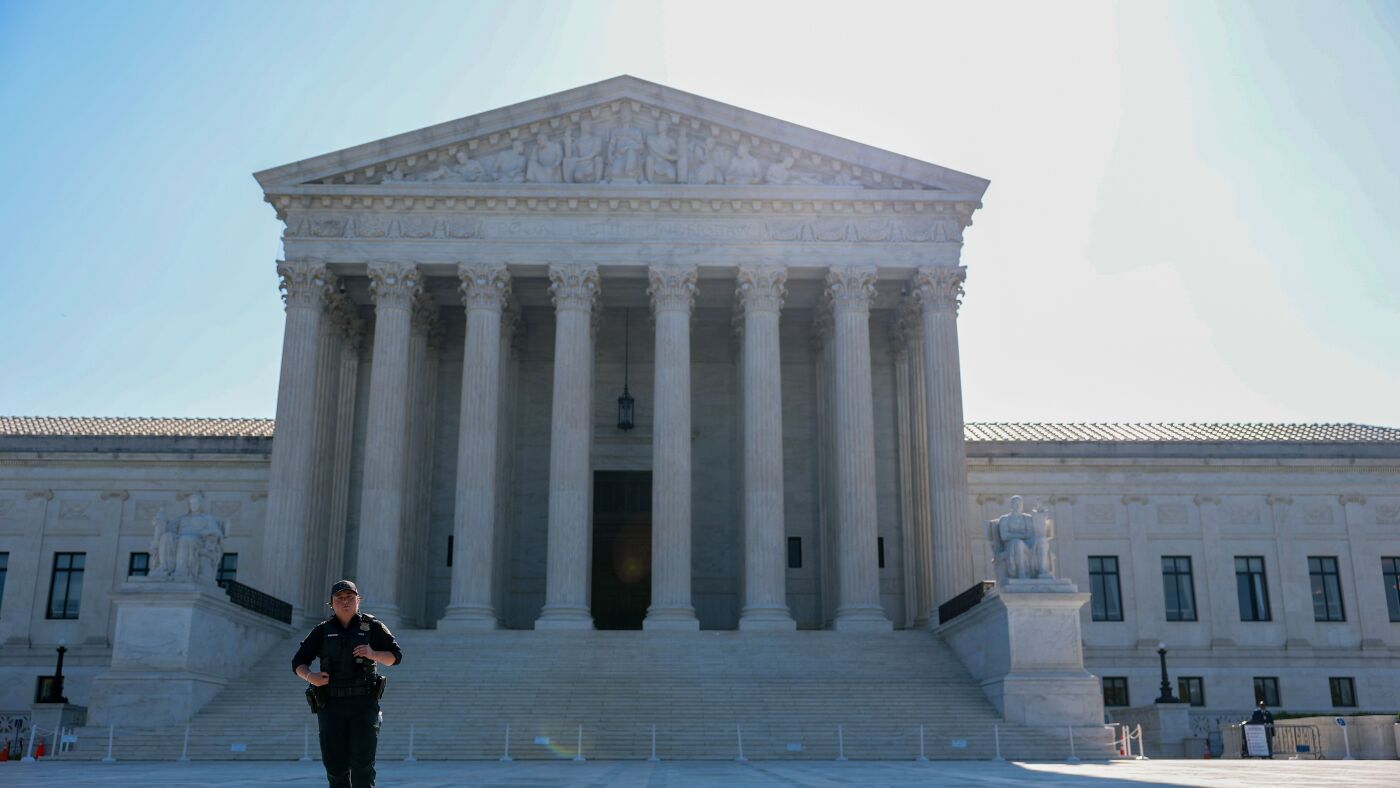
Supreme Court blocks redrawing of New York congressional map, dealing a win for GOP

The Supreme Court

Win McNamee/Getty Images


hide caption

toggle caption

Advertisement

Win McNamee/Getty Images

The Supreme Court on Monday intervened in New York’s redistricting process, blocking a lower court decision that would likely have flipped a Republican congressional district into a Democratic district.    
  
At issue is the midterm redrawing of New York’s 11th congressional district, including Staten Island and a small part of Brooklyn. The district is currently held by a Republican, but on Jan. 21, a state Supreme Court judge ruled that the current district dilutes the power of Black and Latino voters in violation of the state constitution.  
  
GOP Rep. Nicole Malliotakis, who represents the district, and the Republican co-chair of the state Board of Elections promptly appealed to the U.S. Supreme Court, asking the justices to block the redrawing as an unconstitutional “racial gerrymander.” New York’s congressional election cycle was set to officially begin Feb. 24, the opening day for candidates to seek placement on the ballot.  
  
As in this year’s prior mid-decade redistricting fights — in Texas and California — the Trump administration backed the Republicans.   
 
Voters and the State of New York contended it’s too soon for the Supreme Court to wade into this dispute. New York’s highest state court has not issued a final judgment, so the voters asserted that if the Supreme Court grants relief now “future stay applicants will see little purpose in waiting for state court rulings before coming to this Court” and “be rewarded for such gamesmanship.” The state argues this is an issue for “New York courts, not federal courts” to resolve, and there is sufficient time for the dispute to be resolved on the merits. 
  
The court majority explained the decision to intervene in 101 words, which the three dissenting liberal justices  summarized as “Rules for thee, but not for me.” 
 
The unsigned majority order does not explain the Court’s rationale. It says only how long the stay will last, until the case moves through the New York State appeals courts. If, however, the losing party petitions and the court agrees to hear the challenge, the stay extends until the final opinion is announced. 
 
Dissenting from the decision were Justices Sonia Sotomayor, Elena Kagan, and Ketanji Brown Jackson. Writing for the three, Sotomayor  said that  if nonfinal decisions of a state trial court can be brought to highest court, “then every decision from any court is now fair game.” More immediately, she noted, “By granting these applications, the Court thrusts itself into the middle of every election-law dispute around the country, even as many States redraw their congressional maps ahead of the 2026 election.” 

Monday’s Supreme Court action deviates from the court’s hands-off pattern in these mid-term redistricting fights this year. In two previous cases — from Texas and California — the court refused to intervene, allowing newly drawn maps to stay in effect.  
  
Requests for Supreme Court intervention on redistricting issues has been a recurring theme this term, a trend that is likely to grow.  Earlier last month  the high court allowed California to use a voter-approved, Democratic-friendly map.  California’s redistricting came in response to a GOP-friendly redistricting plan in Texas that the Supreme Court also permitted to move forward. These redistricting efforts are expected to offset one another.     
   
But the high court itself has yet to rule on a challenge to Louisiana’s voting map, which was drawn by the state legislature after the decennial census in order to create a second majority-Black district.  Since the drawing of that second majority-black district, the state has backed away from that map, hoping to return to a plan that provides for only one majority-minority district.    
     
The Supreme Court’s consideration of the Louisiana case has stretched across two terms. The justices failed to resolve the case last term and chose to order a second round of arguments this term adding a new question: Does the state’s intentional creation of a second majority-minority district violate the constitution’s Fourteenth and Fifteenth Amendments’ guarantee of the right to vote and the authority of Congress to enforce that mandate?    
Following the addition of the new question, the state of Louisiana flipped positions to oppose the map it had just drawn and defended in court. Whether the Supreme Court follows suit remains to be seen. But the tone of the October argument suggested that the court’s conservative supermajority is likely to continue undercutting the 1965 Voting Rights Act.   

Advertisement
Continue Reading

News

Map: Earthquake Shakes Central California

Published

on

Map: Earthquake Shakes Central California

Note: Map shows the area with a shake intensity of 3 or greater, which U.S.G.S. defines as “weak,” though the earthquake may be felt outside the areas shown.  All times on the map are Pacific time. The New York Times

A minor earthquake with a preliminary magnitude of 3.5 struck in Central California on Monday, according to the United States Geological Survey.

The temblor happened at 7:17 a.m. Pacific time about 6 miles northwest of Pinnacles, Calif., data from the agency shows.

As seismologists review available data, they may revise the earthquake’s reported magnitude. Additional information collected about the earthquake may also prompt U.S.G.S. scientists to update the shake-severity map.

Source: United States Geological Survey | Notes: Shaking categories are based on the Modified Mercalli Intensity scale. When aftershock data is available, the corresponding maps and charts include earthquakes within 100 miles and seven days of the initial quake. All times above are Pacific time. Shake data is as of Monday, March 2 at 10:20 a.m. Eastern. Aftershocks data is as of Monday, March 2 at 11:18 a.m. Eastern.

Advertisement
Continue Reading

News

US says Kuwait accidentally shot down 3 American jets

Published

on

US says Kuwait accidentally shot down 3 American jets

The U.S. and Israel have been conducting strikes against targets in Iran since Saturday morning, with the aim of toppling Tehran’s clerical regime. Iran has fired back, with retaliatory assaults featuring missiles and drones targeting several Gulf countries and American bases in the Middle East.

“All six aircrew ejected safely, have been safely recovered, and are in stable condition. Kuwait has acknowledged this incident, and we are grateful for the efforts of the Kuwaiti defense forces and their support in this ongoing operation,” Central Command said.

“The cause of the incident is under investigation. Additional information will be released as it becomes available,” it added.

In a separate statement later Monday, Central Command said that American forces had been killed during combat since the strikes began.

“As of 7:30 am ET, March 2, four U.S. service members have been killed in action. The fourth service member, who was seriously wounded during Iran’s initial attacks, eventually succumbed to their injuries,” it said.

Advertisement

Major combat operations continue and our response effort is ongoing. The identities of the fallen are being withheld until 24 hours after next of kin notification,” Central Command added.

This story has been updated.

Continue Reading

Trending