Northeast
US judge dismisses lawsuit of mother who claims school encouraged teen's gender expression without permission

- A federal judge has dismissed a lawsuit brought by a Maine woman against school officials.
- The woman accused the officials of encouraging her teen’s gender expression without consulting her.
- According to the lawsuit, a school counselor provided a chest binder, and the school began using a different name and pronouns for the teen.
A federal judge dismissed a lawsuit brought by a Maine woman who accused school officials of encouraging her teen’s gender expression by providing a chest binder and using a new name and pronouns, without consulting parents.
U.S. District Judge Jon Levy acknowledged his decision that a mother such as Amber Lavigne “might expect school officials to keep her informed about how her child is navigating matters related to gender identity” but he concluded that she failed to establish legal claims for which the school district could be held liable.
The lawsuit filed last year was the latest to weigh a minor’s right to privacy when confiding in a mental health professional against a parent’s right to supervise their children’s health and education.
NYC PARENTS ERUPT OVER PROPOSED ‘INCLUSIVE’ CHARTER SCHOOL FOR KIDS TO EXPLORE GENDER: ‘CHILD ABUSE’
According to the lawsuit, a school counselor provided the chest binder and instruction on how to use it. The mother, who has since begun home-schooling her teen, said the school also began calling the 13-year-old by a different name and pronouns.
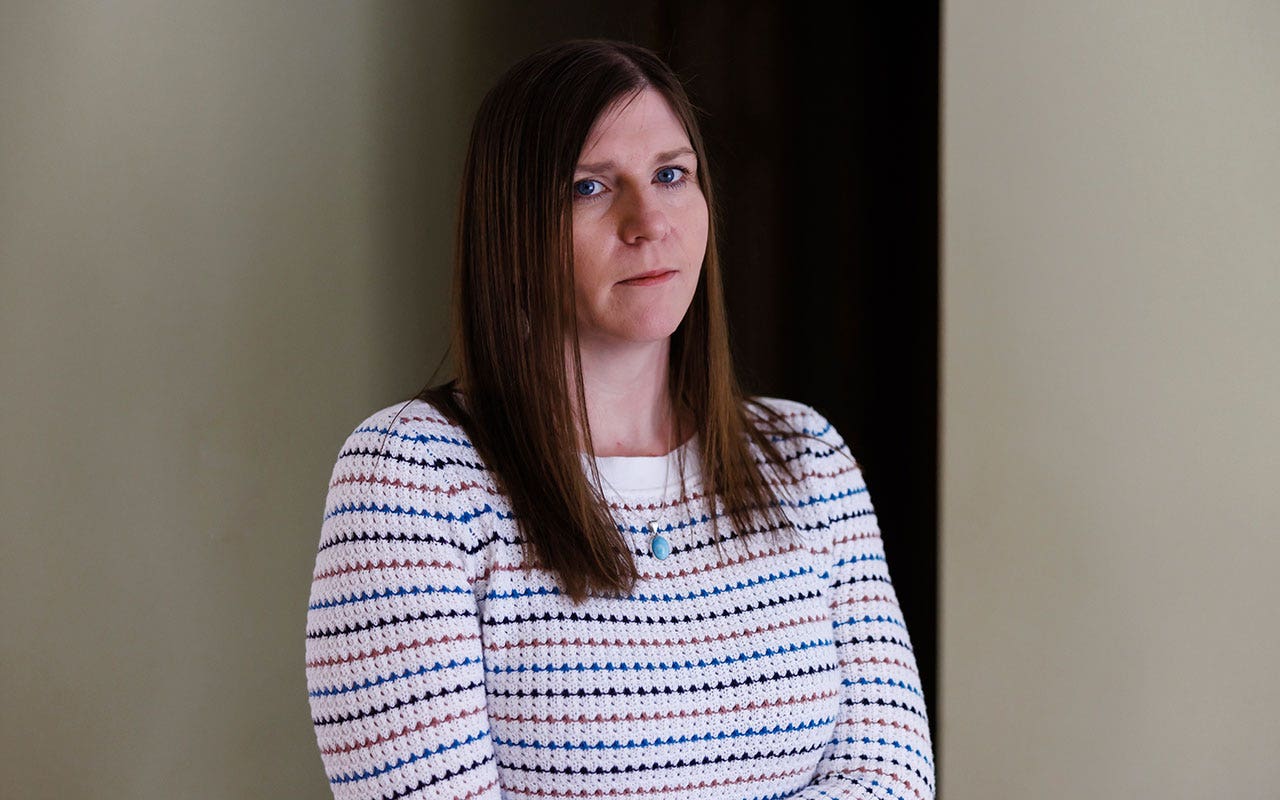
Amber Lavigne, of Newcastle, Maine, is pictured on March 25, 2023. A federal judge has dismissed a lawsuit brought by Lavigne, who accused school officials of encouraging her teen’s gender expression by providing a chest binder and using a new name and pronouns, without consulting parents. (Stephen Davis Phillips/Goldwater Institute via AP)
The lawsuit contended the mother had a “right to control and direct the care, custody, education, upbringing and healthcare decisions of her children,” and that Great Salt Bay Community School in Damariscotta violated her constitutional right by keeping the student’s gender expression from parents.
The judge previously dismissed claims against individual school officials. The remaining claim against the school board was dismissed by the judge in his May 3 order.
Read the full article from Here


new video loaded: Debris Falls Onto Car on Busy New York City Highway
May 15, 2026
Watch Today’s Videos

Debris From Overpass Strikes Car on Busy N.Y.C. Road
0:19

Judge Releases Suicide Note Said to Be Epstein’s
0:46

Highlights From the Met Gala
1:09

New York’s Plan to Slow Down Reckless Drivers
2:26

King and Queen Spend a Day in New York
1:15

The M.T.A. Is Updating How It Powers the Subway
2:49
Today’s Videos
U.S.
Politics
Immigration
NY Region
Science
Business
Culture
Books
Wellness
World
Africa
Americas
Asia
South Asia
Donald Trump
Middle East Crisis
Russia-Ukraine Crisis
Visual Investigations
Opinion Video
Advertisement
SKIP ADVERTISEMENT
Boston, MA
For kids in public housing, access to higher-income neighbors spurs future economic gains – The Boston Globe

Now, research shows the redesign substantially improved the lives of the children who grew up there. The main reason for these outcomes: increased interactions with people who live nearby, the higher income the better.
Compared to kids raised in similar but unchanged public housing, those raised in Hope VI sites are more likely to go to college and less likely to be incarcerated, and earn more money, according to the research from Harvard’s Opportunity Insights, an economic mobility nonprofit.
Researchers found little difference for adults, but for children, each year spent in these renovated spaces increased their adult household income by 2.8 percent. All told, those born and raised there earned 50 percent more over their lifetimes, compared to those who grew up in more isolated and impoverished surroundings.
The new Old Colony complex is fully integrated into the neighborhood around it, with updated architecture, landscaped grounds, and streets running through it. Outsiders regularly walk their dogs or jog through, sometimes even stopping to say hello, Moreta said, likely unaware they’re in the midst of public housing. There are fewer police sirens, fewer safety concerns — and a lot less stigma.
Moreta’s two older children were already grown by the time the project was completed last year. But her younger daughter, Brianny, who’s 14, is benefiting.
“My older children would feel like scum, because that’s how other people would make them feel,” Moreta said in Spanish, through an interpreter.
With the redevelopment, that sense of “otherness” has lifted, she said: “They don’t see us as criminals anymore.”
Public housing was started by the federal government in the 1930s as a way to get people out of overcrowded slums. The buildings were situated on “super blocks” closed off from the street grid to keep cars from driving through, and to keep children safe, said Alexander von Hoffman, a senior research fellow at Harvard Joint Center for Housing Studies.
But eventually, these secluded spaces isolated residents and provided cover for criminal activity. In time, working-class families increasingly left public housing, prompting authorities to admit more single parents and welfare recipients, said von Hoffman, who has researched the history of public housing. Crime and disorder increased, maintenance faltered, and buildings fell into disrepair.
By the 1980s, public housing was in crisis.
Old Colony was no exception. Kevin Weeks, an associate of notorious gangster James “Whitey” Bulger grew up there, and their organized crime ring took over a liquor store across the street.
Moreta’s oldest child, Samuel, was a baby when they moved into Old Colony in 1999. Back then, the complex was row after row of identical brick buildings, encircled by streets that cordoned it off from the rest of the neighborhood. Inside, there were cockroaches and mold, peeling paint and crumbling walls. Homeless people came inside to sleep and do drugs in the stairwells. Gun shots and drunken fights broke out in the street.
At school, Samuel’s rowdy behavior was dismissed as him being a “project kid.” At home, he saw neighbors walking by with a “clutch of a purse,” and he avoided them as well.
“I think subconsciously what it did … is hold off me being able to make connections with certain people sometimes, because I don’t know what their intentions are,” said Samuel, who asked that his last name not be used to protect his privacy.
The government started revamping these deteriorating housing developments in 1993. In Boston, Old Colony was the last of five to undergo a transformation. Housing developments in Cambridge, Taunton, New Bedford, and Holyoke were also part of the Hope VI makeover.
Researchers at Opportunity Insights, led by famed economist Raj Chetty, began studying tax and housing data of people living in these resuscitated spaces. Earlier research by Chetty showed that families who move to higher-income neighborhoods improve their children’s future success, and he wanted to know if bringing opportunity to lower-income families would produce better outcomes, too.
It did — by breaking up the concentration of poverty and increasing social interactions between children of different income levels, said Matthew Staiger, coauthor of the Opportunity Insights study. Cellphone data, Facebook connections, and Census records showed that children who grew up in Hope VI developments were more likely to befriend and later live with peers from outside public housing.
The rate of violent crime in refurbished projects fell by 41 percent compared to untouched ones, national police records show.
Before, segregated public housing likely reinforced the idea that lower-income kids were different and better economic opportunities were not for them, Staiger said.
“Interacting with and befriending kids from higher-income families changes your aspirations and what you think is possible for yourself,” Staiger said. “It changes how you think you fit into the world.”
Occupants of reconfigured housing developments in disadvantaged areas, on the other hand, didn’t experience any economic gains during the same time period.
Not all Hope VI public housing residents are happy with how things have changed. Only about a fifth of residents came back after they moved out during construction, including some who had settled elsewhere in their years away. Others were screened out by criminal background checks and drug tests.
At Washington Beech in Roslindale, resident Meena Carr said the formerly close-knit community is no longer.
“There’s no togetherness,” said Carr, 84, a retired teacher originally from Trinidad and Tobago. “It looks nice, but inside is rotten.”
There are no more bingo nights, no coffee hours. Even the basketball court, formerly used by kids from around the neighborhood, is fenced off with a sign reading: “This is not a public playground.”
Regardless, the Boston Hope VI properties are better off than some because they are all located in or near wealthy, resource-rich areas, said Kenzie Bok, administrator of the Boston Housing Authority, and because the housing authority gets more grants from the city than from the federal government, which has been cutting funds for public housing.
The key, said Bok, is that these new apartments make children feel valued at an impressionable time in their lives.
“It’s going to embolden you in making those connections, feeling like those people and those resources are available to you, that they’re for you,” Bok said.
The economic gains weren’t due to the new mix of residents, noted Staiger, the Opportunity Insights study coauthor. The longer a child lived in a redeveloped property, the better he or she did later in life. Younger siblings who lived in these new spaces longer than an older brother or sister went on to outearn them, Staiger said, and this shows that the environment played a role in their outcomes.
Von Hoffman, at the Harvard Joint Center for Housing Studies, questioned the implication that “poor people left to their own devices will just wallow in the slums.”
This criticism has been raised before. But the real takeaway, Staiger stressed, is that it’s harmful to wall people off from society.
Moreta, at Old Colony, can already feel the difference. She and her family moved to another public housing complex during the final phase of construction, and came back about a year ago. Her new apartment is spacious, with high ceilings and central air conditioning. Security cameras and key cards make the property more secure.
More than anything, she said, she finally feels like she belongs.
“Everything has changed because the appearance of the buildings has changed,” said Moreta, who works in a high school cafeteria.
Her daughter Brianny, who is finishing up her freshman year, gets straight A’s. Her friends sometimes joke about her being from “the projects,” her mother said, but, so far, she isn’t experiencing the discrimination and stress that Samuel did.
And she’s thinking big. Samuel, now 27, recently told Brianny, who loves to draw, she should think about art school.
“Art school?” she scoffed. “I’m aiming for Harvard.”
This story was produced by the Globe’s Money, Power, Inequality team, which covers the racial wealth gap in Greater Boston. You can sign up for the newsletter here.
Katie Johnston can be reached at katie.johnston@globe.com. Follow her @ktkjohnston.

-
 Sports1 minute ago
Loyola wins Southern Section Division 1 lacrosse championship
-

 World13 minutes ago
Terrorism scenario excluded following Modena car attack
-
 News43 minutes ago
Bus riders to Montgomery retrace old steps while fighting a new fight
-

 New York2 hours ago
Video: Debris Falls Onto Car on Busy New York City Highway
-

 Los Angeles, Ca2 hours ago
Long Beach to hold new pride festival after previous one canceled
-

 Videos2 hours ago
Does a Labour leadership race mean another UK Brexit debate? | BBC Newscast
-

 Detroit, MI3 hours ago
4 Reasons Detroit Lions 2026 NFL Schedule Is Very Promising
-

 San Francisco, CA3 hours ago
Where to watch San Francisco Giants vs Athletics : TV channel, start time, streaming for May 17

