Business
Federal labor investigators say L.A. poultry plant used child labor and tried to cover it up

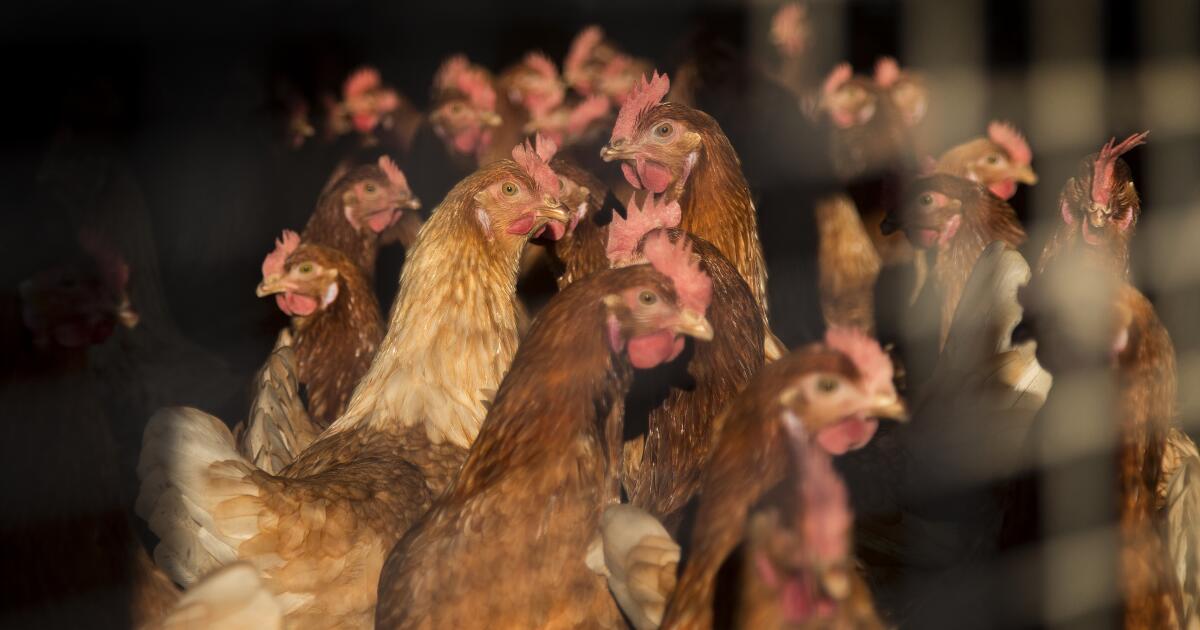
A federal judge issued a temporary restraining order on Monday to block a poultry processing plant in the city of Irwindale from using “oppressive” child labor.
The order came after investigators with the U.S. Department of Labor filed a lawsuit on Saturday alleging the poultry processor and its affiliated companies illegally employed children under the age of 18 to debone raw meat with sharp knives.
The department is seeking action forcing involved companies to forfeit money they made from selling products processed in facilities where minors were allegedly made to work in dangerous conditions.
The judge’s order involves three companies in the San Gabriel Valley — L & Y Food, Moon Poultry and JRC Culinary Group — that are all either owned, operated or managed by Fu Qian Chen Lu, who is also named in the lawsuit.
The Labor Department said in court documents that the companies continued to deliver and sell products even after agreeing to voluntarily refrain from shipping products following accusations of their use of child labor, and refused to provide information to investigators.
The companies hid 794 boxes of processed chicken and seven 1500-pound bins of chicken from investigators visiting the Irwindale facility, according to the court filings .
Federal officials and the poultry companies have presented dueling narratives of the child labor allegations.
Gregory W. Patterson, an attorney representing Chen Lu and other defendants named in the suit, accuses the Labor Department of planting an underage worker in the facility as part of its investigation, a claim the department has dismissed as “baseless.”
The crackdown by federal investigators comes as some of the country’s biggest consumer brands have come under broad scrutiny for child labor in their domestic supply chains amid revelations that children are working throughout American manufacturing and food production.
Investigators discovered children deboning poultry at the plant after visiting the facility in the city of Irwindale on Mar. 20 for a civil search warrant, the lawsuit said. Operators of the facility continued to process products, even after the Labor Department raised objections during its search warrant, in violation of federal laws prohibiting sale of products “tainted by child labor,” according to the lawsuit.
The “hot goods” provision of the Fair Labor Standards Act prohibits companies from selling products from locations flagged for child labor use in the prior 30 days.
U.S. District Judge Otis D. Wright II in his Monday decision issued a temporary restraining order requiring the businesses to stop using child labor, provide the Labor Department with information it is requesting related to its investigation, and refrain from shipping any poultry from facilities accused of employing child labor.
“In light of the immediacy of irreparable harm pending the Court’s review of this action, the Court finds a temporary restraining order warranted,” Wright wrote in his order on Monday.
Barring immediate action, he said, companies named in the lawsuit “will continue to employ oppressive child labor to the risk of minors’ life and limb; hot goods may enter the stream of commerce; and Defendants will continue to thwart Plaintiff’s investigation.”
Patterson, the attorney representing Chen Lu and other defendants, said in an emailed statement that the labor department had a 17-year-old “gain employment with Moon Poultry under false pretenses by presenting a fake government identification” and “directed this person to work in a hazardous area of the Moon Poultry facility in Irwindale.”
Patterson alleged that the Labor Department aimed to manufacture a child labor claim to “strengthen its negotiating hand” in an investigation about overtime wages that had not been paid to workers.
“The defense counsel’s allegations are false. The Labor Department has previously responded to the defense counsel on this issue, but he has nevertheless chosen to press his baseless claims,” said Marc Pilotin, regional solicitor for the Labor Department, in an emailed statement.
The Labor Department has investigated other poultry processing plants in California in recent months.
In December, federal investigators found grueling working conditions at two poultry plants in City of Industry and La Puente operated by Exclusive Poultry Inc. as well as other “front companies” owned by Tony Elvis Bran.
Children as young as 14 stood for long hours cutting and deboned poultry and operating heavy machinery, the labor department said. The workers came primarily from Indigenous communities in Guatemala.
The poultry processor, which supplies grocery stores including Ralphs and Aldi, was ordered to pay nearly $3.8 million in fines and back wages.
An investigation published in early February by the Fresno Bee detailed dangerous and sometimes deadly conditions for primarily Latino immigrant workers at Pitman Farms in the Central Valley, which produces the Mary’s Free Range Chicken brand.


Airbnb unveiled a new set of services for guests on Wednesday, adding car rentals, airport pickup and grocery delivery to its online marketplace that connects travelers with local hosts.
Customers can now get groceries delivered to their Airbnb through a partnership with Instacart and have a driver meet them at the airport with Airbnb’s Welcome Pickups. The app is also offering luggage storage in partnership with Bounce and will add in-app car rentals later this summer.
At the same time, Airbnb is ramping up its use of AI by adding AI-powered review summaries and lodging comparisons, the company said.
The company has been expanding beyond lodging since last year, when it introduced Airbnb Experiences and Services, giving guests the option to book private tours and chef-cooked meals through the app.
In an earnings call earlier this month, the company’s chief executive, Brian Chesky, said the company is at “the very, very beginning of how AI is going to change how we all do our jobs.”
The changes are coming in time for the 2026 FIFA World Cup, which will take place in 16 cities across the U.S., Mexico and Canada. The company said its offering exclusive World Cup experiences, such as watch parties and access to stadiums.
“In terms of what we’ve seen in cumulative bookings heading into the event, the World Cup is slated to be the largest event in Airbnb’s history,” said the company’s chief financial officer, Ellie Mertz, on the earnings call.
Airbnb gained popularity for offering travelers unique and homey stays on other people’s property, but it added boutique hotel bookings to its platform late last year. The move had some customers questioning if the app was straying too far from its original purpose.
In its announcement this week, the company said it is partnering with more independent hotels in 20 top destinations, including New York, London and Singapore. On the earnings call, Chesky said hotels on Airbnb could become a multibillion-dollar revenue business.
The San Francisco-based company was founded in 2007 and gave homeowners the opportunity to earn money by renting out their space to travelers seeking something different from a hotel. Airbnb bookings can range from private bedrooms in a shared home to luxury mansions and yachts.
The company’s revenue grew 18% year over year to $2.7 billion in the first quarter, while net income increased slightly to $160 million. Airbnb’s new services and offerings could transform it from a home-sharing platform to a holistic travel marketplace, analysts said.
Shares of the company have increased by 14% over the past six months and fell by less than 1% on Thursday.

Elon Musk wants to take investors on a ride to the moon — and beyond.
His pioneering rocket company SpaceX filed Wednesday for what’s expected to be the largest initial public offering in history, potentially raising at least $75 billion and valuing the company at as much as $2 trillion.
The registration statement with the Securities and Exchange Commission for an expected public offering next month explicitly sets aside stocks for retail investors, though the exact number will be spelled out in a later filing, as will the offering price and company valuation.
Interest in the stock offering is expected to be high despite the billionaire’s controversial politics, including his involvement last year with the Department of Government Efficiency, the makeshift cost-cutting effort that resulted in the loss of hundreds of thousands of government jobs.
“Potential investors are probably just as polarized as the electorate is too, given his dabbling in politics,” said Carol Schleif, chief market strategist for BMO Private Wealth. “But it’s not just the SpaceX IPO per se, it’s a bigger, broader excitement among investors for space investment in general.”
Investor interest was piqued by the Artemis II moon mission this year that SpaceX did not participate in, she said. However, the company is expected to play a larger role in future missions that take astronauts to the moon..
Ultimately, Musk, 54, wants to establish a colony on Mars but those plans have been set on the back burner, with NASA now focusing on moon missions.
Musk will remain the company’s chief executive and chairman. Under a dual-class stock structure as a holder of special Class B shares he will be able to control the election of directors, the filing says.
The IPO is expected to be at least twice as large as the current record holder: Saudi Aramco, the state-controlled national oil and gas company of Saudi Arabia, which raised nearly $30 billion in 2019.
Nearly two dozen banks will be underwriting the IPO and offering shares to investors, including Goldman Sachs, Bank of America and Citigroup.
Founded in 2002 in El Segundo, SpaceX has revolutionized the aerospace industry by developing the reusable Falcon 9 rocket that has radically lowered launch costs.
The company moved its headquarters from Hawthorne to Texas in 2024. However, SpaceX retains large operations in the South Bay city and blasts off regularly from Vandenberg Space Force Base in Santa Barbara County.
Scores of former SpaceX employees have launched startups in Southern California, including rocket company Relativity Space, hypersonic missile startup Castelion and satellite manufacturer Apex Space.
Since developing its reusable rocket technology, SpaceX has established its Starlink network as the leading satellite-based broadband internet service. It also is moving into satellite-based cellular service and this year merged with Musk’s xAi artificial intelligence company that also included his X social network.
Marco Cáceres, an aerospace analyst at Teal Group, said that the advantage of going public for SpaceX lies in the IPO’s ability to raise a large amount of capital quickly to complete development of its Starship rocket.
“It is going to dominate the market even more than the Falcon 9 is dominating the market now,” he said. “That’s going to be ultimately what’s going to drive their business for the next 10 years.”
The 12th test launch of Starship is set for Friday from the company’s south Texas launch facility. The rocket is the third version of craft, standing more than 400 feet tall and with about three times the payload of the second version.
The regulatory filing claims that the market for its rocket, internet and mobile telephone businesses could be as large as $28.5 trillion.
SpaceX also plans to launch thousands of orbiting data centers powered by the sun that would perform AI calculations.
With the company making massive capital investments, it recorded a $4.28-billion loss in the first quarter. Last year, it recorded $18.7 billion in revenue and lost $4.94 billion, according to the filing.
The public offering is expected to hit the market next month after a “road show,” during which SpaceX will seek to drum up interest from institutional and retail investors.
It will arrive after a fairly quiet year for IPOs that was brightened last week when Cerebras Systems, a Sunnyvale company that makes semiconductors for AI supercomputers, went public.
Shares at Cerebras were offered at $185 and jumped 68% on its opening day. They closed Wednesday at $290.69.
Matt Kennedy, a senior strategist at Renaissance Capital, said the SpaceX offering would dwarf that of Cerebras, as it is expected to raise more than every IPO combined in the last two years.
“A win here or a loss could really impact the IPO market,” he said. “The sheer size of this deal is going to make or lose fortunes.”
Among the oddest disclosures of the IPO is a decision by the company’s board in January to grant Musk 1 billion Class B shares if the company reaches a certain market capitalization and establishes a “permanent human colony on Mars with at least one million inhabitants.”
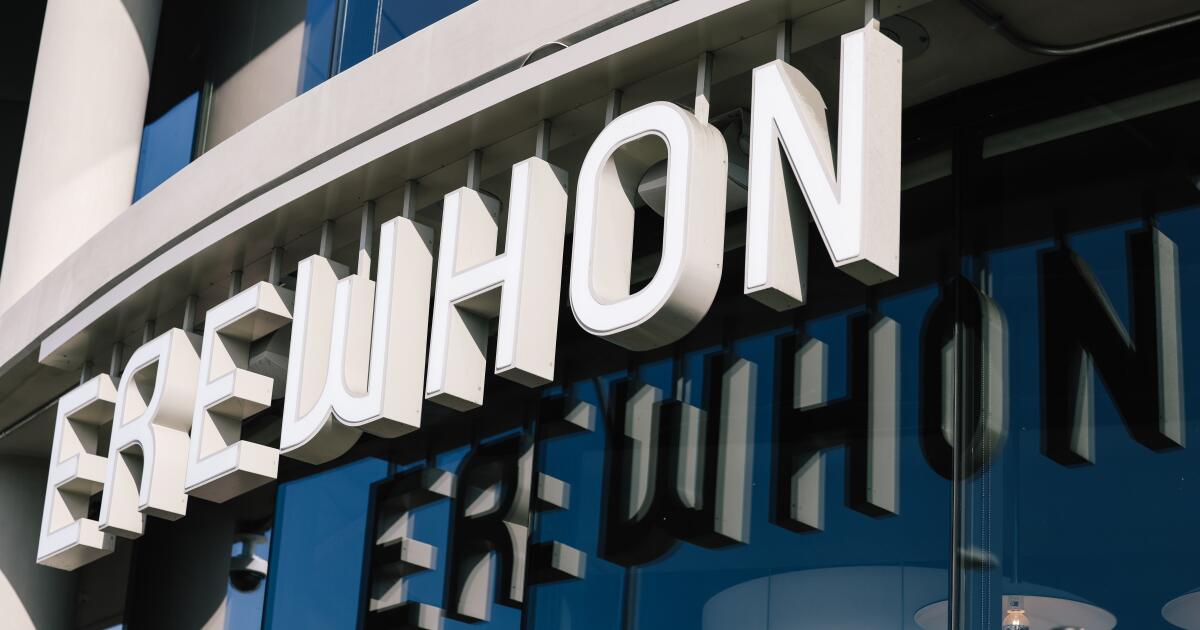
Erewhon opened its newest location in Glendale on Wednesday, marking the luxury grocer’s 14th store in Southern California with more set to open soon.
The new store, located at 520 N. Glendale Ave., includes the chain’s signature cafe and tonic bar as well as an indoor-outdoor patio space.
Known for its upscale, trendy products and high prices, Erewhon has grown into a tourist destination in Los Angeles and a hot spot for celebrities and influencers.
The Glendale location will bring Erewhon staples to trendy consumers in the area, including the beloved Strawberry Glaze Skin Smoothie, which until last year was named after the model Hailey Bieber.
Employees at the store handed out complimentary gift bags and fresh flowers during the grand opening Wednesday morning.
“This location was designed to reflect the spirit of the neighborhood while creating a welcoming space to gather, centered around wellness, connection, and a commitment to the quality standards that define Erewhon,” Erewhon President Josephine Antoci said in a statement.
The company purchased the space, which was formerly a hardware store, in 2024.
Erewhon has locations in several of Southern California’s wealthiest areas, including Calabasas and Beverly Hills. It also has stores in Venice, Manhattan Beach and at the Grove.
“Erewhon’s decision to invest in Glendale reflects confidence in our city’s economic future,” Glendale Mayor Ardashes Kassakhian said in a news release.
The grocer was founded in 1966 by Japanese immigrants Michio and Aveline Kushi — pioneers of the natural-foods macrobiotic movement — who began selling imported organic goods out of their Boston home. In 1969, the company opened its first Los Angeles location on Beverly Boulevard.
Josephine and Tony Antoci bought the company in 2011 and helped launch it to its luxury status with a cult-like following. Tony serves as chief executive while Josephine handpicks much of the store’s merchandise.
By the mid-2010s, Erewhon had become a watering hole for celebrities such as the Kardashians and the Beckhams.
The company has its eye on further expansion. A Thousand Oaks location is slated to open this August and stores in Costa Mesa and downtown Los Angeles are planned for 2027. An Erewhon cafe opened in the Los Angeles County Museum of Art’s new David Geffen Galleries earlier this month.
The Pacific Palisades location, which shut down after the wildfires last year, is set to reopen in January.
The Glendale Erewhon takes the place of Virgil’s Hardware Home Center, which opened in 1932 and closed in 2019.
-
 Lifestyle35 minutes ago
‘It’s one of my dreams,’ Rose Byrne says of her comic turn on Broadway
-

 Education41 minutes ago
Video: Opinion | A Defense of a Liberal Arts Education in the Age of A.I.
-

 Technology47 minutes ago
Philips’ new display has a screen on both sides
-

 World53 minutes ago
Record number of climbers summit Mount Everest from Nepali side despite overcrowding concerns
-

 Politics59 minutes ago
Senate GOP erupts over Trump DOJ ‘anti-weaponization’ fund, punts ICE, Border Patrol funding
-

 Health1 hour ago
‘Wild West’ peptide craze surges beyond GLP-1s as FDA faces pressure to ease access
-

 Sports1 hour ago
College football player William Davis cause of death revealed: report
-

 Technology1 hour ago
Fake Geek Squad billing scam email: Red flags and how to avoid

