Virginia
Column: Virginia is cultivating indoor agriculture to forge a brighter future


Virginia has long understood the importance of nurturing promising new industries, and indoor agriculture is no exception. Despite some recent skepticism about the industry’s relevance, we in Virginia see it differently. Here, indoor agriculture represents more than just a tech trend; it signifies a source of skilled horticultural and manufacturing jobs, rural development, and cutting-edge technology that can complement outdoor agriculture, providing fresh, locally grown produce.
Similar to other growing industries, indoor agriculture holds immense potential. While not every company will thrive, it’s an early-stage sector, and those who fail to support it may miss out on a unique opportunity.
Several years ago, Virginia laid the groundwork for a different revolution. Despite early critics, Virginia invested in the budding technology that grew into Data Center Alley, which now spans Fairfax and Loudon counties. It evolved into a vital ecosystem powering global digital infrastructure and turned the commonwealth into ‘the internet capital of the world.’
Today, we find ourselves at a critical juncture, faced with the urgent need to shape and diversify the future of our economy. Just as we foresaw the potential of the internet amid doubt, we are now turning our attention to a new frontier.
As an economic powerhouse enhanced by our rich agricultural history, manufacturing leadership and recent growth in technology, life sciences and professional services, Virginia is well-equipped to meet this challenge. Our renowned universities, skilled workforce, strategic location and commitment to innovation are the ideal ingredients to cultivate indoor farming.
Indoor agriculture represents a remarkable fusion of innovation and technology to address the age-old challenge of providing ample food with minimal land and resources. Over the last 15 years, companies such as AeroFarms, Beanstalk, Better Future Farms, BrightFarms, Greenswell Growers, Plenty Unlimited, Red Sun Farms and Soli Organic have invested in operations across the state, making Virginia the country’s largest hub for indoor agricultural operations.
These enterprises have brought hundreds of highly skilled and well-paid jobs, spurring growth in related industries and injecting opportunity into rural communities. Critically, these operations and jobs are dispersed across the Shenandoah Valley in communities such as Culpepper and Harrisonburg, not concentrated in the “Golden Crescent.”
Virginia is strategically positioned to become a leading hub for indoor agriculture, fostering partnerships, incentives, research and a skilled workforce pipeline. Our universities, specializing in agriculture and technology, are exploring tactical research and development, and addressing high-skill career demands. Collaborative programs such as the Controlled Environment Agriculture Innovation Center in Danville, initiated by Virginia Tech and the Institute for Advanced Learning and Research, are driving industry progress, complemented by Virginia State’s academic and research programming that are shaping the next generation of industry professionals.
We also support innovative entrepreneurs, start-ups and industries through policy initiatives and market development strategies. Recently, Gov. Glenn Youngkin reinforced this commitment by expanding the agricultural sales tax exemption. It now includes items used to produce agricultural products within controlled environment commercial facilities, a significant incentive for businesses seeking growth opportunities.
We know that it will take a diverse ecosystem to accelerate indoor innovation, including finance, retail, food, education, utilities and more, to drive Virginia’s future as the preferred destination for indoor agriculture. Last fall, we hosted the first Great Indoors Symposium, bringing together leading innovators across the sector to discuss scaling these technologies. We are confident the conversations and relationships initiated at that illuminating and energizing event will continue to advance the future of indoor food production.
Our approach to indoor agriculture exemplifies why the commonwealth’s economic development strategy works. We combine traditional elements of business development with a forward-looking analytical approach, predicting and targeting up-and-coming industries and creating an ecosystem tailored to their needs.
Growing up on our family’s farm in the Shenandoah Valley shaped my understanding of agriculture’s critical role in Virginia’s robust economy and communities. Today, whether indoors or outdoors, agriculture is evolving with new advancements, and innovation is instrumental in shaping Virginia’s economy and future for generations to come.
Matthew Lohr is the Virginia secretary of agriculture and forestry.



RICHMOND, Va. — Jerrod Buford first picked up a paintbrush as a kid, never imagining that same creative outlet would carry him through his darkest days in prison.
Buford, who grew up in Williamsburg, was convicted and arrested as a young man and spent almost a decade behind bars. During that time, he struggled deeply.
“Turning to drugs and alcohol to kind of shadow over emotions,” Buford said. “Looking for acceptance, approval. Not just from my parents, but from friends, from, you name it. I mean, I tried to commit suicide, I don’t even know how many times,” Buford said.
WTVR
It was inside prison walls that art became more than a hobby.
“Throughout my prison time, I learned, the freedom that I desired, I’ve always had it. I got, I found it, in a box,” Buford said.
More than three years after his release, Buford continues to advocate for art as a tool for healing. He describes his work as a gift he feels called to share.
“I received a blessing from God that just allowed me to display what he’s given me,” Buford said.
For Buford, creating art is also a way of processing his past.
“That’s what art has done for me. It’s given me the ability to look at parts of my life, all parts of my life, and find the good and the negative, learn from the negative,” Buford said.
He shares his story and artwork with a wide audience through social media, including live sessions on TikTok, and holds art classes with new communities.
The Story Cafe
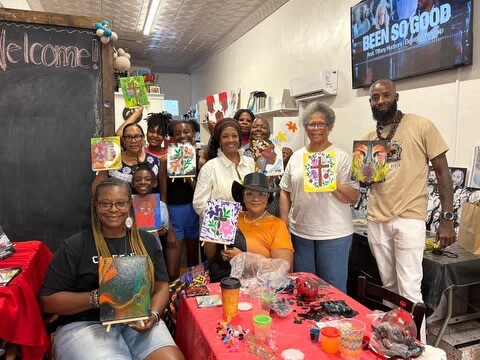
Buford said his mission is to help others find their own path toward healing — whatever form that takes.
“What I strive to do is guide this person to just create, man. Don’t care what people think about your creation, you just need to get it out,” Buford said. “Whether it’s with art, addressing your mental health, getting your life right — just do it.”
CBS 6 is committed to sharing community voices on this important topic. Email your thoughts to the CBS 6 Newsroom.
📲: CONNECT WITH US
Blue Sky | Facebook | Instagram | X | Threads | TikTok | YouTube

This story was initially reported by a journalist and has been converted to this platform with the assistance of AI. Our editorial team verifies all reporting on all platforms for fairness and accuracy. To learn more about how we use AI in our newsroom, click here.

Lovingston, VA (7News) — Good Morning Washington interviews Amanda Beckwith of Virginia Distillery Company- one of the contributing distilleries to the Virginia Spirits Board’s 250th Celebration Trio Pack, a special, exclusive release created to commemorate America’s upcoming 250th anniversary. This limited-edition package features a curated collection of a rum, a gin, and a whiskey, all crafted from scratch by distillers in Virginia to celebrate the rich history and current state of distilling within the Commonwealth.
Beckwith elaborates on VA Distillery Company’s role in the project, noting her focus on Virginia-grown grain to make the bottle of unique whiskey that is included in the Trio Pack. It is also worth noting that the Trio Packs themselves were bottled and produced right here at Virginia Distilling Company!
American single malts are the newest official category of American whiskey, distilled from one grain and from a single distillery. Virginia Distillery Co specializes in this new category of whiskey and crafted their contribution to the Trio Pack with this very specialty. Given the limited remaining availability of the Trio Pack, its historical value and collectible nature, the message it loud and clear encouraging viewers to grab a pack before they are all gone!
BE THE FIRST TO COMMENT
21+ Please drink responsibly, this content is sponsored by Virginia Distillery Company.


Powerball, Mega Millions jackpots: What to know in case you win
Here’s what to know in case you win the Powerball or Mega Millions jackpot.
Just the FAQs, USA TODAY
The Virginia Lottery offers multiple draw games for those aiming to win big.
Here’s a look at June 24, 2026, results for each game:
Powerball
Powerball drawings are held Monday, Wednesday and Saturday at 11 p.m.
13-14-16-21-38, Powerball: 14, Power Play: 2
Check Powerball payouts and previous drawings here.
Saturday, June 27, 2026
Pick 3
DAY drawing at 1:59 p.m. NIGHT drawing at 11 p.m. each day.
Night: 3-1-5, FB: 8
Day: 7-8-8, FB: 4
Check Pick 3 payouts and previous drawings here.
Pick 4
DAY drawing at 1:59 p.m. NIGHT drawing at 11 p.m. each day.
Night: 4-7-2-1, FB: 7
Day: 7-3-4-6, FB: 3
Check Pick 4 payouts and previous drawings here.
Pick 5
DAY drawing at 1:59 p.m. NIGHT drawing at 11 p.m. each day.
Night: 7-5-2-6-9, FB: 0
Day: 6-9-4-0-7, FB: 0
Check Pick 5 payouts and previous drawings here.
Cash Pop
Drawing times: Coffee Break 9 a.m.; Lunch Break 12 p.m.; Rush Hour 5 p.m.; Prime Time 9 p.m.; After Hours 11:59 p.m.
Coffee Break: 12
After Hours: 08
Prime Time: 13
Rush Hour: 01
Lunch Break: 14
Check Cash Pop payouts and previous drawings here.
Cash 5
Drawing every day at 11 p.m.
09-12-15-24-43
Check Cash 5 payouts and previous drawings here.
Bank a Million
Bank a Million draws are held every Wednesday and Saturday at 11 p.m.
18-21-25-33-36-39, Bonus: 13
Check Bank a Million payouts and previous drawings here.
Millionaire for Life
Drawing everyday at 11:15 p.m.
03-04-10-36-37, Bonus: 05
Check Millionaire for Life payouts and previous drawings here.
Feeling lucky? Explore the latest lottery news & results
This results page was generated automatically using information from TinBu and a template written and reviewed by a Center for Community Journalism (CCJ) editor. You can send feedback using this form.
-

 Los Angeles, Ca17 minutes ago
Woman ambushed, violently attacked by robber in downtown Long Beach
-

 Detroit, MI35 minutes ago
Where to watch Houston Astros vs Detroit Tigers: TV channel, start time, streaming for June 26
-
San Francisco, CA47 minutes ago
I own a Turkish Restaurant in San Francisco. Turkey’s World Cup match here has changed my business.
-

 Dallas, TX50 minutes ago
Australia advances at World Cup, how to buy Australia soccer tickets
-

 Miami, FL55 minutes ago
2 detained after police pursuit ends with bailout, neighborhood search in NW Miami-Dade – WSVN 7News | Miami News, Weather, Sports | Fort Lauderdale
-

 Boston, MA1 hour ago
Delta flight returns to Logan after smoke scare in cockpit – Boston News, Weather, Sports | WHDH 7News
-

 Denver, CO1 hour ago
Pat Surtain II Gets More Bad News Amid Broncos’ Uncertainty
-

 Seattle, WA1 hour ago
The World Cup 2026 Pride Match between Egypt and Iran that Seattle hopes can ‘unite football community’

