Business
Movie theaters make plea for more films, rail against piracy at CinemaCon 2024

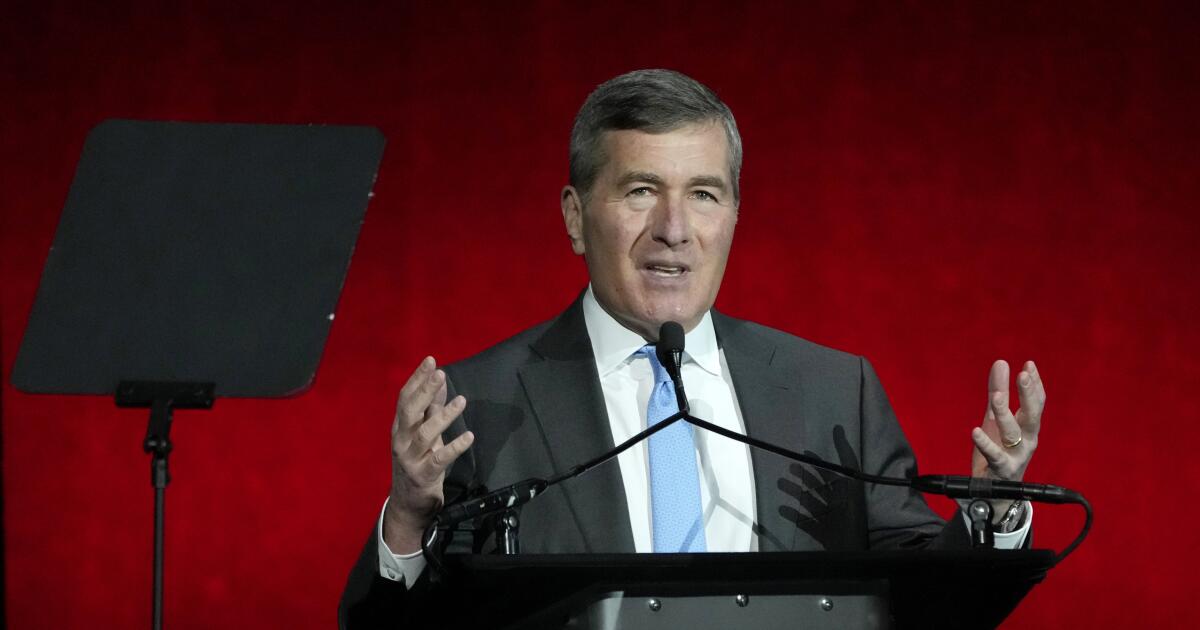
Somehow, heartbreak feels good in a place like CinemaCon — where no matter how many hits the motion picture industry has taken over the last year (and, uh, it’s taken a lot), exhibitors from all over the world unfailingly come together to exude enthusiasm about the moviegoing experience and optimism about the future of cinema.
Flag bearers for the Motion Picture Assn., the National Assn. of Theatre Owners and other major industry players convened Tuesday at Caesars Palace in Las Vegas to deliver their annual state-of-the-business address and officially kick off the event. Movie stars, filmmakers and studio heads are expected to tease, extol and in some cases screen their upcoming releases.
There’s a lot riding on those movies in the wake of a box office slump partially brought on by the Hollywood writers’ and actors’ strikes, which delayed several movies and effectively halted film and TV production last year for about six months.
“We can’t shy away from the stark challenges of this moment, nor can we ignore this time of volatility in our industry,” said Charles Rivkin, chief executive of the MPA, during Tuesday’s presentation. Washington-based MPA represents the Hollywood studios, including Disney and Netflix.
“Yet no one should fear that uncertainty,” he added, “because after all, we work in a business where unexpected twists can make for an epic story. … We understand the stakes. We recognize the need to do everything possible to ensure the enduring health of cinema.”
Global box office revenue is predicted to hit $32 billion in 2024, according to film analytics firm Gower Street, which is nowhere near the $40-billion-plus heights of the pre-COVID-19 era. But since the beginning of 2024 — when domestic box office revenue was down 20% from the previous year — some glimmers of hope have emerged.
In March, the highly anticipated sequel to Warner Bros.’ “Dune” launched at $82.5 million in the United States and Canada — the first true blockbuster opening weekend since AMC Theatres’ “Taylor Swift: The Eras Tour” ($93.2 million).
Following the desperately needed success of “Dune: Part Two” — which has now grossed more than $255 million domestically — Universal Pictures’ “Kung Fu Panda 4” notched a solid $58-million domestic debut, Sony Pictures’ “Ghostbusters: Frozen Empire” posted a decent $45 million and Warner Bros.’ “Godzilla x Kong: The New Empire” drew an impressive $80-million bow.
Exhibitors on Tuesday also touted the rising popularity of Japanese cinema in the United States, including Crunchyroll-distributed anime hits such as the latest “Demon Slayer” movie and Toho Co.‘s Oscar-winning “Godzilla Minus One.”
Mitchel Berger, senior vice president of global commerce at Crunchyroll, said Tuesday that the global anime business generated $14 billion a decade ago and is projected to generate $37 billion next year.
“Anime is red hot right now,” Berger said.
“Fans have known about it for years, but now everyone else is catching up and recognizing that it’s a cultural, economic force to be reckoned with.”
Exhibitors are hoping that momentum holds despite also weathering several recent box office disappointments, such as Universal Pictures’ misbegotten spy thriller “Argylle” and Sony Pictures’ superhero disaster “Madame Web.”
When the actors’ strike concluded in November, theater operators expressed concerns about the health of the 2024 film slate. The overlapping work stoppages prompted studios to push at least a dozen movies to 2025 from 2024, including the eighth installment in Paramount Pictures’ “Mission: Impossible” saga and Disney’s live-action remake of “Snow White.”
Cinemark Chief Executive Sean Gamble estimated in February that 95 pictures were slated to open this year in wide release, as opposed to 110 in 2023. And nothing spells danger for exhibitors like a thinned-out release schedule. It doesn’t help that the average length of the theatrical window significantly shrank (from 90 days to roughly 35 to 40 days) after the COVID-19 pandemic shut down movie theaters for more than a year.
At Tuesday’s presentation, exhibitors pleaded with distributors to take a leap of faith and commit to releasing movies in cinemas year-round — not just during times that have historically seen heavier foot traffic.
“For my friends in distribution, please embrace digital’s flexibility and offer your awe-inspiring movies 52 weeks of the year to every exhibitor,” said Chris Johnson, CEO of Classic Cinemas. “Eliminate print counts and trust us to make programming and scheduling decisions that yield the best results for all. … If you have a hit, we will hold it.”
Michael O’Leary, CEO of the National Assn. of Theatre Owners, also made the case for more small- and medium-budget releases that attract cinephiles, citing prestige titles such as A24’s “Past Lives” and Amazon MGM Studios’ “American Fiction.”
“It’s not enough for us to simply sit back and want more movies,” O’Leary said. “We must work with distribution to get more movies of all sizes to the marketplace.”
This year, a number of potential upcoming blockbusters remain.
Universal is cooking up “Twisters,” “Wicked” and “Despicable Me 4”; Warner Bros. is sitting on “Furiosa: A Mad Max Saga,” “Joker: Folie à Deux” and “Beetlejuice Beetlejuice”; Paramount is distributing “Gladiator 2” and “A Quiet Place: Day One”; Sony is launching “Venom: The Last Dance”; Disney is set to release “Inside Out 2,” “Moana 2” and “Deadpool & Wolverine”; and Amazon MGM Studios is about to drop “Challengers,” starring Zendaya.
The last few years at CinemaCon have drawn battle lines between exhibitors and streamers. During the streaming wars of 2021 and 2022, studios threw an excessive amount of resources and funds at streaming projects in an effort to compete with Netflix.
At the time, streaming was painted as theaters’ archnemesis. But the great streaming boom of the early 2020s has subsided as entertainment companies — reeling from financial losses — are tightening their belts and greenlighting less streaming content.
In December, Disney unveiled plans to re-release three Pixar titles — “Soul,” “Turning Red” and “Luca” — in theaters this year after initially routing them directly to streaming. Additionally, “Moana 2” — originally conceived as a TV series to be streamed on Disney+ — was reworked into a feature coming to the big screen in November.
Though streaming undoubtedly still poses a threat to movie theaters, the tides appear to be turning ever so slightly in exhibitors’ favor as studios rethink their release strategies and film fanatics continue to splurge on Imax and other premium large formats.
“You can watch a movie on TV or on your tablet or on your computer, but you experience it in a theater,” O’Leary said. “And part of what makes the movie so special is the theaters themselves.”
However, exhibitors at CinemaCon did repeatedly express concerns about the rise of illegal streaming and digital piracy. Rivkin condemned the practice as “insidious forms of theft” that harm production workers, actors, directors, writers, craftspeople and even consumers who risk falling prey to malware viruses when watching movies illegally online.
Rivkin estimated that on average, piracy costs the movie theater industry more than $1 billion per year. During his state-of-the-industry address, he called on Congress to enact site-blocking legislation that would prevent internet users in the United States from accessing websites that stream films illegally.
“Piracy operations have only grown more nimble, more advanced and more elusive every day,” Rivkin said. “These activities are nefarious by any definition. They’re detrimental to our industry by any standard. And they’re dangerous for the rights of creators and consumers by any measure.”


Social media company Snap is being sued by the parents of a girl who was raped when she was 12 years old by a man she met on disappearing messaging app Snapchat.
The 111-page lawsuit, filed this week in a Missouri Circuit Court, alleges that Santa Monica-based Snap “enabled and facilitated the grooming, exploitation, and sexual abuse” of the minor who is referred to as “J.F.”
The company failed to disable or warn users about “dangerous” features that predators use on the app to find and abuse their victims, according to the lawsuit.
Missouri resident Gabriel Joel Valentin-Rios, who was 25 years old at the time, raped the girl in September 2021 after she sneaked out of her house, the lawsuit alleges. The parents are also suing the attacker, who pleaded guilty to sexually assaulting the girl and is serving 18 years in prison, according to the Social Media Victims Law Center.
The center and the Holland Law Firm announced Thursday they filed the lawsuit on behalf on the victim’s family.
“This assault did not happen in a vacuum — it happened because Snapchat’s product design made it easy for a predator to reach and manipulate an unsuspecting child,” said Matthew Bergman, founding attorney of the Social Media Victims Law Center, in a statement. “Snap executives have long known that their features create a perfect environment for predators to exploit children, yet they have repeatedly failed to make the platform safe.”
A Snap spokesperson said in a statement the company cares “deeply about the safety and well-being of all Snapchatters.”
“Our teams have worked for years to build safeguards, launch safety tutorials, partner with experts, and work with law enforcement to help prevent the misuse of our platform,” the spokesperson said in a statement.
The lawsuit is the latest legal hurdle facing Snap. Multiple parents who lost their children have previously sued the company, alleging that Snap failed to provide enough safeguards on the messaging app. Parents and child safety groups have voice concerns about how the app can be used to connect young people with drug dealers and child predators.
Other tech companies such as gaming platform Roblox, Google-owned YouTube and Facebook parent company Meta have also faced lawsuits over safety and mental health issues.
In March, a Los Angeles jury found that Meta-owned Instagram and YouTube were liable for the suffering of a California woman who alleged the platforms were built to addict young users. Snap settled that lawsuit before the trial started.
The latest lawsuit against Snap highlights safety concerns surrounding several features on the messaging app including “Quick Add,” which suggests users to connect with on Snapchat. Valentin-Rios used that feature to connect with the girl along with others to disguise his identity and groom her into sending explicit photos, the lawsuit said. The company’s “Snap Maps” feature allowed him to find the girl’s home address. And he used a cartoon avatar known as Bitmoji on Snapchat to conceal his age and present himself as a “a young, innocuous, and friendly looking boy.”
Families have faced challenges holding tech companies accountable for safety issues because a U.S. law shields platforms from being held liable for content posted by its users.
The lawsuit against Snap, though, says that it seeks to hold the company liable for the design and marketing of “unreasonably dangerous social media products.” It alleges that Snap co-created content such as Bitmojis abused by child predators and it designed the app to entice users to spend more time messaging others.
The lawsuit accused Snap of consistently turning a “blind eye” to underage users of its app. Snapchat requires users be at least 13 years old to sign up for an account, but J.F. started using the app when she was 11 years old. Snapchat was popular among her peers and friends so J.F. downloaded the app, which was presented as lighthearted and entertaining platform, without her parents’ knowledge or consent. The company failed to warn users about potential dangers, verify the ages of minors and lacks adequate parental controls, the lawsuit alleges.
Snapchat has a “family center” where parents can see their teen’s friends, view time spent and other insights about how their children are using the app. But the lawsuit said it isn’t enough because parents can’t restrict teens from sending private messages and children can create accounts without their parents’ knowledge.
The plaintiffs’ counsel also tested Snap’s “Quick Add” feature in 2023 and found that many of the usernames “generated by Snap’s recommendation algorithm appeared on their face to belong to predatory users,” the lawsuit said.
Valentin-Rios was also able to create a second Snapchat account with the username “Nocits21g” to connect with J.F. and to conceal the activity from his girlfriend, according to the lawsuit.
The rape victim, who was diagnosed with PTSD, anxiety and depression, started to engage in self-harm and expressed suicidal thoughts, the lawsuit states.
The lawsuit seeks a jury trial and financial damages for the harm allegedly caused by the company to the family.
“J.F. feels embarrassed and ashamed, but she is also angry that Snap facilitated this by design, and angrier still that Snap continues to operate its platform in the same manner today,” the lawsuit said.

Gov. Gavin Newsom signed a law Thursday to crack down on inflated profits stemming from car crash lawsuits, blessing a hard-fought compromise between Uber and the state’s trial attorneys that averts a November showdown between two of California’s most powerful and moneyed lobbying forces.
The deal, the fruit of months of negotiations, takes aim at the lucrative way doctors can charge for procedures on patients referred to them by personal injury lawyers.
If a law firm has a client who was hurt in a car accident, the lawyer will often send them to a doctor who will perform surgery on a “lien” basis, meaning the doctor will be paid from money that comes from a lawsuit settlement rather than through insurance.
Uber contends this arrangement has created an incentive for doctors and attorneys to collude to dramatically inflate medical bills. The more expensive the bill, they say, the bigger the resulting payout.
The law, SB 623, caps how much these doctors can charge when their patient is involved in a lawsuit against a ride-share company, which are frequent targets of litigation due to their top-of-the-line insurance policies. The new law will also require Uber to ramp up background checks of its drivers.
“We’re going to have a much safer state both for medical patients and passengers in Ubers,” said Nicholas Rowley, a prominent Texas attorney who helped bankroll the fight and took a leading role in the negotiations.
The law only applies to cases that involve ride-share accidents that take place after Jan. 1, 2027.
“This legislation puts meaningful guardrails in place to better protect accident victims, increase transparency and accountability in the medical lien system and strengthen safety,” said Ramona Prieto, Uber’s head of public policy for the Western U.S., in a statement.
For months, Uber and lawyers from across the state poured tens of millions into dueling ballot measures that threatened to devastate the profits of whichever side lost.
Uber fired the first shot with a ballot measure that sought to cap how much attorneys can earn in lawsuits involving auto accidents. The company argued attorneys were swindling their own clients, inflating medical bills of car crash victims to increase the value of the settlement and then pocketing a hefty chunk of the payouts.
The state’s trial attorneys countered that the fee cap would make small or difficult cases a money-losing endeavor and block scores of accident victims from the courts. They shot back with their own ballot measure that would increase legal liability for ride-share companies if a passenger or driver is sexually assaulted while on a ride, seizing on investigative reporting that highlighted assaults in Ubers.
“They were waiting for us to blink and we didn’t,” said Douglas Saeltzer, the head of the Consumer Attorneys of California, the lawyer trade group that pushed for the measure against Uber. “Their starting place, I don’t believe, was in the interest of protecting victims — it was in the interest of protecting Uber.”
With the passage of Thursday’s law, both sides have agreed to pull their respective measures from the November ballot, halting campaigns that had both parties amassing tens of millions in funding and blanketing the airwaves with ads.
“Now we can stop seeing all the commercials,” said Assemblymember Blanca Pancheo (D-Downey) at a Tuesday hearing.
The law, put forward by Assemblymember Diane Papan (D-San Mateo) and Sen. Thomas Umberg (D-Santa Ana), also caps the amount that can be earned by third-party investors who buy out a doctor’s lien in a personal injury case. These companies will purchase a doctor’s stake in the case at a reduced rate, then pocket a share of the payout if the case settles.
“Private equity and hedge funds buy them at a steep discount, then turn around and collect the full inflated amount,” Saeltzer said at a Tuesday hearing on the bill. “That’s money flowing to Wall Street investors, not patients.”
The law will require annual background checks for ride-share drivers and expand the list of offenses that disqualify someone from the job.
In addition to the ballot battle, has Uber sued two of LA’s most well-known personal injury firms — the Law Offices of Jacob Emrani and Downtown L.A. Law Group — accusing them of inflating medical bills and forcing clients to undergo needless and expensive surgeries to inflate the value of the claim. The firms asked the judge to dismiss the case Wednesday, arguing Uber had failed to prove fraud. Both firms have vehemently denied wrongdoing.
The lawsuit, filed last year, has put the plaintiff lawyers in the unusual position of playing defense. Listening in the audience at Wednesday’s hearings were the partners of Downtown L.A. Law Group and Jacob Emrani.
“Let’s be clear about what this Uber case really is,” said John Hueston, outside counsel for Emrani. “It’s brought by a $150 billion dollar company … to intimidate the plaintiff’s bar, exhaust its resources and chill the suits that hold Uber accountable.”
Michael Huston, one of the lawyers who represents Uber, countered that the case is “not an attack on the plaintiff’s bar.”
“We have brought suit against the two in this state … that are engaged in naked fraud,” he said.
Business
Snap CEO Evan Spiegel and Miranda Kerr help erase $550 million in medical debt for Californians

Snap Chief Executive Evan Spiegel and his wife, supermodel Miranda Kerr, have helped pay off $550 million in medical debt for more than 261,000 Californians.
The couple made a multimillion-dollar donation to Undue Medical Debt, a nonprofit that provides debt relief to people in financial need. The organization acquires medical debt in bulk from hospitals, physician groups, collection agencies and other groups for a fraction of the cost.
“When someone you love is sick. All you want to do is focus on helping them get better,” Kerr said in a video with Spiegel. “That’s why we wanted to support this effort and help relieve medical debt, so families can focus on caring for their loved ones and really supporting their healing.”
The couple and the nonprofit didn’t disclose the exact amount of the donation, but a small gift can go a long way. Every $10 donated to Undue Medical Debt relieves an average of $1,000 in medical debt.
The gift comes as Americans struggle with the medical debt and rising cost of living. California is one of the most expensive states to live in because of soaring housing costs and energy prices. Concerns about wealth inequality have sparked heated political debates about how much billionaires should contribute.
In the United States, 1 in 4 adults are in medical debt, said Undue Medical Debt President and Chief Executive Allison Sesso in a statement.
“It’s a growing crisis undermining healthcare access, economic wellbeing and mental health and we’re so grateful that Evan Spiegel and Miranda Kerr share our belief that no one should go bankrupt because of a cancer diagnosis and no family should have to choose between insulin and groceries,” she said.
Californians whose medical debt have been paid off will start receiving a letter in mid-July from Undue Medical Debt informing them of the debt relief. Individuals can’t request debt relief because the nonprofit acquires bundled debt for thousands of people at once. Those who qualify for debt relief either earn at or below 400% of the federal poverty level or have medical debt that is more than 5% of their income, the nonprofit says on its website.
San Diego County residents benefited the most from the donation with total medical debt relief through the couple’s gift totaling roughly $99 million and affecting 40,369 people. In Los Angeles County, the gift provided $26.7 million in medical debt relief to 17,466 people, according to the nonprofit.
Spiegel, whose net worth is roughly $2 billion, and Kerr have helped relieve debt for others in the past. In 2022, the couple paid off the student loans for the Otis College of Art and Design’s graduating class.
In 2025, Spiegel was among business leaders and philanthropists who helped form the Department of Angels, a group that aims to help L.A.’s fire recovery efforts. The California Community Foundation, Snap, Spiegel and Snapchat co-founder Bobby Murphy committed $10 million to help start that group.
Roughly 200,000 people lost their homes in the January 2025 Los Angeles County wildfires. Spiegel, who grew up in Pacific Palisades and lost his childhood home in the fires, donated $5 million in immediate aid with Snap and Murphy that month.
He said in a statement that California has given so much to him and his family and that he cares “deeply about the wellbeing of our communities.”
“At a time when many families are already facing rising costs across nearly every aspect of daily life, an unexpected medical bill can create financial stress that lasts for years,” Spiegel said.
Undue Medical Debt said it’s abolished more than $40 billion of medical debt in all 50 states.
-
Maryland4 minutes ago
Celebrate America 250 at Maryland State Parks with Fun Events Planned All Weekend
-

 Michigan7 minutes ago
University of Michigan Regent Jordan Acker apologizes after investigation confirms
-

 Massachusetts12 minutes ago
Crash disupts traffic on Interstate 195 in Seekonk
-

 Minnesota19 minutes ago
Minnesota primary voting starts for major 2026 races
-

 Mississippi22 minutes ago
Retirement savings gap hits seniors. How to avoid outliving your money
-

 Missouri27 minutes ago
24 Missourians charged in national health care fraud investigation
-

 Montana34 minutes ago
EXCLUSIVE: 2 ‘Exceptionally Rare’ Ski-In, Ski-Out Montana Mansions Head to Auction in Big Sky—and Could Sell for a Serious Steal
-

 Nebraska37 minutes ago
Today in History – June 26: University of Nebraska holds first commencement

