Midwest
Former Chicago Mayor Lori Lightfoot hired to investigate so-called 'worst mayor in America' at $400 an hour

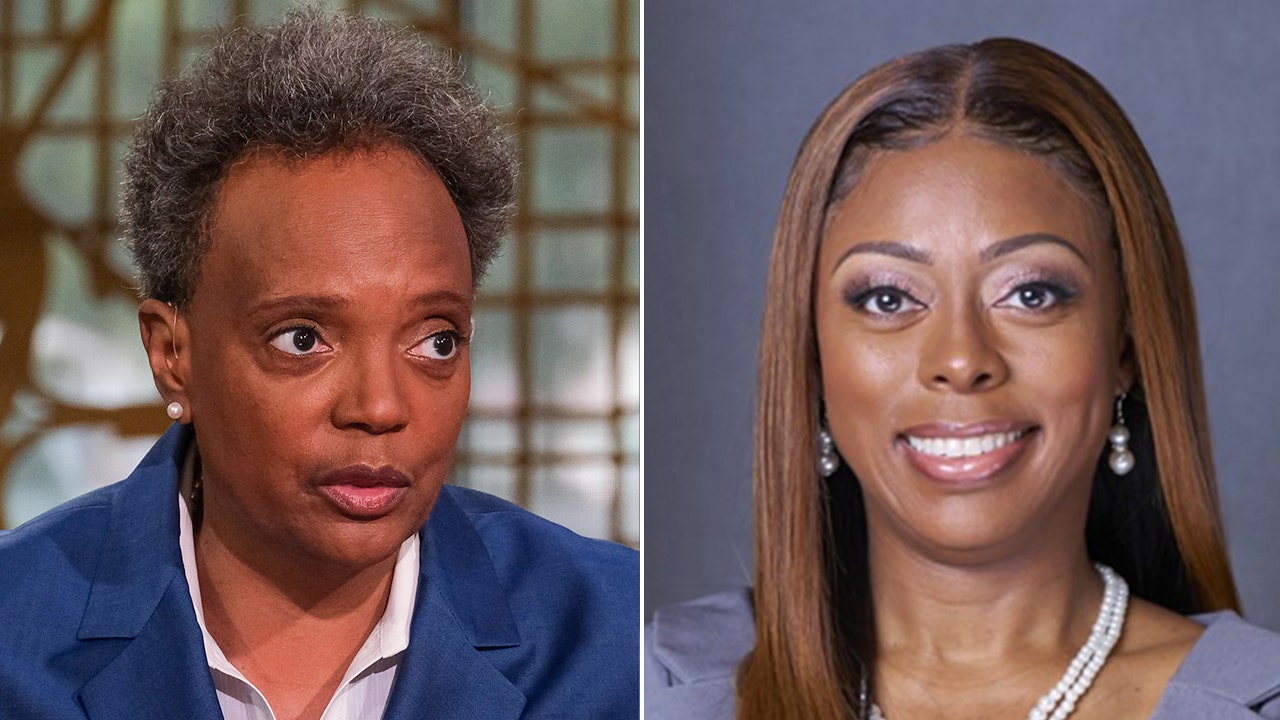
The Village of Dolton in Illinois voted Monday to hire former Chicago Mayor Lori Lightfoot as a “Special Investigator” to look into Dolton Mayor Tiffany Henyard.
Starting Tuesday, Lightfoot will be paid $400 an hour to gather information on Henyard’s alleged spending and finance mismanagement as well as “any state and federal violations.”
Ahead of Monday’s vote, Lightfoot said she understood the residents want to go in a different direction from Henyard, and promised to “follow the facts where they lead.”
L-R: Former Chicago Mayor Lori Lightfoot and Dolton Mayor Tiffany Henyard. (Getty Images/Village of Dolton)
At the end of her investigation, Lightfoot will present a report to the Village of Dolton on her findings. The findings in the report will determine what happens beyond that.
Trustees also re-voted on issues the Dolton mayor had previously vetoed and about paying vendors and invoices that have not yet been paid by the Village.
FORMER EMPLOYEE SUING ‘NARCISSITIC’ MAYOR, CLAIMS SHE WAS LOCKED OUT OF OFFICE, DENIED PAY AND FIRED
Monday’s vote was held off-site, at the Park District building since it wasn’t an official Village Board meeting. It was also moved there to accommodate residents who wanted to attend.
The Village of Dolton, Illinois’ monthly town hall meeting once again made headlines last week for fiery confrontations with the scandal-ridden mayor.
Henyard has been accused of misdeeds ranging from weaponizing police in retaliatory business raids to spending taxpayer money on luxuries like traveling to Las Vegas. Last month, Henyard reportedly vetoed the board’s resolution to probe her spending over purported misuse of funds.
While the FBI has allegedly already begun to investigate Henyard for purportedly misusing her local police force, the board’s resolution had called for the FBI to do further investigation into her spending of the town’s money.
Read the full article from Here

Detroit, MI
Where to watch Houston Astros vs Detroit Tigers: TV channel, start time, streaming for June 26


What to know about MLB’s ABS robot umpire strike zone system
MLB launches ABS challenge system as players test robot umpire calls in a groundbreaking season.
The 2026 MLB season has surpassed the quarter mark, and after each team’s first 40 games, there’s plenty of reasons to tune in all summer long.
Chicago White Sox slugger Munetaka Murakami has already proven doubters wrong by launching 17 home runs, Pittsburgh’s Paul Skenes consistently looks like the best version of himself on the mound and Milwaukee ace Jacob Misiorowski is throwing harder than any starter in the majors.
The MLB action continues on Friday as the Houston Astros visit the Detroit Tigers.
Here’s everything you need to know to tune in for the first pitch.
See USA TODAY’s sortable MLB schedule to filter by team or division.
What time is Houston Astros vs Detroit Tigers?
First pitch between the Detroit Tigers and Houston Astros is scheduled for 6:40 p.m. (ET) on Friday, June 26.
How to watch Houston Astros vs Detroit Tigers on Friday
All times Eastern and accurate as of Friday, June 26, 2026, at 6:34 a.m.
Watch MLB all season long with Fubo
MLB regional blackout restrictions apply
MLB scores, results
MLB scores for June 26 games are available on usatoday.com . Here’s how to access today’s results:
See scores, results for all of today’s games.

Milwaukee’s current wastewater treatment contract holder, Veolia Water Milwaukee, is under fire, with some calling for an audit.
A look at MMSD’s South Shore and Jones Island wastewater plants
A look at MMSD’s South Shore and Jones Island plants as leaders weigh a contested $700M, 10-year operations contract in Milwaukee.
It goes without saying that Milwaukee Metropolitan Sewerage District (MMSD) is an essential community asset.
Recently, MMSD has been in the news and not in a good way. The MMSD Commission voted to approve an audit of the district’s private wastewater operator. This is less than six weeks after the community organization Common Ground launched a public campaign calling for an audit of Veolia Water Milwaukee, alleging mismanagement of the Jones Island and South Shore wastewater treatment facilities.
I was briefly on a six-member MMSD advisory committee for the 1998 United Water Services contract. Now 28 years, and 2008, 2018, contracts later, the question is what firm to hire for the 2028 contract. I read Milwaukee Journal Sentinel and Urban Milwaukee articles, whistle-blower letters and other materials and jotted down concerns listed below (there are others):
- Veolia cut corners on treatment time and process chemicals
- Veolia allowed MMSD assets — buildings and process equipment — to deteriorate
- Veolia provided inadequate staffing
- Employees, particularly those who questioned management, were treated poorly
- Reversing these conditions will be very expensive, if it is even possible to do so
Aren’t these issues sufficient to disqualify Veolia from future consideration?
MMSD has an innovative civil engineering history.
The national American Society of Civil Engineers (ASCE) designated the Milwaukee Metropolitan Sewage Treatment Plant a National Historic Civil Engineering Landmark when they honored Milwaukee in 1974 for developing the waste-activated sludge treatment process and pioneering a beneficial reuse of biosolids (Milorganite). MMSD has also been recognized for the Deep Tunnel and many innovative infrastructure and flood management projects over the years.
Wisconsin has a strong civil engineering community, which includes the American Society of Civil Engineers-Wisconsin Section (ASCE-WI); five civil engineering university programs with three —Marquette, MSOE and UW-Milwaukee — in Milwaukee); as well as many technical school and apprenticeship programs. Civil engineering projects require many types of expertise and skills.
Is anyone asking questions such as what should be the future of wastewater treatment in Milwaukee? Or what do citizens know about wastewater treatment? Or what do citizens need to know about treatment options to make informed decisions about parameters such as feasibility, public health, environmental protection, costs and financing?
Before the next contract is decided and awarded, shouldn’t human waste generators (citizens), civil engineers and the wastewater industry be asking some of these important questions?
Carol Diggelman, PhD, Emerita Professor, Milwaukee School of Engineering, where she taught for over 30 years, has since retiring, resumed volunteer activities with the League of Women Voters and organized many programs at the intersection of infrastructure and natural resources.
Minneapolis, MN
Reform, money and trust: Council members’ key criteria for Minneapolis’ next police chief

Minneapolis leaders agree the next police chief is a critical choice, but it remains unclear whether the mayor and City Council can align on a candidate.
Mayor Jacob Frey declined an interview on the topic after announcing the hiring process and timeline earlier in the week. But 5 EYEWITNESS NEWS spoke with City Council Member and Public Health, Safety & Equity Committee Chair Jason Chavez and Council Member LaTrisha Vetaw, the prior Public Health, Safety & Equity Committee Chair.
All agree the police chief is one of the most important roles in Minneapolis.
Asked what it would take to get enough members on board with a candidate so that they can be confirmed, Council Member Vetaw said, “I think we’re figuring some of those things out, but what I hear from all council members is someone who’s strong on reform and wants to actually get reforms done right.”
Vetaw added that the next permanent chief should also have a strong record on slowing overspending.
“We need somebody who’s really going to reel that in and handle our money with care. I think those are two things that I hear from all of my colleagues,” she said.
Brian O’Hara resigns as Minneapolis police chief after report shows he interfered with investigation into his conduct
Asked the same question, Council Member Chavez agreed on key candidate criteria, but he expressed less confidence in the hiring process.
“Well, I mean, I’ve cleared out — I’ve laid out some of the things that I would like to see in a candidate,” Chavez said. “And then I want us to feel included in this process, so they can hear our feedback, and I want there to be robust community engagement. I don’t think that it’s oppositional to this plan. I guess my only thing is I want to make sure that all 13 members are included in this process.”
“I really care about community engagement, I really care about the criteria, and I want to make sure that the police chief that comes into Minneapolis is strongly committed to police accountability,” he continued.
“People want transparency and accountability. They want someone who can speak to the community, and it’s truthful,” Vetaw said.
“Like, we’re all looking for the same kind of leader.”
The question comes as Community Safety Commissioner Todd Barnette, as the head of the department overseeing MPD and nominated by Mayor Frey in April, remains without enough City Council votes to be reappointed. Vetaw supports Barnette, while Chavez does not.
Vetaw said the lack of agreement over Commissioner Barnette is not an omen for the process of hiring a new MPD chief.
“I don’t believe that what’s happening with the commissioner is a direct reflection on the process for searching for a new chief. I think this council certainly separates those two,” she said.
“Do I want to move fast? Absolutely not. I want to move at a pace where we get the best person for the job … and I think we all want that. This is one of the most important roles in the city of Minneapolis.”
Chavez said he hopes the process leads to a chief he can support.
Asked if he believes he’ll be able to put his vote behind the candidate ultimately nominated by the mayor at the end of the process, Chavez said, “I would hope so.”
“And I want to be able to vote for a chief,” he continued. “I just think that we have to make sure that there’s a robust process that includes all council members, and that ensures that the voices of our community are not being left out.”
Former Chief Brian O’Hara was unanimously confirmed in 2022, though the council had a few different members at the time.
In a statement, a spokesperson for Mayor Frey said, “Mayor Frey has been very clear that the search for a new police chief will be a collaborative process that includes community, City staff, and Council Members.”
5 EYEWITNESS NEWS will continue tracking the selection process, including its cost to taxpayers.
-
 Lifestyle17 minutes ago
‘Supergirl’ has a solid hero but could use a better villain : Pop Culture Happy Hour
-

 Technology27 minutes ago
Of course Meta thinks gambling is the future
-

 World32 minutes ago
Death toll from Venezuela earthquakes rises to at least 589, with thousands reported missing
-

 Politics39 minutes ago
McCarthy says Trump will use ‘everything he can’ to force Senate action on SAVE America Act
-

 Health42 minutes ago
Switching from cigarettes to vapes linked to higher risk of major eye diseases, large study finds
-

 Sports47 minutes ago
2026 World Cup Odds: Which Nations are Favored to Reach Semifinals?
-

 Technology54 minutes ago
World Cup ticket scams target desperate fans
-
Business57 minutes ago
Snap sued by parents of girl who was raped by man she met on Snapchat


