Business
Column: Courts finally move to end right-wing judge shopping, but the damage may already be done

Some lawsuits are won by smart lawyers and some on the facts. But nothing spells success as much as the ability to pick your own judge.
That’s the lesson taught by conservative activists who have moved in federal courts to overturn government programs and policies on abortion, contraception, immigration, gun control, student loan relief and vaccine mandates, among other issues.
In recent years they’ve gamed the judicial system to get their lawsuits heard by judges they knew would be sure to see things their way. The process is known as judge shopping, and the committee that makes policy for the federal courts just moved to put an end to it.
The courts have now formally recognized the need to do something about a really troubling pattern of judge shopping.
— Amanda Shanor, University of Pennsylvania constitutional law expert
In a policy statement and official guidance issued last week, the Judicial Conference of the United States said that henceforth, any lawsuit seeking a statewide or nationwide injunction against a government policy or action should be assigned at random to a judge in the federal district where it’s filed.
If that sounds a bit vague to the layperson, its target is crystal clear to legal experts: It’s aimed at right-wing activists and politicians who have filed their cases in federal courthouses presided over by highly partisan judges in Texas. Most of those judges were appointed by Donald Trump.
It would be bad enough if those judges’ rulings applied only within their judicial districts or affected only the plaintiffs. But the judges have issued sweeping nationwide injunctions that block government programs and policies coast-to-coast.
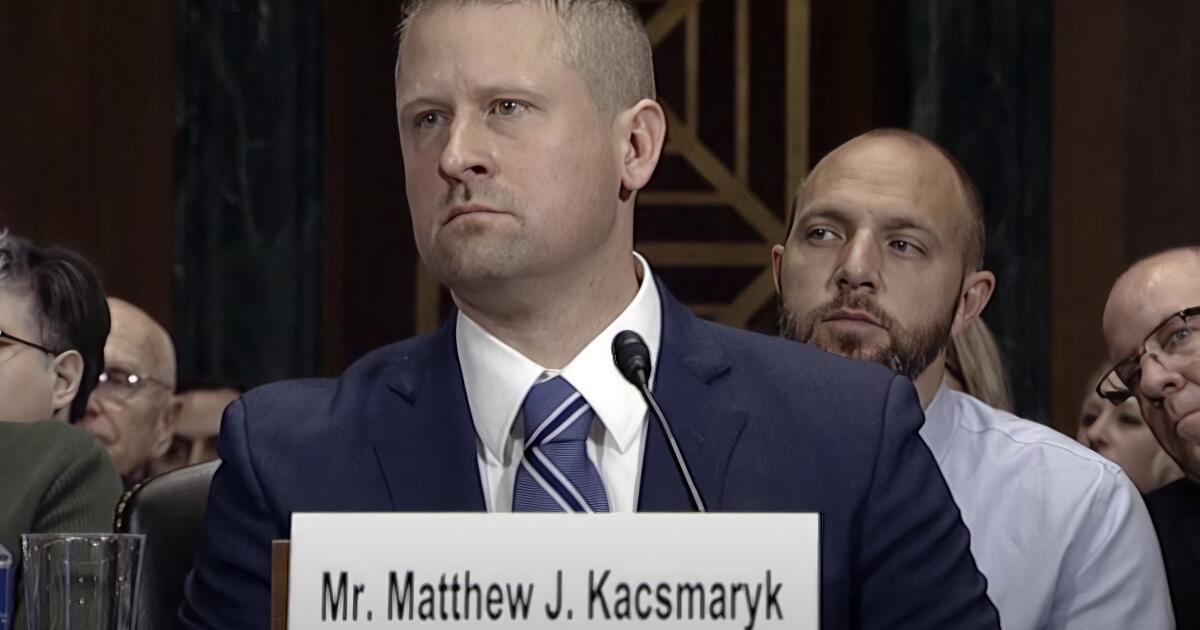
As Ian Millhiser of Vox put it, this is America’s “Matthew Kacsmaryk problem.” Kacsmaryk is the Trump-appointed Texas federal judge who most recently attempted to outlaw mifepristone, a widely used abortion medication, nationwide. His April 2023 ruling has been temporarily stayed by the Supreme Court, but it’s still on the docket, ticking away.
But Kacsmaryk is not alone. As recently as March 8, Judge J. Campbell Barker, a Trump appointee who presides over 50% of the civil cases filed in his rustic courthouse in Tyler, Texas, invalidated a ruling by the National Labor Relations Board broadening the standard by which big corporations could be held jointly responsible for the welfare and unionization rights of workers employed by their franchisees.
How serious a blow could the judicial conference’s policy be to conservatives aiming to roll back civil rights? Massive, judging from the reaction of Senate Minority Leader Mitch McConnell (R-Ky.). Only 48 hours after the conference announced its initiative, McConnell wrote to the chief judges of all judicial districts urging them to ignore the new policy.
This was an audacious move, considering that the presiding officer of the Judicial Council is Chief Justice John G. Roberts Jr., its membership comprises the chief judges of the 12 judicial circuits and one judge from a district court in each circuit, and its role is to set policy for the entire federal court system.
McConnell asserted that only Congress can make the rules for the assignment of federal trial judges, but that’s dubious. In an analysis last year, the Justice Department concluded that the Supreme Court has full authority to impose rules of civil procedure in the federal courts, including a rule mandating that all federal judicial districts assign judges randomly to civil lawsuits aimed at statewide or nationwide injunctions. The Judicial Council’s policy isn’t the same as as a Supreme Court rule, but it’s a fair bet that if pushed, the court would issue the rule.
McConnell also asserted that the Judicial Conference had been pressured into acting by Senate Majority Leader Charles E. Schumer (D-N.Y.), but that’s untrue. Although Schumer has spoken out against judge shopping, numerous legal experts and Roberts himself have expressed concerns about the practice.
“The courts have now formally recognized the need to do something about a really troubling pattern of judge shopping,” Amanda Shanor, a constitutional law expert at the University of Pennsylvania, said of the Judicial Conference’s initiative.
What’s yet unclear is whether the conference’s initiative goes far enough. Its policy statement is described as “guidance,” not a mandate. it acknowledges the district courts’ “authority and discretion” to manage their dockets as they see fit.
Last year, Shanor, with Alice Clapman and Jennifer Ahearn of NYU’s Brennan Center for Justice, proposed that the conference require all judicial districts to use a “random or blind procedure” to distribute cases among all the judges in the district when the litigants seek an injunction or other relief that would extend beyond the district’s borders.
The practice traditionally labeled “forum shopping” is not especially new. The earliest case cited by legal experts dates back to 1842, when a litigant chose to file a lawsuit in federal rather than state court in New York to gain a strategic advantage over his adversary.
Plaintiffs have been known to choose a venue based on local statutes of limitation, or a sense that juries in a region might be more amenable to their case, or because their location may be more convenient for parties or witnesses.
More recently, however, the practice has been heavily abused for partisan and ideological purposes. This results from two trends. One is the increasing partisanship of individual federal judges, especially those appointed by Trump. The second is those judges’ habit of issuing nationwide injunctions against government policies or programs.
Nationwide injunctions can impose parochial partisan ideologies on the whole country. Through 2023, the state of Texas filed more than 31 federal lawsuits challenging Biden administration policies — but not a single one in federal court in Austin, which is the state capital but an island of blue in a red state.
The state had filed seven lawsuits in Amarillo, where by local procedure every one was automatically assigned to Kacsmaryk; six in Victoria, where all civil cases are assigned to Trump appointee Drew B. Tipton; and four in Galveston, where all civil cases come before Trump appointee Jeff Brown.
The rest were filed in divisions with two judges, most of whom are also Trump appointees or conservative appointees of George W. Bush. In the Tyler division from which Barker issued his NLRB decision, all the cases he doesn’t get are assigned to Judge Jeremy Kernodle, also a Trump appointee.
Although some nationwide injunctions have been lifted by the Supreme Court, that process seldom happens speedily. The result is that the plaintiffs effectively win by losing, as injunctions against government policies can have “the lasting systemic effect of blocking these policies for months or years,” Shanor, Clapman and Ahearn observed.
Kacsmaryk got the mifepristone case for two reasons. First, antiabortion activists knew of his strong antiabortion inclinations. Second, the policy in the Northern District of Texas is to assign cases to judges in the division where they’re filed.
Kacsmaryk is the only judge sitting in the Amarillo division of the Northern District of Texas. So it was an easy call for the mifepristone plaintiffs to file there, knowing that their chance of drawing Kacsmaryk as their judge was 100%.
The same pattern drove plaintiffs to file lawsuits against Biden administration initiatives in the same district’s Fort Worth division, which has two judges, Trump appointee Mark T. Pittman and George W. Bush appointee Reed O’Connor. Both have been sought by conservative litigants. O’Connor also presides over 100% of the cases filed in the district’s Wichita Falls courthouse, where he is the only judge.
Pittman obligingly overturned Biden’s student loan relief program in 2022. Just this month, he ruled the government’s 55-year-old Minority Business Development Agency to be unconstitutional and ordered it opened to contract applicants of all races — obviously a ruling that defeats the purpose of a program designed to help minorities get a start in the business world. O’Connor tried to declare the entire Affordable Care Act unconstitutional in 2018. The Supreme Court overruled him in 2021.
The judicial conference’s initiative is long overdue.
Customarily, rulings by federal trial judges have constituted precedents binding at most on other judges in a particular judicial district or resulted in court orders benefiting only the plaintiffs who filed the case.
Matters are different “when a court effectively can bind the entire nation with an injunction” that applies to “an unlimited range of persons and to conduct occurring in … an equally unlimited array of places,” legal scholar Ronald A. Cass wrote in 2018.
The prospect of sweeping rulings incentivizes “an extreme race to courthouses more inclined to issue nationwide injunctions and more sympathetic to the plaintiff’s position,” Cass wrote.
In its latest incarnation, “litigants effectively have the ability to effectively choose an actual judge,” Shanor told me.
“We don’t know how the policy will be rolled out, what exactly is in it, or how much of it is a recommendation rather than a requirement,” she says. “A policy may be effective, but having a rule would advance the fairness and randomness of the distribution of these nationally important cases, and ensure the perceived legitimacy of the courts.”
One is that the policy won’t apply to cases that have already been assigned to a judge. Another is that litigants can still try to game the system by filing their lawsuits in states from which appeals are heard by circuit courts known to have a particular partisan lean.
That’s a major issue with Texas cases, which are funneled on appeal to the 5th Circuit, sitting in New Orleans. That court has been the source of right-wing decisions so loopy that they’ve been slapped down by the conservative majority on the Supreme Court. Of that circuit’s 17 active judges, six are Trump appointees.
McConnell’s objection to the Judicial Conference’s policy thus should be seen in context. He had more to do than anyone else with embedding Trumpian judges in the federal judiciary, where they wreak havoc on government policies and programs that help ordinary Americans, not just corporations and the rich. The conference’s initiative may be the first step toward a more fair-minded judiciary, but it’s a crucial one.



Business
Snap CEO Evan Spiegel and Miranda Kerr help erase $550 million in medical debt for Californians

Snap Chief Executive Evan Spiegel and his wife, supermodel Miranda Kerr, have helped pay off $550 million in medical debt for more than 261,000 Californians.
The couple made a multimillion-dollar donation to Undue Medical Debt, a nonprofit that provides debt relief to people in financial need. The organization acquires medical debt in bulk from hospitals, physician groups, collection agencies and other groups for a fraction of the cost.
“When someone you love is sick. All you want to do is focus on helping them get better,” Kerr said in a video with Spiegel. “That’s why we wanted to support this effort and help relieve medical debt, so families can focus on caring for their loved ones and really supporting their healing.”
The couple and the nonprofit didn’t disclose the exact amount of the donation, but a small gift can go a long way. Every $10 donated to Undue Medical Debt relieves an average of $1,000 in medical debt.
The gift comes as Americans struggle with the medical debt and rising cost of living. California is one of the most expensive states to live in because of soaring housing costs and energy prices. Concerns about wealth inequality have sparked heated political debates about how much billionaires should contribute.
In the United States, 1 in 4 adults are in medical debt, said Undue Medical Debt President and Chief Executive Allison Sesso in a statement.
“It’s a growing crisis undermining healthcare access, economic wellbeing and mental health and we’re so grateful that Evan Spiegel and Miranda Kerr share our belief that no one should go bankrupt because of a cancer diagnosis and no family should have to choose between insulin and groceries,” she said.
Californians whose medical debt have been paid off will start receiving a letter in mid-July from Undue Medical Debt informing them of the debt relief. Individuals can’t request debt relief because the nonprofit acquires bundled debt for thousands of people at once. Those who qualify for debt relief either earn at or below 400% of the federal poverty level or have medical debt that is more than 5% of their income, the nonprofit says on its website.
San Diego County residents benefited the most from the donation with total medical debt relief through the couple’s gift totaling roughly $99 million and affecting 40,369 people. In Los Angeles County, the gift provided $26.7 million in medical debt relief to 17,466 people, according to the nonprofit.
Spiegel, whose net worth is roughly $2 billion, and Kerr have helped relieve debt for others in the past. In 2022, the couple paid off the student loans for the Otis College of Art and Design’s graduating class.
In 2025, Spiegel was among business leaders and philanthropists who helped form the Department of Angels, a group that aims to help L.A.’s fire recovery efforts. The California Community Foundation, Snap, Spiegel and Snapchat co-founder Bobby Murphy committed $10 million to help start that group.
Roughly 200,000 people lost their homes in the January 2025 Los Angeles County wildfires. Spiegel, who grew up in Pacific Palisades and lost his childhood home in the fires, donated $5 million in immediate aid with Snap and Murphy that month.
He said in a statement that California has given so much to him and his family and that he cares “deeply about the wellbeing of our communities.”
“At a time when many families are already facing rising costs across nearly every aspect of daily life, an unexpected medical bill can create financial stress that lasts for years,” Spiegel said.
Undue Medical Debt said it’s abolished more than $40 billion of medical debt in all 50 states.

The electric vehicle company Slate Auto set out in 2022 to make the most affordable electric truck in the country. This week, it unveiled the price tag: $24,950.
At a time when demand for new electric vehicles is cooling and cars are getting harder to afford, Slate’s customizable truck could bring a fresh wave of excitement to the industry.
Deliveries will begin later this year and accelerate in 2027, the company said. Slate’s vehicle is built around a simple concept — pay only for what you actually want.
Buyers will start with a basic truck without power windows or even paint and can then customize it however they like. They can tailor-make their “blank slate” by paying extra for smart phone-compatible screens, speakers, colored wrap or paint. A $5,000 kit even converts the truck into an SUV.
Slate’s design team is based in Los Angeles County and recently moved into a new space in Carson, which employs about 50 workers. The company’s headquarters are in Troy, Mich., and its vehicles will be produced in Warsaw, Ind.
Squeezing out as much cost as possible while making it as easy as Legos to snap on different options has required complex engineering, which is why the company decided to set up its design studio in Southern California. The region is full of experts.
“Slate has done something smart,” said auto industry analyst Brian Moody. “Their EV isn’t only about price, there’s also a strong personalization element. In Southern California, the boxy, retro look will earn it a lot of attention.”


Slate is an EV startup that makes electric trucks and SUVs. Customers buy only the features they want. Photographed on Friday, Dec. 19, 2025. (Myung J. Chun/Los Angeles Times)
The company is building a marketplace of accessories for customers to choose from, including 54 basic wraps that cost less than $500 each. In contrast, a paint job on a car can cost thousands of dollars. The marketplace also offers roof stacks, zip-on seat covers and stereos.
For just under $30,000 total, customers can get a basic SUV in a fastback or squareback style. Whether it’s configured as a truck or SUV, the EV will have an estimated range of 205 miles and will be compatible with Tesla chargers.
“This is the first time in automotive history that consumers are going to get to choose,” said Slate Chief Executive Peter Faricy, who joined the company in March after 13 years with Amazon.
“It started with design, then engineering, and eventually manufacturing, and we figured out innovations in all three of those phases that make the vehicle less expensive,” he said.
For example, Slate vehicles were designed from the beginning to be wrapped instead of painted. The company will offer more than 100 colors of wrap at its launch, or customers can choose a custom color.
Slate did not disclose financial information or how much the vehicles cost to produce. However, Faricy said the company will generate a positive gross margin on its vehicles, meaning they are selling for more than what they cost to make.
“Whether Slate succeeds or fails, it has already influenced the conversation … forcing the industry to ask why affordable vehicles have become so rare,” said Jesse Toprak, an industry analyst and founder of OptiCar.ai. “They are betting on making higher profit margins on the accessories and do-it-yourself angle.”
Slate says it has already received more than 180,000 reservations. The earlier a customer placed their reservation, the sooner they’ll get their vehicle. Pre-orders opened Wednesday for $300, or $250 if the customer has already paid a $50 reservation fee.
Despite the hype, Slate is still a startup that has yet to prove itself in the market. The company has about 750 employees and has raised more than $700 million from Amazon’s Jeff Bezos and others.
“For the vehicle itself, the concept is brilliant,” Toprak said. “I think the execution risk is enormous.”
The EV industry has been under fire from the Trump administration, which has removed incentives for ownership and clean-car goals. Major automakers including Ford and Stellantis have pared back their EV offerings, and other startups have struggled to turn a profit.
The Irvine-based EV company Rivian, which hasn’t reached profitability since its founding in 2009, recently laid off hundreds of workers. It launched its highly anticipated R2 SUV earlier this month, which will eventually be available for less than $45,000.
Lucid, the luxury electric vehicle maker based in Newark, Calif., announced this week that it’s reducing its workforce by 18%. The cuts come just months after it laid off 319 Bay Area employees in February.
Faricy, Slate’s chief executive, said the company’s vehicle will appeal to a wide range of customers.
“There will be a lot of people that are attracted to the affordability but have never had an EV before,” he said.
According to Cox Automotive, the average transaction price for a new EV in the U.S. is $55,000, compared with $49,000 for a gas-powered vehicle.
“The EV market at this point doesn’t have a technology problem anymore,” Toprak said. “It has an affordability problem. Slate is one of the first companies built entirely around solving that.”

Sony Pictures will invest $100 million and take a minority stake in virtual reality venue operator Cosm, as the studio continues to build a business in communal experiences.
As part of the investment, Sony Pictures Chief Executive Ravi Ahuja will also join Cosm’s board of directors, the studio said Wednesday. The size of Sony’s minority stake was not disclosed.
The El Segundo-based Cosm currently operates three venues — one at Hollywood Park in Inglewood, and the others in Dallas and Atlanta. The company plans to open additional venues in Detroit and Cleveland.
Cosm bills itself as a “shared reality venue,” and its facilities center around a massive, wraparound screen that is intended to envelop viewers with additional digital effects. The company has largely focused on sports, though it has also shown Cirque du Soleil shows and done several collaborations with Warner Bros., including recent screenings of 2001’s “Harry Potter and the Sorcerer’s Stone” in honor of the film’s 25th anniversary.
“Cosm sits at the intersection of several trends shaping the future of entertainment,” Ahuja said in a statement. “We’ve followed Cosm since before launch and have been impressed with the quality of the experience and the enthusiasm it’s generating with audiences.”
The investment is Sony’s latest venture into experiential entertainment. In 2024, the Culver City-based studio acquired dine-in theater chain Alamo Drafthouse Cinema.
-

 Minneapolis, MN3 minutes ago
Minneapolis City Council approves 5-month pause on data center development
-

 Indianapolis, IN10 minutes ago
Indiana veteran completes 250-mile march for semiquincentennial
-

 Pittsburg, PA13 minutes ago
Hoffmann family makes very good first impression: ‘You will win in Pittsburgh’
-
Augusta, GA18 minutes ago
Nancy H. Bowers Obituary Jun 24, 2026 – Platt’s Funeral Home
-

 Washington, D.C25 minutes ago
Watch: Americans visit Great American State Fair in Washington DC
-

 Cleveland, OH28 minutes ago
U.S. Marshals arrest suspect in murder of Northeast Ohio rapper
-

 Austin, TX33 minutes ago
New podcast searches for accountability after 2025 Central Texas flood
-

 Alabama40 minutes ago
Millions in SNAP Overpayments: Alabama and Florida Required to Submit Corrective Action Plans

