Connect with us

West

Las Vegas chapel offering free weddings to couples named Taylor and Travis on Super Bowl Sunday

Published

on

Las Vegas chapel offering free weddings to couples named Taylor and Travis on Super Bowl Sunday
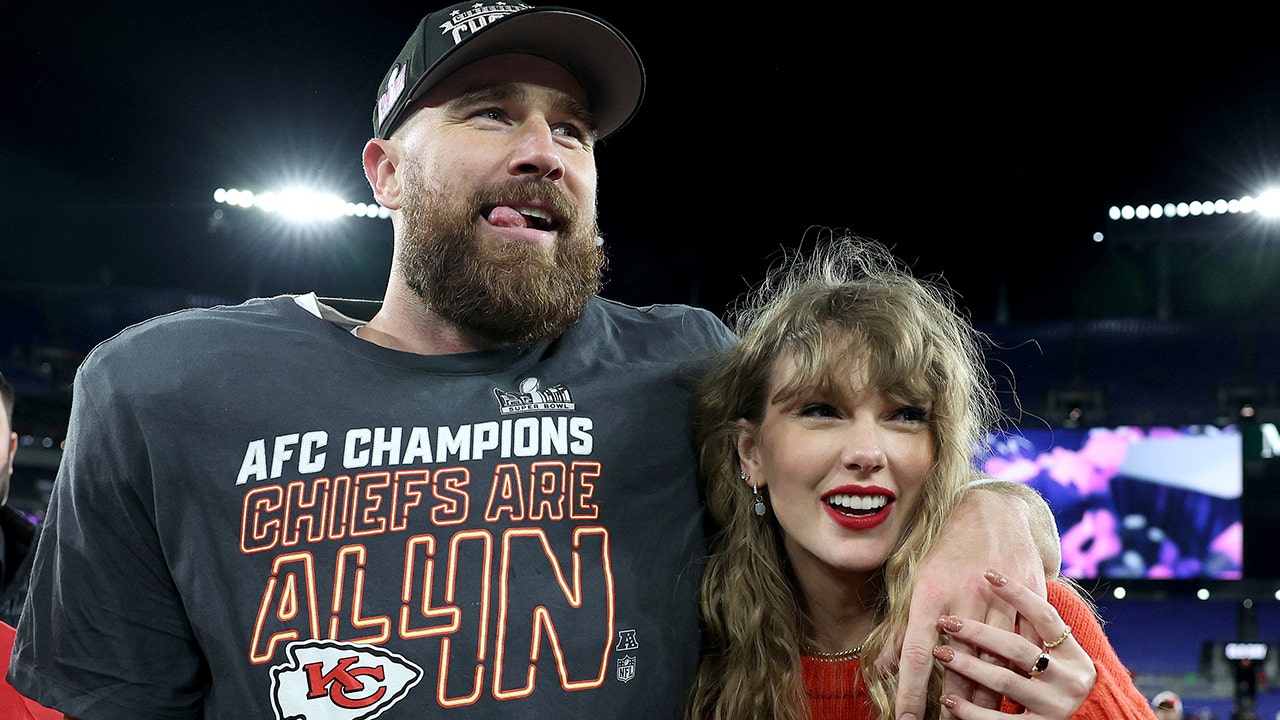
A Las Vegas chapel is offering free weddings to couples named Taylor and Travis who are looking to tie the knot on Super Bowl Sunday, a nod to singer Taylor Swift and her boyfriend, Kansas City Chiefs tight end Travis Kelce, who will be playing in the big game.

Kelce’s Chiefs are preparing to take the field against the San Francisco 49ers for Super Bowl LVIII, a rematch of Super Bowl LIV when the Chiefs won four years ago by a score of 31 to 20.

Chapel of the Flowers announced free weddings for couples named Taylor and Travis on Super Bowl Sunday.

“For those not eligible for a Super Bowl ring, how about a game-day wedding with some Las Vegas Bling? If your name is Taylor and you’d like to get married to your partner Travis after the big game, this is your chance to score a free Vegas wedding!” The chapel’s CEO Donne Kerestic said in a press release, according to PEOPLE.

JELLY ROLL SAYS TAYLOR SWIFT HAS HAD AN ‘INCREDIBLE IMPACT ON THE NFL’ AHEAD OF SUPER BOWL: ‘THE QUEEN’

Advertisement

A Las Vegas chapel is offering free weddings to couples named Taylor and Travis who are looking to tie the knot on Super Bowl Sunday. (Patrick Smith/Getty Images)

Kerestic also said one lucky couple whose names are not Taylor and Travis could win a free wedding.

“Perhaps your name isn’t Travis or Taylor, but you’d still really love to get married in the wedding capital of the world?” Kerestic asked. 

“We’re an equal-opportunity chapel and we’d love to assist you, too! Upload a photo of you and your partner kissing beneath the Married in Las Vegas sign, and tag @littlechapel on Instagram! We’ll provide one lucky couple with a free wedding ceremony, and a professional wedding planner will contact you to assist with the details of making your dream wedding a reality,” he continued.


Advertisement

Kerestic said the deadline for couples not named Taylor and Travis to apply for a free wedding will be Valentine’s Day.

“We realize you might not have time to take pictures right after the big game, so let’s push the deadline for submissions back to Valentine’s Day!” he said. “This should allow everyone to participate… even if your name isn’t Travis or Taylor and you like to spend some time planning your perfect Vegas Wedding!”

DRAKE PLACES $1.15M TAYLOR SWIFT-INSPIRED SUPER BOWL WAGER

One lucky couple whose names are not Taylor and Travis could also win a free wedding. (Patrick Smith)

Advertisement

This comes as Swift makes her way to Las Vegas for the Super Bowl after performing in Tokyo, Japan, less than 24 hours before kickoff. There were initial concerns about whether she would be able to make it to the game on time, but she landed in the U.S. on Saturday and appeared poised to watch Kelce play at Allegiant Stadium.

Speaking to reporters last week ahead of the big game, Kelce discussed what the experience has been like receiving the extra media attention that comes with dating the 14-time Grammy-winning pop star.

“You asked me how it is. And to be honest, I’m learning throughout this all,” he explained. “I’m just kind of on the plane ride, just cruising [and] trying to figure this thing out on the run.”

Read the full article from Here

Advertisement
Continue Reading
Click to comment

Leave a Reply

Your email address will not be published. Required fields are marked *

This site uses Akismet to reduce spam. Learn how your comment data is processed.

Alaska

Made In The USA: The Alaska Wall Tent By The Alaska Gear Company

Published

on

Made In The USA: The Alaska Wall Tent By The Alaska Gear Company


This is the Alaska Wall Tent by the Alaska Gear Company, each one is made in the United States from Sunforger 13oz DLX, a double-filled, pre-shrunk, marine-grade canvas ideal for longterm outdoor use.

The Alaska Wall Tent comes in an array of sizes and versions, allowing you to choose the one that best suits your individual use-case. They’re all individually made in Alaska, and perhaps even more importantly, they’re all tested extensively to be able to handle local conditions.

The Alaska Wall Tent By The Alaska Gear Company 5

The Alaska Wall Tent By The Alaska Gear Company 2

Image DescriptionThis is the Alaska Wall Tent by the Alaska Gear Company, each one is made in the United States from Sunforger 13oz DLX, a double-filled, pre-shrunk, marine-grade canvas ideal for longterm outdoor use.

History Speedrun: The Alaska Gear Company

The Alaska Gear Company was formerly known as Airframes Alaska, it’s an aviation and outdoor equipment supplier and manufacturer headquartered in Palmer, Alaska. The company is led by majority owner Sean McLaughlin, who bought the original bush airplane parts business when it had just two employees and $100,000 in annual revenue. McLaughlin has since grown it to approximately 100 employees and $20 million in annual sales.

The company can trace its early roots to a licensed maker of Piper PA-18 Super Cub fuselages at Birchwood Airport. Through a series of acquisitions, including Reeve Air Motive (an aircraft parts retailer operating out of Anchorage’s Merrill Field since 1950, Alaska Tent & Tarp, and Northern Sled Works, the company grew well beyond aviation into outdoor recreation and cold-weather gear.

Advertisement

That diversification ultimately drove the rebrand from Airframes Alaska to Alaska Gear Company in late 2023, as the old name no longer conveyed the full scope of what the company produces and sells.

The Alaska Gear Company now operates out of three locations – a 100,000 square foot manufacturing facility in Palmer, a production facility in Fairbanks, and a retail store with an in-house sewing workshop at Merrill Field in Anchorage.

Its product lines span two major categories. On the aviation side, the company is best known for its hand-built Alaskan Bushwheel tundra tires, FAA-approved titanium landing gear, Super Cub fuselage modifications, and a wide range of bush plane parts. On the outdoor side, it manufactures Arctic Oven hot tents, canvas wall tents, custom freight and pulk sleds, and a modernized version of the iconic military bunny boot designed for extreme cold weather conditions.

More recently in 2024, the Alaska Gear Company was named “Made in Alaska Manufacturer of the Year” by the Alaska Department of Commerce.

The Alaska Wall Tent By The Alaska Gear Company

The Alaska Canvas Wall Tent is a handmade-in-Alaska canvas tent made from 13oz Sunforger DLX double-filled, preshrunk, marine-grade cotton canvas that’s treated to resist fire, water, and mildew while still remaining breathable.

Advertisement

It comes in four sizes, including 8×10, 10×12, 12×14, and 14×16 feet, all with 5-foot wall heights, and it’s available either unframed (starting at $1,295) or with a frame (starting at $2,300). The unframed version can be constructed in the field using lengths of wood sourced from the area, reducing the initial pack weight – this is crucial for trips into the wilderness by bush plane where every pound of weight is critical.

The Alaska Wall Tent By The Alaska Gear Company 7

The Alaska Wall Tent By The Alaska Gear Company 4

Image DescriptionIt comes in four sizes, including 8×10, 10×12, 12×14, and 14×16 feet, all with 5-foot wall heights, and it’s available either unframed (starting at $1,295) or with a frame (starting at $2,300). The unframed version can be constructed in the field using lengths of wood sourced from the area, reducing the initial pack weight – this is crucial for trips into the wilderness by bush plane where every pound of weight is critical.

All tents include a 4.5 inch oval stove jack for use with wood or propane stoves, as well as a 56 inch triangular rear window with insect screening, an 18oz vinyl sod cloth around the base to block drafts and moisture, ridgepole openings at both ends, rope-reinforced eaves, brass grommets, overlapping door flaps with ties, a heavy-duty zippered door, and 100 feet of sisal rope for tie-downs.

The tents are now available to buy direct from the Alaska Gear Company here, and at the time of writing they have stock ready to ship out immediately.

The Alaska Wall Tent By The Alaska Gear Company 10
The Alaska Wall Tent By The Alaska Gear Company 9
The Alaska Wall Tent By The Alaska Gear Company 8
The Alaska Wall Tent By The Alaska Gear Company 3

Images courtesy of the Alaska Gear Company


Source link

Continue Reading

Arizona

What have the Cardinals done in NFL free agency? – Arizona Sports

Published

on

What have the Cardinals done in NFL free agency? – Arizona Sports


The NFL’s legal tampering window is officially open, and it didn’t take long for the Arizona Cardinals to get in the mix.

A running list of the new names and familiar faces coming to Arizona in 2026:

New names on Cardinals roster this free agency

Kendrick Bourne

The former San Francisco 49ers and New England Patriots wide receiver brings another body to Arizona’s wide receivers room that includes Michael Wilson and Marvin Harrison Jr.

Advertisement

He’s got plenty of familiarity with new Cardinals head coach Mike LaFleur from their time together in San Francisco (2017-20). Bourne also spent a year with expected Cardinals starter Jacoby Brissett in 2024 with the Patriots.

The wide receiver caught 37 passes for 551 yards in 16 games played (eight starts) last year.

He’s now on board for two years in Arizona.

Isaac Seumalo

The guard spent the past three years with the Pittsburgh Steelers after a seven-season stint with the Philadelphia Eagles.

Advertisement

He’s started 104 out of 125 games played and has spent time at both left and right guard during his NFL career.

According to Next Gen Stats, the guard allowed a 3.7% pressure rate last year. That was the lowest rate among all eligible guards in 2025.

Gardner Minshew

Minshew agreed to terms on a one-year deal on Monday.

He’s expected to back up expected starter Jacoby Brissett in 2026, according to Arizona Sports’ John Gambadoro.

Advertisement

Coming off his seventh NFL season and first with the Kansas City Chiefs, Minshew appeared in four games (one start) last year. He completed 46.2% of his throws for 37 yards and an interception.

Before landing with the Chiefs, Minshew spent time with the Las Vegas Raiders (2024), Indianapolis Colts (2023), Philadelphia Eagles (2021-22) and Jacksonville Jaguars (2019-20).

RB Tyler Allgeier

Allgeier comes over to Arizona on a reported two-year contract.

Before agreeing to terms on the $12.25 million deal with Arizona on Monday, Allgeier played four seasons with the Atlanta Falcons.

Advertisement

He ran for 514 yards and eight touchdowns on 143 carries last year, while adding another 14 catches for 96 yards.

While he worked mostly behind Bijan Robinson the past three years, Allgeier did surpass the 1,000-yard mark as a rookie in 2022.

Familiar faces

L.J. Collier

Collier is back on a one-year deal.

The defensive lineman appeared in four games in 2025 due to a knee injury suffered in Week 2.

Advertisement

He recorded six tackles and two QB hits in what was his third season with the team.

Roy Lopez

After a one-year stint with the Detroit Lions, Lopez is back with his hometown team on a reported two-year deal.

In 17 games played last year, he recorded two sacks, four tackles for loss and a pass defensed.

Before his time in Detroit, Lopez spent two seasons with Arizona from 2023-24. During that span, he registered a sack, six tackles for loss, three passes defensed and a forced fumble in 30 games played (21 starts).

Advertisement

K Chad Ryland

Ryland is back on a one-year deal, the team announced.

Ryland went through plenty of struggles last season after a having a career year in 2024. His accuracy dropped from 87.5% in 2024 to 75.8% last season. He was especially inconsistent from 40 yards and on, compiling a 13-of-20 mark (65%). Inside 40 yards, though, Ryland was 12-of-13 (92.3%).

Arizona brought in kicker Josh Karty late in the year (more on him later), but Ryland never gave up his role and appeared in all 17 games.

A one-year deal isn’t going to break the bank by any means.

Advertisement

P Blake Gillikin

The Cardinals must feel pretty good about where Gillikin is at in his recovering from a back injury last year with their signing of the punter to a one-year deal.

Before he went down five games into the season, the punter was leading the league in yards per punt with 51.7.

Not only that, across his five seasons (65 games) in the NFL, he holds the all-time record for yards per punt at 48.5.

Staying healthy is key for Gillikin, who also missed time in 2024 due to an ankle injury.

Advertisement

RB James Conner

Technically not a free agent, Conner was a potential cut candidate given his contract.

But after reportedly revising his deal, Conner is returning for his sixth season with the Cardinals.

The running back brings plenty of leadership and a bruising running style to the mix.

He’s coming off an abbreviated 2025 (three games) due to an ankle injury but had rushed for a pair of 1,000-yard seasons the two years prior. He scored at least seven rushing touchdowns each season from 2022-24.

Advertisement

CB Sean Murphy-Bunting

Much like Conner, Murphy-Bunting was another prime cut candidate due to his contract but reportedly revised his deal with Arizona as well.

Murphy-Bunting has a lot to prove after missing all of 2025 due to an injury suffered away from the team facility.

In his first season with the Cardinals, the cornerback recorded 52 tackles, three interceptions, five passes defensed and two forced fumbles across 15 starts.

Advertisement


Source link

Continue Reading

California

California’s Voter ID Initiative is Way More Chill Than Trump’s SAVE Act

Published

on

California’s Voter ID Initiative is Way More Chill Than Trump’s SAVE Act


Sources: California Voter ID Initiative text (proposed); H.R. 7296, Safeguard American Voter Eligibility Act, 119th Congress, 2d Session (introduced January 30, 2026); Congressional Research Service Bill Summary; California Secretary of State; National Conference of State Legislatures (NCSL).

Background: How California Currently Handles Voter Identification

Under current California law, U.S. citizenship is required to vote, but the state relies on voters to simply attest to their citizenship when registering. California does not generally require voters to show identification at the polls. The limited exceptions apply only to first-time federal election voters who registered by mail or online without providing a California ID or Social Security number, and even then, the state allows a broad range of documents, including utility bills, bank statements, paychecks, or official government mail.

In 2024, Governor Gavin Newsom signed legislation explicitly banning local jurisdictions from requiring voter ID, following Huntington Beach voters’ approval of a local measure to do so. California currently has among the most permissive voter identification rules in the nation.

The California Initiative: A Targeted, Inclusive Reform

A proposed California ballot initiative would amend the state constitution to add a new Section 3.1 to Article II. The initiative states three purposes: to “promote public confidence and trust in the electoral process,” to “deter and detect voter fraud by maintaining accurate voter registration records and confirming eligibility to vote,” and to “minimize the risk of voter impersonation by requiring proof of identity to vote.”

Advertisement

The measure is notable for what it does and, just as importantly, for what it does not do.

For in-person voting, the initiative requires that “each time a voter casts a ballot in person in any election in the State, the voter shall present government-issued identification.” The initiative defines government-issued identification as “documentation that allows conclusive verification of the voter’s identity.”

For mail voting, the requirement is far more limited. The voter needs only to provide “the last four digits of a unique identifying number from government-issued identification that matches the one designated solely by the voter for their voter registration.” Importantly, the type of ID designated by each voter “must be indicated in their voter registration record, noted on the mail ballot envelope provided to them, and available to them on request by phone or electronically,” so voters are never caught off guard.

On the question of cost, the initiative is explicit: “Upon request by an eligible voter, the state shall provide, at no charge, a voter ID card for use in casting a ballot.” This is perhaps the most important provision in the measure. One of the most common and legitimate criticisms of voter ID laws is that they can function as a de facto poll tax. This initiative addresses that concern directly by guaranteeing that the means of compliance are freely available to every eligible voter.

On citizenship verification, the initiative directs the Secretary of State and county elections officials to “use best efforts to verify citizenship attestations using government data” and to “annually report what percentage of each county’s voter rolls have been citizenship-verified.” This is a transparency measure, not a documentation barrier.

Advertisement

On accountability, the initiative requires that “during every odd-numbered year, the State Auditor shall audit the State’s and each county’s compliance with this section and report its findings and recommendations for improving the integrity of elections to the public.” Citizens may also “seek judicial review and remedy of the State’s or any county’s compliance with this section.”

What the initiative does not do is equally important. It does not require documentary proof of citizenship to register to vote. It does not require voters to submit citizenship documents with mail ballots beyond the last four digits of an ID number. It does not impose criminal penalties on election officials. It does not create unfunded mandates. It does not establish a private right of action against election workers.

In short, the California initiative is a narrowly drawn measure. It asks voters to confirm who they are while ensuring that the tools to do so are freely available to all.

The Federal SAVE Act (H.R. 7296): A Sweeping and Problematic Mandate

Introduced in the House on January 30, 2026, by Rep. Chip Roy and referred to the Committee on House Administration, the Safeguard American Voter Eligibility Act amends the National Voter Registration Act of 1993. Unlike the California initiative, which works within existing systems, the SAVE Act would fundamentally restructure how Americans register to vote and cast ballots in federal elections, with requirements that, in many cases, are practically impossible for millions of eligible citizens to meet.

Advertisement

Here is what the bill actually requires, provision by provision, and why each raises serious concerns.

1. Documentary Proof of Citizenship Required to Register

The bill is unambiguous on this point. It states that “a State may not register an individual to vote in elections for Federal office held in the State unless, at the time the individual applies to register to vote, the individual provides documentary proof of United States citizenship.”

The bill defines acceptable proof narrowly. It includes a REAL ID-compliant document “that indicates the applicant is a citizen of the United States,” a valid U.S. passport, or a military ID combined with “a United States military record of service showing that the applicant’s place of birth was in the United States.” For voters who cannot provide those documents, the bill allows a government photo ID paired with a certified birth certificate, but that birth certificate must meet an exacting list of requirements: it must include “the full name, date of birth, and place of birth of the applicant,” must list “the full names of one or both of the parents of the applicant,” must carry “the signature of an individual who is authorized to sign birth certificates,” must include “the date that the certificate was filed with the office responsible for keeping vital records in the State,” and must bear “the seal of the State, unit of local government, or Tribal government that issued the birth certificate.”

This is an extraordinarily demanding standard. Birth certificates are lost, damaged, or were never properly recorded, particularly for older Americans, rural residents, and low-income citizens.

Let Us Vote : Sign Now!

The bill does include a fallback process for applicants who cannot produce these documents. They may “sign an attestation under penalty of perjury that the applicant is a citizen of the United States” and “submit such other evidence to the appropriate State or local official demonstrating that the applicant is a citizen.” The official then makes a personal judgment and must sign a sworn affidavit “swearing or affirming the applicant sufficiently established United States citizenship.” This places an unusual and significant legal burden on individual election workers who are simply trying to help voters register.

Advertisement

2. A Photo ID Requirement That Specifies Citizenship on the Face of the Document

The bill requires that every voter in a federal election present an “eligible photo identification document.” The bill defines that document as one containing “a photograph of the individual identified on the document,” “an indication on the front of the document that the individual identified on the document is a United States citizen,” and either an ID number or “the last four digits of the social security number of the individual identified on the document.”

The citizenship indicator requirement is the critical problem. Currently, only a handful of states denote citizenship status directly on driver’s licenses. Even REAL ID-compliant cards display the same gold star insignia for citizens and lawfully present non-citizens alike. The bill does include a limited workaround: a voter may present a non-compliant ID “together with another identification document that indicates the individual is a United States citizen.” But requiring two documents at the polls is itself a significant additional burden, and it would disqualify the standard ID held by the vast majority of Americans unless paired with a second document.

The bill also specifies that for in-person voting, the eligible photo identification document “shall be a tangible (not digital) document,” closing off the possibility of using a digital ID on a smartphone, a technology that several states have begun adopting.

3. Double Documentation Required for Absentee Voting

For voters casting absentee ballots, the bill requires that a copy of the eligible photo identification document be submitted both “with the request for an absentee ballot” and again “with the submission of the absentee ballot.” This double documentation requirement, which most states do not currently impose at any stage, would add substantial friction to the process that millions of Americans, including elderly, disabled, and overseas military voters, rely upon as their primary means of voting.

4. Immediate Effective Date, No Funding, No Phase-In

The bill states plainly that its provisions “shall take effect on the date of the enactment of this section.” There is no phase-in period. There is no federal funding provided to help states implement new documentation systems, train election workers, update voter registration forms and databases, or communicate requirements to the public. The Election Assistance Commission is given just 10 days after enactment to “adopt and transmit to the chief State election official of each State guidance with respect to the implementation of the requirements.” States are given 30 days to “establish a program” for identifying non-citizens on voter rolls. These are the conditions under which states would be expected to overhaul their entire voter registration and election administration infrastructure.

Advertisement

5. The Risk of Bifurcated Elections

States that cannot comply with the law’s requirements could be forced to maintain two separate voter rolls: one for voters who have provided documentary proof of citizenship and are eligible to vote in federal elections, and one for voters who have not. Arizona has operated under just such a bifurcated system since 2004, resulting in nearly two decades of continuous litigation. The SAVE Act would risk spreading that legal and administrative chaos to all 50 states simultaneously, with no funding and no preparation time.

6. Mandatory Federal Database Cross-Checks and Data Sharing

The bill requires states to establish programs to identify non-citizens on voter rolls using information from the Department of Homeland Security’s SAVE system, the Social Security Administration, and state driver’s license agencies. Federal agencies must respond to state requests within 24 hours and are directed to “share information with each other with respect to an individual who is the subject of a request.”

More Choice for San Diego

The bill goes further: it directs the Secretary of Homeland Security to “conduct an investigation to determine whether to initiate removal proceedings” against any non-citizen found to be registered to vote. This means voter registration data would become a direct input into federal immigration enforcement. The scope of personal voter information flowing between state election systems and federal agencies raises significant privacy concerns that the bill does not address.

7. Criminal Penalties for Election Officials

The bill amends the existing criminal penalties section of the National Voter Registration Act to make it a federal crime for an election official to register “an applicant to vote in an election for Federal office who fails to present documentary proof of United States citizenship.” The bill also criminalizes “providing material assistance to a noncitizen in attempting to register to vote or vote in an election for Federal office” for executive branch officers and employees.

Critically, the bill does not limit criminal liability to knowing or willful violations. An election official who makes an honest administrative mistake could face federal criminal prosecution. This provision could have a severe chilling effect on election administration, discouraging qualified people from serving as election officials and causing those who do serve to deny registration to borderline applicants out of fear of personal legal consequences.

Advertisement

8. A Private Right of Action Against Election Officials

The bill expands private right of action provisions under the National Voter Registration Act to include “the act of an election official who registers an applicant to vote in an election for Federal office who fails to present documentary proof of United States citizenship.” This means private individuals may sue election officials directly for compliance failures, compounding the chilling effect of the criminal penalties and creating a hostile legal environment around the routine work of election administration.

Side-by-Side Comparison

Feature

California Initiative

Federal SAVE Act (HR7296)

Advertisement

Photo ID for in-person voting

IVP Donate

Yes

Yes

Digital IDs accepted

Not specified

Advertisement

No, tangible only

Mail ballot ID requirement

Last 4 digits only

Full photocopy required twice

Let Us Vote : Sign Now!

Proof of citizenship to register

Advertisement

No

Yes, documentary proof required

Citizenship indicator required on ID

No

Yes, on the face of the document

Advertisement

Free ID provided

Yes, guaranteed by the initiative

More Choice for San Diego

Not addressed

Federal or state funding provided

State legislative implementation is required

Advertisement

No funding provided

Phase-in period

Legislature required to act promptly

No phase-in, effective immediately

Criminal penalties for officials

Advertisement

IVP Donate

No

Yes, including for non-willful errors

Private right of action against officials

No

Yes

Advertisement

Risk of bifurcated elections

No

Yes

Let Us Vote : Sign Now!

Federal database surveillance of voters

No

Advertisement

Yes, extensive, including immigration referrals

Annual audits and public reporting

Yes, required by the initiative

No

Advertisement

The Bottom Line

Both proposals share a stated goal: ensuring that only eligible U.S. citizens cast ballots in American elections. But they represent fundamentally different visions of how to pursue that goal, and the differences matter enormously for millions of American voters.

The California initiative works within existing systems. It asks voters to confirm who they are, provides free IDs to those who need them, and builds in transparency and accountability through annual audits and public reporting. Its requirements are clearly defined, its burdens are modest, and its protections for voters are explicit.

More Choice for San Diego

The SAVE Act, as written in H.R. 7296, would impose requirements that tens of millions of eligible American citizens cannot currently meet, without providing a dollar in funding, a meaningful period of preparation, or protection for the election officials expected to carry it out. It takes effect the day it is signed. It gives states 30 days to overhaul their voter rolls. It exposes election workers to both criminal prosecution and private lawsuits for honest mistakes. It routes voter registration data into federal immigration enforcement. And it threatens to force all 50 states into the kind of bifurcated election chaos that Arizona has lived with for two decades.

Reasonable people can disagree about whether voter ID requirements are necessary or wise as a matter of policy. But the contrast between these two proposals is instructive. One is a carefully drawn, incremental reform that takes eligible voters’ concerns seriously. The other is a sweeping federal mandate that, as written, would make voting harder for millions of lawful American citizens while creating new legal and administrative burdens that states are given neither the time nor the resources to meet.


Source link

Advertisement
Continue Reading

Trending