West
California government introduces nation's first series of reparations bills, after years of deliberating

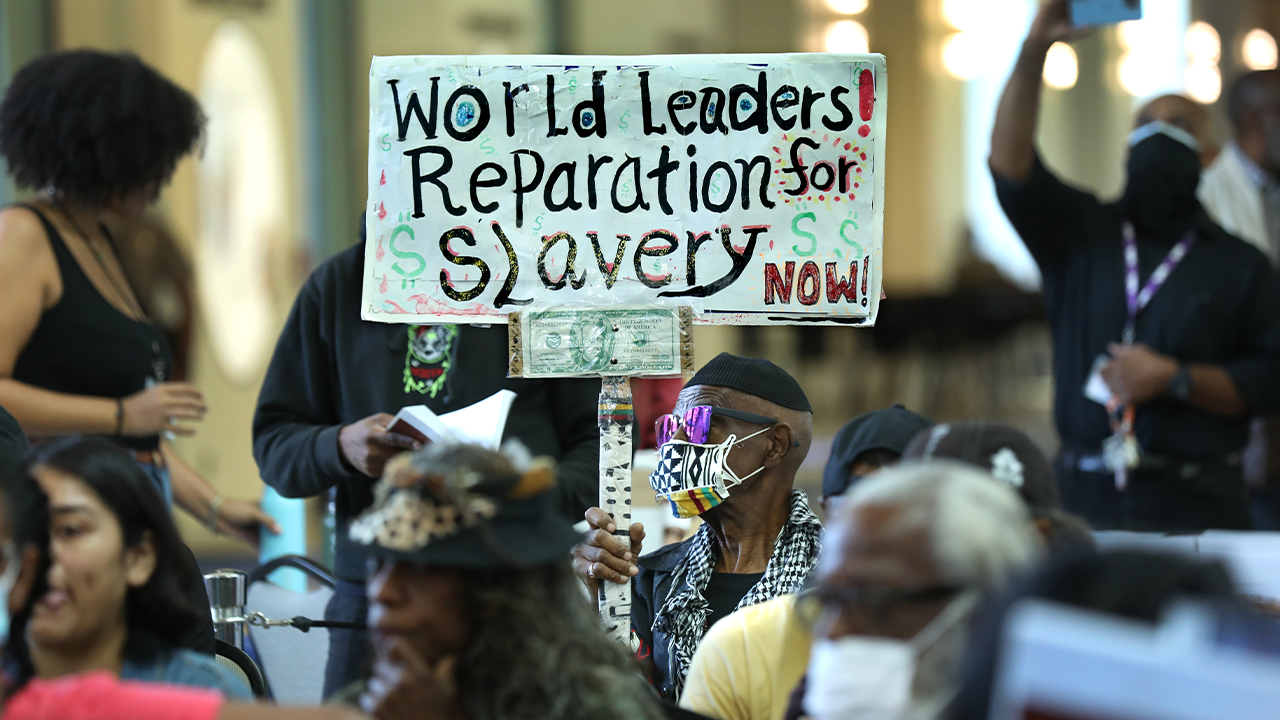
Following more than a year of deliberation on implementing reparations for descendants of African Americans in the state, California has finally introduced a series of reparations bills.
This legislative package makes California the first state to produce reparations legislation, aimed at providing restitution to descendants of slaves and those African Americans whose lives were harmed by segregation and other racist policies in California history.
As reported by Politico, the state’s Legislative Black Caucus introduced the package Wednesday which includes 14 measures that “touch on education, civil rights and criminal justice, including reviving a years-old effort to restrict solitary confinement that failed to make it out of the statehouse as recently as last year.”
‘SQUAD’ LAWMAKER EXPLAINS ‘CREATIVE’ WAY TO PAY $14 TRILLION IN REPARATIONS: ‘MORAL AND LEGAL OBLIGATION’
California state lawmakers recently unveiled a first in the nation reparations legislative package this week. (Carolyn Cole / Los Angeles Times )
However, one of the most controversial reparations proposals discussed by the state’s Reparations Task Force – the panel tasked with informing lawmakers on how to best implement reparations – did not make it into the package. The bill made no mention of providing cash payment to descendants of slaves and others historically discriminated against by the government.
The cash compensation proposal made headlines last year, after the task force recommended payments given to Black residents based on the type of historical discrimination their family faced.
For instance, the panel calculated that Black residents affected by redlining by banks might receive $3,366 for each year they lived in California from the early 1930s to the late 1970s, amounting to up to $148,099.
Gov. Gavin Newsom, D-Calif., at the time, declined to endorse cash payments, though he expressed support for the work the Reparations Task Force had done.
He told Fox News Digital last May, “The Reparations Task Force’s independent findings and recommendations are a milestone in our bipartisan effort to advance justice and promote healing. This has been an important process, and we should continue to work as a nation to reconcile our original sin of slavery and understand how that history has shaped our country.”
BOSTON ANNOUNCES REPARATIONS TASK FORCE THAT WILL STUDY IMPACT SLAVERY HAD ON RESIDENTS: CITY ‘ON TRIAL’
The reparations package notably does not have a bill proposal cash payments to descendants of African Americans in the state, a notion that even Gov. Gavin Newsom, D-Calif., declined to endorse last year. (California Governor Gavin Newsom YouTube channel)
In a recent statement, caucus chair and Democratic Assemblymember Lori Wilson touched on the lack of cash payments included in the slate of bills, noting the fight for reparations is much bigger than that.
The Democrat said, “While many only associate direct cash payments with reparations, the true meaning of the word, to repair, involves much more. We need a comprehensive approach to dismantling the legacy of slavery and systemic racism.”
The legislative package reportedly has a provision for giving payments to those residents whose families dealt with “property takings.” This bill, authored by State Sen. Steven Bradford, D-Los Angeles, would “Restore property taken during raced-based uses of eminent domain to its original owners or provide another effective remedy where appropriate, such as restitution or compensation.”
The series of bills still need to be decided on by state lawmakers, with passage of them into law being the next big hurdle.
The governor’s office did not immediately reply to Fox News Digital for comment.
Fox News’ Jessica Chasmar and Peter Hasson contributed to this report.
Read the full article from Here

San Francisco, CA
I own a Turkish Restaurant in San Francisco. Turkey’s World Cup match here has changed my business.

This as-told-to essay is based on an interview with Aziz Aslan, 45, the owner of Turquaz, a Turkish restaurant on Mission Street in San Francisco. It has been edited for length and clarity.
I opened my Turkish restaurant, Turquaz, in San Francisco in February 2025. Typically, most of our customers are locals, and Turkish diners make up a small minority.
But Turkey’s World Cup appearance in San Francisco has brought a different type of customer through our doors.
Over the past week, we’ve had far more Turkish customers dine with us. Reservations are up, walk-in traffic has increased, and we’ve hired additional staff to keep up with demand.

Gabriela Hasbun for BI
Turkey qualifying for the World Cup changed my business
As soon as we heard that San Francisco would be one of the World Cup host cities, we were thrilled. We knew it would bring visitors to the city, and potentially new customers to our restaurant.
At that point, we didn’t yet know whether Turkey would qualify.
Gabriela Hasbun for BI
In March, Turkey secured its place in the tournament, and we later learned the team would be playing at the San Francisco Bay Area Stadium on June 20. That’s when I knew we needed to start preparing for the tournament.
Over the last few weeks, we launched targeted advertising campaigns on social media. One Instagram post was written in Turkish. In another, we told visitors that wherever they were traveling from, if they were looking for good food, they should come to us. It helped spread the word about our restaurant.
Gabriela Hasbun for BI
Most of my customers aren’t usually Turkish
I’m originally from Istanbul, although I’ve been in the Bay Area for about 10 years. Compared with places like New York and New Jersey, there aren’t as many Turkish people in this part of California.
Usually, our customers come from a wide range of backgrounds, with Turkish people making up only 5% to 10% of those who dine with us.
With our usual customers, our most popular dishes are chicken kebabs and lahmacun, a flatbread topped with minced meat, vegetables, and herbs. We’re a traditional Turkish kitchen, and our pastry section is popular as well, especially our fresh baklava.
Gabriela Hasbun for BI
In recent weeks, however, we’ve had a lot of Turkish customers, which is unusual for us. Some have come from places like New Jersey and Texas, while others have flown in from Istanbul, all to watch Turkey play.
Turkey’s World Cup match in San Francisco has changed who our customers are and what they’re ordering. Dishes like beans and braised meats aren’t as popular with our usual clientele, but we’re selling a lot more of them now because of our Turkish customers.
Gabriela Hasbun for BI
They’ve been ordering foods like white beans with pilaf, braised meat with pilaf, and salads, all of which are really traditional dishes. Turkish customers can be tough critics because they’re comparing our food to what they have back home, but I feel confident in our food, and we’ve received compliments so far.
It hasn’t really affected our stock, thankfully. We have good inventory management, and my warehouse for the wholesale food business is only a short drive away, so we can pick up products whenever we need.
We’ve hired extra staff to meet demand
To prepare for the World Cup, we’ve had to hire additional employees. On top of the 24 staff members we already had, we added three more because of increasing demand. The staff is also working longer hours than usual.
Gabriela Hasbun for BI
For Turkey’s first match, against Australia, we didn’t do anything special, other than create a football-shaped cake. We decided to host watch parties for Turkey’s second and third matches because customers kept asking for them. We set up a big screen for fans to watch together.
I think the World Cup is giving Turkish people a reason to gather, reconnect, and talk about soccer.
I hope the World Cup leaves a lasting impact
The first few months of opening a restaurant are never easy. We spent them getting things set up, perfecting our recipes, and building awareness. We’re still a relatively new restaurant, so it’s been encouraging to see this positive momentum from the World Cup.
Gabriela Hasbun for BI
The city feels busy. You can see it on the streets. There’s an energy in San Francisco right now that’s having a positive effect on businesses like ours, and I hope we can keep that going.
Of course, the World Cup is a one-time event, but we’ll do our best to serve these customers well. If we can meet their expectations, I hope they’ll come back.
And who knows? Maybe the Turkish national team will stop by for a meal before the tournament is over. I’m still holding out hope.

Getty
Denver Broncos star Pat Surtain II is navigating uncertainty on and off the field.
Pat Surtain II and the Denver Broncos could already have to overcome not having outside linebacker Jonathon Cooper for an indeterminate length of time amid his ongoing legal matters, and the 2024 Defensive Player of the Year is now facing another hurdle.
This one affects Surtain off the field, and personally.
It will be but a footnote on his 2026 season, but the standout defender’s recent experiences are reminders about how quickly things can change in the NFL.
Broncos’ Pat Surtain II Gets More Bad News
GettyPat Surtain II could have forced to make a difficult decision about one of his ventures off the field.
In addition to his award-winning play on the field for the Broncos, Surtain has also taken on podcasting during his spare time. He co-hosts the “Closed on Sundays” podcast with fellow Alabama alum and current Detroit Lions cornerback Terrion Arnold.
The duo’s joint venture is in imminent danger.
“#Broncos star Pat Surtain II has a successful podcast with Arnold,” The Denver Post’s Troy Renck posted on X on June 24. “Now, Arnold is facing some serious charges.”
According to NFL.com’s Grant Gordon on June 24, “Detroit Lions cornerback Terrion Arnold has been arrested in connection with a February robbery and kidnapping in Tampa, Florida, the Hillsborough County State Attorney announced late Wednesday night.
“Arnold, 23, turned himself in at Orient Road Jail (Florida) on Wednesday and is facing eight total felony charges — four for robbery with a firearm or deadly weapon and four for kidnapping, the Hillsborough County Sherriff’s Office told NFL.com. Arnold is being held with no bond and is due in court Thursday at 1:30 p.m. ET, per the Sherriff’s office.”
Arnold’s charges “carry a potential life sentence in prison,” per Gordon.
Gordon also noted that prosecutors will request he remain in custody until his trial. That is in addition to his current no-bond status.
The matter all stems from an alleged retaliation attempt after Arnold and several friends had their property stolen from an AirBNB they were staying in. Arnold is the alleged mastermind of the plot, which targeted individuals police say were not involved with the initial theft.
Broncos Navigating Distractions
GettyPat Surtain II and the Denver Broncos are navigating legal issues with a player on their roster.
Surtain and Arnold last put out an episode of the podcast in February. Moreover, the Lions corner’s status and their podcast must come after Surtain’s commitment to the Broncos, who are once again expected to be one of the top teams in the NFL.
They face an internal threat to that, with Cooper.
Broncos head coach Sean Payton said they are following the NFL’s lead on handling the matter, while Surtain expressed support for his teammate.
“He’s our brother at the end of the day, and we all rally behind Coop,” Surtain told reporters on June 16 when asked directly. “We just wish him the best with everything, but just keeping him in good spirits.”
Cooper’s situation, obviously, affects the Broncos–and, by default, Surtain–directly.
Still, the star corner could need a new podcast partner, lest he prefer to sunset the endeavor entirely, as well as hope Denver can replace a key piece in Cooper if necessary.
Josh Buckhalter covers the NBA and NFL for Heavy.com. He has covered both leagues since 2016, including bylines at FanSided, Last Word on Sports and Clocker Sports. He’s based in Villa Park, Illinois. Follow Josh on Twitter and Instagram: @JoshGBuck More about Josh Buckhalter
Seattle, WA
The World Cup 2026 Pride Match between Egypt and Iran that Seattle hopes can ‘unite football community’

When Seattle announced it would host a Pride Match during the 2026 World Cup, it was long before the draw had even been made.
The match at Lumen Field on June 26 (4am on June 27 in the UK) – one of six the city is hosting – falls on the same date as Seattle’s annual Pride weekend, setting the stage for a festival of celebrations outside the stadium.
It is a game that could determine who makes it through to the knockout stage – and it is a game that will feature two countries with some of the strictest anti-gay laws in the world: Egypt and Iran.
In Iran, same-sex relationships are illegal and gay men have been executed on sodomy charges, making their laws some of the most oppressive against the LGBTQ community in the world.
Egypt has previously arrested LGBTQ people on indecency laws and has cracked down in recent years on the outward expression of Pride and the waving of rainbow flags.
Both countries have called on FIFA and Seattle to cancel the Pride celebrations.
Iran Football Federation president Mehdi Taj described the Pride branding for the match as “inappropriate” and “an irrational move”.
A statement from the Egyptian Football Association read: “Egypt categorically rejects holding any activities related to supporting (homosexuality) during the match. Such initiatives conflict with the cultural, religious and social values in the region, especially in Arab and Islamic societies.”
FIFA, which has no official involvement in the plans, has resisted calls from Iran and Egypt to cancel or move the match.
Seattle’s local organising committee says they will go ahead as planned, saying: “Soccer has a unique power to unite people across borders, cultures, and beliefs. We are honoured to host a Pride Match and to celebrate Pride as part of a global football community. This match reflects our ongoing commitment to respect, dignity and unity for all.”
Both sides will be looking to secure qualification to the round of 32, with Egypt top of group G on four points and Iran in second with two points.
Iran will also have to travel to Seattle from their base in Mexico on the day of the match due to restrictions not allowing the team to stay overnight in the United States.
‘We want people in Egypt and Iran to know they would be welcome in Seattle’
Eric Wahl, who fell in love with football while living in Seattle, is a member of the Seattle Pride Match Advisory Committee and has been helping to organise the game.
He is also the brother of journalist Grant Wahl, who passed away at the Qatar World Cup in 2022 after suffering an aortic aneurysm. Wahl had a month earlier been briefly detained by security staff for wearing a rainbow football shirt.
Despite some initial apprehension when the draw was made, Eric Wahl believes the Pride Match will be an opportunity for the world to see how welcoming Seattle is.
“We had a sole mission of wanting to highlight LGBTQ organisations and businesses in Seattle and to unite that with the shared love of soccer as a world sport,” he said.
With hundreds of thousands of visitors and millions of viewers tuning into Seattle during Pride Weekend, we are presented with a unique opportunity to make a lasting impact. This moment allows us to educate the world, inspire our LGBTQ+ community, and uplift LGBTQ+ businesses and cultural organisations.
“This is actually a really positive thing.
“We want people from Egypt and Iran to know that, regardless of their personal identities, they would be welcome in Seattle, and we would be happy to have them.
“I really hope that there will be soccer fans in Iran and Egypt who will be able to watch this match for the match itself, but also with the halo of equality around it.”
Footballers in Qatar four years ago were caught up in a controversial U-turn over the ‘OneLove’ rainbow armband but Wahl does not expect the Iran or Egypt players to comment on anything except the football itself.
“I think it is par for the course [there will be questions of them] but also slightly unfair to the players on both of those national teams who have unquestionably been put into a position they didn’t ask for.
“To ask any of them to comment on these situations puts them in an unfair position.
“Whether they are for or against gay rights in general doesn’t matter to me, because they have to think about the oppressive regimes that they come from and that to me is a much greater concern.”
FIFA to treat match the same as any World Cup game
While FIFA is not in charge of organising the Pride Match, it has been liaising with the Seattle local organising committee and the Pride advisory committee.
The match will be treated the same as any game in the World Cup, with a FIFA spokesperson telling Sky Sports News: “The FIFA World Cup 2026 is an inclusive event that welcomes people from all backgrounds. Fans of all sexual orientations and gender identities are welcome at matches and events.”
FIFA’s branding will be limited to its regular ‘No Discrimination’ campaign material but rainbow flags will be allowed inside the stadium.
“General statements of human rights, including rainbow flags and other flags representing sexual orientation and gender identity, are permitted under the FIFA World Cup 2026 Stadium Code of Conduct and may be displayed inside stadiums provided they are used in a manner consistent with the code.”
The governing body remains adamant it will not stand for discrimination of any kind at the World Cup and that anyone can report any abuse they face at FIFA events via its app.
Any discrimination in the stadium would follow the FIFA three-step procedure in place for all matches.
First the match would be stopped when an incident occurs, with an annoucement urging spectators to cease the offensive behaviour. If it continues after the restart, the match could be suspended and even abandoned as a last resort.
Seattle hopes that instead it will be a joyous, inclusive occasion celebrating the LGBTQ community.
Wahl is expecting to see a sea of colour at kick-off in a match that also marks an opportunity to honour his late brother.
“I will be wearing a version of the rainbow soccer ball shirt that Grant was detained for in Qatar,” Wahl said.
“I think it’s going to be amazing. I just can’t wait to share that experience, and I can feel Grant smiling about it too.”
-

 Los Angeles, Ca36 minutes ago
Woman ambushed, violently attacked by robber in downtown Long Beach
-

 Detroit, MI54 minutes ago
Where to watch Houston Astros vs Detroit Tigers: TV channel, start time, streaming for June 26
-
San Francisco, CA1 hour ago
I own a Turkish Restaurant in San Francisco. Turkey’s World Cup match here has changed my business.
-

 Dallas, TX1 hour ago
Australia advances at World Cup, how to buy Australia soccer tickets
-

 Miami, FL1 hour ago
2 detained after police pursuit ends with bailout, neighborhood search in NW Miami-Dade – WSVN 7News | Miami News, Weather, Sports | Fort Lauderdale
-

 Boston, MA1 hour ago
Delta flight returns to Logan after smoke scare in cockpit – Boston News, Weather, Sports | WHDH 7News
-

 Denver, CO1 hour ago
Pat Surtain II Gets More Bad News Amid Broncos’ Uncertainty
-

 Seattle, WA1 hour ago
The World Cup 2026 Pride Match between Egypt and Iran that Seattle hopes can ‘unite football community’


