Business
Last orders: Britain's pubs struggle to survive in an atomized, remote-work world

Over the bar of a 200-year-old pub in southeast London hangs a sign: “For the people of East Greenwich, by the people of East Greenwich.”
What might sound like a pithy slogan is in fact the truth. The Star of Greenwich, which almost closed for good last year, has been saved by the local community after three residents — all of whom hold down full-time jobs — came to the rescue of their “local.”
“Once these things go, they never come back,” says James Gadsby Peet, who banded together with two friends to take over running the pub. It’s not the drinks that matter here, he says, but preserving “a community space for people to come together.”
Directors and co-founders of the Star of Greenwich community pub are Lisa Donohoe, left, James Gadsby Peet and Kirsty Dunlop.
(Joshua Bright / For The Times)
Had the trio not resolved to save the Star, it would have become one of the many taverns in the British capital that closed at a record pace last year. Hit by a stubborn cost-of-living crisis and post-pandemic economic woes, 383 London pubs called for last orders in the first six months of 2023, compared with 380 in all of 2022.
Earlier this month, four sister pubs in central London — including one believed to have been frequented by two of Jack the Ripper’s victims — were put up for sale, highlighting the struggles of an industry synonymous with British life.
The Star (formerly the Star and Garter, before the new team renamed it) has been serving up pints since the early 1800s, with the dark wooden beams inside believed to be from its original construction. But even its long history wasn’t enough to guarantee its future until the community rallied around it.
Pubs across Britain, not just in London, are suffering a worse fate. Government figures show that from 2000 to 2019, the last full year of business prior to the COVID-19 pandemic, 13,600 pubs around the country, or 22% of the total, shut their doors for good. Last week, the British Beer and Pub Assn. warned that, without economic support, a further 2,000 may be gone by the time this year is out, potentially leading to 25,000 jobs lost — and 288 million fewer pints poured.
Aside from financial pressures, pubs — long the social glue in British communities — are increasingly falling victim to shifting work and leisure patterns. “Old boozers,” as they are affectionately known, are struggling to compete in a world where people work from multiple locations at variable hours and have myriad entertainment options on their phones and computers.
1
2
3
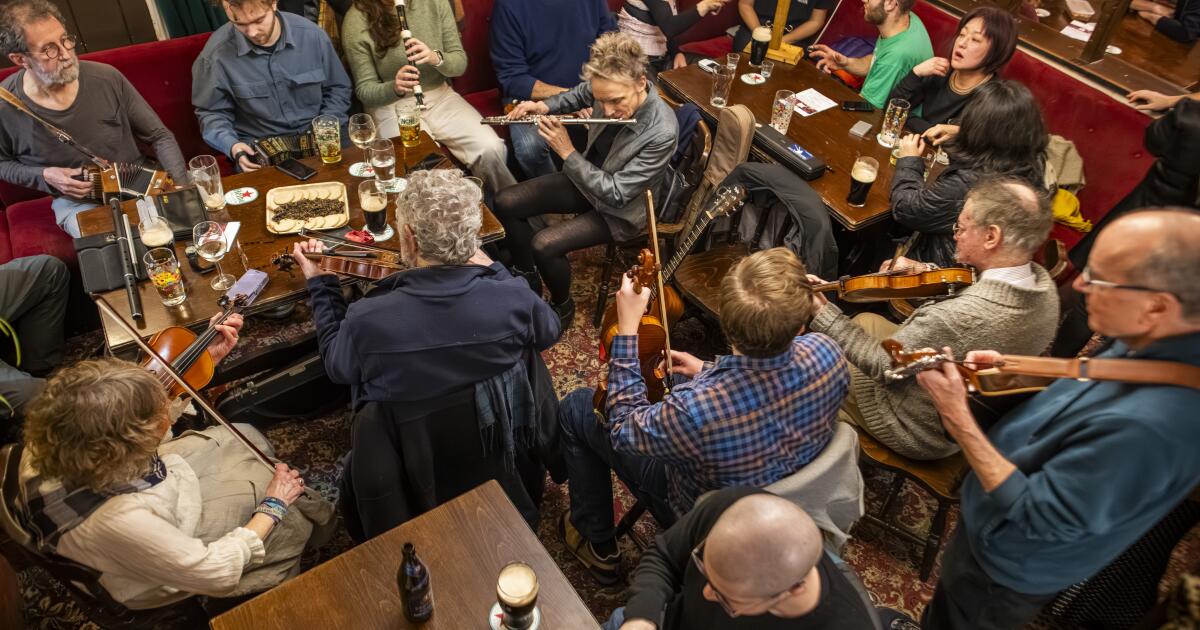
1. Musicians and patrons chat at the Star of Greenwich. James Gadsby Peet said he decided to help run the pub to preserve “a community space for people to come together.” 2. Rolo enjoys some beer at the Star of Greenwich. 3. The Star of Greenwich was on the verge of closing down before the community stepped in to save it. (Photographs by Joshua Bright / For The Times)
Charo Havermans, a historian at University College London who studies the role of pubs in public life, says that such establishments remain vital and inclusive gathering spots in an age when religion is in decline and communication is increasingly virtual.
“There’s a true sense of community that falls away when pubs disappear,” she says. “You lose a sense of history.”
Given the crucial role that pubs have played in local neighborhoods, it’s perhaps no surprise that some communities have stepped in themselves to keep the lights on.
When the Step pub in north London closed in 2020, there was an outcry as property developers tried to take it over, leading Dan Jones, a resident of four years, to consider a different solution: “Why don’t we try and buy it as a community?”
He began handing out fliers and, in a matter of weeks, “very quickly realized there was a large appetite” to enact his plan. Hundreds of people pledged to invest in a fundraising campaign, and within four weeks, the effort raised $357,000 — far in excess of the $319,000 goal — which was topped up by a government grant of $382,000.
“It took us by surprise, the speed at which we were able to raise the money and the fact that we got over target,” Jones says.
He puts this down to the Step being more than just a place to drink. “It was the hub of the area … so people really missed that when that was gone,” he says. “And that’s why there was this feeling to bring it back.”
Border collie Stanley is a favorite at the Star.
(Joshua Bright / For The Times)
Another pub-saving initiative, CityStack, lets bar-hoppers pay $32 for a special beer mat that gives them $13 off tabs of $25 or more at participating establishments. The discount is good for up to 10 visits.
At the Star in East Greenwich, Gadsby Peet admits that financially, things are “really tight,” even though the community-run pub needs to pay only for behind-the-counter staff, with no management costs, and there is no pressure to turn a profit. Currently, the pub welcomes customers from Thursday through Sunday, as the team “can only open [at] the times we can afford to open.”
Strong business over Christmas has meant that “at the moment, it’s sustainable,” he says, though “you never quite know what’s going to happen.”
The crowd on a Saturday night is a mixture of friends, a smattering of solo drinkers and a young couple on a date, mulling whether to head to the jukebox or dartboard. The bar staff knows regulars by name and is primed for chitchat in a part of London best known for its role in maritime history and as the birthplace of notable Tudors, including Henry VIII.
The pub was open until 2021, when its license was suspended following a stabbing outside. After news circulated that the building was to be sold, Gadsby Peet and Kirsty Dunlop fell to chatting at the gates of their children’s school and resolved that, together with another friend, Lisa Donohoe, they would put together a proposal to save it.
1
2
3
1. A sign above the bar at the Star of Greenwich pub. 2. Pete Ribers throws a dart at an old board still bearing the previous name of the Star of Greenwich. 3. Alan Campbell, left, and Rob Calnan play the ring and hook game. (Photographs by Joshua Bright / For The Times)
The building’s owners “bought into the vision,” Gadsby Peet recalls. “They saw this as a great way that they could use some of their assets for community good.”
The team still has to make sure that rent for the premises is paid each month. Gadsby Peet admits that juggling the Star, his job as director of a web design agency and his young family has been more challenging than he imagined.
“At the beginning you don’t realize how much [work] it’s going to be, so the first thing is just, ‘We’ll send a couple of emails,’” he says. “And before you know it, you’ve got a lot of people interested.”
His main measure of success comes at the end of the week, when in the Star he “see[s] people who are working on the railways … next to people who are working in Canary Wharf [a business district] … next to people who have been drinking here since the ’50s. That, for me, is where the really great stuff happens.”
Pat Murray, 86, has been a loyal customer since his early 20s. He recalls coming to the pub when he and his wife “were courting. I’ve since brought my children, grandchildren and now great-grandchildren into the pub. It’s a family tradition for us.”
Keeping prices low — a pint of beer costs from $6, compared with $9 at many London pubs — and offering the space for free to community groups and activities including kids’ clubs, Italian classes and local folk musicians has eased concerns about gentrification and fostered new connections, Gadsby Peet says.
James Gadsby Peet admits that financially, things are “really tight” at the Star. Behind him are co-founders Lisa Donohoe and Kirsty Dunlop.
(Joshua Bright / For The Times)
He adds that throwing the Star’s doors open to a wider group has allowed locals “to meet people that they wouldn’t otherwise run into. We think the more that that happens, the more cohesive the community becomes, the nicer a place it is to live.”
A September report by Co-operatives UK, an organization that represents cooperative businesses, showed that they play “a significant role in community development” and that community-owned pubs have increased by 62.6% in the last five years.
But some pubs in London’s commercial centers have found it harder to weather the current storms. The rise of remote working, with many employees now going into the office only on Tuesdays, Wednesdays and Thursdays, has significantly slashed footfall in neighboring hospitality businesses. Late last year, figures showed that office occupancy in Central London had reached its highest level since the pandemic, at an average of 50.9% — but that is still 10% to 30% lower than before the coronavirus hit.
When the first national lockdown was announced in March 2020, “everybody thought it was just going to be a blip,” says Lorraine Crawford, who took over the Centre Page tavern near St. Paul’s Cathedral, in London’s historic financial district, in 2005. But her business “overnight just took a nosedive. … It never ever really gained momentum again.”
Crawford and her husband, who had by that stage been in the industry for four decades, “tried everything” to keep the place afloat, she says, but paying $127,000 per year in rent, along with $45,000 in business taxes, was “horrendous. We were getting in debt all the time.”
People pass by the lighted-up Star pub. “There’s a true sense of community that falls away when pubs disappear,” says Charo Havermans, a historian at University College London who studies the role of pubs in public life. “You lose a sense of history.”
(Joshua Bright / For The Times)
Add the inflation on alcoholic drinks — which late last year reached 9.9%, the highest since the early ’90s — and the only thing left to do “was back out of it gracefully, which was so sad,” Crawford says. “We were more of a family because we were just a small business.”
The Centre Page closed more than a year ago.
“In our industry, nothing has gone back to being the same,” Crawford laments. “And I don’t think it ever will.”
Lytton is a special correspondent.


Ethics experts sounded the alarm Wednesday after new financial disclosure reports revealed that President Trump’s income ballooned to $2.2 billion in 2025, with $1.4 billion coming from various new cryptocurrency-related businesses.
“It’s bribery. It’s graft. It’s exploitation of public power for private financial gain,” said Kathleen Clark, a law professor at Washington University and an expert in government ethics. “Trump has — with the acquiescence of a somnolent, GOP-controlled Congress and the active assistance of John Roberts’ Supreme Court — transformed the presidency into a massive corruption racket.”
Trump reported income of over $600 million in 2024. But after he entered the White House in 2025, he reported that his income had soared to more than $2.2 billion.
The 2025 annual disclosure report filed with the Office of Government Ethics shows that Trump ramped up his real estate business in countries across the globe, particularly in the Middle East, at a time when his government was negotiating over vital issues of military aid and economic tariffs. The president also expanded his dealings in the relatively new realm of cryptocurrency.
According to the 927-page report, Trump made $635 million in royalties from Celebration Coins and more than $500 million from his World Liberty Financial crypto firm. He drew in millions from a raft of Trump-branded merchandise including God Bless the USA Bibles and sneakers depicting him with his hand raised in a fist. He also brought in $10.4 million from a property in the United Arab Emirates and $9 million from a property in Saudi Arabia.
Noah Bookbinder, an ethics expert and former president of Citizens for Responsibility and Ethics, a nonprofit watchdog group in Washington, described Trump’s business dealings while in the White House as “entirely unprecedented, certainly in modern history, but I think by most ways of measuring, in all of American history.”
“This is corruption,” Bookbinder said. “You have a president who has been quite transparently using the presidency in ways that benefit his business interests and intertwining the presidency and business interests.”
But the president and the White House brushed aside ethics concerns about the money Trump is making.
Trump told reporters Wednesday that he made a lot of money before he came to the White House, he had “big institutions” run his money, and that he had benefited, like every other American, as the stock market went up.
“We’re all profiting,” he said. “I’m profiting because I have a lot of money and a lot of cash.”
In a statement, White House spokesperson Anna Kelly said: “Neither the President nor his family has ever engaged — or will ever engage — in conflicts of interest. … All actions by President Trump and his administration are taken in the best interest of the American people.”
Although the report does not show exactly how much Trump is earning — it provides details of revenue, rather than profit — the scale of the president’s cryptocurrency dealings elevated ethics watchdogs’ long-standing concerns.
Jordan Libowitz, a vice president at Citizens for Responsibility and Ethics, said the most concerning detail of the new report is the hundreds of millions of dollars coming in from various crypto ventures partnered with companies that the American public knows little about.
“At a time when his own administration itself is setting regulation for these types of companies,” Libowitz said, “there’s just this massive opportunity for corruption when foreign governments and foreign nationals can pour tens of millions of dollars into the president’s pocket.”
As a real estate mogul, Trump has long invested in hotels, condominiums and golf courses. But cryptocurrency, Libowitz said, offers vastly more potential for corruption.
“There’s only so many hotel rooms you can book, so many rounds of golf, but there’s no limit with crypto,” Libowitz said. “You can just buy his meme coin and he gets a cut, so you kind of take out the middleman, but also the cap or the amount of money you can funnel to the president.”
Libowitz said it was also problematic for Trump to expand his real estate empire in foreign countries, particularly in the Middle East.
“Now it seems that almost all his new developments are in foreign countries, and that opens up, if you’re building this giant resort, you’re going to need help from the local government, whether it’s tax breaks or utility issues, or building a road, or speeding up permits,” Libowitz said. “These are ways that foreign governments can do favors for the American president.”
In the half a century before Trump was elected, ethics experts say, presidents from Nixon to Obama publicly released their tax returns, sold properties or put the proceeds in a blind trust managed by someone they did not know.
“They weren’t doing it because they legally had to, but because they thought it was the right thing to do,” Libowitz said.
Ever since Trump was first elected in 2016 and opted to not sell his businesses or put them in blind trusts, ethics experts have urged Congress to impose more aggressive financial oversight over money in politics.
“Congress needs to update the law, and basically, mandate blind trusts and sale of assets and disclosure of tax returns,” Libowitz said.
Noting that the Constitution’s Emoluments Clause explicitly states that the president cannot accept things of value from foreign or domestic governments, ethics experts say Trump is flouting the law and Congress has chosen to not enforce it.
Richard Painter, a law professor at the University of Minnesota and former White House ethics lawyer under President George W. Bush, said Congress needed to close loopholes that exempt presidents from federal conflict of interest laws as well as enforce the Foreign Emoluments Clause.
“Nobody holding a position of trust with the United States government can accept emoluments, profits and benefits from foreign governments, and that is flatly prohibited under the United States Constitution,” Painter said. “Now, if the United Arab Emirates put money into Liberty Financial, as I understand they did … and then Trump makes money off Liberty Financial, that’s a Foreign Emoluments Clause problem.”
Congress, he said, should empower an independent prosecutor to investigate such conflicts.
“The problem with the Foreign Emoluments Clause is how do we enforce it?” Painter said. “The founders and head of the Congress enforced it by impeaching anybody who took a bunch of foreign government money, but I guess that system’s not working. That’s a serious problem.”

The race to bring air travel to the sky is heating up as Santa Cruz-based Joby Aviation and Toyota launch a joint venture to commercially produce air taxis.
The companies said in a news release Tuesday that they will work together on productivity, quality and costs and move toward mass production of Joby’s electric vertical takeoff aircraft. Joby and Toyota were first linked when Toyota made a nearly $400-million investment in the company in 2020. It has since increased its backing of the company to $900 million.
“It’s really meaningful for us to take on this challenge together with Joby, a partner that shares the same vision,” Toyota Chair Akio Toyoda said. “We believe this strengthened relationship is an important step forward in realizing the future mobility society.”
Joby‘s all-electric vertical takeoff vehicles are designed to hold four passengers and a pilot and can travel at up to 200 mph. The vehicle uses six tilting propellers to achieve vertical takeoff before switching to forward flight.
In February, Joby announced a partnership with Uber to start service in the United Arab Emirates this year, bringing on-demand air taxi rides to the country. It plans to expand to the U.S. after the completion of its final stage of Federal Aviation Administration testing.
Prior to its full FAA certification, Joby is hoping to launch early flight operations later this year as part of a White House program that will bring flights to several states, including New York, Texas and Arizona. Flights in California will not begin until after obtaining FAA certification.
Joby has been in a fierce battle to be the first with taxis in the sky with its Northern California competitor Archer Aviation. The two companies are involved in overlapping lawsuits, with Joby alleging corporate espionage against Archer, and Archer filing a suit alleging dubious ties to China that sparked an investigation into Joby by the U.S. International Trade Commission.
“Toyota has been by Joby’s side for nearly a decade, providing invaluable guidance and support as we built the foundation for manufacturing our aircraft,” JoeBen Bevirt, Joby’s chief executive and founder, said in the news release. “Together, we share a vision of making aerial mobility an everyday reality, and we look forward to delivering on that promise together.”
Joby Aviation’s shares, which have fallen more than 30% this year, climbed 3% on Tuesday to $8.92.

Disneyland Resort in Anaheim will offer $59 tickets for select evening admission to either theme park as part of a new promotion.
The one-day, one-park evening ticket offer will allow attendees to enter Disney California Adventure at 5 p.m. or Disneyland at 7 p.m. Park reservations are still required, as has been the case since the COVID-19 pandemic.
The offer only applies for admission from July 12 through Aug. 5 on Sundays to Wednesdays.
Disneyland Resort is commemorating its 70th anniversary through Aug. 9, and has introduced new shows and additions to rides as part of the occasion.
Walt Disney Co.’s theme parks and experiences business are a crucial boost to its finances, making up about 56% of the company’s operating income last fiscal year.
During the Burbank-based company’s most recent earnings call in May, Disney executives said attendance at its U.S.-based parks was down 1% compared with the prior year, a shift they attributed to “continued softness” in international visitations. However, the company said at the time that it was starting to move past those issues.
Disney’s experiences division reported $9.5 billion in revenue in that fiscal second quarter, up 7% compared with the same period a year ago, something executives said was due to higher guest spending domestically and more capacity on its cruise line.
-

 Boston, MA2 minutes ago
2026 Yukon Denali Ultimate gets pricey, but tops the charts
-

 Denver, CO9 minutes ago
Nuggets Sign Marvin Bagley to 1-Year Deal: What It Means
-

 Seattle, WA12 minutes ago
FOURTH OF JULY 2026: Here’s where Seattle Parks will leave the lights on longer
-
 San Diego, CA17 minutes ago
USA fans pack San Diego bar to cheer on USMNT’s dominant World Cup knockout win
-
 Milwaukee, WI24 minutes ago
Hundreds rally on Milwaukee’s South Side against ICE arrests and in solidarity with immigrants
-

 Atlanta, GA27 minutes ago
Braves News: Tarik Skubal rumor, Cam Caminiti to the Futures Game, more
-

 Minneapolis, MN32 minutes ago
In the 70s
-

 Indianapolis, IN39 minutes ago
BC39 Results: July 1, 2026 (Indianapolis Dirt Track) – Racing News

