Plus get unlimited access to thousands of articles, videos and more with your free account!
Please enter a valid email address.
Pandemonium overtook a historic New York City synagogue when agitators battled with cops over a bizarre, illegally dug tunnel under the holy building.
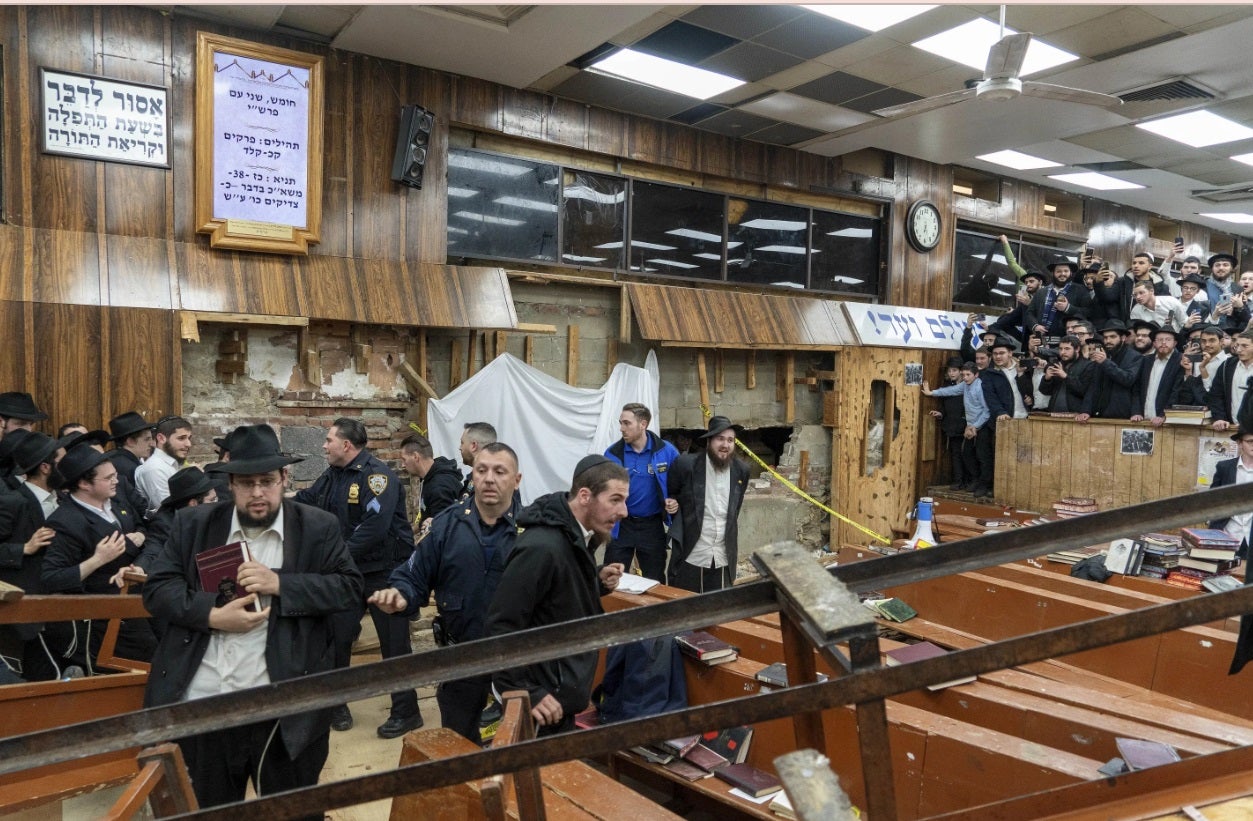
Viral videos show responding officers pulling young men from the tunnel, as dozens of other agitators shouted, clapped and, at one point, appeared to bull rush through police and climb over destroyed wooden furniture.
Advertisement
But the cops stood their ground and kept the large crowd at bay as their fellow officers continued to pull rabble-rousers from the tunnels and take them into custody, as they appeared to laugh and sing along.
In one video, posted on X by @FrumTikTok, which has since been deleted, Monday evening’s wild night started when several men blasted wooden panels with sledgehammers and ripped the coverings that hid the underground pathway, as construction crews prepped to fill it in.
NYS MOM WHO KILLED ABUSIVE BOYFRIEND REUNITED WITH KIDS AFTER YEARS IN PRISON
Jewish students riot against NYPD officers, who were called to inspect a secret tunnel dug under the synagogue by students in New York.(Bruce Schaff/AP)
One officer is heard telling members of the antagonistic group that they need to clear the synagogue out tonight.
Advertisement
“They want to fix this tonight,” the officer said in a video originally posted by @FrumTikTok.
The account user has since deleted the videos and lengthy thread after it was raided by antisemitic conspiracies and remarks.
“I will NOT allow my account to be used by antisemitic Jew haters to promote their pathetic hatred of religious Jews,” the user posted on X.
BIDEN DRAWS SHARP REACTION FOR SAYING HE’S ‘QUIETLY WORKING’ TO GET ISRAEL OUT OF GAZA
The chaos started with a 3:30 p.m. call about a “disorderly group outside of 770 Eastern Parkway” in the Crown Heights section of Brooklyn, an NYPD spokesperson told Fox News Digital.
Advertisement
“Officers were informed that a group of individuals unlawfully entered 770 Eastern Parkway by damaging a wall,” the NYPD said in an emailed statement Tuesday morning.
“At this time, it is known that a number of individuals were taken into custody. Charges are pending. No injuries were reported as a result of this incident.”
NYPD officers arrest a student after he was removed from a breach in the wall of the synagogue that led to a tunnel dug by students.(Bruce Schaff/AP)
Hasidic Jewish students observe as law enforcement establishes a perimeter around a breached wall in the synagogue that led to a tunnel dug by students. (Bruce Schaff/AP)
What are the tunnels for and where do they lead?
CrownHeights.info first reported the shocking discovery under the Headquarters of Lubavitch in New York City in late December.
Advertisement
Workers reportedly stumbled upon the bizarre underground pathway while they were working on the plumbing near the site, according to CrownHeights.info.
It reportedly was designed to reach an abandoned women’s mikvah — or ritual bath — around the corner and exited the building, the Jewish outlet Forward reported.
The small crew who dug the tunnel had been working on it for months to a year, according to the news outlet, but what purpose it serves or what motivated anyone to dig the tunnel remains a head-scratching enigma.
The inside of the dirt-walled tunnel was posted in a video by CrownHeights.info on its Instagram account in December.
Advertisement
Jewish students sit behind a breach in the wall of a synagogue that led to a tunnel dug by the students in New York.(Bruce Schaff/AP)
After the inadvertent discovery, structural engineers assessed the damage, and the synagogue’s leadership prepared to fill in the tunnel.
As the cement mixers rolled into the area, the riot began, and the chaos ensued.
Rabbi Motti Seligson, spokesperson for Chabad.org, said efforts to repair the walls “were disrupted by the extremists who broke through the wall to the synagogue, vandalizing the sanctuary, in an effort to preserve their unauthorized access.”
“They have since been arrested and the building closed pending a structural safety review,” he said in a statement on X. “Lubavitch officials have attempted to gain proper control of the premises through the New York State court system; unfortunately, despite consistently prevailing in court, the process has dragged on for years.
Advertisement
“This is, obviously, deeply distressing to the Lubavitch movement, and the Jewish community worldwide. We hope and pray to be able to expeditiously restore the sanctity and decorum of this holy place.”
Rabbis condemn actions of ‘agitators’
Rabbi Yosef Braun, Rov of the Crown Heights Beis Din, said in a recorded statement that a group of people “who were not appointed by anyone, have taken reign and control of the holy Shul (synagogue) of 770 (East Parkway), and decided to do as they wish.”
“Things came to a head today where people saw in the open where they’re ready to destroy and deface the Holy Walls … whose hand did not shake and tremble when they went and touched those walls, when they took a hammer to those walls?”
World Headquarters of the Chabad-Lubavitch Hasidic movement, located on Eastern Parkway in the Crown Heights section of Brooklyn, New York.(Google Street View)
Rabbi Yehuda Krinsky said they’re “pained by the vandalism of a group of young agitators” in a statement on behalf of the Chabad-Lubavitch Headquarters. (Chabad Lubavitch HQ/X)
Advertisement
Rabbi Yehuda Krinsky said they’re “pained by the vandalism of a group of young agitators” in a statement on behalf of the Chabad-Lubavitch Headquarters.
“These odious actions will be investigated, and the sanctity of the synagogue will be restored,” Rabbi Krinsky said. “Our thanks to the NYPD for their professionalism and sensitivity.”
MIFFLIN COUNTY, Pa. (WHP) — A Mifflin County man was arrested Thursday after Pennsylvania State Police say he dumped oil on a vending machine and rubbed raw chicken on the door of a nearby business.
Timothy Peachey, 33, is accused of committing the acts on May 17 on East John Street in McVeytown, according to a state police release.
The oil caused an estimated $10,843 in damages to the vending machine and the items inside of it, troopers said.
Peachey allegedly rubbed raw chicken on the front glass door of McVeytown Market. The reason for these actions is unknown.
Advertisement
Peachey is charged with criminal mischief — a third-degree felony due to the total property damage — as well as a misdemeanor count of disorderly conduct and a summary offense for scattering rubbish.
He was released on bail and is awaiting a preliminary hearing, according to his court docket.
In Charlestown, a garden village called the Fantastic Umbrella Factory sells no umbrellas. What it has instead is bamboo paths, a flock of emus, and a greenhouse of carnivorous plants, all down a back road as though it needs no explanation. That matter-of-fact oddness runs through the nine towns here. Some keep working relics going rather than roping them off as exhibits, like a windmill in Jamestown still open to the climb and a portrait painter’s birthplace in North Kingstown with its waterwheel still turning. Others trade in the genuinely strange: troll sculptures hidden in the woods, and a stretch of open sand that locals call Rhode Island’s desert. None of them sit far apart, which is the quiet advantage of a small state.
Little Compton
The marina in Little Compton, Rhode Island.
Little Compton’s village of Adamsville holds Gray’s General Store, founded in 1788 and run by the same family for seven generations until it closed in 2012. Rhode Island officials once proclaimed it the oldest continuously operating general store in the country, and its marble soda fountain and penny candy still live in local memory. The store sold johnnycakes made from cornmeal ground at Gray’s Grist Mill, which sits about 100 yards down the road and just across the state line in Westport, Massachusetts. Elsewhere in town, the Whitehead Preserve at Dundery Brook runs a boardwalk trail through ponds and wetland forest. Sakonnet Gardens opens its tightly planted garden “rooms,” hidden pathways, and water features by limited reservation, so anyone hoping to see it should book well ahead.
New Shoreham
The National Hotel on Block Island in New Shoreham, Rhode Island. Editorial credit: Ray Geiger / Shutterstock.com
New Shoreham is the town that covers Block Island, reached by ferry from the mainland. The Southeast Lighthouse, built in 1875, stands above the Mohegan Bluffs on the island’s south side, where a long stairway drops to a beach beneath the clay cliffs. People scoop the natural wet clay, let it dry in the sun, and rinse it off in the surf, a ritual that has become part of a Block Island summer. Inland, the 1661 Farm keeps a small menagerie of exotic animals, including alpacas, emus, and kangaroos, and rents rooms on the property along with a wellness center. Cars come over on the ferry, though the island is small enough to cover by rented moped or bicycle.
Charlestown
Sand Sculpture at the Seafood Festival in Ninigret Park, Charlestown. Image credit: TongRoRo / Shutterstock.com.
Charlestown is a quiet coastal town whose strangest stop is the Fantastic Umbrella Factory, the garden village named at the top of this list. Bamboo paths wind past small teepees and rock mazes to pens of emus, goats, and ducks, with bohemian shops and a greenhouse selling carnivorous plants such as the Venus flytrap. A few minutes away, Ninigret Park holds two of the giant recycled-wood trolls that the Danish artist Thomas Dambo has installed around the world, and tracking them down feels like a treasure hunt. The same park is home to Frosty Drew Observatory, which opens on Friday nights under some of the darkest skies in the state for views of the Milky Way, the planets, and distant nebulae. East Beach adds clear water and white sand for a quieter afternoon.
Jamestown
Aerial view of the Beavertail Lighthouse in Beavertail State Park in Jamestown, Rhode Island.
On Conanicut Island, the Jamestown Windmill is the town’s signature landmark, a three-story octagonal mill built in 1787 to replace an earlier 1730 windmill on the same hill. Its sails turned until 1896, and the structure still stands in the Windmill Hill Historic District, open for a climb up the winding stairs into the bonnet where the gears sit. The town marks it with Windmill Day each July. The shoreline carries a different kind of history: Beavertail, Fort Getty, and Fort Wetherill state parks hold concrete passageways and gun emplacements left from the island’s coastal defenses, with coves below for swimming and offshore wrecks for certified divers. Watson Historic Farm, a 265-acre colonial-era farm, runs hiking trails toward the water.
Lincoln
Aerial view of the historic village center of Albion in Lincoln, Rhode Island.
Lincoln Woods State Park is studded with glacial boulders that climbers know by name, among them Ship Rock, Buddy Boulder, and Bear Hug. Deeper in, an overgrown section locals call the “post-apocalyptic” woods hides old stone walls, abandoned structures, and roadbeds swallowed by trees. Olney Pond anchors the park with hiking, horseback riding, and mountain biking, and the whole place stays quiet because it takes some effort to reach. Along the Blackstone River, the Blackstone River Bikeway follows the old canal past preserved 19th-century mill villages such as Ashton, including an elevated boardwalk over the Lonsdale marshlands.
Johnston
Tulip Farm in Johnston, Rhode Island.
Johnston keeps its oddities in the woods. Snake Den State Park is scattered with ruins and relics that turn an ordinary walk into a low-key treasure hunt, while Johnston Memorial Park adds more open ground for a morning outside. Dame Farm and Orchards works year-round, with apple picking and a corn maze in fall, blueberries and peaches in summer, and wagon rides through the orchard’s wooded hills. The farm’s apple cider donuts have a following of their own.
Bristol
Adults dressed in British red coats from the American Revolution march in a Fourth of July parade in Bristol, Rhode Island. Editorial credit: James Kirkikis / Shutterstock.com
Bristol runs the oldest continuous Fourth of July celebration in the country, first held in 1785 and still drawing crowds that dwarf the town. Its Main Street is painted red, white, and blue year-round, and on the holiday the bands and floats parade for hours before the fireworks close the night. The rest of the year, Bristol looks the part of a waterfront New England town, with historic architecture, the 18th-century Coggeshall Farm Museum at Colt State Park, and the open-air Chapel-by-the-Sea. The East Bay Bike Path runs 14.5 paved miles through coastal and wooded stretches, and the Beehive Café serves pastries and lunch by the water. On the strength of that July tradition, Bristol has been called America’s most patriotic town.
West Greenwich
West Greenwich Public Library in West Greenwich, Rhode Island.
West Greenwich holds something a small New England state has no business having: a patch of open sand dunes that locals nickname The Dunes, or “Rhode Island’s desert.” It sits inside the Big River Management Area, roughly 8,300 acres where dunes meet woods and green swimming holes. Stepstone Falls is a multi-tiered cascade with an accessible swimming hole, and Breakheart Ponds opens onto horseback and mountain-biking trails. Just outside town, another of Thomas Dambo’s trolls hides near Browning Mill Pond in the Arcadia Management Area.
North Kingstown
Updike Square in Wickford Village, North Kingstown, Rhode Island.
North Kingstown was the birthplace of Gilbert Stuart, the painter behind the portrait of George Washington that appears on the dollar bill. His restored 1750s home and mill still run a wooden waterwheel and gristmill, set among gardens, a millpond, and a stream where river herring migrate in from the Atlantic Ocean each spring on their way to Carr Pond. Nearby, Smith’s Castle preserves nearly four centuries of history on a site that traces back to a 1630s trading post, which makes the present house one of the oldest standing in Rhode Island. Casey Farm, an 18th-century working farm, overlooks Narragansett Bay, and the seaside village of Wickford, laid out around 1709, fills its blocks with eclectic shops and local eateries.
The Quieter Side of Rhode Island
What ties these nine places together is not a postcard version of New England but the opposite: working mills, a year-round painted Main Street, troll sculptures in the trees, and a desert that has no business existing. The state’s size means a person can string several of them together in a single day without much planning, and each one repays the detour with something genuinely its own.