Sports
Salvian: There’s no world juniors for women. What would it take to make it happen?


The top under-20 men’s players from Czechia, Finland, Sweden and the United States will vie for a spot in the gold medal game during the semifinals of the 2024 World Junior Championship on Thursday.
The best women in that age group won’t have the chance. They never have.
Since 1977 the IIHF has sanctioned a men’s world juniors. The world’s best female hockey players compete in annual under-18 and senior national championships, tournaments which began years after their male counterparts. And even though the women’s game is rapidly growing — look no further than what will be a multi-million dollar investment into the professional game with the PWHL — there is still no women’s world juniors.
That’s something Team Canada and Team USA general managers Gina Kingsbury and Katie Million want to change.
GO DEEPER
PWHL season previews: How do the teams stack up heading into the first season?
“The U20 group is the missing piece,” Million said in an interview with The Athletic. “It’s been (our) dream to make this happen.”
There have been discussions with the IIHF about a potential women’s world juniors within the last year, Million said, but in recent committee meetings the idea has been voted down largely because other nations outside the U.S. and Canada aren’t ready to add another team to their women’s programming.
It’s true that Canada and the U.S. have dominated at the under-18 level, just as their senior teams have — no other nation has won a U18 gold medal since the tournament started in 2008. But there has been noticeable growth. Last year, Sweden beat Team USA in the semifinals and won a second silver medal after making it to the gold medal game for the first time in 2018. And it was Nela Lopušanová, a 14-year-old from Slovakia, who was the star of the 2023 tournament.
Lopušanová might be the most obvious example of growth in international women’s hockey. If the IIHF had decided women’s hockey wasn’t ready for a U18 tournament all those years ago, Lopušanová probably wouldn’t have become one of the most exciting young players to watch right now.
“We have to start somewhere,” Million said.
The main critique of all levels of women’s international hockey has typically been that Canada and the U.S. are going to win everything, so what’s the point? It’s a stale argument.
Because what’s also true is that two countries have dominated the men’s world juniors over its nearly 50-year history. Canada and Russia, or formerly the Soviet Union and CIS teams, have won 33 of the 47 gold medals since the tournament officially began. Canada, with 20, has won nearly half of the possible championships and only missed the podium a 13 times. Only six teams have ever won over five decades of competition.
Since 2013, only Canada (5), Finland (3), and the U.S. (3) have won gold.
If you’re OK with two or three teams dominating a men’s tournament, why is it a problem when it happens with women?
Team Canada has been dominant at the world juniors — their early exit at this year’s tournament notwithstanding — and this has become entwined with national pride and making hockey “Canada’s Game.” Why do we celebrate this, and then use Canadian women’s dominance as a reason to not play?
It’s entirely possible, even with two teams at the top, to grow interest in a niche product. That’s what the men’s world juniors was before TSN bought the rights in 1991. Now it’s must-see TV, particularly in Canada because of the team’s dominance and TSN’s investment.
“It’s a spectacle here in Canada,” said Canadian Olympian Sarah Nurse. “And I think that speaks to TSN, the media and how they’ve been able to spin a tournament into this Canadian tradition. I think we can do the same thing with women’s events.”

Claire Thompson never made a U18 national team before playing for Princeton, where she was noticed by Team Canada scouts only because they had gone to watch Sarah Fillier play. (Dan Hamilton / USA Today)
With the right partners, and money, of course.
But besides all that, a women’s world juniors would be vital for the overall health of women’s hockey and would provide a critical — and missing — opportunity for development.
Under-18 or -19 female hockey players, for the most part, are well served. There are club team championships and U18 nationals in Canada. USA Hockey has national championships for 19U girls. And, of course, there’s the IIHF under-18 world championships.
But very few players in North America can jump from U18s or high school hockey right to the senior women’s national team — Marie-Philip Poulin, who went from U18 worlds to senior worlds in 2008-09, is one of the few to have done it — which creates a large gap in opportunity for the top players in the sport. Team USA and Canada have played an under-22 series since 1999 — it’s now called the collegiate series — but that’s typically only three games played in August.
“Those kids that are on a U18 team, we don’t see them again until they’re maybe junior, senior in college or post-grad,” Million explained. “It only helps our development of those players to have that touch point when they’re younger and keep them in our culture and playing our systems.”
An under-20 team would expose decision-makers in the game to a potentially different set of players at a critical point in their careers, or provide more touch points for the development of stars from their under-18 years. Players are different at 19 years old than they are at 17 — some take off, others might go the other way — but there is no perfect way for national teams to track that progress other than scouting college teams.
“There is almost this forgotten group of players,” said Nurse. “You see girls at 16, 17, 18 years old and send them off to college. And they have to hope that our GM or scouts are at games at the right times and are talking to the right people.”
Take Claire Thompson as a recent example. The Canadian defender did not make an under-18 national team before heading off to Princeton in 2016 and was only spotted by Team Canada scouts who were sent to watch her teammate Sarah Fillier. Thompson was quickly invited to the under-22 team and went on to set a record at the 2022 Olympics for points by a defender.
“Imagine a player like that slipping through the cracks,” said Nurse.
It would also provide the opportunity for players who are too old for U18s and just outside the senior team to continue to play important games.
At 19 years old, Laila Edwards has already made history as the first Black woman to play for Team USA and is expected to become one of the faces of the game — in due time. She should be squarely in the mix to make the 2024 world championship roster, but if she’s not quite ready she won’t have any national team opportunities until USA Hockey’s annual August training camp. And then she wouldn’t play in international competition until the 2025 worlds, should she make that roster.
Of course someone like Edwards can continue to develop in college, but it would only aid her development to get into competitive international games.
Player development is not just about Team Canada and Team USA anymore, either. Not with the first-ever PWHL season officially underway. Men’s world juniors offers not just one of the most prestigious stages for young hockey players, but an opportunity to significantly boost their draft stock heading into the NHL Draft.

GO DEEPER
A guide to the PWHL: Everything you need to know, from the rosters to schedules and more
Let’s consider TSN for a moment again. The network promotes the world juniors as an opportunity to watch the future legends of the game before they become legends. One promo for the 2023 world juniors said, “Before they were household names they were here on TSN.”
Women’s hockey players should be afforded the same opportunity, to not just grow as players, but to announce themselves on a big stage. Fans, too, deserve to know who to watch for, or who to hope their favorite team drafts in the first round of the PWHL Draft.
So, what next? And what could this look like?
At first, it could be as simple as Canada and the U.S. expanding their national team offerings. Each summer, Canada’s U18 and Collegiate teams face off in a mini-series. Maybe they could add an under-20 — next generation — rivalry series to the mix.
Or maybe, instead of a 10-team tournament like the men’s world juniors, it’s a smaller number of teams like a Four Nations tournament, but for the under-20 age group. Maybe it’s a World Cup-style tournament with teams from Canada, the United States and Europe. The latter option would allow top players — like Lopušanová — from countries that might not have enough U20 players for a full roster to be in the mix.
What a women’s world junior offering might look like remains to be seen. The timing is even more challenging to predict.
Hopefully these decisions are made soon, though. Because every year that goes by is another missed opportunity to grow the game.
(Photo: Dennis Pajot / Getty Images)



NEWYou can now listen to Fox News articles!
It’s a two of a kind for Golden Tempo.
The winner of last month’s Kentucky Derby, who sat out the Preakness Stakes, forfeiting a shot at the Triple Crown, took home the victory at the 158th Belmont Stakes in New York on Saturday.
Renegade opened up as the morningline 2-1 favorite, similar to the Derby, followed by Chief Wallabee at 3-1 and Golden Tempo at 9-2.
The racing post is pulled down the front stretch for a race at Saratoga Race Course. (Gregory Fisher/Imagn Images)
Just like the Derby, Golden Tempo was well at the back of the pack but began to make his move at the final turn. At one point, Golden Tempo was neck-and-neck with Commandment, but Golden Tempo was able to get away from the pack in the final stretch.
This was the second consecutive year in which the Derby winner skipped out on the Preakness to tune up for the Belmont. Last year, Sovereignty won the Kentucky Derby before not traveling to Pimlico Race Course and then taking home the Belmont.
Golden Tempo (9) with Jockey Jose Ortiz crosses the finish line to win the 158th running of the Belmont Stakes horse race, Saturday, June 6, 2026, in Saratoga Springs, New York. (AP Photo/Yuki Iwamura)
CHERIE DEVAUX REFLECTS ON MAKING KENTUCKY DERBY HISTORY AS FIRST FEMALE TRAINER TO WIN THE RACE
“We made our decision, he won today, and we’re happy about that,” trainer Cherie DeVaux said after the race.
Saturday’s Belmont Stakes marked the third consecutive, and final, year in which the race took place at Saratoga Race Course in Upstate New York, as Belmont Park finishes up renovations.
Due to the change in course since 2024, the race ran at 1 ¼ miles instead of its usual mile-and-a-half. Saratoga is home to the annual Whitney, Travers, and Jim Dandy Stakes.
A sign at Saratoga Race Course for the 2026 Belmont Stakes. (Will Waldron/Albany Times Union via Getty Images)
This year’s Belmont did not feature any horses from the Preakness Stakes three weeks ago and just four from the Kentucky Derby in early May: Renegade, Commandment, Chief Wallabee, and Golden Tempo.
All four of them finished in the top four.
Follow Fox News Digital’s sports coverage on X, and subscribe to the Fox News Sports Huddle newsletter.
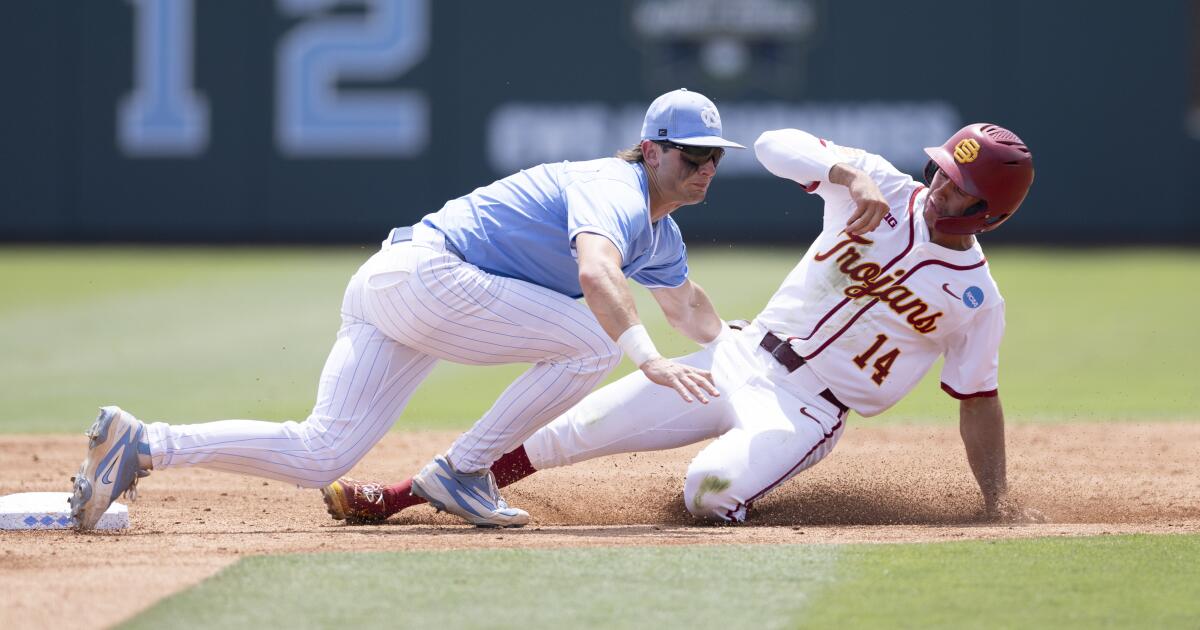
CHAPEL HILL, N.C. — Grant Govel was good, but Jason DeCaro was almost perfect.
USC baseball lost 4-0 in Game 2 of the NCAA Chapel Hill Super Regional, meaning its quest to break a 25-year College World Series drought will come down to a single game on Sunday.
North Carolina (49-12-1) turned to DeCaro with its season on the line, the seventh career NCAA tournament start for the veteran right-hander. DeCaro delivered a complete-game masterpiece, allowing just two hits — singles in the first and fifth innings — with eight strikeouts and one walk on a career-high 117 pitches.
“Obviously it was all about Jason DeCaro,” USC coach Andy Stankiewicz said. “He threw a heck of a game. He spotted his fastball and his breaking ball, we couldn’t get inside of it and couldn’t get through it. A very nice performance obviously by him, but the good thing is, we have tomorrow.”
Outside of giving up a solo home run to Colin Hynek in the second inning, Govel had a strong performance for USC (48-17). After throwing 153 pitches across two appearances in the NCAA regionals, including 64 pitches in Monday’s clinching win over Texas A&M, he gave up just five hits and struck out three over five innings and 83 pitches.
His final pitch was a crucial one, inducing an inning-ending double play with runners on the corners to hold the game at 1-0.
“Physically good,” Govel said when asked how he felt after making 236 pitches over a nine-day span. “I think having a good defense around me the entire time was very helpful. The solo shot didn’t really affect me. I’ve had a lot of homers hit off me this whole entire year. Competing with their guy — hats off to him, he pitched a hell of a game — felt good. The game just didn’t fall where we wanted it to.”
But for all of Govel’s great work, the day was all about DeCaro’s dominance.
North Carolina pitcher Jason DeCaro delivers against USC in Game 2 of the NCAA Chapel Hill Super Regional on Saturday.
(Kara Durrette / For The Times)
North Carolina found success against the Trojans’ bullpen in the sixth. Erik Paulsen hit a 339-foot home run over the left-field corner wall to double the Tar Heels’ lead, just the second home run given up by USC’s Sax Matson all season. The Tar Heels added two more on sacrifice flies in the sixth and seventh innings, but failed to drive in more with the bases loaded in the seventh and ninth innings.
“We pitched well enough to keep ourselves close and give ourselves a shot,” Stankiewicz said. “But at the end of the day, it was just all about DeCaro.”
DeCaro got better as the game continued, retiring the final 10 USC batters. It was a dominant pitching performance, but thanks to USC’s comeback win Friday, the Trojans still have life.
North Carolina coach Scott Forbes confirmed either Folger Boaz or relief ace and National Collegiate Baseball Writers Assn. Stopper of the Year Award finalist Caden Glauber will start Game 3. Stankiewicz did not name a starting pitcher for the decisive game.
Regardless, it will be all hands on deck.
“We’ll need everybody,” Stankiewicz said. “We can’t go too long with too many.”
The game will start at noon PT on ESPN. The Trojans won four elimination games last weekend and they’ll need one more to complete its mission to Omaha.
“We tell our guys Sundays are always important,” Stankiewicz said. “This is probably the most important Sunday that they’ll ever play.”
The biggest afternoon of Trojans baseball in a quarter of a century awaits.
Sports
Maxx Crosby plans to attend America 250 UFC fight, talks White House, Fernando Mendoza, Tom Brady and Olympics

NEWYou can now listen to Fox News articles!
Las Vegas Raiders star Maxx Crosby told Fox News Digital he plans on attending the UFC fight at the White House on June 14 to celebrate America’s 250th anniversary.
“I’ve never been to the White House,” Crosby said. “I’m excited, I like history…
“It’s incredible that we all have an opportunity to celebrate our country and just be part of a historic event… we live in the greatest country in the world and it should be celebrated.”
Maxx Crosby of the Las Vegas Raiders walks on the sideline before a game against the Denver Broncos at Allegiant Stadium in Las Vegas, Nev., on Dec. 7, 2025. (Chris Unger/Getty Images)
For Crosby, as a highly successful NFL star, the celebration represents an opportunity to recognize the freedoms and opportunities he appreciates most as an American.
“You have an opportunity every day to chase your passion,” Crosby said. “Everyone comes from different backgrounds, but in this country you have a choice every day to chase what you love and what you aspire to do. People don’t say the American Dream for no reason. It’s the greatest country because it’s opportunity. It’s a land of opportunity.”
Crosby also revealed who he’s rooting for at the event.
“I think everyone knows how much I love Justin Gaethje,” Crosby said. “Justin Gaethje is one of the greatest fighters to ever do it, and he’s an absolute legend. He’s also a great friend, so I’ll definitely be biased for him. I want to see him go to the White House and do his thing for sure.”
The fight, slated for the South Lawn, came about after Donald Trump casually leaned over to Dana White during a live UFC match and suggested they “do a fight at the White House”. White immediately agreed, and logistics were set in motion days later.
“Dana White is like family to me. He always does it big, and he always does it the biggest and best way. He’s always going to put on an incredible show,” Crosby said.
“I’ve met Trump a couple times, and he’s been incredible to me,” Crosby later added. “I know Dana [White] thinks nothing but the world of him and has a lot of respect for him. But you know we’ve met a couple times, and he’s always been great to me. So, going to the White House, and being there, is going to be a lot of fun for sure.”
Playing flag football for Team USA at the 2028 LA Olympics
Crosby also said he would welcome the opportunity to represent the United States in flag football when the sport makes its Olympic debut at the 2028 Los Angeles Games.
“Oh, no doubt,” Crosby said when asked whether he would consider playing. “I think it’d be incredible.”
While Crosby noted that his family has roots in the Balkans, he made clear where his allegiance would lie if given the opportunity to compete on the international stage.
TEAM USA FLAG FOOTBALL STAR WANTS OPPORTUNITY TO MAKE OLYMPIC TEAM AMID NFL PARTICIPATION
Las Vegas Raiders defensive end Maxx Crosby stands on the field after a loss to the Philadelphia Eagles at Lincoln Financial Field in Philadelphia, Pa., on Dec. 14, 2025. (Eric Hartline/Imagn Images)
“My mom’s side, I’ve got a Yugoslavian background, so I’ve got some Serbian and Albanian in me over there,” Crosby said. “I’m sure they’d give me a call as well, so it’d be an interesting decision.”
Still, the Raiders star said his heart remains with the country where he was born and raised.
“Everyone knows my heart’s here,” Crosby said. “This is the country I’ve been raised in, born and raised, so yeah, it would definitely be special.”
Crosby was also asked whether he would try to recruit Raiders minority owner Tom Brady to play quarterback for Team USA if he joined the Olympic squad.
“I don’t think he would do that,” Crosby said with a laugh. “I think he’s retired and there’s a lot of great quarterbacks right now. But I wouldn’t be mad at Tom Brady coming back. It’s a great time.”
Getting Fernando Mendoza ready for the NFL
Crosby also had high praise for quarterback Fernando Mendoza, who is adjusting to life at the NFL level after a successful college career.
“He’s a young guy and he’s coming in off an incredible season and an incredible college career,” Crosby said. “But when you get to the NFL, you’ve got to start from square one.”
The veteran defensive end said Mendoza has impressed him with his willingness to learn and fit into the locker room.
“I think he’s done an incredible job of just being one of the guys, being humble, being a sponge, just learning from everybody and asking questions,” Crosby said.
WHO IS FERNANDO MENDOZA? THE NFL DRAFT SENSATION NO ONE COULD HAVE PREDICTED
Las Vegas Raiders quarterback Fernando Mendoza warms up during a rookie minicamp at Intermountain Health Performance Center in Henderson, Nev., on May 2, 2026. (Candice Ward/Imagn Images)
But Crosby won’t be taking it easy on the fresh-faced rookie in practice.
“There’s no taking it easy,” Crosby said with a laugh. “We play this game one way, and I’m going to go out there and do what I do. It’s going to help him in the long run and making him better. I want to push all my teammates. That’s how teams improve — by pushing each other and making each other better on a daily basis.”
While many young quarterbacks are immediately compared to established NFL stars, Crosby said Mendoza should be given the opportunity to carve out his own identity.
“A lot of times people try to make comparisons,” Crosby said. “People just need to allow Fernando to be Fernando. I think he’s going to be a really special player.”
Playing for Tom Brady
Crosby also spoke about the unique opportunity to play for an organization that includes NFL legend Tom Brady as a minority owner.
“Tom has had one of the greatest careers, if not the greatest career, of anybody,” Crosby said. “He’s an incredible player and won at the highest level.”
Tom Brady looks on before the game between the Los Angeles Chargers and the Washington Commanders at SoFi Stadium on Oct. 5, 2025. (Jayne Kamin-Oncea/Imagn Images)
While Brady isn’t involved in the day-to-day operations of the franchise, Crosby said having someone with his experience around the organization is a valuable resource.
“Anybody you get around an organization that has done it at that level, I think is a positive,” Crosby said. “He’s not there all the time, but he is a resource for people in that building. I think his winning mindset is only a plus.”
Crosby only played Brady once before Brady retired.
“I wish we could have had a couple more swings at it,” Crosby said.
A big partnership
Crosby’s appearance with Fox News Digital came as part of a partnership with SAXX Underwear, a brand he said immediately caught his attention for more than one reason.
“Obviously, everyone knows I make a living sacking quarterbacks, so the name alone drew me in,” Crosby joked. “The double X was a bonus, too.”
But beyond the name, Crosby said he became a fan of the product itself. Crosby said the product has become part of his everyday routine.
“I literally wear it every single day,” Crosby said. “I wear it during workouts, I wear it around the house, I literally wear it everywhere I go.”
CLICK HERE TO DOWNLOAD THE FOX NEWS APP
Still, while Crosby wears it to workouts, he won’t be wearing it during games.
“It’s not NFL certified yet,” he said. “But I wear it to the games, for sure.”
-

 Los Angeles, Ca47 minutes ago
Protests mark 1-year anniversary of federal agents storming L.A.’s Fashion District
-

 Detroit, MI1 hour ago
Hundreds gather for rally against gun violence on Detroit’s east side
-

 San Francisco, CA1 hour ago
San Francisco unveils iconic Pink Triangle to kick off Pride Month
-

 Miami, FL1 hour ago
Miami Dolphins Discussion: Could He Be The One
-

 Dallas, TX1 hour ago
Dallas Hoops Journal Podcast: James Barlowe Details Mavs’ NBA Draft Options
-

 Boston, MA1 hour ago
NBA insider believes Giannis Antetokounmpo’s intrigue in Celtics ‘is real’
-

 Denver, CO2 hours ago
Denver weather: More hot weather Sunday
-

 Seattle, WA2 hours ago
PHOTOS: West Seattle High School alums gather for 2026 All-School Reunion

