World
UK police arrest four people for pro-Palestine ‘Intifada’ calls


Arrests made at protests supporting imprisoned Palestine Action hunger strikers, as Gaza death toll surpasses 70,000.
Published On 18 Dec 2025
Police in the United Kingdom have made their first arrests since announcing their intent to crack down on people making public calls to “globalise the Intifada” after Australia’s Bondi Beach attack, speciously linking largely peaceful protests against Israel’s genocidal war with a deadly targeting of a Jewish festival.
London’s Metropolitan Police posted on X late on Wednesday that it had made four arrests at pro-Palestinian protests held outside the Ministry of Justice in Westminster, “all involving the alleged shouting or chanting of slogans involving calls for intifada”.
list of 3 itemsend of listRecommended Stories
The arrests were made at a demonstration that had been called in support of eight imprisoned hunger strikers, whose lives are in peril. They were jailed over connections to the Palestine Action group, just hours after the Metropolitan (Met) and Greater Manchester Police (GMT) said they would be “more assertive” in policing pro-Palestine protests to counter alleged anti-Semitism.
UK Safeguarding Minister Jess Phillips backed the Met’s action. “I cannot think of any interpretation other than that [it] is inciting people to violence, which has the terrible consequences,” she was cited as saying by The Times of London.
But Ben Jamal, from the Palestine Solidarity Campaign, pointed out in a statement that the Arabic word “intifada” means “shaking off or uprising against injustice”.
In the Palestinian context, the word is understood to mean civil uprising against military occupation and illegal settlement expansion, with key historical instances in 1987-93 and 2000-05, drawing brutal responses from Israel that left thousands of people dead.
Jamal criticised the lack of consultation over the new police stance, saying on X that “forces across the political establishment” were using the “grotesque racist violence on Bondi beach” to delegitimise any protest against “open genocide”.
The police crackdown follows father-and-son gunmen killing 15 people Sunday at a Hanukkah festival on the Sydney beach and an October attack on a Manchester synagogue on Yom Kippur, the holiest day of the Jewish calendar.
“Violent acts have taken place, the context has changed – words have meaning and consequence. We will act decisively and make arrests,” said the commanders of the Met and GMP in a joint statement.
Jewish groups welcomed the announcement, with the UK’s Chief Rabbi Ephraim Mirvis calling it “an important step towards challenging the hateful rhetoric we have seen on our streets, which has inspired acts of violence and terror”.
Groups like the Community Security Trust (CST), which works to provide security to protect British Jews, say anti-Semitic incidents have risen in the UK.
In the meantime, Islamophobia and attacks against Muslims in the UK, prompted by racist rhetoric in mainstream politics on the right of the political spectrum, most prevalently but not only by Nigel Farage’s Reform party and its supporters, have soared in recent years.



NEWYou can now listen to Fox News articles!
Someone was playing possum — or stuffed animal.
Among plush kangaroos, dingoes and Tasmanian devils ready to be bought by parents of antsy children, a live brushtail possum waited in a gift shop at an Australian airport this week.
The wild animal was first noticed by a shopper in the store on Wednesday, retail manager Liam Bloomfield of Hobart Airport in the state of Tasmania said.
“A passenger reported it to …. one of the staff members on shift who couldn’t quite believe what she was hearing,” Bloomfield told The Associated Press. “She then called the (airport) management and said we’ve got a possum in the store.”
TOURISTS IN LAS VEGAS PAY $1,000 FOR DINNER ON THE STRIP WHILE SHARKS EAT LIKE ROYALTY
A live Australian brushtail possum sits on the display shelf at a terminal shop at Hobart Airport in Hobart, Australia, on Wednesday. (Melissa Oddie via AP)
Staff at the airport were able to remove the animal without harming it.
“I’m imaging it saw some of the plush animals that were for sale on the shelf and it decided to make its home with those,” Bloomfield joked of why the possum was hiding with the stuffed toys. “It wanted to blend in.”
EXPERT SOUNDS ALARM AFTER STUDY FINDS POPULAR TRAVEL ITEM CARRIES FAR MORE BACTERIA THAN EXPECTED
The arrivals area at Hobart Airport in Australia. (Steve Bell/Getty Images)
“Can you spot the imposter?” the airport wrote in a Facebook post Thursday that showed the possum curled up in a cubby with its stuffed counterparts.
“This cheeky lost possum found a clever hiding place among the Aussie plushies in our retail store,” the airport continued. “Luckily it was safely relocated out of the terminal area and the space was cleaned.”
Passengers boarding a plane at Hobart Airport in Australia. (William West/AFP via Getty Images)
CLICK HERE TO DOWNLOAD THE FOX NEWS APP
Bloomfield said the possum not only found a way into the airport but also their hearts.
“We’ll have a little shrine to the possum,” he revealed, according to The Independent. “There will be a nice little photo; once it gets a name, we will put a nice little post in front of the store to make sure it’s remembered.”

Published on •Updated
From a start-up founded in Malaga in 2015 with a few thousand euros, Ly Company has become one of Europe’s fastest-growing multinationals, and a global leader in the sustainable water packaging sector.
ADVERTISEMENT

ADVERTISEMENT
With ten factories located across Europe, Latin America and the Middle East, Ly Company produces about 10 million bottles of water in cardboard packaging per month.
Unlike most competitors, Ly Company doesn’t owe its success to mass retail firms.
It sells personalised products to more than 3,000 brands, ranging from airlines and hotel chains to private transport companies and major events organisers. “There is a lot of water in sectors where no one thinks it is consumed”, notes Rodríguez. “An airline, for example, can consume 50 million bottles per year.”
The company is now targeting China and, above all, the United States.
Its positioning is also based on sustainability: factories powered by green energy, cardboard from responsibly managed forest, bioplastic made from sugar cane and water guaranteed to be microplastics-free. Part of the profits fund his “Agua y Vida” Foundation, which is involved in environmental and humanitarian projects.
“I’ve gone through some very difficult times. Now that I’m doing well, I want to give something back to society”, explains Curro Rodríguez.
Behind this rise lies a chaotic journey. While working as a first-responder in emergency medical services for twenty years, he was simultaneously launching businesses, sometimes risky ones. Two successive bankruptcies saw him resort to food aid and doing odd jobs for a while, before he reinvented himself.
“My passion is bringing projects to life”, explains Curro Rodríguez, who has founded a total of 39 companies, 23 of which are currently active within his holding company. “When things are done out of emotion, and not for money, they create value. The money follows. But you have to look for value first”, he concludes, a big smile on his face.

new video loaded: What Tunnel Entrances Reveal About a Key Iranian Nuclear Site
transcript
transcript
What Tunnel Entrances Reveal About a Key Iranian Nuclear Site
Satellite images show how Iran has tried to bolster its defenses at parts of the Isfahan nuclear facility.
-
What you’re seeing here are buried tunnel entrances at a nuclear facility in Iran. It’s one of the most important sites in the country for U.S. and Israeli forces. U.N. inspectors think that roughly half of Iran’s highly enriched uranium is buried here. And these three entrances are the only known ways to access it. If you think about nuclear sites in Iran, three main sites come to mind. They’re pretty well known: Fordo, Natanz and Isfahan. Natanz and Fordo, They were largely taken out in U.S. strikes last year. So I’ve been focusing on Isfahan. The uranium here is still relatively accessible. It’s actually a pretty large complex. This area here was very important for uranium processing, but it was heavily hit by the U.S. and Israel last June. If you go a little bit further north, that is underground and that requires tunnels to enter. In a terrain view, it gets quite interesting. There are three roads that lead to these tunnel entrances, and these tunnel entrances have become very important, both last year, but also right now. They lead to the underground facility where U.N. inspectors say uranium is stored and a new enrichment site could be located. If this falls into the wrong hands, that would be a problem in the long term. Here’s a great example of how very recent satellite imagery gives us new insights. This is from late January of this year, and what you see here is a line of trucks. And they’re filled with soil, and they’re lining up to go to some of these tunnel entrances. If you look a little bit closer here, you see another one of these trucks that’s just unloading some of the soil and some earthmoving equipment. Iran in preparation for any possible attacks at that point. They try to protect this facility a little bit more. So this is Jan. 29. And if you just look a few days later, we go to Feb. 2. This is the completely buried tunnel entrance, completely covered in soil to protect from any attack. And this is how it still looks in mid-March. The U.S. and Israel have basically two options here: The first one is to heavily bombard the entrances to this underground complex that would block any access, at least in the near future. They haven’t done that yet. So that’s very, very interesting — a little bit surprising. And it might point towards a second option: That would be to go in with ground forces and to extract the uranium. But that would require a really large amount of troops to secure the vast area, bringing in earthmoving equipment to clear the tunnels and a lot of time in hostile territory.

By Christoph Koettl and Alexander Cardia
March 20, 2026

ARKANSAS A-Z: Arkansas plays role in ‘Woman They Almost Lynched’ | Arkansas Democrat Gazette

I booked a bedroom and a roomette on the same overnight Amtrak train. The bedroom is worth the splurge for longer rides.

Tribes want input, influence on Colorado River drought plan

CT Agency Picked To Lead Federal Career Training Grant Expansion

Delaware County uses AI traffic cameras to ease congestion on Lancaster Avenue

Florida High School Football Rankings: Top 25 teams – Oct. 21

How old is Bo Nix? What to know about Oregon quarterback ahead of 2024 NFL Draft

Cleary's 21 help Le Moyne down Central Connecticut State 69-64 in OT

99th annual Pony Swim held in Virginia

Indiana Members Credit Union announced as new anchor tenant at Bottleworks District

Read the Ruling in The Times’s Lawsuit Against the Pentagon

NYC Mayor Mamdani’s wife glorified terrorists in online posts, criticized US military: report

Curro Rodríguez: from bankruptcy to global water empire

Jury finds Elon Musk misled investors during Twitter purchase

Pritzker pushes prosecutions of Trump officials as part of Dem ‘Project 2029’ agenda
-

 Detroit, MI2 days ago
Drummer Brian Pastoria, longtime Detroit music advocate, dies at 68
-

 Oklahoma7 days ago
Family rallies around Oklahoma father after head-on crash
-

 Nebraska1 week ago
Wildfire forces immediate evacuation order for Farnam residents
-

 Georgia5 days ago
How ICE plans for a detention warehouse pushed a Georgia town to fight back | CNN Politics
-

 Massachusetts1 week ago
Massachusetts community colleges to launch apprenticeship degree programs – The Boston Globe
-

 Alaska6 days ago
Police looking for man considered ‘armed and dangerous’
-
 Southwest1 week ago
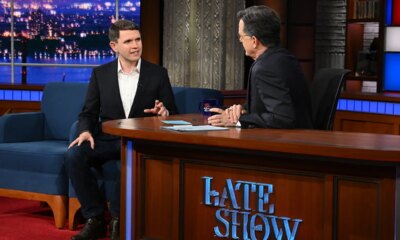
Talarico reportedly knew Colbert interview wouldn’t air on TV before he left to film it
-

 Michigan1 week ago
Michigan-based Stryker hit with cyberattack