Politics
Democrats excluded from USC gubernatorial debate urge rivals to boycott in solidarity

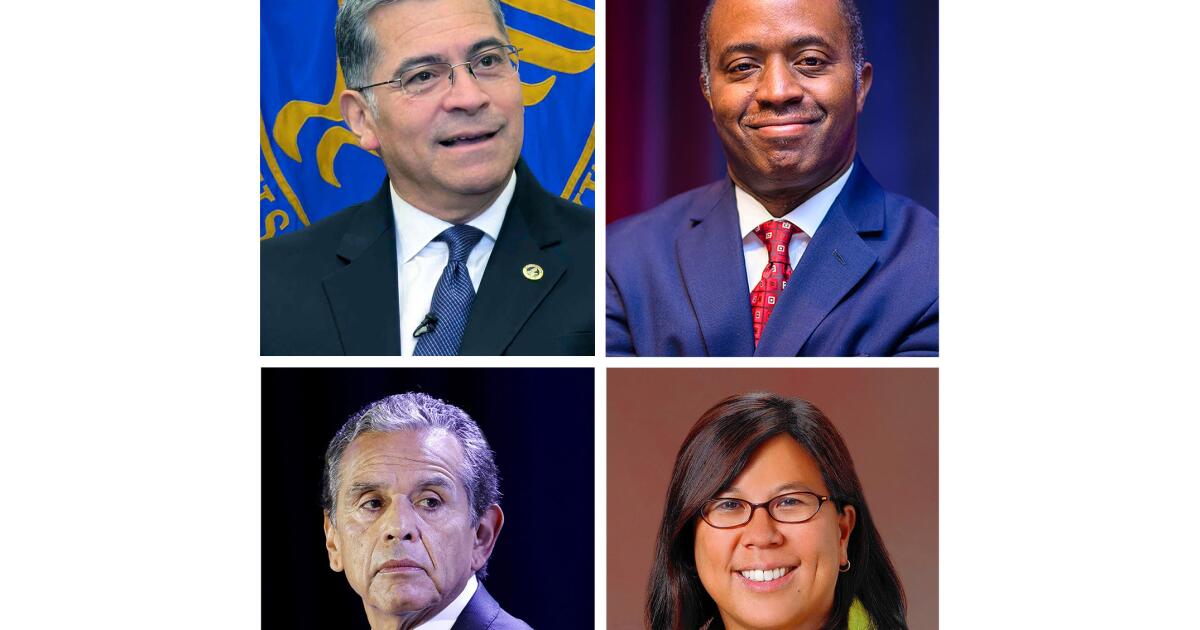
Four Democrats running for governor called on their fellow candidates to boycott an upcoming debate at USC, reiterating concerns that the criteria used to determine who was invited to participate resulted in every prominent candidate of color being excluded from the forum.
“We ask each and every candidate who is in this race to recognize that if we can’t have a fair process for a debate, then we should all not participate,” said Xavier Becerra, the former U.S. Health and Human Services secretary. “We call on them to withdraw from this biased forum.”
Becerra’s call was echoed by former Los Angeles Mayor Antonio Villaraigosa, state Supt. of Public Instruction Tony Thurmond and former state Controller Betty Yee during a Friday afternoon news conference.
The candidate’s request comes a week after some of them raised concerns about the criteria for Tuesday’s debate, arguing that it was engineered to allow the inclusion of San José Mayor Matt Mahan, who entered the race in late January and quickly raised millions of dollars from Silicon Valley executives.
“The rules initially were polling and money. Matt Mahan is [polling] lower than some of us, period,” Villaraigosa said, adding that the debate organizers “then added time in the race,” which resulted in Mahan’s invitation.
Mahan’s campaign did not respond to a request for comment on Friday, but when Becerra raised such concerns last week, Mahan said the former Biden administration official ought to be included in the debate.
The matter is further complicated by Mahan supporters who have notable ties to the university.
Mike Murphy, a co-director of the USC center hosting the debate, has been voluntarily advising an independent expenditure committee backing Mahan. The veteran GOP strategist said last week that he had nothing to do with organizing the debate and that he has asked for unpaid leave at the university through the June 2 primary if he takes a paid role in the campaign.
USC has also received tens of millions of dollars in donations from billionaire real estate developer Rick Caruso and his wife. Caruso, a USC alumnus who served as a trustee for years, is also a Mahan supporter.
A representative for Caruso did not respond to a request for comment.
The debate, hosted by the USC Dornsife Center for the Political Future, KABC-TV Los Angeles and Univision, is scheduled to take place on campus at 5 p.m. Tuesday — less than two months before ballots begin arriving in voters’ mailboxes. The forum will be streamed and broadcast on ABC and Univision affiliates across the state.
USC and the television stations put out a joint statement Friday morning, prior to the candidates’ news conference, justifying the criteria used to determine who was invited to participate and saying none of the debate partners had any influence on the methodology.
“We want to be clear that we categorically, unequivocally deny any allegations that the debate criteria was in any way biased in favor or against any candidate and want to clarify the facts,” they said in a statement, adding that Christian Grose, a USC political science professor, was asked to develop “data-driven” benchmarks to determine which candidates were invited.
“The methodology was based on well-established metrics consistent with formulas widely used to set debate participation nationwide — a combination of polling and fundraising — and developed without regard to any particular candidate.”
After the Democratic candidates called for their competitors to not participate, USC and KABC declined to comment further. Univision did not respond to a request for comment.
Grose defended the methodology he crafted as “objective” in an interview Friday, and said he met with Becerra as well as the staff of other candidates to explain it.
“The idea that it was biased or designed to create some sort of outcome to disfavor the candidates who spoke at the press conference is just not correct,” Grose said, adding that attacks on the methodology have a “chilling effect” on universities and media outlets who sponsor debates.
“I’m not worried about the optics,” he said. “The optics are we are having a debate at USC to inform voters and educate students.”
Jarred Cuellar, a political science assistant professor at Cal Poly Pomona, described Grose’s methodology as “thoughtful” and “empirically grounded,” and characterized the concerns raised by candidates not included in the debate as unfounded and not credible.
“The formula is methodologically sound and represents a clear improvement over how debate participation has often been determined,” he said. “Rather than relying on a single metric such as polling, it takes a multidimensional approach to evaluating candidate viability. That approach better reflects how political scientists measure complex phenomena like electoral competitiveness.”
But the controversy has caused consternation among USC professors past and present.
“It seems like an unforced error that is casting the entire event in a bad light,” said a current USC professor who closely follows politics but is not involved in the debate, and who asked for anonymity to speak candidly. “It’s super important that if the debate happens, it happens correctly.”
Darry Sragow, a veteran Democratic strategist who taught election and environmental law at USC for 19 years, said that while he believes the large field of Democratic candidates needs to be winnowed, that’s not the job of a university or media outlets.
“Every one of these eight [Democratic candidates] is capable of running the state of California,” he said. “It would certainly be my advice to USC and to Univision and to ABC to allow all the candidates to take part, or to cancel the debate.”
The four Democratic candidates not invited to the debate argued that voters are just starting to pay attention to the thus-far sleepy race and that diverse candidates should be represented.
“We are a minority-majority state, and the idea that the four candidates of color are not going to be on the stage to bring those perspectives, to really speak to those communities, is really not doing right by the voters,” Yee said.
Becerra said some of the candidates had requested to speak with top university leadership, including President Beong-Soo Kim. In other conversations, he said university officials raised the possibility of “either canceling this debate or incorporating more of the candidates in it. Evidently they could not agree to do that. … I think they recognize that there were problems with the way this debate had been organized.”
Becerra said he reviewed the formula and has “never seen” debate criteria like it before during his decades of serving in elected office.
“Your fundraising numbers are divided by the number of days you’ve been out there campaigning in front of voters,” he said. “So you could have raised millions of dollars, but if you’ve been in longer than someone else who just raised millions of dollars very quickly, you get penalized.”
Campaigns for most of the invited candidates — Democrats Rep. Eric Swalwell of Dublin, former Orange County Rep. Katie Porter, climate activist Tom Steyer and Mahan; as well as Republican Chad Bianco, the sheriff of Riverside County — did not respond to requests for comment on the call to boycott the debate.
Former Fox News commentator Steve Hilton, a Republican who will be appearing at the debate, blasted the Democrats who were upset about not qualifying for the debate as well as USC’s debate criteria as “completely ridiculous.”
“You’ve got a bunch of Democrats that aren’t doing well enough to get into the debate, complaining about it, and I don’t have any time for that at all. Do better, and then you’ll get in the debate,” Hilton said in a video posted Friday evening on the social media platform X. “Then you’ve got Matt Mahan, who’s a candidate who’s just got into the race, absolutely doesn’t meet the criteria, but they’ve rigged the rules in order to get him in.”
Hilton said he was also offended by the exclusion of developer Elaine Culotti, who starred in the second season of the reality show “Undercover Billionaire” and is running for governor as an independent.
“She’s a businesswoman, she’s got a big following. There’s a lot of independent voters in California now. Of course, I would love those voters to support my campaign, but the fact that you don’t have an independent on that stage, you’ve got a bunch of Democrats, and you’ve got two Republicans, but no independent, that is outrageous,” Hilton said of Culotti, who has never registered support in any public polls. “She should be on that stage next week at USC.”

SACRAMENTO — Gov. Gavin Newsom and Democratic leaders of the California Legislature plan to approve a proposed constitutional amendment this week that would ask voters to give them more flexibility over state spending and allow them to save money that could otherwise go back to taxpayers.
The proposal seeks to exempt deposits into state savings accounts from a spending limit that voters adopted through a series of ballot measures dating back to the late 1970s and to increase the share of tax revenue that can be put into the rainy day fund.
“Putting money aside to protect ourselves from future uncertainties isn’t just good government; it’s common sense,” Newsom said in a statement. “California is strong and resilient, but we’re not immune to economic headwinds. At a time when our essential services are under pressure, we have a responsibility to safeguard the programs and investments that Californians rely on.”
Assembly Constitutional Amendment 20, which Democrats are calling the “Save for California’s Future Act,” could receive push back from taxpayer advocates.
Under an existing state appropriations restraint, also known as the Gann limit, lawmakers cannot spend more than an amount determined by a formula that takes into consideration annual tax proceeds and changes to the population and cost of living. Tax revenue above the limit must be divided between schools and refunds to taxpayers.
With few exceptions, the limit applies to most appropriations of tax revenue, including money that lawmakers tuck away into the rainy day fund and other reserves. California voters have also capped the amount of money lawmakers can set aside in the rainy day fund to 10% of general fund proceeds in a given year.
Since taking office, Newsom has argued that it doesn’t make sense for savings to count as spending under state law.
State budget revenue is subject to dramatic swings from year to year based on stock market activity. The law, Newsom has said, prevents the state from saving more money in good years to stave off cuts to programs in bad years.
The proposed changes would exempt deposits into the rainy day fund and a short term reserve, called the “Projected Surplus Temporary Holding Account,” from the state appropriations limit. The cap on the rainy day fund would grow from 10% of general fund tax revenue to 20%.
“Californians live by a simple, bipartisan truth: set money aside when times are good so you’re ready when they’re not,” Assembly Speaker Robert Rivas (D-Hollister) said in a statement. “The Save For California’s Future Act is what responsible leadership looks like — and future taxpayers will thank us for it.”
The measure could incentivize Democrats to save more money because funds tucked away in the rainy day fund would no longer be considered expenditures counted toward the spending limit. By allowing lawmakers to set aside more money that is not subjected to state spending limits, it could also allow them to hold onto money that would be returned to taxpayers under current law.
The measure is slated for a vote Thursday. If approved by two-thirds of lawmakers, voters will consider the proposal on the November ballot.
Politics
Social media erupts over Mamdani’s silence after Brooklyn coffee shop bans Jewish congressman

Socialists push progressive agenda in NYC primaries
Fox News national correspondent Bryan Llenas reports on the New York City primary, highlighting the influence of socialists. Candidates backed by Zohran Mamdani advocate for abolishing ICE and all deportations, even for convicted murderers.
NEWYou can now listen to Fox News articles!
New York City Mayor Zohran Mamdani is facing swift backlash after declining to condemn a local coffee chain that told a Jewish congressman with pro-Israel views that he was not welcome.
Mamdani has remained silent after the Williamsburg, Brooklyn-based Poetica coffee shop posted — and later deleted — a message on social media telling Rep. Dan Goldman, D-N.Y., not to return after he stopped by the shop with his daughter Monday. The mayor declined to comment through a spokesman when contacted by The New York Times on Monday.
“Shameful,” Fox News Radio analyst Josh Kraushaar wrote on social media in response to a section of The Times story detailing that Mamdani declined to comment.
“Well folks, we’ve reached the stage of antisemitism where Jews are being publicly barred from businesses,” the CEO and co-founder of the antisemitism-focused nonprofit Boundless Israel said on X. “A coffee shop in Mamdani’s New York City told Jewish Congressman Dan Goldman he wasn’t welcome in their store.”
Zohran Mamdani announces new members of his team at the Brooklyn Public Library Greenpoint Branch in Brooklyn on Dec. 17, 2025. (Shawn Inglima/New York Daily News/Tribune News Service via Getty Images)
MAMDANI SKIPS ISRAEL DAY PARADE DESPITE JOINING OTHER CULTURAL CELEBRATIONS
“The café is implementing Mamdani’s wishes,” journalist Melissa Braunstein said.
Fox News Digital reached out to Mamdani’s office for comment but did not immediately hear back.
In a since-deleted social media post, Poetica Coffee said it would have declined to serve Goldman had staff recognized him in the store. Goldman has notably declined to characterize Israel’s war in Gaza as a genocide and has received financial contributions from the pro-Israel lobby AIPAC, drawing criticism from some on the progressive left.
“Hey Congressman Dan Goldman, we see that you stopped by our shop today for a coffee. Do you see how it doesn’t taste like genocide juice? Or are you still having a hard time telling the difference?” the post said.
“See, here at Poetica, we don’t serve racists, fascists, homophobes, genocide enablers, or anyone in between,” the post continued. “Too bad we didn’t recognize you right away, or we would have turned you away. We issued you a refund—we don’t need your money (it’s probably coming from AIPAC anyways). Enjoy your loss on Tuesday. Don’t ever come to Poetica.”
The coffee chain has since deleted its Instagram page amid social media backlash.
Mamdani’s silence comes as he is working to unseat Goldman, despite the incumbent lawmaker being a leading Trump critic and embracing an array of leftist legislative proposals. Goldman notably did not endorse Mamdani’s mayoral campaign, citing concerns about how his administration would approach Jewish New Yorkers.
A Brooklyn, N.Y., coffee shop refunded a purchase made by Rep. Dan Goldman, D-N.Y., over the weekend over his support for Israel, saying the company doesn’t serve “genocide enablers.” (Getty Images; Google Maps)
The mayor publicly backed former New York City Comptroller Brad Lander to represent Goldman’s district, which spans Lower Manhattan and deep-blue, wealthy pockets of Brooklyn.
Democratic voters will decide whether to hand Goldman a third House term during the Empire State’s primary elections on Tuesday.
NY DEM WOULDN’T BACK MAMDANI FOR MAYOR — NOW MAMDANI IS BACKING HIS CHALLENGER
Since both men largely hold the same policy stances, the bruising primary battle has revolved around support for Israel — with Lander vowing to elevate the Palestinian cause if elected to the House.
Goldman has notably supported military aid to Israel following Hamas’ Oct. 7, 2023, attacks and distanced himself from inflammatory rhetoric used by some on the left to criticize Israel.
Goldman offered a tempered response after the coffee chain effectively banned him from their storefronts.
“I’m sorry to see this post,” he said. “The barista could not have been nicer to my 7-year-old daughter and me—allowing her to use the bathroom even though we had not purchased anything. I made sure to buy a coffee in return for her kindness. I hope you at least make sure she gets the tip that she deserved.”
New York City Mayor Zohran Mamdani speaks in support of Brad Lander, Democratic candidate for Congress in New York’s 10th Congressional District, in Carroll Park in the Carroll Gardens neighborhood of Brooklyn on June 14, 2026. (Shuran Huang/For The Washington Post via Getty Images)
CLICK HERE TO DOWNLOAD THE FOX NEWS APP
Assistant Attorney General for Civil Rights Harmeet Dhillon said Tuesday her office has opened an investigation into the matter.
“Federal law prohibits public accommodations such as coffee shops from discriminating against patrons based on their race, religion, or national origin,” Dhillon wrote. “These actions are not only reprehensible, they’re potentially illegal.”

Attorneys general in seventeen states are suing California over its landmark single-use plastic law, which went into effect on June 1.
The lawsuit comes after a coalition of environmental groups sued the state over the same law this month, arguing the new final regulations create loopholes so large they gut the law.
The states are led by Nebraska Atty. Gen. Mike Hilgers, and the plaintiffs include the National Assn. of Wholesaler-Distributors. The coalition is asking the court to block enforcement of the law immediately.
“Once again, California is trying to enact a policy that negatively impacts the rest of the country,” said Hilgers in a news release. “If California goes unchecked, consumers will be forced to pay more for basic necessities.”
The other states in the coalition are Alabama, Florida, Georgia, Idaho, Indiana, Iowa, Louisiana, Missouri, Montana, North Dakota, Oklahoma, South Carolina, South Dakota, Texas, Utah and West Virginia. The lawsuit was filed in the U.S. District Court of Eastern California in Sacramento on Monday.
State Senate Bill 54, the Plastic Pollution Prevention and Packaging Producer Responsibility Act, was signed by Gov. Gavin Newsom in 2022. It was considered landmark legislation because it requires plastic and packaging companies to use less single-use plastic and ensure by 2032 that all food packaging is either recyclable or compostable.
Accumulating plastic waste is overwhelming waterways and oceans, sickening marine life and threatening human health.
The intent was not only to reduce single=use plastic, but also to put the onus and cost of dealing with it on packaging producers and manufacturers, not consumers and local governments. It was supposed to incentivize companies to consider the fate of their products and spur innovation in material redesign.
Plastic bottles of dishwashing liquid at Compton’s Market in Sacramento on June 17, 2022.
(Rich Pedroncelli/AP)
According to one state analysis, 2.9 million tons of single-use plastic and 171.4 billion single-use plastic components were sold, offered for sale or distributed during 2023 in California.
The single-use plastic law is what is known as a producer responsibility law. It emphasizes the idea of a “circular economy” in which the producer of a material must consider its fate — making sure it can be reused or recycled, or at least reduced.
In California, all producers of single-use packaging and plastic foodware (plates, knives, spoons, etc.) join a private entity known as a producer responsibility organization. Only one such organization has been approved in California: the Circular Action Alliance.
The states and the National Assn. of Wholesaler-Distributors say the plastic law discriminates against businesses selling into the state in two ways: by making them change or alter their plastic packaging and by conferring government authority upon the alliance, enabling a private entity to regulate and impose taxes and fees on businesses selling into California.
“California is not entitled to pronounce nationwide policies,” Eric Hoplin, president and chief executive of the wholesalers group, said in a statement. “Because the Act extends California’s regulatory reach far beyond its borders and brings within its sweep conduct wholly unconnected to California, the Act violates principles of federalism, the horizontal separation of powers, and due process.”
In addition, the attorneys general say the law suppresses their free speech by compelling companies to join and fund the speech of an organization with which they may disagree.
Hoplin and his organization filed a similar suit in Oregon in February. Oregon has a comparable single-use plastic law. A federal judge blocked enforcement of that law. A trial begins on July 13.
Heidi Sanborn, executive director and CEO of the National Stewardship Action Council, which advocates for the producer responsibility laws and a more circular economy, said in May that both SB 54 and the Oregon law are public policies that were “passed by legislatures and implemented with government oversight.”
She said the laws create clear and consistent rules so all producers contribute fairly to the cost of recycling and waste management.
Meanwhile, environmental groups are also unhappy.
On June 2, Oceana, the Natural Resources Defense Council and Californians Against Waste Foundation filed a lawsuit in San Francisco Superior Court.
They allege that the final regulations for the law, drafted and approved by the state’s waste agency, include exclusions for large categories of plastic packaging that companies could use indefinitely. In addition, they say, the regulations also allow for recycling technologies that pollute, such as chemical recycling, which the law as originally drafted forbids.
“While SB 54 remains a monumental achievement as the nation’s strongest single-use plastic reduction law, some of the final regulations implementing the statute undermine the law’s ambitions,” Christy Leavitt, Oceana’s senior campaign director, said in a statement.
-
 Lifestyle3 minutes ago
‘Worth every penny’: This is how much fans spent to attend the World Cup in L.A.
-
Politics6 minutes ago
Democrats want California voters to give them more flexibility over spending
-
 Sports21 minutes ago
Dodgers game to start 30 minutes late; give updates on Kyle Tucker and Dalton Rushing
-

 World33 minutes ago
Iceland kills first whales since 2023, resuming whaling
-

 News56 minutes ago
ODNI under Pulte fires 6 staff, sends 45 back to home agencies
-

 Los Angeles, Ca2 hours ago
Air quality concerns remain as the Boyle Heights warehouse fire continues to burn
-

 Detroit, MI3 hours ago
Wenceel Pérez returns home, but when will he return to Detroit Tigers?
-

 San Francisco, CA3 hours ago
San Francisco Supervisor Jackie Fielder to return following mental health leave

