News
Jury finds Elon Musk misled investors during Twitter purchase

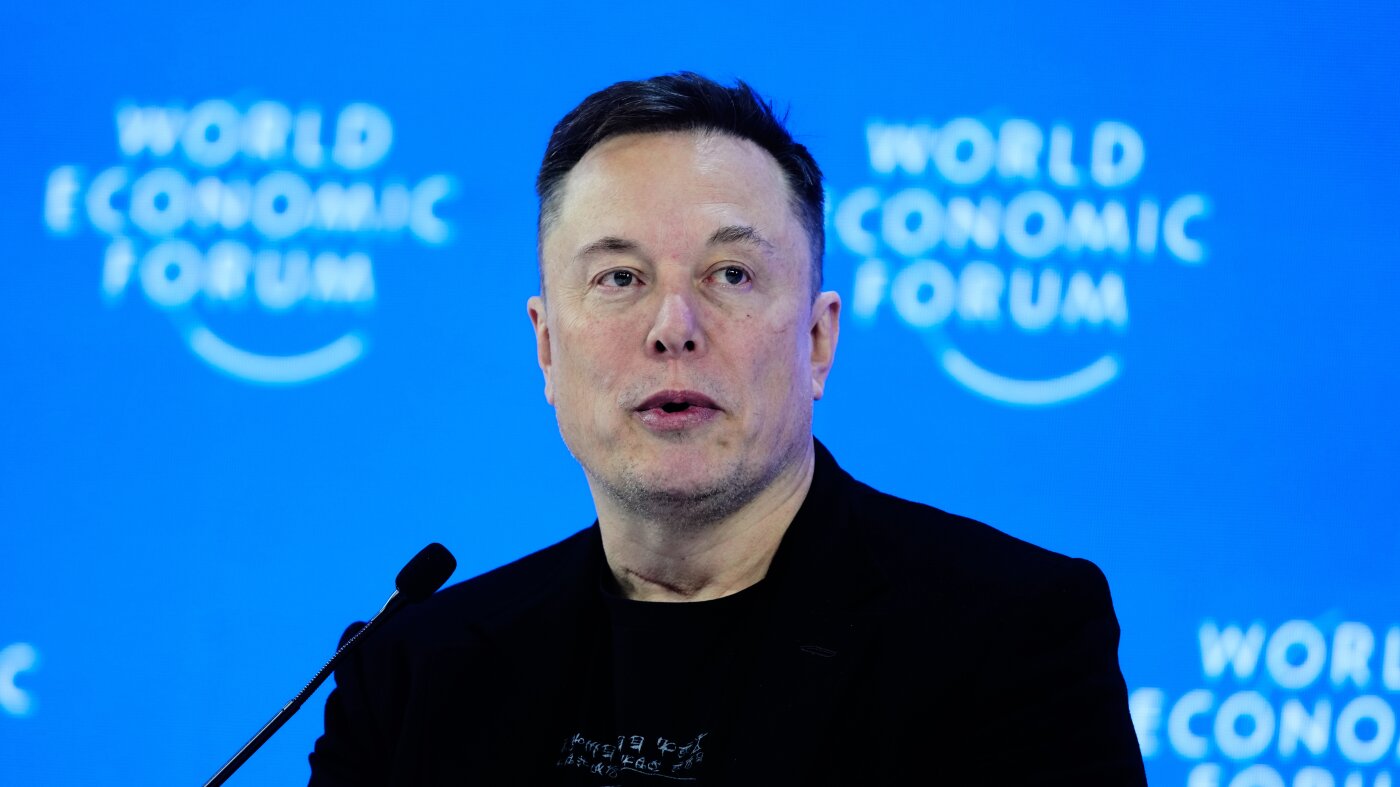
Elon Musk attends the annual meeting of the World Economic Forum in Davos, Switzerland, on Jan. 22.
Markus Schreiber/AP
hide caption
toggle caption
Markus Schreiber/AP
SAN FRANCISCO — A jury has found Elon Musk liable for misleading investors by deliberately driving down Twitter’s stock price in the tumultuous months leading up to his 2022 acquisition of the social media company for $44 billion. But it absolved him of some fraud allegations, finding that he did not “scheme” to mislead investors.

The civil trial in San Francisco centered on a class-action lawsuit filed just before Musk took control of Twitter, which he later renamed X. Jurors were asked to decide if two tweets and comments Musk made on a podcast in May 2022 amounted to him intentionally defrauding Twitter shareholders, who sold their shares based on Musk’s statements.

The nine-person jury returned the verdict after nearly four days of deliberation, nearly three weeks after the trial began on March 2. They said that while Musk was liable for misleading investors with two tweets — including one said the Twitter deal was “temporarily on hold,” he did not do so with a statement he made on a podcast and that he did not intentionally “scheme” to defraud investors.
The jury awarded shareholders between about $3 and $8 per stock per day as damages, which the plaintiffs’ lawyers said amounts to about $2.1 billion. Musk’s fortune is currently estimated at about $814 billion, much of it tied up in Tesla shares.
“It’s an important victory, not just for investors of Twitter, but for the public markets,” said Joseph Cotchett, an attorney for the plaintiffs. “I think the jury’s verdict sends a strong message that just because you’re a rich and powerful person, you still have to obey the law, and no man is above the law.”
Musk’s lawyers said they had no comment as they walked out of the courtroom.
Much of the trial focused on Musk’s claims about the number of bots on Twitter. Musk testified that Twitter had a much higher number of fake and spam accounts than the 5% it disclosed in regulatory filings. He used what he called Twitter’s misrepresentation of the number of fake accounts on its service as a reason to retreat from the purchase.
After Musk tried to back out, Twitter went to court in Delaware to force him to honor his original deal. Just before that case was scheduled to go to trial, Musk reversed course again and agreed to pay what he had originally promised.
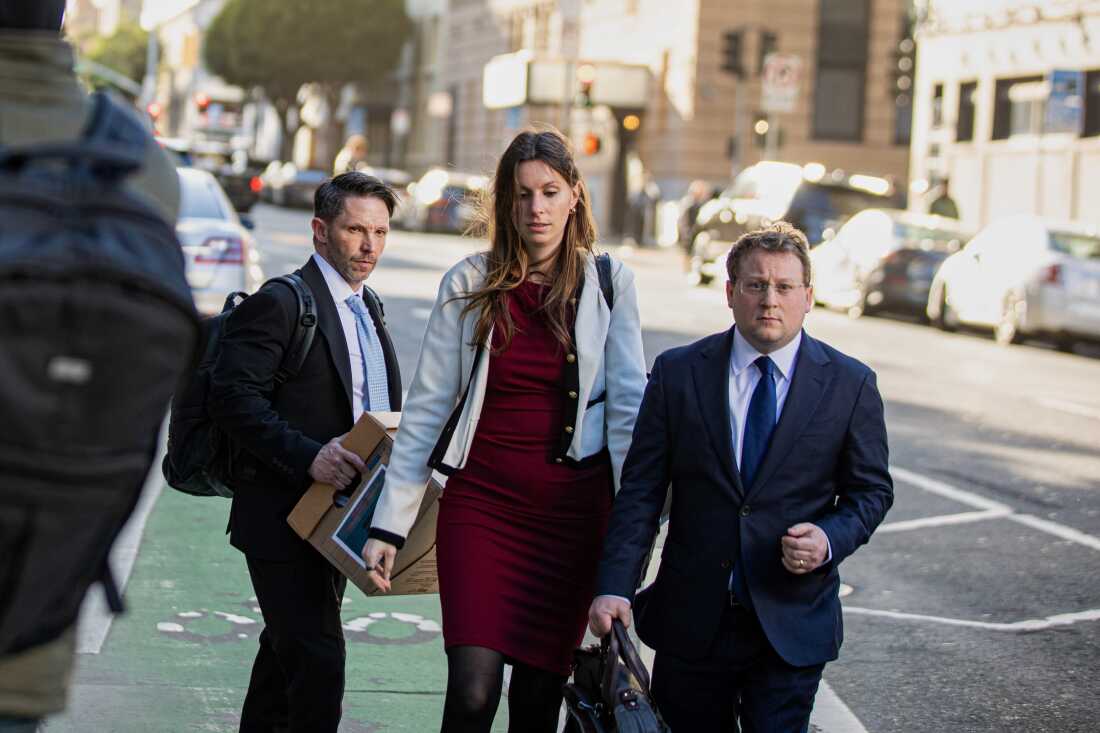
Members of Elon Musk’s legal team, including attorney Michael Lifrak (left), exit the Phillip Burton Federal Building in San Francisco on March 4.
Dan Hernandez/San Francisco Chronicle/AP
hide caption
toggle caption
Dan Hernandez/San Francisco Chronicle/AP
The central question of the case was whether Musk sent out tweets — including one on May 13, 2022, that said the Twitter deal was “temporarily on hold” while he sought information on the number of fake accounts on the service — as a deliberate scheme to tank Twitter’s shares. The jury found that while Musk did mislead investors with two tweets, he did not do so with a statement he made on a podcast because it was an opinion. The jurors also absolved him of scheming to drive down the stock.
The nearly three-week trial in San Francisco federal court for the Northern District of California saw testimony from former Twitter executives including CEO Parag Agrawal and CFO Ned Segal, as well as Musk, who was on the stand for more than a day.
In his testimony, Musk maintained that Twitter’s leadership lied about the amount of bots on the platform and withheld information from him about how the number of fake accounts was calculated. He repeatedly described the information that Twitter’s board provided with an abbreviation for a bull’s scatology. “I did make it clear that I thought it was BS,” Musk said of Twitter’s calculations asserting that only about 5% of its accounts were bots.
Musk also asserted that his decision to follow through on the deal at the original sales price provided a huge windfall for most Twitter shareholders.
But Twitter’s shares fell below $33, or about 40% below Musk’s original purchase price, while the deal was hanging in limbo. That downturn cost shareholders who sold their stock during the uncertainty caused by what the lawsuit alleges was Musk’s deceitful behavior.
“I can’t control whether people sell their stock, but everyone who held the stock fared extremely well,” Musk said.
The plaintiffs argued that, as Tesla’s stock price declined and buying Twitter became too expensive for Musk, he tweeted statements that drove down the stock price in the hopes he could renegotiate the deal for a lower price or get out of it altogether.
Musk’s tweets, the plaintiffs’ lawyer argued, were not some “innocent mistake” or a “stupid tweet” off the top of his head, but carefully calculated to drive down’s Twitter’s stock price.
In closing arguments, Mark Molumphy, a lawyer for the plaintiffs, asked jurors to hold Musk accountable and compensate thousands of investors who lost money because of tweets Musk sent, including one from May 13, 2022, that said the deal was “on hold.”
“He knew what he was doing,” Molumphy said.
Musk’s lawyers motioned for a mistrial several times during the contentious trial, contending that the billionaire Tesla CEO can’t get a fair trial in San Francisco because of animosity toward him from the public.
This isn’t the first time that Musk has been dragged into court to defend himself against allegations of duping investors with his social media posts. Three years ago, Musk spent about eight hours testifying in a San Francisco federal trial about his plans to buy Tesla — the electric automaker that he still runs as a publicly traded company — for $420 per share in a proposed 2018 deal that never materialized. A nine-member jury absolved Musk of wrongdoing in that case.



Andrea (left), Pablo (center), and Martin Langesfeld (right) hold a photograph of their daughter and sister, Nicky Langesfeld and her husband Luis Sadovnic, at a park in Doral, Fla., where the city named a street Nicky Langesfeld Place to honor her memory, Martin says, “as a reminder that she’ll be here with us forever.” Nicole “Nicky” and Luis were two of the 98 people killed when the Champlain Towers South condominium building collapsed in Surfside on June 24, 2021.
Meredith Nierman/NPR
hide caption
toggle caption
Meredith Nierman/NPR
SURFSIDE, Fla. — Just around the corner from where a beachfront condominium collapsed five years ago, there’s a makeshift memorial: a plastic banner strung up on a wood frame, with the names of the 98 victims, ranging in age from a year-old infant to a 92-year-old grandmother.
“It’s an unfortunate reminder of how big this tragedy was,” says Martin Langesfeld, locating the name of his sister Nicky, 26, and her husband Luis Sadovnik, 28. “It’s more than just names. It’s stories. It’s families.”
Two-thirds of the 12-story Champlain Towers South building collapsed just after 1 a.m. on June 24, 2021. It started when the pool deck caved in. Seven minutes later, as many of the occupants were sleeping, the tower began to fall.
Five escaped, and three were rescued from the rubble with severe injuries by first responders. Search teams evacuated residents in the remaining part of the building, which was demolished 10 days later for safety reasons.

Search and rescue personnel work in the rubble of the 12-story, beachfront Champlain Towers South condominium that crumbled to the ground on June 24, 2021 in Surfside.
Joe Raedle/Getty Images
hide caption
toggle caption
Joe Raedle/Getty Images
Hundreds were left without a home and belongings, and the state was forced to grapple with how it regulates structural safety.
Langesfeld is among those who’ve been pushing to improve what they consider a lax system of building oversight. His sister and brother-in-law were newlyweds, who had moved into the condo together just a few months earlier.
“A dream place, home, where you feel you’re safest is where they were killed,” he says.
He’s also frustrated there is no permanent memorial honoring the victims, while a new luxury condo is going up on the land where Champlain Towers once stood.
“It’s been almost five years and there’s no development for the memorial,” he says. “And the development for the new building is very well underway.”

The North Tower of the Champlain Towers condominium complex stands on April 27, overlooking the vacant site where its sister building, Champlain Towers South, collapsed on June 24, 2021. The collapse resulted in 98 deaths and remains one of the largest structural failures in U.S. history. A new luxury condominium complex, the Delmore, is slated for construction on the empty lot.
Meredith Nierman/NPR
hide caption
toggle caption
Meredith Nierman/NPR
Technical findings released Monday by the National Institute of Standards and Technology concluded the problem started about three weeks before the collapse when two connections between garage columns and the pool deck failed, causing cracks to grow and loads to shift to connections that were not strong enough to support them.
Investigators found “severe and widespread deviations in the building’s original structural design from the codes and standards of the day,” and that the building’s construction in 1981 deviated from the design drawings. Investigators will issue a final report later that includes recommendations for changes to standards, codes and practices to improve building safety.
To date, no one has been held criminally responsible.
But in a complex civil lawsuit, more than 30 defendants contributed to a $1.2 billion class action settlement reached just a year after the collapse to address wrongful death, personal injury and property loss claims.
“I think what was apparent to all parties, legal parties, is that it was an enormous loss,” says Coral Gables attorney Rachel Wagner Furst, co-lead counsel representing the Surfside victims.
None of the settling parties admitted liability or wrongdoing, but Wagner Furst says the litigation pointed to many factors that contributed to the scope of the disaster beyond the condo board, which was singled out in the initial lawsuit for not heeding warning signs and deferring repairs on the 40-year-old building.
She notes, “Companies and individuals who had serviced the Champlain Towers South condominium building in the years before the collapse that had arguably or allegedly failed in some way to provide proper maintenance advice or counsel, including the security company that had staffed the front desk of the building and was on duty at the time that the alarm ought to have sounded.”

Attorney Rachel Wagner Furst served as co-lead counsel for the plaintiffs in a class-action lawsuit for the victims of the Champlain Towers South collapse in Surfside, which resulted in a $1.2 billion settlement.
Meredith Nierman/NPR
hide caption
toggle caption
Meredith Nierman/NPR
The Surfside collapse was a wake-up call for condo associations and regulators around the country.
In the immediate aftermath in South Florida, some two dozen properties were evacuated for safety concerns. Most eventually were able to return after repairs.
The state responded by passing more stringent regulations, including new mandates for structural inspections and requiring condo associations to maintain a minimum level of reserve funding for structural upkeep.
“The Florida legislature pushed the burden to create safe housing stock in Florida onto the people who are least able to bear it, which is the Florida consumer,” says Ft. Lauderdale attorney Donna DiMaggio Berger who specializes in condominium law, and founded a group that lobbies on behalf of the more than 50,000 community associations in Florida.
She says developers also should share in the burden.
“If we wind up with the safest housing stock in the country. Bravo, well done,” she says. But “safe buildings start with the people who build them and repair them.”

Construction cranes line the skyline along the beach in Surfside, Fla., on April 27.
Meredith Nierman/NPR
hide caption
toggle caption
Meredith Nierman/NPR
No matter how well-intentioned, the building reforms could have unintended consequences, says Miami-Dade County Mayor Daniella Levine Cava.
She says some buildings have been taken over by people who want to turn them into more expensive, luxurious developments.
“There’s tremendous pressure that people can’t afford these things and so they’re forced to sell,” she says. “We call it ‘condo vultures,’ and it is at our peril.”
Levine Cava says she understands that people want to live “the good life” in South Florida, but there must be balance.
“We know we live in paradise,” she says. “We also know that we need to have people of all means in our community.”

Miami-Dade Mayor Daniella Levine Cava says her community was severely changed by this tragedy, “the pain is still very real. Many people have moved on with their lives and others are still suffering greatly.”
Meredith Nierman/NPR
hide caption
toggle caption
Meredith Nierman/NPR
That’s long been the conundrum in Florida, a trend that accelerated during the COVID-19 pandemic when people flocked to the Sunshine State.
And it’s evident in Surfside, just north of Miami Beach, which is becoming an ultra-wealthy enclave with a wall of condos lining the Atlantic, and more under construction. The area is adjacent to swanky shopping malls and private islands where tech titans have waterfront estates.
The Champlain Towers South property itself is soon to be home to the community’s latest luxury development, The Delmore. Billed as “expansive mansions in the sky,” the sales price of the units starts at $15 million; penthouses go for more than $150 million.
“Each penthouse has its own private pool, and that’s a glass-fronted pool that gets the view to the ocean,” says developer Jeffery Rossely, pointing to the layout on a scale model in a posh sales gallery.

Jeffery Rossely, a developer at the Dubai-based firm Damac Properties, points to a model of a luxury property called The Delmore.
Marisa Peñaloza/NPR
hide caption
toggle caption
Marisa Peñaloza/NPR
Rossely is with Damac Properties, a Dubai-based firm. This is the company’s first residential project in the U.S. Damac was the only bidder with a $120 million cash offer for the property.
“It was obviously at the time a tragic opportunity, but the courts had already ordered sale of the property,” Rossely says. “The money was required to compensate the victims.”
But the project has not received a warm welcome in Surfside. At town meetings he says his company has been accused of having blood on its hands.

A sign welcoming visitors to Surfside, Fla., stands directly across the street from the former site of the Champlain Towers South condominium. Today, a new luxury residential development called The Delmore is under construction on the empty lot where the tower once stood.
Meredith Nierman/NPR
hide caption
toggle caption
Meredith Nierman/NPR
“I didn’t understand why there would be angst for someone coming in and paying that money upfront,” says Rossely.
But in retrospect, he concedes, the project needed a different approach.
“We should have spent a bit more time on due diligence, on community reaction, rather than on the physical property itself,” Rossely says. “We went through what I would call the traditional due diligence. Maybe we should have gone through emotional due diligence, as well.”
The question now is whether people will want to live in the new building. There are no buyers yet in the pre-sale phase.
Meanwhile, the town of Surfside will light a torch at 1:15 a.m. on Wednesday, just outside the development’s fence, to remember the Champlain Towers South victims five years after the collapse.
News
Trump says proof of his allegations that vandals cut Reflecting Pool paint will be provided in court

Washington — President Trump on Monday said proof will be provided in court of his allegations that vandals “cut” a massive slit in the Lincoln Memorial Reflecting Pool, which he claims is the reason the paint is peeling on the recently renovated but algae-plagued project.
In an exchange with CBS News senior White House correspondent Ed O’Keefe, Mr. Trump insisted that vandals, rather than questionable craftsmanship, are responsible for the enduring problems following the $14.7 million sealant job. The president claimed vandals cut a 350-foot slit in the pool between the World War II Memorial and the Lincoln Memorial. Five people have been arrested for vandalism related to the Reflecting Pool, and five additional individuals were issued federal citations, according to the U.S. Park Police, although neither the company behind the project nor the U.S. Park Service has said a cut slit was responsible for the peeling.
Asked if he had proof, such as photos or video, that vandals used a knife to cut a massive slit in the pool, Mr. Trump responded: “Well, let’s put it this way, when you have a 350, I think it’s 350, not 250, when you have a 350-foot slit, from one end to the other, you think that’s proof? You think that’s proof?”
O’Keefe noted that reporters had been to the site and found no evidence of a slit.
“Well, you’d have to go see the Parks Department. They’ll show it to you, or see, see the secretary, but I saw it,” Mr. Trump said, likely referencing Interior Secretary Doug Burgum. “They cut it, they cut it very violently. The same thing with the floor, they cut it, and then they lifted it. They pulled it, and that’s what it is.”
After defending the project, the president said, “We also have pictures.”
O’Keefe asked the president for evidence of his claims.
“Yeah, at the right time you’ll see it,” Mr. Trump said. “You’ll see it in court. You’ll see it in court, but all you have to do is call the Parks Department, call the Department of Interior.”
The president also suggested someone may have placed fertilizer in the water to create the algae that teams have been attempting to clear.
“If you put fertilizer in the water, you get algae, but somebody said they might have put fertilizer, they did something to create the algae,” the president said, again without providing evidence for his claims.
CBS News has reached out to the National Park Service and the Department of the Interior. So far, there’s been no response.
Atlantic Industrial Coatings, which received a no-bid contract to install the sealant on the floor of the Reflecting Pool, told CBS News there are “some areas” that “require repairs.”
“These areas are a very small part of the massive 7-acre project, and do not indicate a failure of the liner,” the company said. “These repairs can not be made until the pool is drained. As soon as it’s feasible for the park, the pool will be drained and AIC will be back to make those needed repairs as part of the warranty.”

new video loaded: The Rise of Deadly Trucks and S.U.V.s
By Michael H. Keller, Danielle Ivory, Irineo Cabreros, Eli Murray, Gabriel Blanco and Joey Sendaydiego
June 22, 2026
-

 Los Angeles, Ca1 hour ago
Air quality concerns remain as the Boyle Heights warehouse fire continues to burn
-

 Detroit, MI1 hour ago
Wenceel Pérez returns home, but when will he return to Detroit Tigers?
-

 San Francisco, CA2 hours ago
San Francisco Supervisor Jackie Fielder to return following mental health leave
-
Dallas, TX2 hours ago
Impact: How Jeffery Simmons’ extension could affect Quinnen Williams
-
Miami, FL2 hours ago
Jaylen Brown bidding war? Haslem drove this? All the fallout from Antetokounmpo trade to Miami
-

 Boston, MA2 hours ago
Your next Uber ride in Boston could be a taxi
-

 Denver, CO2 hours ago
Nuggets 2026 NBA mock draft tracker 2.0: What national experts predict Denver will do
-

 Seattle, WA2 hours ago
How to watch Bosnia vs. Qatar in next Seattle World Cup match

