World
Protestors Interrupt Nancy Pelosi During Live Taping of ‘The Late Show With Stephen Colbert’ Outside the DNC


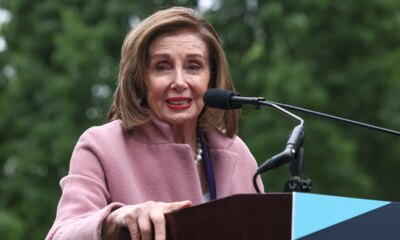
CHICAGO — Protesters interrupted a live broadcast of CBS’ “The Late Late Show With Stephen Colbert” on Tuesday night, shouting loudly from the balcony of the Auditorium Theatre several times during two segments with former Speaker of the House Nancy Pelosi.
Pelosi was there to discuss the Democratic National Convention and also her new book, “The Art of Power.” Several minutes into Colbert’s segment with Pelosi, a protester began shouting from above regarding the war in Gaza.
Colbert addressed the person and the audience stating, “For the people who can’t tell, there’s a protest going on in the audience.”
The host then swiftly threw it to a commercial, while stating that he had planned to ask Pelosi about the protests and concerns regarding the Middle East. “The subject is on Israel and Palestine and if you have a seat, we have to go to the commercial break,” Colbert said. “When we come back, I’ll ask the next question I had on that subject.”
Colbert’s conversation with Pelosi began with a discussion about her involvement in President Joe Biden’s decision to step down from the 2024 Presidential race. Pelosi balked at the idea of being labeled the “architect” of that choice, and even at first said she hadn’t called Biden at all. The second night of “The Late Show With Stephen Colbert” live at Chicago’s Auditorium Theatre, right after the Democratic National Convention, was unexpectedly interrupted.
When they returned, Colbert first finished his questions about Biden, and whether it was rare to see a leader give up power in that way. He then switched gears.
“Let’s talk about another aspect of power: The U.S. using its power overseas,” he said, pivoting back to the question from the protestors. “As I said earlier, there is a political protestor here. There is a political convention in town, you are politician and protests are natural. People are protesting, even within the Democratic party, there is dissension over what is the proper use of American power, especially ourprotected power overseas, both firm and soft power. If the goal is the peaceful and prosperous future for both Israelis and Palestinians, what role does the United States play?”
Pelosi’s response focused first on President Biden’s current and past track record in foreign policy. “Let me just say this was a role that President Biden played very well for years he was chair of the Foreign Affairs Committee,” said Pelosi. “He was a senator for a long time, Vice President and President. So his experience globally has been huge.”
Pelosi recounted attending the inauguration of John F. Kennedy, during which he gave his now iconic address, “Ask not what your country can do for you, but what you can do for your country.” Pelosi noted that, “The very next sentence that he says in the speech is, ‘To the countries of the world, ask not what America can do for you, but what we can do working together for the freedom of mankind.’ That is our mission… So yes, we have had a commitment to Israel. It’s been in our security interest to do so. Israel was attacked by a terrorist organization. We want the hostages freed. But we don’t want children killed in Gaza. And so we have to come up with a solution. And right now, we just got word earlier today that Israel had agreed to the cease-fire agreement. We’re hoping that Hamas will too. But it takes me to the point of saying to you, war has no role in a civilized society. We have to learn more about trust and peace.”
During the end portion of this response, an audience member began shouting, repeating her words, “And war has no role in a civilized society,” followed by several other audience members also shouting, to which Colbert responded, “As you can see from the continuing protest out here, that answer is unsatisfying to some people. Would you like to respond to what they’re saying?”
Colbert then turned to the protestor and asked if they would like a response to their question asking if they would “listen” Pelosi’s response. Switching back to Pelosi, he then directed the question to her, “They have said that the United States should not have any role in supplying Israel arms to kill people of Gaza. That’s what they are saying.”
“Israel has a right to defend itself,” Pelosi said. “But the other part of it is that’s been so major for all of us for many years is that there must be two-state solution. You cannot have peace unless you have a two-state solution. Israel, a secure Jewish democratic state in the region. And the Palestinians having their own, secure country there as well. Unless you have a two-state solution, you will not have a resolution of this.”
At this point the shouting increased and Colbert instructed the protestors, “Please don’t interrupt my guest.”
Colbert then ended the segment. “Madame Speaker, we’re a live show and we have to go at this point. Please come again and we can continue the conversation.”
Pelosi then attempted to change the subject by ending, “I have to say, isn’t it great to be in Chicago?” The segment went to commercial shortly after. There wasn’t any further interruptions during the show; according to insiders, all protestors left on their own accord, and the matter was handled peacefully.
Hakeem Jeffries was the next guest, and Colbert also asked him about the ongoing conflict in Gaza in a hypothetical asking: How would a Speaker Jeffries advise a President Harris?
“What President Biden is doing right now, what Kamala Harris is doing as part of the Biden-Harris administration, to do everything possible to try to achieve a cease-fire agreement,” Jefferies said. “To bring the hostages home, to surge humanitarian assistance to Palestinian civilians who are in harms way, through no fault of their own. Surge that aid immediately and continuously. And to find a path toward a just and lasting peace. A safe and secure Israel and the Palestinian people being able to experience the dignity and self-determination that they deserve.”
At the end of the night, after the show went off the air, Colbert addressed the audience and thanked them for coming, expressing his gratitude — but didn’t further address the protestors. “Thank you for a lovely night, it means the world for us, for you all to come out,” he said. “And I can’t begin to tell you what a joy it is to play this house in Chicago.”
As the Democratic National Convention has gotten underway in Chicago, protests have taken place around the city, including one on Tuesday where dozens of pro-Palestinian protesters and Chicago police clashed on Tuesday during a demonstration outside the Israeli Consulate in downtown Chicago.
The Auditorium Theatre is located in the South Loop area, several miles from the DNC, but a large number of police could be seen stationed outside the Auditorium as audience members filed out of the theater around 12:40 a.m. CT.
This is day two of Colbert’s Chicago live run, with Monday’s episode wrapping up just after 1 a.m. Central Time.





NEWYou can now listen to Fox News articles!
Secretary of State Marco Rubio arrived in France on Friday to attend the G7 foreign ministers meeting where he will deliver a clear message on U.S. priorities for the ongoing war with Iran.
In the days leading up to the meeting, other members have taken markedly different approaches to the war. Nearly all of Washington’s partners — Britain, Canada, France, Germany, Italy and Japan — have reacted cautiously to the U.S.-Israeli military campaign and declined to participate in offensive operations, even as they condemn Iranian actions.
Before departing on Thursday, Rubio signaled a defiant approach to the talks: “I don’t work for France or Germany or Japan… the people I’m interested in making happy are the people of the United States. I work for them,” he said in a video posted on X.
The divergence has drawn frustration from President Donald Trump, who has pressed allies to contribute more, particularly in securing key maritime routes such as the Strait of Hormuz. While some countries have signaled a willingness to support defensive or maritime security efforts, they have stopped short of joining direct military strikes.
TRUMP PRESSES NATO PARTNERS ON SUPPORT AS HEGSETH BLASTS HESITATION
“The U.S. is constantly asked to help in wars and we have. But when we had a need, it didn’t get positive responses from NATO. A couple leaders said that Iran was not Europe’s war. Well, Ukraine isn’t our war, yet we’ve contributed more to that fight than anyone,” Rubio added.
“The Strait of Hormuz could be open tomorrow if Iran stops threatening global shipping, which is an outrage and a violation of international law. For all these countries that care about international law, they should be doing something about it,” he said before boarding his plane to France.
The remarks set the tone for a summit already marked by growing friction between Washington and some of its closest allies over how to handle the Iran conflict. Rubio has framed the stakes in stark terms. “Iran has been at war with the United States for 47 years… Iran has been killing Americans and attacking Americans across this planet,” he said during a White House cabinet meeting, adding that allowing Tehran to obtain nuclear weapons would be “an unacceptable risk for the world.”
But even before Rubio arrived at the meeting, European officials were signaling a markedly different approach.
“We need to exit from the war, not escalate this further, because the consequences for everybody around the world are quite severe,” Vice President of the European Commission Kaja Kallas said during a briefing on the sidelines of the G7 on Thursday.
JACK KEANE CALLS OUT NATO’S WEAKNESS AS SHIPPING CRISIS GRIPS STRAIT OF HORMUZ
(L/R, clockwise) French President Emmanuel Macron, European Commission President Ursula Von der Leyen, NATO Secretary General Mark Rutte, Japanese Prime Minister Shigeru Ishiba, German Chancellor Friedrich Merz, US Secretary of Treasury Scott Bessent, Canadian Prime Minister Mark Carney, Ukrainian President Volodymyr Zelenskyy, British Prime Minister Keir Starmer, and Italian Prime Minister Giorgia Meloni meet during the Group of Seven (G7) Summit at the Pomeroy Kananaskis Mountain Lodge in Kananaskis, Alberta, Canada on June 17, 2025 (LUDOVIC MARIN/AFP via Getty Images)
“It can only be a diplomatic solution… sit down and negotiate to have a way out,” she added.
The contrast between Rubio’s framing and Kallas’s message captures the core tension shaping the meeting.
U.S. officials say Rubio is heading into the talks with a broader agenda that goes beyond Iran.
According to a State Department spokesperson, who spoke to Fox News Digital on background, Rubio will use the meeting to “advance key U.S. interests” and push discussions on the wars in Ukraine and the Middle East, as well as “international burden sharing” and the overall effectiveness of the G7.
The U.S. is also expected to emphasize maritime security, including freedom of navigation in the Strait of Hormuz and the Red Sea, while urging allies to take on a greater share of responsibilities in conflict zones and international organizations, the spokesperson said.
RUBIO, RATCLIFFE TO DELIVER CLASSIFIED IRAN BRIEFING TO ‘GANG OF EIGHT’ AHEAD OF TRUMP’S STATE OF THE UNION
U.S. Secretary of State Marco Rubio speaks to reporters before boarding a plane as he is headed to France where he will take part in the G7 foreign ministers’ meeting, at Joint Base Andrews in Maryland, U.S., March 26, 2026. (Brendan Smialowski/Pool via Reuters)
European officials have instead emphasized the broader risks of the conflict.
France’s foreign minister, Jean-Noël Barrot, said discussions at the G7 would build on a recent joint statement condemning Iran’s actions while also addressing maritime security concerns.
He said the “discussions will provide an opportunity to revisit positions already agreed at the G7 level… including the unjustifiable attacks carried out by Iran against Gulf countries… which we condemned in the strongest possible terms.”
Barrot added that ministers would also focus on securing global shipping routes.
A satellite image shows the Strait of Hormuz, a key maritime passage connecting the Persian Gulf to the Gulf of Oman, vital for global energy supply. (Amanda Macias/Fox News Digital)
“We will also have the opportunity to address maritime security and freedom of navigation… including an international mission… to ensure the smooth flow of maritime traffic in a strictly defensive posture, thereby helping to ease pressure on energy prices,” he said.
Kallas echoed that global framing. “All the countries in the world are one way or another affected by this war… it is in the interest of everybody that this war stops,” she said.
IRAN SIGNALS NUCLEAR PROGRESS IN GENEVA AS TRUMP CALLS FOR FULL DISMANTLEMENT
Kaja Kallas, High Representative of the European Union (EU) for Foreign Affairs and Security Policy speaks to the press during EU Summit in Brussels, Belgium on Dec. 19, 2024. (Photo by Nicolas Landemard/Anadolu via Getty Images)
Her remarks also pointed to the interconnected nature of the crisis. “Russia is helping Iran with intelligence… and also supporting Iran now with drones,” she said, linking the Iran conflict to the war in Ukraine.
That uncertainty is already affecting the structure of the summit, with officials dropping plans for a unified final communiqué to avoid exposing divisions, Reuters reported.
Analysts say those differences reflect deeper structural tensions in the alliance. “Europe has criticized Donald Trump’s ‘maximum pressure’ strategy towards Iran while pursuing a failed diplomatic approach that has enabled the regime to expand its terrorist networks and edge closer to nuclear threshold status,” Barak Seener, senior research fellow at the Henry Jackson Society, told Fox News Digital.
“This reflects a lack of European capability to project power in the region, particularly in safeguarding the Strait of Hormuz.”
FILE PHOTO: Cargo ships in the Gulf, near the Strait of Hormuz, as seen from northern Ras al-Khaimah, near the border with Oman’s Musandam governance, amid the U.S.-Israeli conflict with Iran, in United Arab Emirates, March 11, 2026. (REUTERS/Stringer/File Photo/File Photo)
Seener added that years of reliance on Washington have left Europe increasingly exposed as the U.S. shifts its strategic priorities. “Years of underinvestment in defense and reliance on the United States have created a dependency that Washington increasingly views as a betrayal of the peace it has guaranteed Europe since the Second World War,” he said.
“With the U.S. placing greater value on its relationship with Israel than NATO, the result may be further erosion of the alliance, reduced support for Ukraine and rising economic pressure on Europe.”
He warned that the immediate test will come at the G7 itself. “Divisions over how to respond to Iran and to any U.S. request for support are likely to expose a deeper transatlantic split,” Seener said.
“Operation Epic Fury has showcased President Trump’s ability to assemble a coalition of allies to eliminate a common threat — in this case the Iranian regime — and stabilize international trade,” Jacob Olidort, chief research officer and director of American security at the America First Policy Institute, told Fox News Digital.
CLICK HERE TO DOWNLOAD THE FOX NEWS APP
A satellite view shows the Strait of Hormuz, a key global energy chokepoint connecting the Persian Gulf to the Gulf of Oman, on Oct. 2, 2024. (Gallo Images/Orbital Horizon/Copernicus Sentinel Data via Getty Images)
“The failure of Western Europe to participate in securing the Strait of Hormuz is particularly egregious because those countries depend on it more than we do,” he added.
“At the same time, the historic successes of Operation Epic Fury have awakened a new confidence in our Middle East partners to eradicate the threats from the Iranian regime and to work together to shape a more peaceful and prosperous region.”

Published on
On today’s show:
ADVERTISEMENT

ADVERTISEMENT
Top story: G7 Summit debrief with Méabh Mc Mahon and Maia de la Baume.
Explainer by Jakub Janas: What’s the point of the G7 meeting?
Iran war update with Méabh Mc Mahon and Babak Kamiar.
Interview with Ghassan Salamé, Lebanese Culture Minister.
Interview with Valérie Hayer, Member of the European Parliament (Renew Europe, France).
When and where to watch Europe Today?
You can join Euronews’ chief anchor Méabh Mc Mahon and our EU editor Maria Tadeo live on TV and Euronews’ website and digital platforms every weekday.
Our new format brings you the day’s key events plus crucial analysis of all the stories shaping the EU and beyond. It’s also available as a newsletter and podcast.

The official additionally stated that Iran has reviewed a US 15-point proposal for ending the ongoing war in the Middle East and deemed it “one-sided and unfair,” serving only US and Israeli interests, and lacking “the minimum requirements for success.”
“In brief, the proposal suggests that Iran would relinquish its ability to defend itself in exchange for a vague plan to lift sanctions,” he told Reuters.
No arrangement for negotiations has been established yet, the official continued, adding that Turkey and Pakistan are attempting to “establish common ground between Iran and the United States and reduce differences.”
The proposal, which was conveyed to Iran through Pakistan, “was reviewed in detail on Wednesday night by senior Iranian officials and the representative of Iran’s Supreme Leader,” the official said.
On Wednesday, Iranian regime-tied Press TV cited an Iranian official as stating that Tehran considered the conditions of the proposal excessive and would only agree to end the war at a time of its choosing if its conditions are met.
According to an N12 News report on Tuesday, citing three sources familiar with the details of the potential plan, the US was considering declaring a month-long ceasefire during which negotiations on the agreement would take place.
The 15-point plan reportedly contained terms including the dismantling of all existing Iranian nuclear capabilities, a commitment that Iran will discontinue efforts to obtain nuclear weapons, and a requirement that any already enriched uranium be moved out of Iran.

Bill Maher is getting the Mark Twain Prize after all

Judge sides with Anthropic to temporarily block the Pentagon’s ban

Rubio meets G7 ministers in France as US leads on Iran — allies under fire for tepid response

DHS shutdown breakthrough comes at cost for Republicans as funding fights nears end

Dementia risk signals could lie in simple blood pressure readings, researchers say

Florida High School Football Rankings: Top 25 teams – Oct. 21

How old is Bo Nix? What to know about Oregon quarterback ahead of 2024 NFL Draft

Cleary's 21 help Le Moyne down Central Connecticut State 69-64 in OT

99th annual Pony Swim held in Virginia

Indiana Members Credit Union announced as new anchor tenant at Bottleworks District
DHS shutdown breakthrough comes at cost for Republicans as funding fights nears end

Rubio joins crucial G7 talks as Iran war set to dominate second day

A surprise resignation could open the door for an independent to win a Montana Senate seat

Video: Savannah Guthrie Says She Believes Her Mother Was Taken for Ransom

Stefanik grills University of Michigan leader on lack of audit after string of Chinese national arrests
-

 Detroit, MI1 week ago
Drummer Brian Pastoria, longtime Detroit music advocate, dies at 68
-

 Science1 week ago
How a Melting Glacier in Antarctica Could Affect Tens of Millions Around the Globe
-

 Movie Reviews1 week ago
‘Youth’ Twitter review: Ken Karunaas impresses audiences; Suraj Venjaramoodu adds charm; music wins praise | – The Times of India
-
 Science1 week ago
I had to man up and get a mammogram
-

 Sports6 days ago
IOC addresses execution of 19-year-old Iranian wrestler Saleh Mohammadi
-

 New Mexico4 days ago
Clovis shooting leaves one dead, four injured
-

 Texas7 days ago
How to buy Houston vs. Texas A&M 2026 March Madness tickets
-

 Tennessee3 days ago
Tennessee Police Investigating Alleged Assault Involving ‘Reacher’ Star Alan Ritchson