World
Palestinians in West Bank protest, strike against Israeli death penalty law


Palestinian Authority president Mahmoud Abbas’s Fatah party had called for the strike, with Palestinian shops and public institutions closing their doors to protest the law.
Palestinian shops and public institutions, including universities, across the occupied West Bank and East Jerusalem were closed as people took to the streets to protest against a new Israeli law that imposes the death penalty for Palestinians convicted of deadly attacks.
Hundreds of people gathered on Wednesday to march in Ramallah against the law backed by Israel’s far-right National Security Minister Itamar Ben-Gvir, chanting slogans condemning the law and calling on the international community to reverse the law’s passage.
list of 3 itemsend of listRecommended Stories
At a protest in the city of Nablus, in the northern West Bank, demonstrators carried signs warning that time was running out.
“Stop the law to execute prisoners, before it’s too late,” one sign read, showing an animation of a prisoner wearing the Palestinian keffiyeh scarf next to a noose.
Most shops in the cities of Hebron, Ramallah, and Nablus were closed with their shutters down at midday, journalists with the AFP news agency reported.
Israeli soldiers forced Palestinian shop owners taking part in the strike in the town of Anata, northeast of Jerusalem’s Old City, to open their businesses.
Palestinian Authority president Mahmoud Abbas’s Fatah party had called for a general strike the previous day.
United Nations High Commissioner for Human Rights Volker Turk has condemned the law, saying “its applications to residents of the occupied Palestinian territory would constitute a war crime”.
At the Ramallah protest, Riman, a 53-year-old psychologist from Ramallah, told AFP that “there isn’t a single person standing here who doesn’t have a brother, a husband, a son, or even a neighbour in prison. There is no Palestinian family without a prisoner.”
More than 9,500 Palestinians are held in Israeli prisons, including 350 children and 73 women. Palestinian and Israeli human rights groups say detainees face torture, starvation and medical neglect, leading to dozens of deaths.
“But honestly, today we feel a lot of anger, because there is also a real weakness in solidarity with them. The occupation [Israel] is betting on the weakness of the street,” said Riman, declining to share her last name.
Separate legal track
Under the new law, passed in the Israeli parliament or Knesset late on Monday, Palestinians in the West Bank convicted by military courts of carrying out deadly attacks classified as “terrorism” will face the death penalty as a default sentence.
Because Palestinians in the territory are automatically tried in Israeli military courts, the measure effectively creates a separate and harsher legal track.
In Israeli civilian courts, the law allows for either death or life imprisonment for those convicted of killing with intent to harm the state.
While the law does not provide for retroactive application, critics say the distinction underscores a system of unequal justice.
On social media, Palestinians shared images of tyres being burnt in protest of the law at the Qalandia checkpoint, one of the West Bank’s busiest entry points into Israel via Jerusalem.
“Eyewitnesses reported that Israeli soldiers fired rubber-coated bullets, stun grenades and tear gas” at the protesters, reported the Palestinian news agency WAFA, adding that no injuries had been reported.
Israel has occupied the West Bank since 1967 and violence there has soared since the start of Israel’s genocidal war on Gaza in October 2023, which has killed more than 72,000 people.



NEWYou can now listen to Fox News articles!
Ukrainian President Volodymyr Zelenskyy on Wednesday touted new momentum toward ending the country’s war with Russia after a high-level call with President Donald Trump’s envoys, pointing to progress on a U.S.-backed security deal.
Zelenskyy announced in an X post that he and his officials had a “positive” conversation with Steve Witkoff and Jared Kushner, along with Sen. Lindsey Graham, R-S.C., and NATO Secretary General Mark Rutte with talks centered around forging a “dignified peace.”
“We agreed to strengthen security guarantees, and I have already instructed our team to promptly update the documents so that the security guarantees for Ukraine are strong, the prospects for post-war reconstruction are real, and everything is doable,” Zelenskyy wrote.
Ukrainian President Volodymyr Zelenskyy at a meeting Wednesday, April 1, 2026. (@ZelenskyyUa via X)
WITKOFF AND KUSHNER SCHEDULED TO MEET PUTIN IN MOSCOW
He emphasized Ukraine needs clear agreements so that its citizens understand exactly how international partners will respond to deter any renewed Russian aggression.
“We need strong, shared positions, and Ukraine’s contribution to this strength is unquestionable,” Zelenskyy wrote. “… I expect that the teams will work substantively in the coming days so that we can all feel progress. A trilateral format — a leaders’ format — all of this is necessary.”
Ukranian leaders at a meeting discussing the Ukraine-Russia war Wednesday, April 1, 2026. (@ZelenskyyUa via X)
TRUMP CONFIRMS HE INVITED PUTIN TO JOIN HIS BOARD OF PEACE: ‘HE’S BEEN INVITED’
In a subsequent video, Zelenskyy reported Russia launched a massive wave of more than 700 drones Wednesday, including “shaheds,” targeting Ukraine’s energy sites, food warehouses and residential buildings across multiple regions.
Although Ukrainian forces intercepted roughly 90% of the incoming drones, Zelenskyy condemned the bombardment as Russia’s direct response to Ukraine’s proposal for an Easter ceasefire.
Leaders meet to discuss the Ukraine-Russia war Wednesday, April 1, 2026. (@ZelenskyyUa via X)
CLICK HERE TO DOWNLOAD THE FOX NEWS APP
He noted that a halt in fighting during the holidays was intended to be a signal that diplomacy could be successful.
Beyond the U.S. and Europe, Zelenskyy said Defense Minister Rustem Umerov is working to secure long-term defense contracts with several Middle Eastern nations, including Saudi Arabia, the United Arab Emirates, Qatar, Jordan, Kuwait, Iraq, Bahrain and Turkey.

new video loaded: Cape Town’s Housing Problem

By John Eligon, Joao Silva, Christina Thornell, Jon Miller, Leila Medina and June Kim
April 1, 2026

NEWYou can now listen to Fox News articles!
Iranian officials pushing for negotiations with the United States risk being labeled traitors and “most likely eliminated,” according to a policy expert, as internal fractures emerge inside Iran’s new regime.
Hooshang Amirahmadi, president of the American Iranian Council, said moderates advocating engagement with Washington are increasingly vulnerable at a moment when the Trump administration says it is in contact with elements of a “new” leadership.
“If the moderates were to push toward negotiation and a ceasefire, they will be considered traitors and will most likely be eliminated,” Amirahmadi told Fox News Digital.
MEET IRAN’S HARDLINE SPEAKER WHO THREATENED TO BURN US FORCES — REPORTEDLY TEHRAN’S POINT MAN FOR TALKS
Amirahmadi’s warning came as Washington also appears to be navigating internal “fractures” amid the ongoing conflict.
President Donald Trump on Monday said the U.S. is engaged in serious talks with a “new” and “more reasonable” regime in Iran as the war enters its fifth week, while Secretary of State Marco Rubio declined to say who exactly the U.S. is negotiating with but cited “fractures.”
Secretary of State Marco Rubio attends a meeting with China’s Foreign Minister (not pictured) in Munich Feb. 13, 2026, on the sidelines of the Munich Security Conference. ( Alex Brandon/Pool/AFP via Getty Images)
“Well, I’m not going to disclose to you who those people are, because it probably would get them in trouble with some other groups of people inside of Iran. Look, there are some fractures going on there internally,” Rubio said on “Good Morning America.”
“Anyone in Iran who speaks of negotiation is suspected of paving the way for more war and destruction,” Amirahmadi said before stating that the moderate reformers are thought of as “infiltrators and deemed traitors.”
Amirahmadi also confirmed Rubio’s comments and highlighted an internal struggle within Tehran’s power structure, where remnants of what he called the “old regime,” or the Khamenei-era system, still exist.
“Many of them support negotiation or a ceasefire. But the emerging new regime is made up of more hard-line elements and views the others as traitors,” he said.
“For a long time, there has been a serious gap — what we call a cleavage — between the hardliners or radicals and the moderates or reformists.”
PAKISTAN’S AMBASSADOR WARNS IRAN TOO ‘WAR-TORN’ TO RESPOND QUICKLY AS TRUMP EXTENDS STRIKE DEADLINE
Iranian Parliament Speaker Mohammad Bagher Ghalibaf attends a news conference at a conference hall in the Iranian Parliament building in Tehran, Iran, Dec. 2, 2025. (Morteza Nikoubazl/NurPhoto via Getty Images)
Amirahmadi also described how “assassination in the Islamic Republic is not a new phenomenon. It has been there for a long time.”
Amirahmadi spoke ahead of Secretary of Defense Pete Hegseth saying Tuesday that Washington remains firm on reaching an agreement to end the monthlong conflict involving the U.S., Israel and the Islamic Republic.
Speaking at a news conference, Hegseth reiterated that Trump is willing to make a deal to end the war, adding the new regime is now in place.
“If Iran is smart, it will make a deal. The new Iranian regime should already know that. This new regime, having undergone a regime change, should be smarter than the previous one. President Trump does not bluff and will not back down. He will make a deal, he is willing and the terms of the deal are known to them,” Hegseth said.
“The field and the war are in the control of the radical colonels, and that is what matters at this point,” Amirahmadi added.
“The established bureaucracy is still run by the same old moderate regime, but then that is not a new regime. The new regime is certainly more radical.”
WHO ACTUALLY RUNS IRAN RIGHT NOW? THE KEY POWER PLAYERS AS TRUMP CLAIMS TALKS TO ‘TOP’ OFFICIAL
Iran’s power structure is increasingly dominated by IRGC figures like Ahmad Vahidi (Morteza Nikoubazl/NurPhoto via Getty Images)
Since the death of Supreme Leader Ayatollah Ali Khamenei and the succession of his son, Mojtaba Khamenei, the regime appears more reliant on the Islamic Revolutionary Guard Corps (IRGC).
Iran’s power structure is increasingly dominated by IRGC figures like Ahmad Vahidi and Qods Force chief Esmail Qaani, alongside judicial figures such as Mohammad Bagher Ghalibaf and Ayatollah Gholam-Hossein Mohseni-Ejei.
While President Masoud Pezeshkian’s influence could have waned, figures like Saeed Jalili, Guardian Council insider Ayatollah Alireza Arafi and Foreign Minister Abbas Araghchi continue shaping Iran’s security posture.
“There are basically the colonels; there are the Revolutionary Guards, people that are in the military. A few non-military hardliners are in universities, in government and places,” Amirahmadi added.
“They have changed the regime into a very radical regime,” Amirahmadi warned, “I don’t even think Khamenei’s son would favor negotiation, at least initially.
CLICK HERE TO DOWNLOAD THE FOX NEWS APP
“His position and condition are not entirely clear. His leadership appears symbolic — a reaction, even a gesture against figures like Trump.
“Trump and Netanyahu wanted regime change, and they have already achieved it, but the regime has just become more radical,” Amirahmadi concluded.
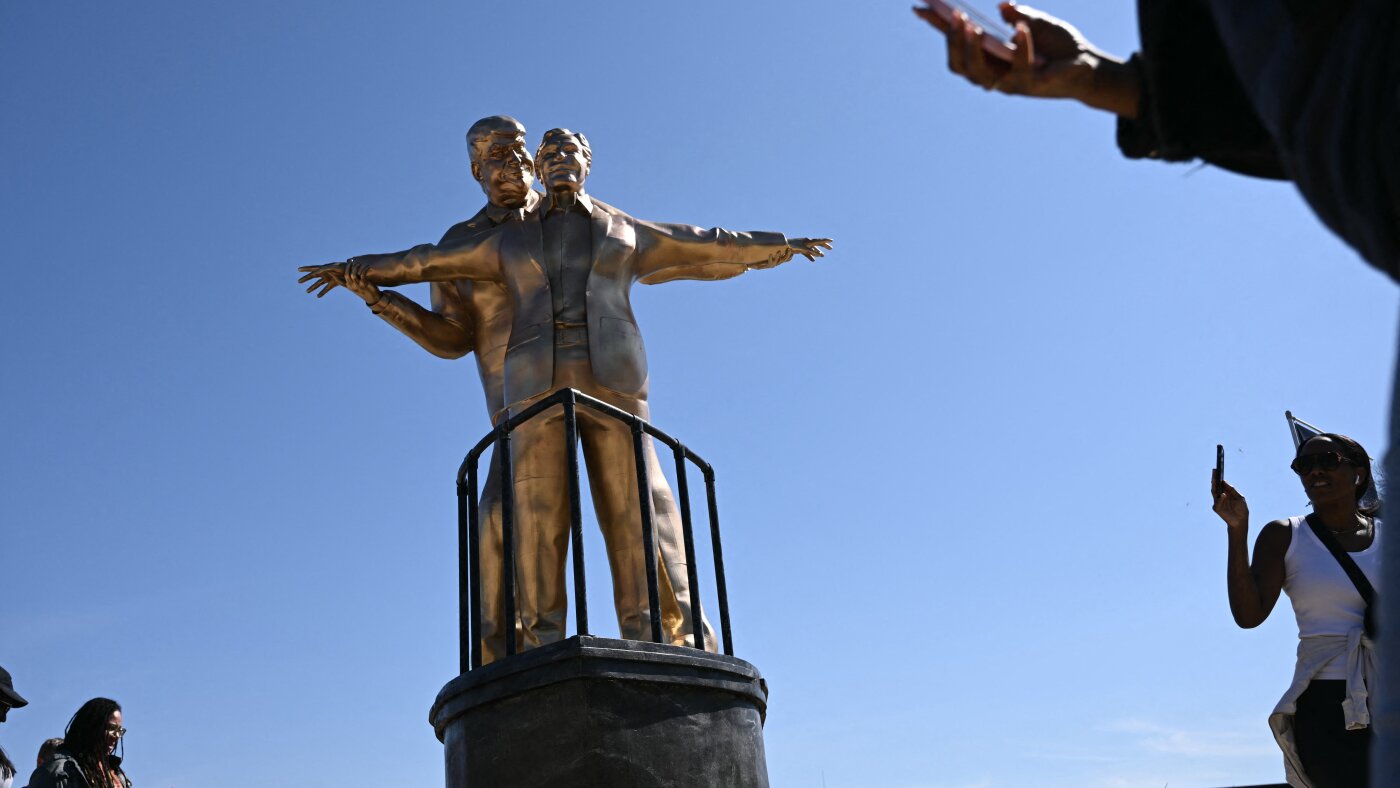
A propaganda war on the National Mall pits Trump against satirical statues and posters

Video: Toy Testing with a Discerning Bodega Cat

The Artemis Moon base project is legally dubious

Ukraine signals progress on US security guarantees after call with Trump envoys

GOP leaders endorse Trump’s shutdown-proof move to end DHS funding lapse

Florida High School Football Rankings: Top 25 teams – Oct. 21

How old is Bo Nix? What to know about Oregon quarterback ahead of 2024 NFL Draft

Cleary's 21 help Le Moyne down Central Connecticut State 69-64 in OT

99th annual Pony Swim held in Virginia

Indiana Members Credit Union announced as new anchor tenant at Bottleworks District
GOP leaders endorse Trump’s shutdown-proof move to end DHS funding lapse

Palestinians in West Bank protest, strike against Israeli death penalty law

Judge delays Luigi Mangione’s federal trial by about a month but won’t push it to next year | CNN

Video: Trump Says U.S. to Leave Iran ‘Very Soon’

April showdowns: 4 key races to watch this month that will test Trump, GOP grip on power
-

 South-Carolina3 days ago
South Carolina vs TCU predictions for Elite Eight game in March Madness
-

 Miami, FL6 days ago
Jannik Sinner’s Girlfriend Laila Hasanovic Stuns in Ab-Revealing Post Amid Miami Open
-

 New Mexico1 week ago
Clovis shooting leaves one dead, four injured
-

 Culture1 week ago
Do You Know the Comics That Inspired These TV Adventures?
-

 Minneapolis, MN6 days ago
Boy who shielded classmate during school shooting receives Medal of Honor
-

 Education1 week ago
Video: Trader Joe’s Dip Head-to-Head Taste Test
-

 Tennessee1 week ago
Tennessee Police Investigating Alleged Assault Involving ‘Reacher’ Star Alan Ritchson
-

 Vermont3 days ago
Skier dies after fall at Sugarbush Resort