Wyoming
University of Wyoming trustees keep President Seidel, form committee to address turmoil – WyoFile


Rising furor over the controversial demotion of a University of Wyoming engineering dean has brought the state’s only public four-year university to a tipping point.
Academic leaders, donors and others decried the demotion as emblematic of a culture of top-down and inscrutable decision making by the UW Board of Trustees and President Ed Seidel.
Twelve college deans signed a letter expressing “deep concern for the trajectory” of the university — citing the dean’s demotion and mounting pressures on academic freedom.
And on Monday, the faculty senate overwhelmingly delivered a vote of no confidence in Seidel, the first such vote in recent memory.
The outrage appeared strong enough to threaten Seidel’s leadership. Professors and deans expressed hope for lasting change to leadership that, according to the faculty senate, has driven the departure of talented academics and made replacing them difficult — ultimately threatening the learning experience for students.
The gravity of the moment was not lost on Seidel, he told the trustees Tuesday morning, reading from a written statement before they entered a closed-door meeting without him.
“How we handle this pivotal moment is important for the future of the institution,” Seidel said, “which is clearly facing a crisis.”
After an hour and a half behind closed doors, the board reemerged and issued its response. They will form a committee to study the issue.
The committee will include two trustees, and most likely one faculty member, one staff member, one student government member, Seidel and the provost, board chairman Kermit Brown said. “That committee will be charged with working on communications and working on ideas to more fully engage shared governance in the university,” he said.
Neither a timeline nor the new committee’s authority were discussed. The trustees are also crafting a “formal statement,” Brown said, “with regard to the current state of affairs and the work of the [new] committee.” That press release will be vetted by the university’s legal department before its release, trustees said.
The trustees had not published the statement by 6 p.m. Tuesday.
The trustees did not raise the prospect of imposing consequences on Seidel for losing the faculty’s trust. His current contract extends through the summer of 2026. Nor did the trustees address the underlying issues that sparked furor following Dean Cameron Wright’s demotion — most notably the allegations lobbed across campus that it was a retaliation for Wright’s opposition to funds being shifted from his budget to that of Seidel’s romantic partner, who heads UW’s new School of Computing.
Faculty senate members considered their vote a risky endeavor. Though many of them are tenured professors, they conducted yesterday’s meeting mostly in a closed session so that senators could feel safe speaking against university leadership. Once the meeting opened to the public, votes on the no-confidence resolution were issued by hand-written paper ballots to avoid any hand raising or spoken votes.
“You are justified in fearing retribution from this administration,” Bob Sprague, a former chair of the faculty senate, wrote in a letter to the body ahead of its Monday vote. But he also urged senators to “speak truth to power and send a clear message to the entire University community that this administration’s conduct is not acceptable.”
The faculty senate ultimately voted 43 to 11 to back a resolution that declared Seidel’s leadership “unacceptable,” though it did not call for him to be removed. Instead, in a final paragraph — referenced by Brown when he announced the new committee — it called for the administration and campus to work together to “reestablish an atmosphere of mutual respect, to rebuild trust and a willingness to work together.”
On Tuesday, faculty members returned to a campus Seidel will remain in charge of for the foreseeable future. During a campus town hall the president hosted yesterday, Seidel rejected any suggestions he would retaliate.
“I am absolutely against any form of retaliatory action,” he said at that event, according to a report in Oil City News. “I’ve been very, very clear about that. And I do not want to ever have any kind of a retaliation against someone for speaking their mind.”

After days of impassioned statements and letters from his critics, Tuesday appeared relatively quiet following the morning board meeting. Ray Fertig, the faculty senate president, did not respond to WyoFile voicemails requesting comment.
Two outspoken former faculty members, and Democratic Laramie lawmaker Karlee Provenza — who has criticized Seidel’s advocacy for the School of Computing and his conciliatory approach to the Legislature’s efforts to meddle with campus — told WyoFile the trustees’ response fell flat.
“They don’t have a really genuine, authentic response to anything is what it feels like,” Provenza said. She hoped faculty and deans would continue to push for change if they wanted something beyond the new committee, she said.
“One choice is ‘aw shucks, I didn’t get what I wanted, I don’t have any power in this situation,’” Provenza said. “But I think the other option is we have to build our power. There are more levers of power for faculty, for deans, and I encourage them to exercise those rights.”
Sprague and former president of the faculty senate, now-retired veterinary professor Donal O’Toole both noted that the committee, as Brown described it, appeared stacked toward the administration and the trustees, with just two faculty representatives and one student on a seven-person body.
“They will put forward probably some very watered down recommendations that ultimately will be ignored,” Sprague said. Ultimately, he feared the episode will lead to “no substantial improvement to the situation on campus,” and the trustees, he said, will “rationalize [faculty] unhappiness in various ways.”
O’Toole agreed that the trustees had opted for a tepid, middle-of-the-road path. “Seidel is a known quantity,” he said, “and [in the wake of criticism] he’s certainly saying all the right things.”
Beginning last week, when the faculty senate leadership expressed dismay in his leadership ahead of the full body’s vote, Seidel has been conciliatory and said he has learned from the uproar. In several statements and in yesterday’s town hall, he promised to renew his commitment to the university’s model of “shared governance,” which, notably, calls for faculty input on the removal of academic officers.
Faculty members say that part of the university’s governing code was firmly ignored when the board demoted Wright. The board demoted Wright even though every department head in his college — with the exception of school of computing head Gabrielle Allen, Seidel’s partner — called on them not to.
Coming back from a no-confidence resolution to a place where the campus is working well together will be very hard to do, O’Toole said.
“On the one hand, I think the faculty senate executive committee thought this had to be done,” he said. “On the other hand, they realized that in the short and medium term it’s going to make dealing with Seidel’s administration pretty frosty … The feeling is ‘we’ve sent the message, let’s hope for the best.’”



A pair of bills signed into law last week aim to build out a more comprehensive system of literacy education across Wyoming’s public schools.
One mandates evidence-based practices and requires regular screenings for dyslexia, while the other enables the Wyoming Department of Education (WDE) to hire a dedicated literacy professional to oversee statewide compliance.
Gov. Mark Gordon’s signing of both bills on Friday was the latest accomplishment of an ongoing push for improved literacy standards. That push has been spearheaded by State Superintendent of Public Instruction Megan Degenfelder.
“Wyoming is not going to let a single child fall through the cracks,” Degenfelder said during a public bill signing last week. “We are not going to fall behind when it comes to ensuring that our children can read at grade level.”
The primary bill, Senate File 59, establishes a statewide K-12 program for teaching students to read that is built on “evidence based language and literacy instruction, assessment, intervention and professional development that supports educators, engages families and promotes literacy proficiency for all Wyoming students.”
The bill defines evidence-based strategies as those that conform to the science of reading, a term that will be defined and updated by Degenfelder’s office. Nationwide, it generally means putting academic research into practice in classrooms. SF 59 specifically prohibits the exclusive use of “three-cueing” — a strategy once widely employed to teach reading but which education experts now say is outdated and less effective than other strategies.
It also requires annual dyslexia screeners for students below the third grade, and testing for reading difficulties for all students.
The screeners are used to identify the severity of reading difficulties in order to direct “tiered” support that offers the most intensive interventions to the students most in need, while still providing “evidence based” language instruction to all students.
Each school district must formulate an individualized reading plan “for each student identified as having reading difficulties or at risk for poor reading outcomes.”
Districts must now report to the state annually regarding their literacy-related work. Any district where 60% or more of the students are struggling will be required to implement “summer literacy camps or extended supports, including after school support and tutoring.”
The bill also requires literacy related professional development for teachers and specialists “appropriate to their role and level of responsibility” related to literacy education.
SF 59 was backed by dyslexia advocates and literacy specialists.
Senate File 14, the other literacy bill signed into law Friday, appropriates $120,000 annually for the next two years for a full-time position at WDE “to assist school districts in implementing a reading assessment and intervention program and language and literacy programs.”
Both bills go into effect July 1.

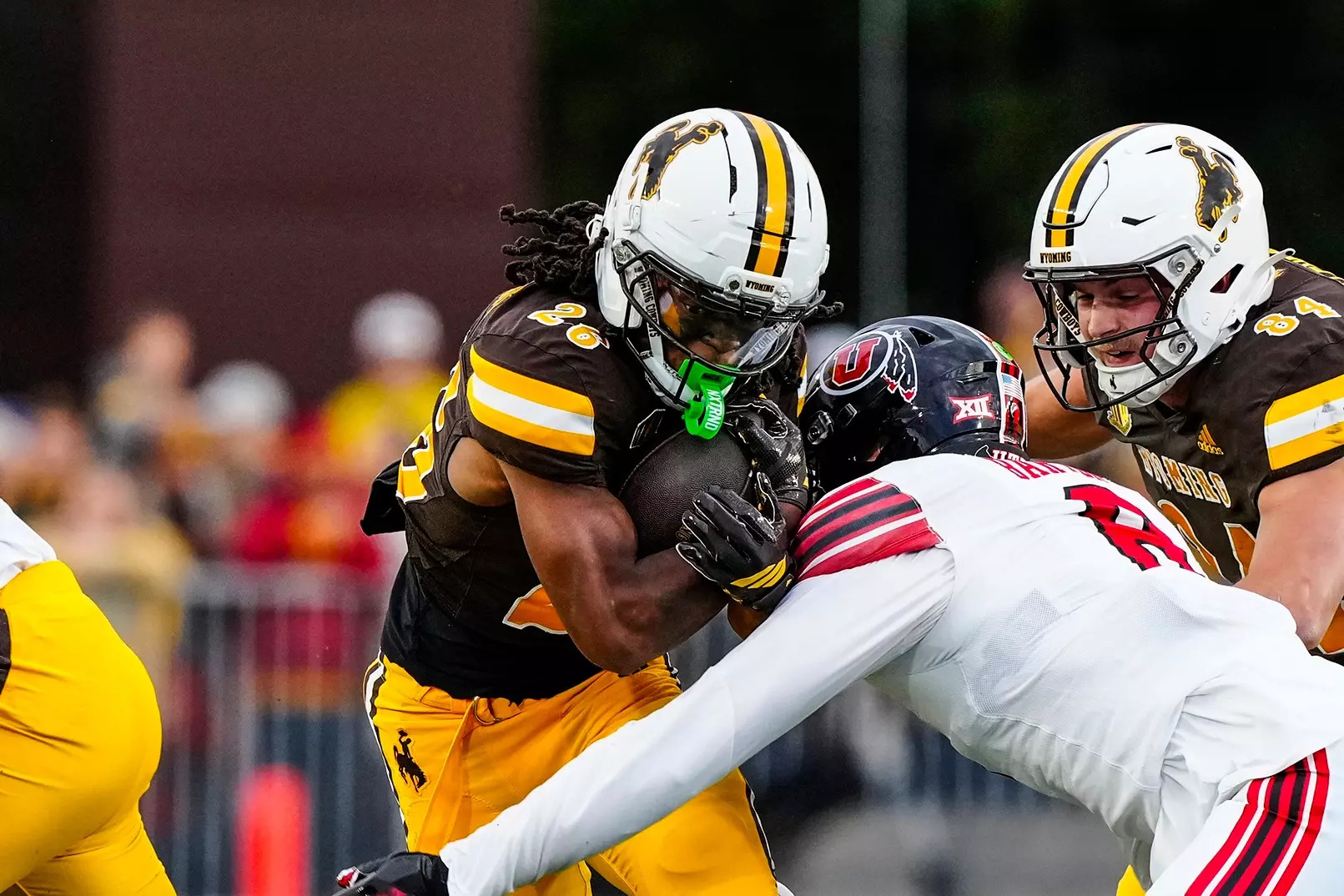
LARAMIE — The University of Wyoming and the Mountain West Conference announced the Cowboys’ 2026 football schedule Monday, a slate that opens with the Border War and concludes with back-to-back home games in Laramie.
Wyoming opens the season Sept. 5 on the road against Colorado State in the 118th edition of the Border War. The Cowboys then host Northern Colorado on Sept. 12 in the home opener before traveling to Central Michigan on Sept. 19.
The Cowboys begin Mountain West play Sept. 26 at home against Hawaii in a matchup for the Paniolo Trophy. Wyoming then faces back-to-back road games at North Dakota State on Oct. 3 and San Jose State on Oct. 10.
Advertisement – Story continues below…
University of Wyoming sports coverage
in Southwest Wyoming is supported by these great sponsors:
Wyoming returns to War Memorial Stadium on Oct. 17 to host conference newcomer Northern Illinois before facing Air Force at home on Oct. 24. The Cowboys will have an open week on Oct. 31.
The Cowboys open November with road games at UNLV on Nov. 7 and at UTEP on Nov. 14, marking Wyoming’s first meeting with the Miners as members of the Mountain West. Wyoming closes conference play by hosting New Mexico on Nov. 21 and wraps up the regular season with a nonconference game against UConn on Nov. 28 in Laramie.
Each Mountain West team will play four home and four road conference games during the 13-week season, which will conclude with the Mountain West Football Championship Game featuring the two teams with the highest conference winning percentages. The championship game date will be announced later.
With the conference schedule set, Mountain West television partners CBS Sports, FOX Sports, and The CW will begin selecting broadcast games, which could include moving some contests to non-Saturday dates. Network assignments and kickoff times will be announced at a later date.
Season ticket renewals for the 2026 Wyoming football season are now available. Fans can renew their tickets online by visiting gowyo.com/tickets and logging into their account.

The 2026 Wyoming prep girls’ basketball season is nearly done. Two state champions were crowned in Classes 1A and 2A last Saturday. Southeast won the 1A title for the third consecutive season, and Sundance won the 2A title for the first time in eight years. Class 3A and 4A held their regional tournaments, which qualified teams for the state tournament later this week in Casper.
WYOPREPS WEEK 12 GIRLS BASKETBALL STANDINGS 2026
These are the girls’ basketball team records for all games played through March 7, 2026. For all but 16 teams, this is the final record of the season. Those squads will play in the 3A-4A state tournament starting on Thursday in Casper.
1A Northwest: (Overall Record, followed by Conference Record)
Burlington 24-5, 8-0
Riverside 14-10, 6-2
Dubois 11-10, 4-4
St. Stephens 3-16, 1-7
Meeteetse 1-20, 1-7
1A Southwest: (Overall Record, followed by Conference Record)
Cokeville 23-4, 10-0
Little Snake River 23-4, 8-2
Farson-Eden 16-12, 5-5
Saratoga 13-11, 5-5
Ft. Washakie 8-13, 2-8
Encampment 3-19, 0-10
1A Northeast: (Overall Record, followed by Conference Record)
Upton 16-7, 10-0
Kaycee 13-12, 7-3
Hulett 12-13, 7-3
Arvada-Clearmont 9-12, 4-6
Casper Christian 4-13, 2-8
Midwest 1-16, 0-10
1A Southeast: (Overall Record, followed by Reg. Season Points)
Southeast 24-5, 40 points
Lingle-Ft. Laramie 17-11, 31 points
Lusk 15-13, 26 points
H.E.M. 13-11, 24 points
Rock River 6-14, 12 points
Guernsey-Sunrise 2-18, 4 points
2A Northwest: (Overall Record, followed by Conference Record)
Thermopolis 16-13, 5-1
Greybull 16-15, 4-2
Rocky Mountain 9-17, 2-4
Shoshoni 11-18, 1-5
2A Southwest: (Overall Record, followed by Conference Record)
Wyoming Indian 23-7, 6-0
Big Piney 8-16, 4-2
Kemmerer 2-21, 1-5
Wind River 2-23, 1-5
2A East: (Overall Record, followed by Conference Record)
Sundance 23-4, 5-0
Big Horn 21-6, 4-1
Tongue River 18-11, 3-2
Pine Bluffs 17-12, 2-3
Moorcroft 7-18, 1-4
Wright 3-23, 0-5
Read More Girls Basketball News from WyoPreps
WyoPreps 1A-2A Girls State Basketball Scoreboard 2026
WyoPreps 3A-4A Girls Regional Basketball Scoreboard 2026
WyoPreps Coaches and Media Final Basketball Poll 2026
WyoPreps 1A-2A Girls Regional Basketball Scoreboard 2026
WyoPreps Coaches and Media Basketball Poll 2-25-26
WyoPreps Girls Basketball Week 10 Scores 2026
WyoPreps Coaches and Media Basketball Poll 2-18-26
WyoPreps Girls Basketball Week 9 Scores 2026
WyoPreps Coaches and Media Basketball Polls 2-11-26
WyoPreps Girls Basketball Week 8 Scores 2026
WyoPreps Coaches and Media Basketball Polls 2-4-26
WyoPreps Girls Basketball Week 7 Scores 2026
Nominate A Basketball Player for the WyoPreps Athlete of the Week Honor
3A West: (Overall Record, followed by Conference Record)
Cody 24-0, 10-0
Lander 21-4, 9-1
Pinedale 20-5, 7-3
Powell 16-9, 6-4
Lovell 16-10, 4-6
Worland 9-16, 2-8
Lyman 10-11, 2-8
Mountain View 4-19, 0-10
3A East: (Overall Record, followed by Conference Record)
Wheatland 22-4, 10-0
Buffalo 13-11, 8-2
Douglas 14-11, 6-4
Burns 16-13, 5-5
Torrington 10-11, 5-5
Glenrock 12-13, 3-7
Newcastle 1-22, 1-9
Rawlins 2-21, 0-10
4A Northwest: (Overall Record, followed by Conference Record)
Green River 23-2, 6-0
Natrona County 9-16, 4-2
Kelly Walsh 8-15, 2-4
Rock Springs 5-20, 0-6
4A Southwest: (Overall Record, followed by Conference Record)
Star Valley 16-7, 5-1
Evanston 16-10, 5-1
Riverton 7-19, 1-5
Jackson 3-19, 1-5
4A East: (Overall Record, followed by Conference Record)
Cheyenne East 21-3, 11-1
Cheyenne Central 16-9, 10-2
Sheridan 14-10, 7-5
Thunder Basin 14-10, 6-6
Laramie 12-11, 6-6
Campbell County 1-19, 1-10
Cheyenne South 1-21, 0-11
*The second Campbell County-Cheyenne South girls’ game was canceled.
Wyoming 3A Boys Swimming & Diving State Championships 2026
Photos from the 3A Boys State Swim Meet
Gallery Credit: Courtesy: Marcello Monterastelli Photography & Jared Newland, WHSAA

In final address, Gov. Bill Lee credits TN economic, innovation gains

Most applicants for Texas school choice vouchers already attend private schools, state data shows

‘They’re trying to change the rules’: Republicans ramp up fight to stop new maps in Utah

Vermont highway shut down following rock slide

Virginia lawmakers criticize anti-redistricting mailer with Jim Crow-era images – WTOP News

Florida High School Football Rankings: Top 25 teams – Oct. 21

How old is Bo Nix? What to know about Oregon quarterback ahead of 2024 NFL Draft

Cleary's 21 help Le Moyne down Central Connecticut State 69-64 in OT

99th annual Pony Swim held in Virginia

Indiana Members Credit Union announced as new anchor tenant at Bottleworks District

Map: 2.3-Magnitude Earthquake Reported North of New York City

Trump stirs GOP primary drama with visit to Massie’s Kentucky home turf

Israeli air strike targets building in south Lebanon

Ed Martin, outspoken Justice Department lawyer, is formally accused of ethical violations | CNN Politics

Trump reveals top issues GOP should focus on to secure midterms victory: ‘I’ve never been more confident’
-

 Wisconsin1 week ago
Setting sail on iceboats across a frozen lake in Wisconsin
-

 Massachusetts1 week ago
Massachusetts man awaits word from family in Iran after attacks
-

 Maryland1 week ago
AM showers Sunday in Maryland
-

 Pennsylvania5 days ago
Pa. man found guilty of raping teen girl who he took to Mexico
-

 Florida1 week ago
Florida man rescued after being stuck in shoulder-deep mud for days
-

 Sports6 days ago
Keith Olbermann under fire for calling Lou Holtz a ‘scumbag’ after legendary coach’s death
-

 Virginia6 days ago
Giants will hold 2026 training camp in West Virginia
-

 Politics1 week ago
Mamdani’s response to Trump’s Iran strike sparks conservative backlash: ‘Rooting for the ayatollah’