Utah
Could making this change help Utah improve sexual assault prosecutions?


SALT LAKE CITY — In the beginning, the criminal justice system worked just the way Taryn Evans anticipated.
She filed a report of rape with Salt Lake City police in 2019, explaining a man she’d met on a dating app forced himself on her the first time they met.
“Against my will, he had sex with me, and I voiced my no’s several times,” Evans told KSL. “I froze, I was terrified.”
Evans went to a hospital for a forensic exam. In the weeks that followed, prosecutors charged Kenneth Joshua Cordova with rape and two other felony crimes.
But those hefty felony charges were later watered down to misdemeanors as part of a plea deal that spared Cordova any prison time and didn’t require him to register as a sex offender.
The reason? Evans said the Salt Lake County District Attorney’s Office told her it came down to proving a lack of consent.
“The prosecutor said that based on that and the way our statutes written, there’s a substantial likelihood of acquittal,” Evans recalled.
Her experience with Utah’s justice system motivated her to advocate for change. That’s when she learned a bill that could impact cases like hers has repeatedly failed on Utah’s Capitol Hill.
“The gap in the law that our legislators are ignoring is the reason for victims of sexual assault not getting any justice,” Evans said.
Taryn Evans reported to Salt Lake City police that a man she met on a dating app forced himself on her even though she said no. Evans is urging Utah lawmakers to pass a bill she says could help ensure perpetrators of sex crimes face serious consequences. (KSL TV)
The gap she’s talking about: Prosecutors say Utah’s rape statute requires they prove that a suspect knew a victim was not consenting. They say that’s a hard burden to meet, especially if a victim is intoxicated, sleeping, or frozen in fear.
It means in cases like Evans’, charges of rape – a first-degree felony punishable by up to life in prison – are often getting dropped down to mere misdemeanors.
KSL does not normally identify survivors of sexual crimes, but Evans gave her permission.
In a statement, a defense attorney for Cordova said the case had many nuances that called into question the issue of consent.
“Mr. Cordova plead guilty to Sexual Battery as Class A misdemeanors also understanding the risk of going to trial,” attorney Cara Tangaro wrote.
KSL obtained a recording of Cordova’s interview with Salt Lake City police through a public records request. In the recording, Cordova is heard telling police, “I certainly didn’t do any rape.”
Salt Lake County District Attorney Sim Gill stands by his office’s decision to offer the plea bargain. Asked whether his office got the best deal it could, Gill said, “That was the best outcome we could have.”
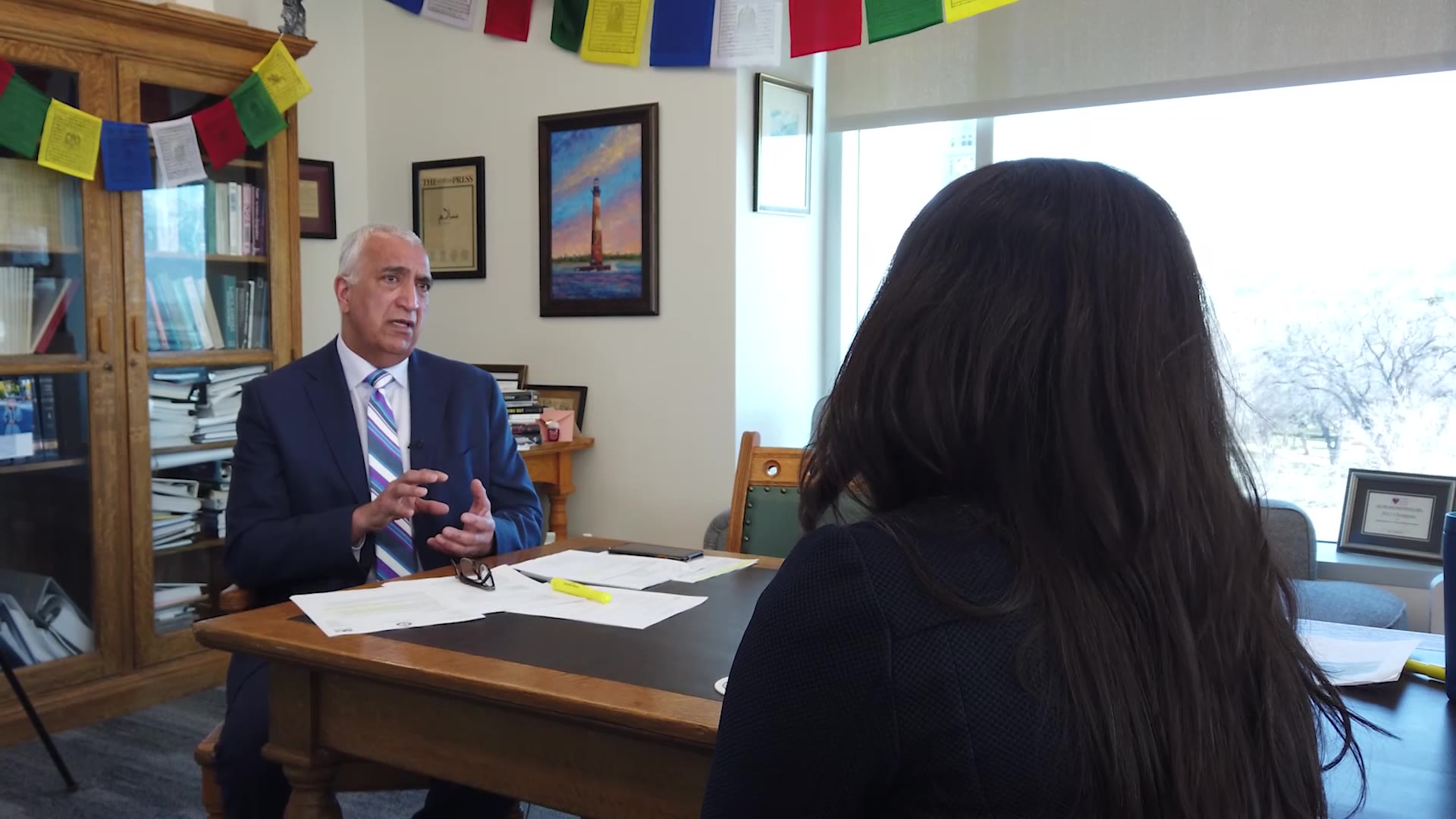
Salt Lake County District Attorney Sim Gill talks about his office’s decision to offer a plea bargain in a rape case. “That was the best outcome we could have,” Gill told KSL. (KSL TV)
Rep. Angela Romero, D-Salt Lake City, has sponsored legislation to fill that gap four times.
“There are individuals who are serial rapists, who know they’re not going to get prosecuted and continue to harm people,” Romero said.
Her affirmative consent bill would create a new third-degree felony offense for cases where a perpetrator fails to get consent from a victim through words or actions.
Gill said he’s long supported Romero’s efforts.
“It gives us also a different place to land at, which I think currently is missing,” Gill said.
Utah House Speaker Mike Schultz, R-Hooper, has voted against the measure in the past.
KSL asked during this year’s legislative session if he would reconsider.
“Absolutely,” Schultz responded. “We need to look at what we can always do to protect the ladies in the state.”
But the bill didn’t get a public hearing before the end of the 2024 Legislature.
“I don’t think they did anything to protect the ladies,” Evans said. “We’re not going to even talk about it? That sends a message of, ‘it doesn’t matter.’”
Will lawmakers consider bill to boost Utah’s low rate of sex assault prosecutions?
But the politics of consent may be shifting. Romero and Evans say they are building momentum behind the scenes.
“I’ve had conversations with the speaker,” Romero said of Schultz. “He’s like, ‘We need to do something, I go, ‘We do. Y’all need to get my bill a hearing.’”
“When we don’t hear legislation,” Romero continued, “people feel like their lawmakers don’t care about them.”
Evans agreed.
“I’m currently trying to get support so that I can, before the next legislative session, have enough people to come in to force a discussion, so that Utah can do better by victims,” she said.
Romero knows many people would prefer to avoid the politics of consent, regardless of their party affiliation.
“They don’t have to have a ‘D’ or an ‘R’ behind their name,” Romero said. “It just makes people uncomfortable.”
But with the support of Utah survivors like Taryn behind her, Romero said she’ll propose her affirmative consent legislation a fifth time next year and is determined to get it passed.
“I’ll continue to make colleagues uncomfortable,” Romero said, “because we need to have these conversations.



Utah
Embattled Utah Rep. Trevor Lee loses county GOP convention — but wins enough support to make primary

Earlier in the week, House Speaker Mike Schultz said lawmakers asked the attorney general to investigate allegations of fraud and bribery against Lee.
(Francisco Kjolseth | The Salt Lake Tribune) Rep. Trevor Lee, R-Layton, running for reelection, addresses delegates during the Davis County Republican Party nominating convention at Syracuse High School on Saturday, April 18, 2026.

Also from Utah Eats: A Utah baker ends his run on a Food Network competition; Lucky Slice’s territory grows.
(Francisco Kjolseth | The Salt Lake Tribune) The Yeti, a Himalayan-themed bar in Cottonwood Heights, is pictured on Wednesday, April 8, 2026.
Utah
Zion National Park closes popular trail during ongoing search and rescue operation – KSLNewsRadio

FILE: An entrance to Zion National Park is pictured on Wednesday, Oct. 14, 2020. The West Rim and Angel’s Landing Trails are temporarily closed in Zion National Park for an ongoing search and rescue operation. (Ravel Call, Deseret News)
(Ravel Call, Deseret News)
SALT LAKE CITY — The West Rim and Angel’s Landing Trails are temporarily closed in Zion National Park for an ongoing search and rescue operation.
According to park officials, an incident occurred on the Angels Landing trail at approximately 2 p.m. on Friday, April 17.
At the time of publication, emergency services and search and rescue officials were on the scene.

Views along the Angel’s Landing Trail, Zion National Park. (KSL)
No further information was available.
Other reading: Supreme Court, Justice Hagen respond to state investigation into misconduct allegations
This story is developing and may be updated.

-

 Texas3 minutes ago
Co‑worker confesses to killing missing North Texas man and stealing his car, police say
-

 Utah9 minutes ago
Embattled Utah Rep. Trevor Lee loses county GOP convention — but wins enough support to make primary
-

 Vermont15 minutes ago
Women’s Lacrosse Bested in Burlington by Vermont – University at Albany Great Danes
-

 Virginia21 minutes ago
Skydiver rescued after crashing into scoreboard during Virginia Tech football scrimmage
-

 Washington27 minutes ago
Washington football displays depth, talent at first spring scrimmage
-

 Wisconsin33 minutes ago
Wisconsin basketball signs Miami transfer Eian Elmer, who gives ‘scoring punch’
-

 West Virginia39 minutes ago
West Virginia American Water set to upgrade water lines in Fayetteville
-

 Wyoming45 minutes ago
(LETTERS) Wyoming Supreme Court judges, congressional responsibility, pregnancy and US involvement in the Middle East