West
UC Berkeley parents raise $40k, hire private security guards to temporarily patrol campus at night

Concerned parents calling themselves SafeBears have raised $40,000 to pay for security guards or “safety ambassadors” to patrol the UC Berkeley campus area for a few weeks in early March.
UC Berkeley may be one of America’s most prestigious schools, but its location in the California Bay Area has parents and students both wary of safety on campus. A group called SafeBears, that touts itself as comprising “1,300+ Cal parents and community allies working to improve safety for UC Berkeley students,” has worked to solve the problem themselves, hoping their prototypical program of patrols around campus will inspire the college to take more action themselves.
The SafeBears website declares that “Cal parents raised over $40,000 to conduct a private security pilot program around UC Berkeley” that was “inspired by USC’s Safety Ambassadors program.” These privately hired security guards have been patrolling the campus area from 6:30 p.m. at night to 3 a.m. starting on March 6, but will only continue to do so until March 23.
UC BERKELEY LAW DEAN SLAMS ‘SCOURGE’ OF ‘ORIGINALIST’ READING OF CONSTITUTION IN LA TIMES OP-ED
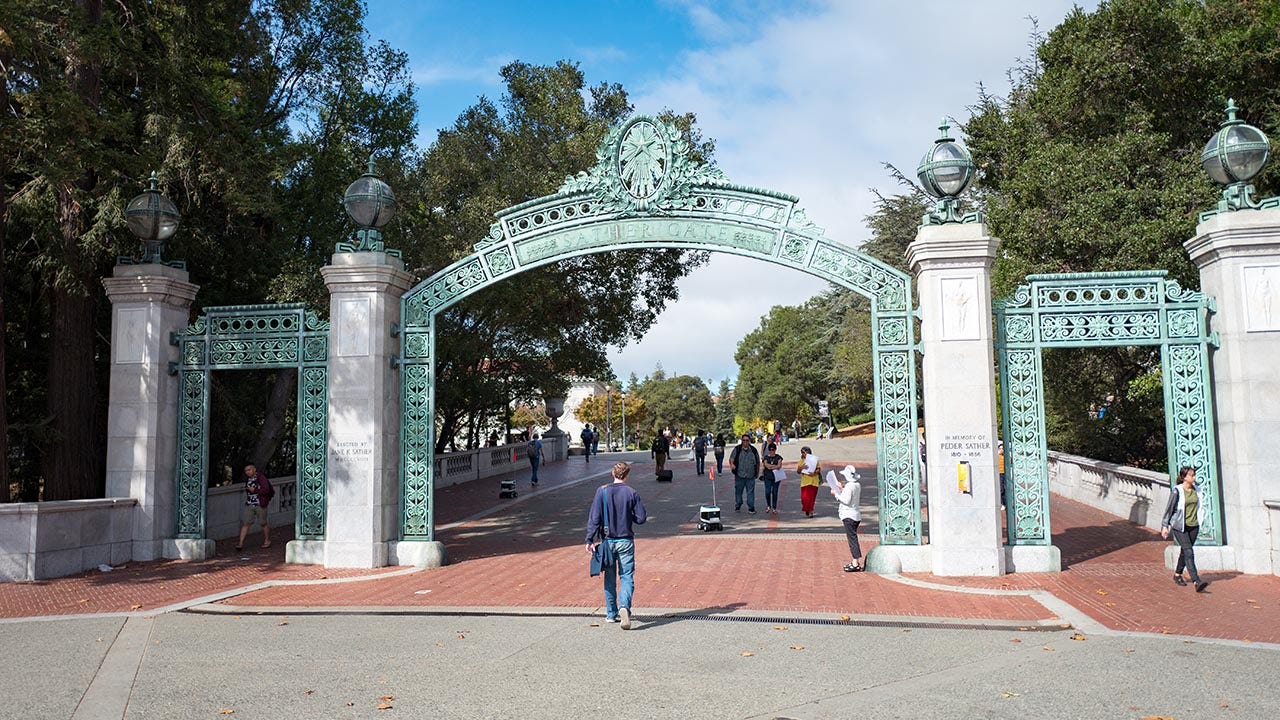
Student walks through Sather Gate, the iconic entrance gate to the campus of UC Berkeley in downtown Berkeley, California, October 9, 2018. (Smith Collection/Gado/Getty Images)
The organization of parents cited a litany of local issues and incidents making the case that students are in dire need of more protection on campus, ranging from citing an “armed robbery spree” to a pattern of trespassing incidents, such as when “a convicted felon made his way to a sixth floor shower in a first-year residence hall before being arrested by UCPD.” All the while, SafeBears noted that the Berkeley Police Department is “in the midst of a staffing crisis.”
SafeBears president Sagar Jethani, who has twin sons at Berkeley, voiced his frustration to CBS News arguing the college has not taken enough action to protect students themselves, “The fact is if they’re not going to act, despite repeated pleas from parents and students to take more substantial action, then we’re going to act.”
HIGH SCHOOL STUDENTS WALK OUT IN PROTEST AFTER JEWISH STUDENT WAS CALLED NAMES, ATTACKED
He added further, “We want to, frankly, turn up the heat with the administration. We want to show that we’re not content to just wait forever to have these safety ambassadors deployed.”
The pilot program of these patrols by hired security will reportedly only last until March 23, after which time parents reportedly hope the university will take over.
A spokesperson from UC Berkeley raised concerns about the effort to Fox News Digital and noted the campus’ own efforts to keep people safe.
“Hiring private security raises a number of concerns including the training and experience of individuals hired by such firms,” the spokesperson warned. “Further, any security effort on the campus must be coordinated with UCPD, independent of the funding source.”
The spokesperson contested that funding can best be used in other ways.
“We believe that university funds are better spent hiring more sworn or non-sworn UCPD officers for standard daily response efforts. Parents who want to donate funds toward additional campus security can do so via a university fund that has been established,” the spokesperson wrote, “We do not believe that private security should take precedence over hiring sworn officers. In addition, a holistic approach to campus safety is required and is the most effective approach.”
Numerous new efforts from the school administration were mentioned as well. One such initiative was “Increased security efforts” including “key card access to buildings, surveillance cameras, and dedicated on-site staff.” Another was the “Increased staffing of Community Service Officers” or “CSOs” which are trained students employed by the UCPD. The spokesperson elaborated that “Early in the fall semester we had 58 CSOs, next week we will be up to 90, and we are planning to increase staffing to at least 100 Community Service Officers.”
All of this is in addition to Berkeley’s ongoing efforts, such as night safety services and student safety education.
Read the full article from Here


After landing Darryn Peterson at the top of Tuesday night’s first round, the Utah Jazz are heading into day two of the 2026 NBA Draft without a second round at their disposal.
However, with a front office like the one that’s in Utah, it’d be hard to truly count out the Jazz from making a trade throughout the night to jump into the second round, in the event there was a prospect the Ainges had a certain appeal for.
While most of the big names of this class have already been scooped up in the first 30 picks, there’s certainly a few both interesting and potentially valuable names to keep an eye on through the next 30.
And for the Jazz, a few of them could fit their current lineup or some specific needs well enough that would make sense to get back on the clock once again.
Let’s take a look at four prospects still left up for grabs on day two of the draft that could be a worthwhile pickup for the Jazz to consider trading up for.
Dillon Mitchell | F, St. Johns
An athletic forward fresh off of a season under Rick Pitino at St. John’s, trading up to add another D-Mitchell to Utah’s draft history might not be the worst idea here.
Offensively, he won’t bring a ton to the table, as he only averaged 8.3 points a night during his senior season and shot a rough 6.7% from three. What he does do is check a ton of boxes in terms of size at 6-foot-8, 210 pounds, as well as his abilities as a defender, rebounder, and energy guy enough to warrant a look at the top half of the second round.
For the Jazz, perhaps they’d like to land on a more dynamic fit on both ends than Mitchell. But he sure would bring a nice spark on the defensive end that Utah could utilize after multiple lackluster years of production on that end of the floor.
Richie Saunders | G, BYU
A local product who spent four years with Brigham Young, Saunders might not fit exactly the type of mold on the defensive end that Utah could really covet here in the second round.
However, he does project to be a pretty seamless connecting wing with solid NBA size standing at 6-foot-5, has a strong outside shooting ability with a 38.7% clip from deep from his career, and should be able to at least hold his own on the other end.
He’d be a nice fit in Will Hardy’s system, and have a solid pro career as role player in the wing.
Trevon Brazile | F, Arkansas
If you’re looking for a lengthy, two-way impact player that could fit with the current standout size in this Jazz frontcourt, Brazile would be a perfect fit to bring in that would do just that.
He’s got great length standing at 6-foot-10, can be an ample shot blocker, is a threat at the rim who can finish well, stretches the floor, and on paper, looks like the type of piece in the frontcourt that many front offices around the league would love to get their hands on.
However, he has seen several questions regarding his lighter frame at 225 pounds, and has shown a lack of physicality and a real motor from his time at Arkansas. That same reason is why many GMs might turn away from taking a flier on him.
Jaden Bradley | G, Arizona
For the guards that are up for grabs in this range, Bradley has some of the best traits in terms of size at 6-foot-3, 200 pounds, and has the chance to be an impactful player on both ends of the floor as a solid playmaker and perimeter defender.
He wasn’t a high-volume scorer during his three years at Arizona, but he was efficient in his opportunities, shooting over 46% from the field and 39% from three on over nine shots a game. He could be a worthwhile dart throw to bring in for the back-end of the roster.
Another note that could make him a fun target for the Jazz: Bradley and Keyonte George are tight-knit from their days as teammates back at IMG Academy. So he’d be a pretty awesome fit into the locker room on top of the impact he offers on the floor.
Be sure to follow Utah Jazz On SI on X to stay up to date for daily Utah Jazz news, rumors and analysis!
 Add us as a preferred source on Google
Follow

The iron gate to Woodlawn Cemetery is almost always locked shut, but Toni White-Richardson was more than happy to let News4 inside.
As president of the Woodlawn Cemetery Perpetual Care Association, she was excited to talk about what makes this resting place so special.
“It is major D.C. history, first. Then it’s also major Black history, second,” White-Richardson said.
More than 30,000 people, mostly African Americans, are buried among the 22 acres of Woodlawn Cemetery, which opened in Southeast D.C. in 1895. And like so many cemeteries that date back to the 1800s, particularly African American cemeteries, this one has fallen into disrepair, is overgrown and has headstones tumbled over, like those of Wilhelmina and her husband James, and Eliza Spencer, a mother who died in 1887.
“Let me do a very upfront disclaimer,” White-Richardson said. “We have no idea where these stones go. And when we looked at the grid, it became even clear as mud, it became less clear as to where these stones should really go. Unfortunately, when we look back, we can tell there was a plan, but we could see we never got totally completed. Even back then, there are no markers saying this is Section H or this is Section G or this is 102 and this is, none of that.”
One of the most notable Washingtonians laid to rest here is John Mercer Langston, Virginia’s first Black congressman.

“Langston University came one year because they had a grand reunion in D.C., and we arranged for them to come to see […] John Mercer Langston, the university that was named after this man,” White-Richardson said.
And Blance Bruce, the first Black U.S. senator to serve a full term and register of the treasury, is also buried in the cemetery.

“He’s the signature on our dollar bill, you know, back in the late 1800s,” White-Richardson said. “So, oh, it’s history. It’s capital letters. No getting around it.”
Woodlawn is also the resting place of several of the original founders of two of the country’s most prominent Black sororities, Alpha Kappa Alpha and Delta Sigma Theta. Both organizations volunteer to help with clean ups.
The Perpetual Care Association recently received a grant from the D.C. Office of Planning to help with upkeep of the grounds and preserving the history here.
“These are important individuals who’ve made contributions to the District a century ago, but today still their history and their stories reverberate and really influence the trajectory of our city,” said Anita Cozart, director of the D.C. Office of Planning.
The cemetery tucked away off Benning Road is only open to the public five days a year, but groups can request tours anytime. The next chance to visit Woodlawn when it will be open to the public is Labor Day.
They’re always looking for volunteers and donors to help with the upkeep of this sacred ground.

Warsaw, N.Y. — Speedy cow, a new community owned internet service is now online in Wyoming County.
The service will bring faster, more reliable internet to Wyoming County residents.
The county received $15 million in grant funding to build the broadband network.
Anyone living in Wyoming County can sign up on the Speedy Cow website.
With the network being community run, that means all customer service experiences will be locally based.
“At the end of the day we own the system, so if there’s an issue with the system, the service or anything like that, you call the county and we’ll take care of it,” a county official said. “We’ll reach out to community broadband networks necessary and resolve any issues that the residents might have and at the end of the day, the residents of the county, the taxpayers of the county, own this system.”
Net profits from the service will be returned to expand and improve the system.
$3.8 Million in funding awarded for Affordable Broadband in Genesee County
___
-

 Texas1 minute ago
Why Texas? Explaining ins and outs of NHL exploring team for Houston or Austin
-

 Utah7 minutes ago
4 Prospects the Utah Jazz Could Trade Up to Draft in the Second Round
-

 Washington11 minutes ago
Inside Woodlawn Cemetery’s mission to preserve history
-

 Vermont14 minutes ago
Vermont Attorney General will not prosecute state trooper who fatally shot unarmed Putney man – VTDigger
-

 Virginia17 minutes ago
Virginia Tech introduces Brian White as new Athletics Director
-

 Wisconsin29 minutes ago
Top 100 Prospect Visiting Wisconsin on Wednesday
-

 West Virginia31 minutes ago
Yeager Airport director receives four percent pay increase – WV MetroNews
-

 Wyoming37 minutes ago
Speedy Cow community-owned internet service goes live in Wyoming County

