
Connect with us

West

This California city will stay in the 'doom loop' in 2024 as businesses flee and crime rises, resident warns

Published

on

This California city will stay in the 'doom loop' in 2024 as businesses flee and crime rises, resident warns

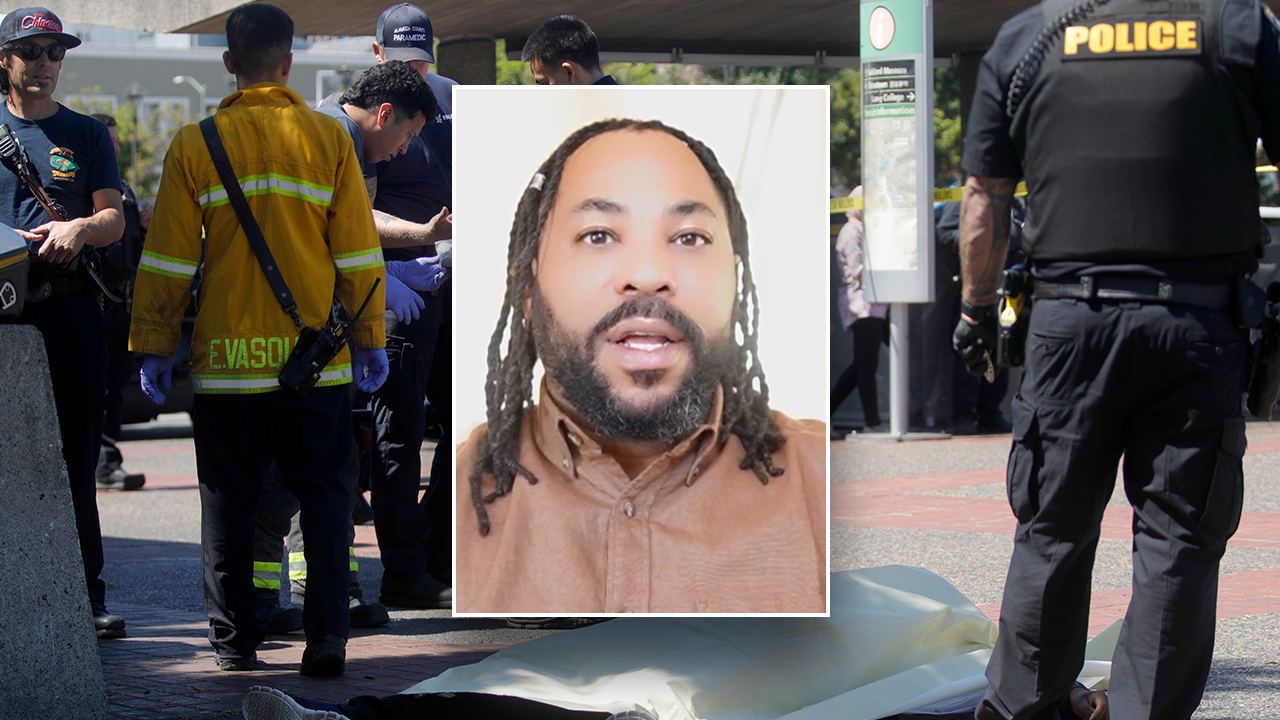
Burgeoning crime, struggling businesses and underfunded police have turned Oakland, California, into a “ghost town,” said a local safe neighborhoods advocate who believes the city’s decline is set to continue into 2024.

“We’re in a doom loop,” Seneca Scott, founder of Neighbors Together Oakland, a nonprofit focused on safety issues, told Fox News. “The doom loop means businesses leave because of the crime and problems, there’s less money to hire more police to solve the problem, and down you tumble.”

There have been over 14,500 motor vehicle thefts in Oakland this year, according to police data. That averages to nearly two thefts per hour. (Jane Tyska/Digital First Media/East Bay Times via Getty Images)

‘ACTIVIST CLASS’ ARE ‘REALLY USEFUL IDIOTS’ ON HAMAS WAR, SIDE WITH TERRORISTS OUT OF OWN VANITY: SENECA SCOTT

“2024 is sadly going to continue the trajectory that we’re on now,” he continued, adding that Oakland will become “less livable and less safe.”

Advertisement

Violent crime in Oakland increased 22% this year, according to the most recently available police data, which also show a nearly 10% increase in commercial burglary. In September, over 200 business owners shut down their stores to strike against the government’s handling of public safety amid rising crime. The protest was held days after city officials admitted to missing a deadline to apply for state funding to fight retail theft.

COMMUNITY ADVOCATE WARNS OAKLAND WILL BE CAUGHT IN A ‘DOOM LOOP’ IN 2024: 

WATCH MORE FOX NEWS DIGITAL ORIGINALS HERE

That same month, Oakland city leaders launched a grant program to provide funding for small business owners to hold events — like workout classes, musical performances and movie nights — to draw customers to local shops that have seen a decrease in patrons due to crime. 

“Community safety is one of my administration’s top priorities, and this program will boost foot traffic and help our City create safe, welcoming, inclusive, and thriving communities,” Oakland Mayor Sheng Thao said. 

Oakland police investigates a shooting. Robbery with a firearm is up 49% in Oakland this year, police data show. (Getty Images )

Advertisement

But Oakland is not thriving, Scott told Fox News.

“Oakland is now a ghost town, and people are scared to go outside,” he said. “So we’re hunkering down, and we’re sheltering in place due to the escalating violence and unsafety in our city.”

POLICE TOWED RVS FROM A HOMELESS CAMP TO HER STREET. NOW RESIDENTS ARE MOVING OUT, ‘OUR TENANTS HAVE LEFT’

The Oakland Police Department, meanwhile, has been without a head since February, when Thao fired then-Chief LeRonne Armstrong after an independent investigation found he mishandled a misconduct probe. On Wednesday, Thao rejected the police commission’s entire list of potential replacements, forcing the months-long process to restart.  

And the defund the police movement led to more crime in Oakland, Scott previously told Fox News.

Advertisement

There have been over 14,500 reported motor vehicle thefts in Oakland, according to police data. On average, nearly two cars are stolen every hour in the city. 

A BLM protester projects “Defund The Police” onto the Oakland Police Department in January 2023.  (Tayfun Coskun/Anadolu Agency via Getty Images)

Further, lax prostitution laws have also led to “open-air sex trades and drug markets that would shock people,” Scott said. Earlier this year, sex workers were caught on camera working outside a Catholic school.

“So we’ve lost all rule of law in Oakland, which leads to a situation where you would think elected officials would change their course,” Scott told Fox News. He said that despite the rising crime, city officials’ approach to the problems remains unchanged. 

Advertisement

“The only thing that has gotten better is that finally neighbors are waking up and organizing and getting ready for the 2024 election cycle to kick the crazy people out of office and restore,” Scott said. “All of these [problems] are results of failed progressive policies.”

Oakland’s City Hall did not respond to a request for comment. 

Read the full article from Here

Continue Reading
Click to comment

Leave a Reply

Your email address will not be published. Required fields are marked *

This site uses Akismet to reduce spam. Learn how your comment data is processed.

San Diego, CA

It’s ‘trust, but verify’ for new AI spine surgery system

Published

on

It’s ‘trust, but verify’ for new AI spine surgery system


On a recent morning, Dr. Joseph Osorio arrived in the operating room ready to sink six surgical screws into his patient’s spine, and he did not seem remotely nervous that their placement and size had been recommended by artificial intelligence software.

Osorio was the first neurosurgeon on the West Coast to begin using Medtronic’s new “Stealth AXiS” surgical robotic system, conducting a spinal fusion procedure to treat degenerative scoliosis at Jacobs Medical Center in La Jolla by anchoring two small custom-shaped metal rods across three vertebrae in his patient’s lower spine.

The process started with a CT scan, identifying the segment of spine that needed reinforcement. A program analyzed the resulting three-dimensional image, using an AI model trained on information from previous successful surgeries, not just where screws should go, but also the best path for their insertion.

An X-ray is taken of a patient’s spine before a spinal fusion surgery at Jacobs Medical Center at UC San Diego Health in La Jolla on Wednesday, April 29, 2026. (Kristian Carreon / The San Diego Union-Tribune)

Board-certified with thousands of such surgeries in his past, having completed a fellowship at Columbia University after a surgical residency at UC San Francisco, Osorio is well-qualified to make these calls with zero help from technology. So, why bother using an algorithm to plan these crucial, but routine details?

Advertisement

The utility, he said, is similar to what many are now experiencing when they use AI writing tools. The software can quickly get a person to the neighborhood of what they intend to say.

“You might say, ‘write me a paragraph on this,’ and it’s going to cut down your time, but you might still need to change some words, add a comma, tweak a sentence … that’s essentially what the AI is doing here,” Osorio said.

In this particular case, the AI system’s recommendations for screw length and diameter seemed on point, allowing the army of surgical technicians assisting with the procedure to pull the proper supplies ahead of time. The suggested locations, though, did require minor adjustment.

“It was slight, very slight, I’d say probably, like one or two millimeter adjustments,” Osorio said.

And the AI auto planning feature, he added, is even more useful in situations where a patient’s health insurance company will not pay for a pre-surgical CT scan, meaning that the guiding image must be taken after the patient is already sedated in an operating room on the day of their surgery.

Advertisement
An X-ray is taken of a patient's spine before a spinal fusion surgery at Jacobs Medical Center at UC San Diego Health in La Jolla on Wednesday, April 29, 2026. (Kristian Carreon / The San Diego Union-Tribune)Dr. Joseph Osorio, a neurosurgeon, uses the Medtronic Stealth Axis Autopilot during a spinal fusion surgery at Jacobs Medical Center at UC San Diego Health in La Jolla on Wednesday, April 29, 2026. The machine uses artificial intelligence to help navigate a patient's spine.(Kristian Carreon / The San Diego Union-Tribune)
An X-ray is taken of a patient’s spine before a spinal fusion surgery at Jacobs Medical Center at UC San Diego Health in La Jolla on Wednesday, April 29, 2026. (Kristian Carreon / The San Diego Union-Tribune)

Once a digital surgical plan is created and approved by a qualified surgeon, a surgical robot can use a system of cameras and electromagnetic sensors, registered against each patient’s anatomy with an initial X-ray, to move its arm to each screw location, placing a drilling guide at the exact angle needed to put each anchor in the correct spot. Here, too, AI is at work comparing previously recorded X-rays with real-time sensor data to compensate for any patient movements that may occur.

It is an evolution of Medtronic’s previous “Mazor” robotic spike system, which had already achieved levels of anatomy navigation using sensors and cameras that have reduced the need for X-ray images during surgery. And other medical device companies have launched similar systems, building in AI functions as the entire industry begins to see such augmentation as table stakes to play in a market that has always been as competitive as a high-stakes table in a Las Vegas casino.

Patients may wonder whether this push toward AI guidance is a good thing. After all, this is a technology that has made headlines for its ability to “hallucinate” convincing, but incorrect details.

ECRI, an independent non-profit organization that works to improve patient safety and cost effectiveness in health care, has been watching these systems develop.

In an email, Scott Lucas, ECRI’s vice president of devices, therapeutics and technology, said that the organization does not comment on any individual case or procedure, but has found that AI-enabled systems do have their merits.

“We can say that AI seems to be particularly helpful when it is used to support imaging, planning, navigation and precision in technically demanding procedures such as spine surgery,” Lucas said. “These tools may help surgeons in multiple ways, including tailoring procedures to a patient’s anatomy and improving consistency in implant placement and alignment.”

Advertisement
An AI-enabled display depicts the position of surgical screws being inserted into a patient's vertebra during a spinal fusion surgery at Jacobs Medical Center at UC San Diego Health in La Jolla on Wednesday, April 29, 2026. (Kristian Carreon / The San Diego Union-Tribune)
An AI-enabled display depicts the position of surgical screws being inserted into a patient’s vertebra during a spinal fusion surgery at Jacobs Medical Center at UC San Diego Health in La Jolla on Wednesday, April 29, 2026. (Kristian Carreon / The San Diego Union-Tribune)

That said, the executive makes it clear that there is no argument for blind loyalty. In these early days, he argues, AI assistance should be less involved with surgeries, and there must be a clear path that allows surgeons to verify the work that their algorithmic assistants perform.

“Used well, AI may strengthen surgical safety; used without appropriate governance, human oversight, training and monitoring, it could introduce new risks, including overreliance, workflow disruption, planning errors or automation bias,” Lucas said.

Such bias, he added, occurs when a surgeon “fails to recognize when the technology is wrong.”

Osorio said that he believes the checks and balances built into the new system he is now using weekly do give him solid checkpoints to make sure that the machine is not hallucinating. While screw placement calculations will automatically calculate for straightforward placements, those with particularly complicated circumstances, such as anatomy that significantly deviates from the norm, will not proceed.

“If things aren’t lining up perfectly in the image, or they’re getting some feedback, it will just refuse to place a screw in that corridor,” Osorio said. “So, it’s only making recommendations in locations that meet the highest standards, and it still requires the surgeon to validate every level.”

AI is now also involved in the calculations used to move the robotic arm to the correct locations for screw insertions and also to make real-time corrections for any patient movement, Medtronic confirmed by email.

Advertisement

Here too, Osorio said, there are ways to verify that the robot’s calculations are pointing at the correct vertebrae, even though this type of minimally invasive surgery does not expose the target bone before screw insertion.

Surgeons use a bony projection at the back of each vertebra called the spinous process to check the robot’s accuracy, laying a special navigation ring over the landmark to verify that what is showing on the computer’s calculated location screen matches the robot’s arm position.

“A very common statement is ‘trust, but verify’,” Osorio said.

While robotic spine surgery is the latest to begin the process of AI integration, other systems have already made similar moves in knee and hip replacements, urologic procedures, and in some aspects of general surgery.

Advertisement


Source link

Continue Reading

Alaska

Alaska Republicans reelect Carmela Warfield as party chair

Published

on

Alaska Republicans reelect Carmela Warfield as party chair


Participants at the 2026 Alaska Republican Party State Convention at the Soldotna Field House in Soldotna on Saturday, May 9, 2026. (Iris Samuels/ADN)

SOLDOTNA — Alaska Republican Party leaders on Saturday reelected Carmela Warfield to continue serving as chair, two years after she was first chosen for the role.

The vote took place during a statewide convention in Soldotna, where more than 200 delegates from across the state gathered under garlands of Alaska and U.S. flags to update the party platform and hobnob with both elected officials and candidates.

Warfield was challenged for the chairmanship by Zackary Gottshall, who called on Alaska GOP leaders to do more to oppose elected Alaska Republicans who work across the political aisle.

Warfield beat Gottshall in a 165-45 vote, after Gottshall accused Warfield of appearing “more focused on building personal political visibility and securing endorsements for another term than organizing a serious effort to replace the seven Republican legislators caucusing with Democrats or challenge Sen. Lisa Murkowski.”

Advertisement

Warfield, ahead of Saturday’s vote, said “the Alaska Republican Party is stronger when we focus on what unites us instead of what divides us.”

Alaska Republican Party leaders on Saturday reelected Carmela Warfield to continue serving as chair. (Iris Samuels/ADN)

Warfield now enters her third year at the helm of Alaska’s largest political organization. She has tightly controlled the party’s public image, declining numerous interview requests from the Daily News during her tenure.

In a departure from the norm, Warfield allowed reporters to attend only five hours out of the two-day convention, denying reporters access to debates on the party rules and a forum featuring several gubernatorial candidates.

Cheerful party staffers were stationed at the entrance to the Soldotna Field House to ensure no reporters had access to the building beyond the allotted window.

But during a brief window of access, divisions over the GOP’s direction and operations were on full display. Delegates spent roughly an hour debating whether to add a sentence to the party platform supporting “granting personhood of the unborn at conception.” The motion ultimately failed 89-109.

Factions of the Alaska GOP have long been critical of elected party members who work with Democrats or deviate from the party platform, which already formally opposes same-sex marriage and abortion access, and supports teaching “the historical Judeo-Christian foundation” of the U.S. in schools.

Advertisement

The party has a long history of attempting to keep its elected members in line and punishing those who stray.

Party leaders in 2021 censured Murkowski, a Republican who has served in the U.S. Senate since 2002, after she voted to impeach President Donald Trump. They also voted in 2021 to censure Republican Eagle River state lawmaker Kelly Merrick after she supported a bipartisan coalition in the Alaska House. But after both Murkowski and Merrick won reelection in 2022, defeating party-backed challengers from the right, party leaders promised to turn away from censuring GOP candidates for a period of at least two years.

Since then, the number of Republicans in the Legislature joining bipartisan legislative coalitions has grown, despite party leaders’ consternation.

In the Alaska Senate, a 14-member bipartisan majority includes five Republicans. In the House, the 21-member majority includes two Republicans. Republican leaders of the bipartisan coalitions did not attend the Saturday convention.

Under Warfield’s leadership, the Alaska Republican Party has aligned itself closely with Trump, who in turn has endorsed Warfield, along with U.S. Rep. Nick Begich and U.S. Sen. Dan Sullivan, who are running for reelection this year.

Advertisement

Trump has also voiced support for the repeal of Alaska’s open primary and ranked choice voting system, which has weakened the party’s tight control over candidate selection.

Both opponents and supporters of Alaska’s voting system, which was adopted by Alaskans in 2020 and withstood a repeal effort in 2024, say it had aided moderate political candidates who are willing to work across the political aisle, ensuring they can more easily withstand challengers from the right.

The Alaska GOP has made repealing the voting system a key tenet of its efforts in the 2026 election. A successful repeal would enable the party to again assert more control over the Republican primary process,

Party leaders on Saturday also elected Jason Perry, a Baptist pastor, as the new Alaska GOP vice chair. Perry received 161 votes in a three-way race against Paul Bauer Jr., a former Anchorage Assembly member who received 23 votes, and Jeanne Reveal, a party district chair on the Kenai Peninsula who received 22 votes.

Voting on party leaders and resolutions was almost derailed — again — by party leaders’ concerns over using an online system to tally the votes of more than 220 delegates.

Advertisement

Several party members said they wanted to use paper ballots instead of “clickers” that allow delegates to cast votes in real time. A similar motion was made during the 2024 convention.

But the idea this year was met with exasperation and outright derision from some longtime party members. Brett Huber — state director for Alaska’s chapter of Americans for Prosperity, a conservative advocacy group — openly chided some of the delegates.

“Everybody agrees on God and country. Everybody. And then we forget that and fight amongst ourselves,” said Huber.

“If we remember what brought us here — God and country — and we quit misbehaving, we may win,” he added.


Source link

Advertisement
Continue Reading

Arizona

Where to watch New York Mets vs Arizona Diamondbacks: TV channel, start time, streaming for May 10

Published

on

Where to watch New York Mets vs Arizona Diamondbacks: TV channel, start time, streaming for May 10


play

Baseball is back and finding what channel your favorite team is playing on has become a little bit more confusing since MLB announced plans to produce and distribute broadcasts for nearly a third of the league.

We’re here to help. Here’s everything you need to know Sunday as the New York Mets visit the Arizona Diamondbacks.

Advertisement

See USA TODAY’s sortable MLB schedule to filter by team or division.

What time is New York Mets vs Arizona Diamondbacks?

First pitch between the Arizona Diamondbacks and New York Mets is scheduled for 4:10 p.m. (ET) on Sunday, May 10.

How to watch New York Mets vs Arizona Diamondbacks on Sunday

All times Eastern and accurate as of Sunday, May 10, 2026, at 6:33 a.m.

  • Matchup: NYM at ARI
  • Date: Sunday, May 10
  • Time: 4:10 p.m. (ET)
  • Venue: Chase Field
  • Location: Phoenix, Arizona
  • TV: DBACKS.TV and SportsNet New York
  • Streaming: MLB.TV on Fubo

Watch MLB all season long with Fubo

MLB regional blackout restrictions apply

MLB scores, results

MLB scores for May 10 games are available on usatoday.com . Here’s how to access today’s results:

Advertisement

See scores, results for all of today’s games.


Source link

Continue Reading
Advertisement

Trending
