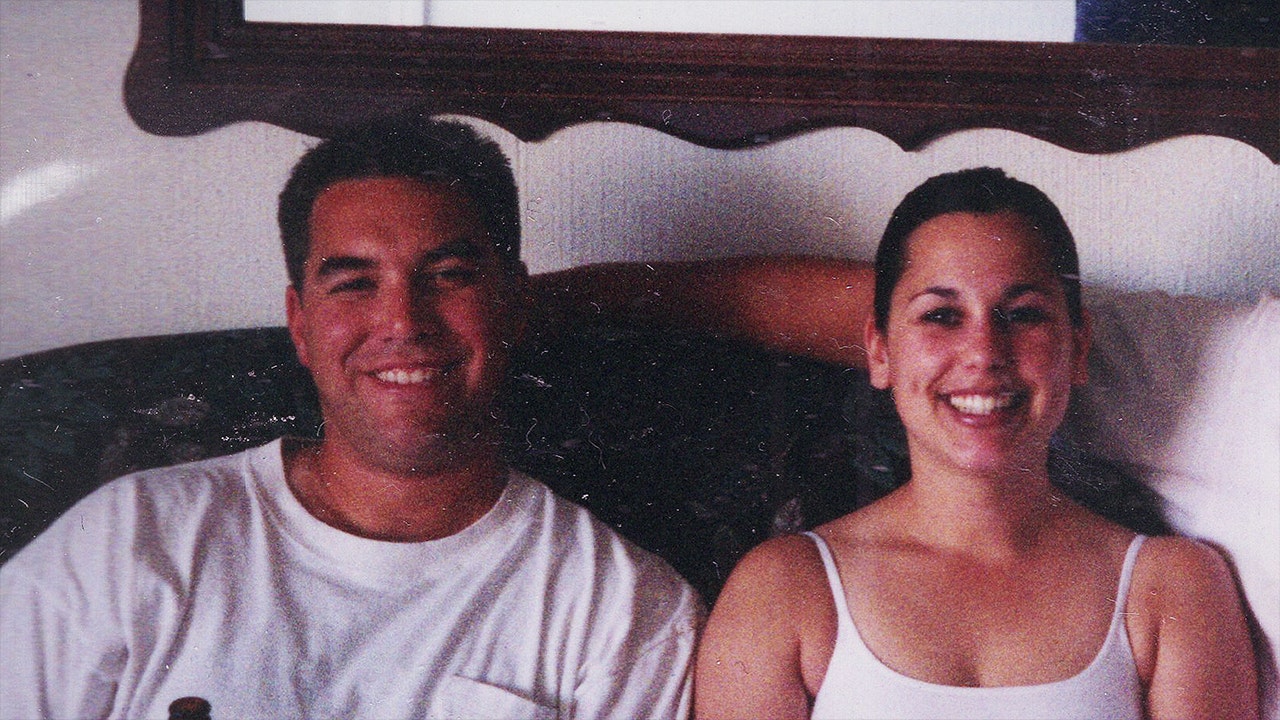
In his first on-camera interview since he was convicted for his wife’s murder twenty years ago, Scott Peterson maintains his innocence – and shares his theory on what really happened to his pregnant wife.
“Why do I want to speak? I regret not testifying,” Peterson said in Peacock’s new three-part series Face-to-Face with Scott Peterson. “I have a chance to show people what the truth is, and if they’re willing to accept it, it would be the biggest thing I can accomplish right now – because I didn’t kill my family.”
Laci, 27, was eight months pregnant when she vanished on Christmas Eve 2002. Peterson reported her missing after allegedly returning from a solo fishing trip to find their Modesto home empty. Laci’s body, along with the body of her unborn child Conner, washed up on shore near Peterson’s fishing spot four months later.
SCOTT PETERSON’S MOST OUTRAGEOUS DEFENSE CLAIMS, DEBUNKED
Scott Peterson and Laci Peterson in a still photo appearing in the docuseries, “American Murder: Laci Peterson.”(Courtesy of Netflix)
Advertisement
After he was arrested at the Mexico border with bleached hair carrying his brother’s passport, prosecutors revealed a mountain of evidence against him. A police K9 unit picked up Laci’s scent at a boat ramp in Berkeley, where Peterson claims he went fishing, and found the woman’s hair in the teeth of a pair of needle-nose pliers on Peterson’s boat.
Convicted of Laci’s murder in 2004, Peterson returned to headlines after the Los Angeles Innocence Project announced it would take on his latest appeal for a new trial.
“There was a burglary across the street from our home,” Peterson told filmmakers via video call from Mule Creek State Prison “And I believe that Laci went over there to see what was going on, and that’s when she was taken.”
A burglary was committed near the Peterson home around the time Laci went missing – but one of the convicted burglars testified that the break-in took place on December 26, 2002 rather than on December 24, when Laci went missing.
LACI PETERSON’S MOM REVEALS FIRST IMPRESSION OF KILLER SON-IN-LAW
Advertisement
Scott Peterson listens to Stanislaus County Deputy District attorney Dave Harris speak during a hearing at the San Mateo County Superior Court in Redwood City, California, on Wednesday, Dec. 8, 2021. Peterson appeared in San Mateo Superior Court for the first time since he was sentenced to death there more than 17 years ago for the murders of his wife Laci and their unborn son Conner. (Andy Alfaro/The Modesto Bee/Tribune News Service via Getty Images)(Andy Alfaro/The Modesto Bee/Tribune News Service via Getty Images)
TIMELINE: THE LACI PETERSON CASE
Journalists and legal experts interviewed in the docuseries said that witnesses had told police that they saw a suspicious van in the area of Peterson’s Modesto home on December 24 – one witness even claimed they saw a pregnant woman being forced into a van.
The burglary wasn’t mentioned the Peterson’s trial in 2004, and the convict cites this as evidence that police did not turn over evidence during the discovery process that potentially could have exonerated him.
“There are so many instances where there was evidence that didn’t fit the detectives’ theory that they ignored,” Peterson insisted.
Advertisement
Peterson even claims that detectives on the case assumed he was guilty from their first walk through of his home.
“When [Modesto Detective Al Brocchini] took a first walk through the house with the other officers, I don’t think that they knew that I was near them when they said ‘we know what’s going on here – it was the husband,’” Peterson claimed in his jailhouse interview “Then he realized I was there and kind of turned around.”
SCOTT PETERSON PROSECUTORS LAY OUT ‘OVERWHELMING EVIDENCE’ AGAINST KILLER’S NEW APPEAL IN 337-PAGE FILING
Scott Peterson and Amber Frey pictured at a Christmas party on Dec. 14, 2002, before the murder of Laci Peterson and before Frey knew Scott Peterson was a married man. (Superior Court of California, San Mateo County)
But Brocchini and former Modesto Police Officer Jon Buhler told filmmakers that they withheld any evidence or failed to investigate leads in the case.
Advertisement
“He was kind of just nonchalant – he didn’t have any urgency about him,” Brocchini said of his first time meeting Peterson. “To me, that was suspicious.”
Peterson, who was involved in multiple extramarital affairs, quickly became the prime suspect in his wife’s disappearance.
Brocchini said that a voicemail Peterson left for his wife at 2:15 p.m. on December 24 2022, telling her he loved her and would see her “in a bit,” was made to cover his tracks hours after killing Laci and dumping her in the San Francisco Bay. “To me, it was really meant for me to hear it,” Brocchini said, saying that the voicemail was “gooey.”
But Peterson said that heartfelt messages were typical in his relationship with Laci, and suggested that police who cast doubt on the intention of the voicemail must have “really sad marriages.”
“We loved one another, we enjoyed one another,” he said in his jailhouse interview. “We were great friends.”
Advertisement
SIGN UP TO GET TRUE CRIME NEWSLETTER
Prosecutors said police recovered Laci Peterson’s hair from the teeth of these needle-nosed pliers, which they found on her husband and convicted killer Scott Peterson’s boat.(Superior Court of California, San Mateo County)
“Every moment remains so tactile,” Peterson said of his final memories with his wife. “I’m still there, and the smells and the lighting, the sound of when I said goodbye to Laci. And then my family was gone.”
Amber Frey, Peterson’s mistress, went to police when she learned about Laci’s disappearance. Peterson, the man who she thought was her boyfriend, previously told her he had never been married, then changed his story and said that he was a widower.
Laci was missing her head and three limbs. A forensic pathologist determined she had not been dismembered, but her body likely came apart due to the marine conditions after being anchored down.
Advertisement
Prosecutors argued that the homemade concrete anchor Peterson used for his boat would have been easily duplicated. They suggested he made more and used them to try and hold his wife’s body on the seafloor.
Prosecutors said these photographs a smiling Scott Peterson were taken during a vigil for Laci Peterson on New Year’s Eve in 2002. Jurors found at the end of his trial in 2004 that he killed her days later. She was more than 8 months pregnant with their son Conner.(Superior Court of California, San Mateo County)
After Laci’s disappearance, Peterson allegedly told Frey that his wife was alive and pregnant, but had gone missing. Frey began recording her phone conversations with the suspected murderer in an effort to help police.
Last week, those recorded conversations were aired for the first time in a new Netflix documentary, American Murder: Laci Peterson.
Advertisement
“So what, do you want to be together with me?” Frey asked Peterson in one of the recordings.
GET REAL TIME UPDATES DIRECTLY ON THE TRUE CRIME HUB
“For the rest of our lives I think we could care for each other,” Peterson replied.
In May this year, Peterson’s defense team asked for DNA testing on a blood-stained mattress found in the bed of a burned-out van located near Peterson’s Modesto home the day after Laci disappeared. In the past, the LA Innocence Project says, only a sample of the mattress was tested. Now they want the entire mattress tested, saying that advancements in DNA technology could find DNA that would support their client’s claim.
Advertisement
But a judge ruled in May that a piece of duct tape found on Laci’s body could be retested, along with a dozen other pieces of evidence. It is unclear whether the mattress will be among the tested items.
Lara Yeretsian, one of Peterson’s lawyers from his first trial, remains hopeful that her client will be exonerated.
“This is not the end of it,” she said in the docuseries. “It’s just the beginning, and at least we’ve got one win.”
Walter Dasheno’s mind drifted toward the distant past as he studied the small black-and-white photograph, with 11 serious-looking Native American teens staring back at him.
Dasheno still knows the names of the other 1965 graduates of St. Catherine Indian School — boys in caps and gowns from New Mexico pueblos and the Navajo Nation, their lives knitted together during their years at the Catholic boarding school in Santa Fe.
They played basketball for the Thunderbirds. They spoke in their Indigenous languages in a crowded dormitory. Overseen by a faculty largely made up of nuns, they cleaned the chapel floors and recited the rosary, sometimes in their traditional Native regalia.
Advertisement
“Him and I joined the service together,” said Dasheno, 79, a former Santa Clara Pueblo governor, pointing out a former classmate in the photo, a boy from San Ildefonso Pueblo. “He went into aviation, and I became a radio man.”
Walter Dasheno, a graduate of St. Catherine Indian School and former Santa Clara Pueblo governor, smiles while looking at a small black-and-white photograph of his former classmates in the mid-1960s at his home at the pueblo on Thursday.
Advertisement
Gabriela Campos/The New Mexican
A raging fire that ripped through the historic St. Catherine Indian School campus last week — claiming the iconic main building, the girls dormitory and the chapel — was painful for Dasheno and many other former students. Officials have not determined what caused the July 2 blaze at the long-vacant property north of downtown Santa Fe. A partial demolition began Friday to provide investigators with safer access to the building where they believe the fire ignited.
St. Catherine, which served students in grades 7-12, was a private boarding school for more than a century before its final graduation ceremony in 1998. Named for St. Catherine of Siena and founded by a woman who would later be known as Mother Katharine Drexel, it was run for decades by women who joined Drexel’s religious order and focused on educating Indigenous youth.
The Catholic school, founded in 1886, had a complicated history, entangled in part in the legacy of trauma caused by federal and church-run boarding schools for Native children and teens in the 19th and 20th centuries — institutions designed to culturally assimilate kids who were forced to enroll. But many former students of St. Catherine, especially in its last several decades of operation, speak of cherished memories and defend the school — known to some as St. Kate’s — as a beloved community.
Advertisement
Walter Dasheno holds up a photo of himself and fellow high school graduates from St. Catherine Indian School’s Class of 1965 — teen boys from the pueblos of New Mexico and the Navajo Nation dressed in their caps and gowns. He recalled memories from his times at the Catholic boarding school in Santa Fe.
Gabriela Campos/The New Mexican
Advertisement
The July 2 fire dealt a devastating blow to the campus, which housed storied buildings bearing priceless murals, such as Our Lady of Guadalupe’s Love for the Indian Race by Edward O’Brien — which showed the Virgin of Guadalupe surrounded by images of Native people.
Competing views of St. Kate’s
The Historic Santa Fe Foundation describes St. Catherine Indian School on its website as “a remnant of a contested system of Indian boarding schools, run by missionaries of various Christian religious orders, first developed in nineteenth century New Mexico to educate, assimilate, and ‘civilize’ indigenous children into Euro-American culture.”
Others remember it as a different kind of Native boarding school. While the nuns could be strict and the campus environment was rigorous, former students have noted, they felt their culture was respected by school officials, and they look back at their time there with fondness.
Advertisement
Some Native people who attended the school also have long pointed out — at least in their experiences from the 1960s forward — their enrollment was a choice made by them or their parents rather than the federal government.
City firefighters battled for hours July 2 at the historic campus of the former St. Catherine Indian School.
Advertisement
Jim Weber/New Mexican file photo
Michael Peacock, a member of Laguna Pueblo who graduated from St. Catherine in 1975, described his experiences at the school in overwhelmingly positive terms, saying it helped shape him.
His mother attended the school in the 1950s before him, and many of his classmates had family legacy ties to the school as well, he said.
“St. Catherine’s was a unique school and a wonderful, wonderful experience, I believe, for me and a majority of the people who went there,” Peacock said. “It was nothing compared to the Albuquerque Indian School or any other schools throughout the United States that abused their kids or brainwashed their kids and institutionalized their kids.”
Advertisement
Still, documents archived in the University of New Mexico’s digital repository show some administrators with the Sisters of the Blessed Sacrament, which operated St. Catherine, were bent on converting Native students to Catholicism and seemed to hold attitudes dismissive of Native religions.
Take, for example, a letter penned in 1946 by an administrator with the Sisters of the Blessed Sacrament to Archbishop Edwin Byrne of the Archdiocese of Santa Fe.
Archbishop Byrne and clergy meeting with Taos dancers at St. Catherine Indian School, circa 1950.
Advertisement
Tyler Dingee, Courtesy Palace of the Governors Photo Archives (NMHM/DCA), No. 120261
“There has been so little done by the Church as well as the government for the bettering of these poor wandering Navajos, the greater number of them pagans, that we have felt concerned,” the letter states, lamenting the closure of some government-run Native schools.
The letter, citing the potential construction of a new high school for Navajo youth, outlines an effort to “win as many Souls as we could through the mission of God and His glory.”
Jean Marquardt, who was president of St. Catherine for two years in the mid-1990s, said she sees the school within the context of Catholic boarding schools that “ravished” aspects of Indigenous culture.
Advertisement
When she was president, she said, about 80% of the 200 students were Native American.
“In terms of academics, I think they did a very good job, but in terms of acknowledging the history of Indian boarding schools, they were very neglectful,” added Marquardt, who now lives in California.
Cochiti Pueblo pupils at chapel, St. Catherine School.
Advertisement
Tyler Dingee, Courtesy Palace of the Governors Photo Archives (NMHM/DCA), No. 120417
“They did not acknowledge the trauma that generations of Pueblo and Navajo people went through in the early 1800s because of the policy of Manifest Destiny, and kids were kidnapped from their homes and brutally taken to these Indian schools,” she said.
Haaland recalls family ties
Former congresswoman and Interior Secretary Deb Haaland of Laguna Pueblo, the Democratic nominee for governor, led the Federal Indian Boarding School Initiative to investigate the troubled history of Native boarding schools. The effort led to a historic apology by former President Joe Biden for the federal government’s role in such schools.
Advertisement
Haaland in January 2025 wrote about listening to Biden’s apology months earlier at the Gila River Indian Reservation in Arizona. In the same reflection, still posted on the Department of Interior’s website, she also wrote about her grandmother’s experience at St. Catherine.
“I remembered my grandma Helen recount the story of when she was taken away to St. Catherine’s Indian Boarding School in Santa Fe, New Mexico,” Haaland wrote. “She told me about the day a priest from the Pueblo of Laguna came to our village of Mesita, ‘gathered up the kids,’ put them on a train, and sent them away. She was 8 years old at the time.”
Haaland said in a statement to The New Mexican last week the recollection was an accurate description of her grandmother’s experience. She went on to describe the impact the boarding school had on her family.
Advertisement
Details at the historic St. Catherine Indian School in 2021 include a small cemetery where clergy were buried and murals created by some of the students.
Jim Weber/New Mexican file photo
“Because my grandma’s dad only had a horse and buggy, he was only able to visit my grandma once in the 5 years that she was at St. Catherine’s,” Haaland said in the statement. “Many parents were forced to be without their children for long periods of time, and all children are impacted when that happens. My grandma was always deeply religious, and she said the rosary every night.”
Advertisement
Haaland’s grandparents met at the boarding school, she said.
“I know the school changed a lot over the years, so it’s important to recognize that the fire and loss of part of this school is felt differently across the community,” she said. “Losing a part of history is always difficult, because we must learn all of that history in order to grow and build better communities.”
‘Woven together by tradition’
For those who treasured their days at St. Kate’s, memories are flooding back of raucous basketball games where the Thunderbirds played hard and established rivalries with Pojoaque Valley and Los Alamos schools.
They remember the pleasure in beating teams from larger schools with taller players.
Advertisement
Walter Dasheno unfurled a school sweater with “Thunderbirds” on the back. It had belonged to his late wife, Judy Dasheno, a former St. Catherine student who died from COVID-19 during the pandemic.
He enrolled at St. Catherine as a seventh grader.
A photo of Walter Dasheno and a female student wearing traditional clothing as they carried in the chalice and unconsecrated wine during a special Mass at St. Catherine Indian School in the mid-1960s.
Advertisement
Gabriela Campos/The New Mexican
“It developed a cadre of young men and young women who went on to become successful in their lives, some of them becoming lawyers, doctors, attorneys, tribal leaders for their communities, health program directors,” Dasheno said. “And then, of course, others became successful in the arts and then, in a traditional sense, going back to their communities and becoming traditional people.”
He was in rock ’n’ roll bands that sprang up on the campus, including one called the Thundertones, influenced by surf rock and the Beatles. Dasheno played saxophone and clarinet.
Advertisement
A small figure of St. Catherine with a young Native American student alongside a Hopi kachina on display at Walter Dasheno’s home in Santa Clara Pueblo on Thursday. Dasheno, a former Santa Clara Pueblo governor, graduated from St. Catherine Indian School in 1965.
Gabriela Campos/The New Mexican
Advertisement
He recalled the music’s echoes in the old school gym and the merriment of his high school years.
Peacock also arrived as a seventh grader. Though he was homesick in the early days, he grew to love St. Catherine so much he didn’t want to leave as a graduating senior.
Advertisement
Bystanders watch July 2 as firefighters battle the blaze at the historic St. Catherine Indian School.
Nathan Burton/The New Mexican
He recalled his first couple of stays in the dormitory, a crowded room filled with bunk beds, hearing the voices and languages of Native students from around the Southwest. Some of his good friends were from the Navajo and Apache nations.
Advertisement
“Those first nights, I remember the soft murmur of conversations in many languages and the feeling that I had joined something bigger than myself — a community woven together by tradition, learning, and shared experience,” he wrote in a reflection posted on a website devoted to the preservation of St. Catherine Indian School.
Downtown Santa Fe was his second classroom, he wrote: “The plaza was our playground and history book all in one — the Palace of the Governors standing proud, the smell of food drifting from La Fonda, the friendly chaos inside Tiano’s Sporting Goods, and the unbeatable taste of a Woolworth’s frito pie.”
The last graduating class of St. Catherine Indian School celebrates outside St. Francis Cathedral in May 1998.
Progress has been made on the East Evans Creek Fire, though the fire is currently estimated to be at 2,656 acres. Containment lines have been built overnight and are continuing to build a line around the perimeter, working on protecting structures
Even though only some 50 men born in the state of Utah have reached the majors, there is enough talent to field a mythical dream team comprised of those who were either born in Utah or went to high school there; college MLB products are another story.
So, with a nod to the MLB All-Star game in Philadelphia next week, here is one writer’s Utah dream team, with birthplace/Utah high school and years played in the majors:
Catcher: John Buck (Taylorsville High, 2004-14) — Born in Wyoming, Buck was drafted in the seventh round out of high school by the Houston Astros in 1998. He worked his way through the minors and made his MLB debut June 25, 2004, for the Kansas City Royals after being traded there the day before.
San Diego Padres’ Chase Headley scores as New York Mets catcher John Buck takes in a late throw during game Thursday, Aug. 15, 2013, in San Diego. | Lenny Ignelzi, Associated Press
Buck also played for the Toronto Blue Jays, Miami Marlins, New York Mets, Pittsburgh Pirates, Seattle Mariners and Los Angeles Angels. He was an All-Star in 2010 — his only season with the Blue Jays. Buck had 134 career homers with an average of .234.
Advertisement
First base: Chris Shelton (Salt Lake City, 2004-09) — A product of Cottonwood High, Salt Lake City Community College and the University of Utah, Shelton was drafted in the 33rd round by the Pittsburgh Pirates but still lasted several years in The Show.
Seattle Mariners first baseman Chris Shelton chases down a ground-out by Oakland Athletics’ Daric Barton during game in Surprise, Ariz., Saturday, March 21, 2009. | Tony Gutierrez, Associated Press
Shelton had 14 hits in his first 20 at-bats and 24 in his first 51, with 13 homers. He also slugged nine homers in his first 13 games.
“I don’t regret anything. I had some moments and did some great things,” Shelton told the Society of American Baseball Research, or SABR. “It’s always exciting to be a part of people’s memories.”
He had 930 at-bats in The Show — third among Utah natives.
Second base: Glenn Hubbard (Ben Lomond High, 1978-89) — Born in Germany in a military family, Hubbard lived in California before the family moved to the Ogden area. He had 4,441 at-bats with the Atlanta Braves and Oakland A’s with a lifetime average of .244 with 70 homers.
He was an All-Star in 1983 when he hit a career-high 12 homers.
Advertisement
Third base: Vance Law (Provo High, 1980-91) — Born in Idaho, Law was drafted out of BYU by the Pirates — the same club that his father, Vern, pitched for in 1960, when they became World Series champs.
“Vance had a 14-year professional career, with 10 of those years in the major leagues, mostly as a second baseman and third baseman,” per SABR. “He was a regular on the 1983 White Sox who won the division, as well as the 1989 Chicago Cubs who also won a division title.”
Law was the BYU coach from 2000-12. He also coached at Provo High and was an assistant at Utah Valley State College. His son, Adam, played at Provo High and BYU, as well as in the minors for the Los Angeles Dodgers.
Shortstop: Gordon Slade (Salt Lake City, 1930-35) — Slade’s 12 career steals, while not impressive, are the most of a player born in Utah. He is second in hits with 353 while playing with the Brooklyn Robins, the St. Louis Cardinals and the Cincinnati Reds.
Slade hit .257 with eight homers. He died in California in 1974. His 1,372 at-bats in the majors place him second among Utah natives.
Advertisement
Left field: Duke Sims (Salt Lake City, 1964-74) — Sims went to high school in Idaho. He has the most homers (100), hits (580) and RBI (310) of any player born in the state. He spent most of his time with the Cleveland Indians and had a career-best 23 homers in 1970.
“A solid defensive catcher whose career batting average of .239 was deceiving, Sims retired with a very respectable .340 OBP — better than many ‘higher-average’ lifetime hitters. He could also play the outfield. Sims is the only major leaguer born in Utah to get over 2,000 at-bats in the majors,” according to SABR.
He mainly played catcher, but is in the outfield for our dream team purposes. He hit the last homer at old Yankee Stadium and was the catcher that day.
Center field: Bobby Mitchell (Salt Lake City, 1980-83) — Mitchell, born in Salt Lake City, played high school and college baseball in California. In the majors, he played for the Dodgers and the Minnesota Twins.
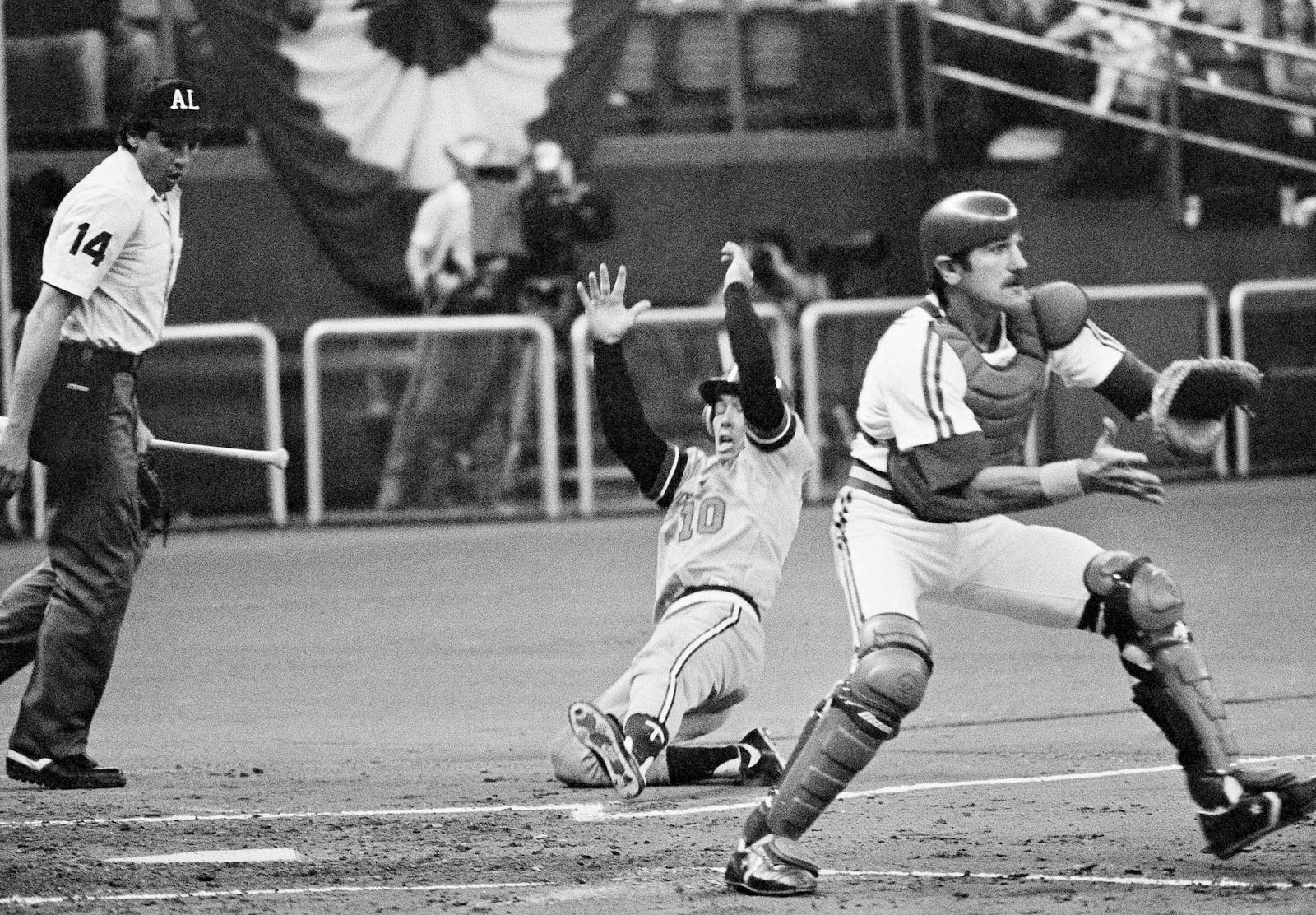
Minnesota’s Bobby Mitchell (10) slides into home behind Seattle’s Jim Essian in the third inning of game in Seattle, Thursday, April 22, 1982. | ASSOCIATED PRESS
Mitchell played in the Little League World Series in 1967 with Northridge, California, and in the College World Series with USC seven years later.
Right field: Chad Hermansen (Salt Lake City, 1999-2004) — Born in Salt Lake City, Hermansen was a high school product of Nevada, who played for the Pirates, Chicago Cubs, Dodgers and Blue Jays. He had a career-high eight homers in 2002 while with the Pirates and Cubs.
Advertisement
His first MLB homer came in 1999 for the Pirates against the Cubs and his last two games in the majors were for Toronto against the Baltimore Orioles.
Starting pitcher: Bruce Hurst (St. George, 1980-94) — The lefty is the only MLB player born in Utah named to an MLB All-Star game, according to Baseball Reference.
His 145 wins are the most of a Utah native and Hurst was the only pitcher to win at least 10 games every season from 1983 through 1992. The lefty made two key starts in the 1986 World Series for the Red Sox against the Mets, then started Game 7 on short rest.
He’s from “a small Mojave Desert town of about 4,000 people in the southwest corner of the state, 120 miles from Las Vegas,” SABR wrote of St. George. “Called Dixie by the locals, St. George was founded by Mormon missionaries in the 19th century to develop a cotton-farming industry.”
Hurst was mentored by Kent Garrett, a former player at BYU who started American Legion baseball in St. George in the 1970s, according to Prep Baseball Report.
Advertisement
“For some reason Garrett saw something in me,” Hurst told SABR. “He was a stickler for fundamentals and detail. We’d get baseball magazines and cut out pictures of pitchers … and look at the positions they were in. I’d get in front of the three-way mirror and practice my windup. He gave me confidence.”
Closer: Brandon Lyon (Salt Lake City, 2001-13) — Lyon, a Taylorsville High product, had 79 saves in the majors — the most of a player born in the state — and 42 wins while pitching for several clubs. His best season may have been 2007 with the Arizona Diamondbacks, when he had an ERA of 2.68 in 73 games.
Los Angeles Angels pitcher Brandon Lyon throws to a Chicago Cubs batter during exhibition baseball game, Tuesday, March 25, 2014, in Mesa, Ariz. | Matt York, Associated Press
His son, Isaac, was drafted out of Grand Canyon in 2025 by the Seattle Mariners and has pitched in the Washington Nationals’ minor league system for three clubs this year, as he was promoted to Double-A Harrisburg on May 26 from Single-A Wilmington.
Other pitchers: Kelly Downs (Ogden, 1986-93); Ed Heusser (Salt Lake County, 1935-48); Brandon Duckworth (Salt Lake City, 2001-08); Fred Sanford (Garfield, 1943-51).
Downs of Viewmont High won 57 games, Heusser won 56 and Sanford recorded 37 victories.
Heusser died in Colorado in 1956 at the age of 46. He led the NL in ERA in 1944. Sanford died in 2011 in Salt Lake City. He played for the St. Louis Browns, New York Yankees and Washington Senators, and was part of two World Series winners with the Yankees.
Advertisement
Manager: Herman Franks (Price): A catcher in the majors, Franks is the only Utah native to manage in the majors. He guided the San Francisco Giants from 1965-68 and the Chicago Cubs from 1977-79.
Franks was a third base coach on the 1954 New York Giants squad that won the World Series over the Cleveland Indians.
He may have also aided the 1951 Giants in a unique way. Published stories report that he relayed signs to hitters from center field late in the season and he was there when Bobby Thomson hit his famous homer to beat the Dodgers for the pennant in the best-of-three playoff series.
Franks died in Utah in 2009.
Pitching coach: Hurst was the pitching coach of the Chinese national team from 2003-2007. He was also involved in the MLB academies in Europe after his playing career, and he worked in the front offices of the Boston Red Sox and Dodgers.
Advertisement
Coach: Mitchell coached in the minors in the systems of MLB clubs.
General manager: Franks was the general manager of Salt Lake City in the Pacific Coast League and worked in the front office of MLB clubs.
Utah notes
The only natives of Utah to make their MLB debuts in 2025 were Jack Dreyer (Salt Lake City), who grew up in Iowa and is with the Dodgers; Paxton Schultz (Orem, Utah Valley), who is in the Nationals’ farm system after breaking in with Toronto; and Jayden Murray (Vernal, Dixie State), who is with the Cubs after his 2025 debut with the Astros.
Washington Nationals pitcher Paxton Schultz delivers during the second inning of a baseball game against the Pittsburgh Pirates in Pittsburgh, Monday, April 13, 2026. | AP
No native of Utah has made their MLB debut this season, as of the time of writing.
The first player born in Utah to make the majors was Lee Thompson (Smithfield), who pitched in four games with the White Sox in 1921. He died in California — the same day as his brother — in 1963 after holding several jobs in that state after his minor-league career.
David Driver is the co-author of “From Tidewater to the Shenandoah: Snapshots from Virginia’s Rich Baseball Legacy.” He covered the Nationals from 2013-22 for several outlets. He has interviewed Buck, Lyons and Duckworth as well as former BYU standouts Jeremy Guthrie and Jackson Cluff, who began this season at Triple-A in the Mets’ farm system. Driver is the former sports editor of papers in Baltimore and his native Harrisonburg, Virginia.