San Francisco, CA
How meteorologists tracked the tornado risk in Scotts Valley, San Francisco


The intense weather seen all around the Bay Area this weekend made for long days for the employees at the National Weather Service’s Bay Area offices in Monterey. The first-ever tornado warning was issued for San Francisco on Saturday and a tornado was confirmed later that day in Scotts Valley in Santa Cruz County.
While having one tornado warning and another actual tornado all in one day might be common in other parts of the country, in the Bay Area, it’s a rarity.
As SFGate first reported, two National Weather Service Bay Area meteorologists had a long day Saturday as they started the day surveying damage in San Francisco and finished the day responding to the tornado in Santa Cruz County.
The two meteorologists, Brian Garcia and Dalton Behringer, started their morning on Saturday at the NWS Monterey offices.
At 5:50 in the morning, Behringer recalled clocking in as his colleagues who had been up all night working had just issued the first-ever tornado warning for San Francisco. Behringer said that a warning was issued due to what NWS had seen on the radar, which indicated there might have been a tornado in San Francisco.
Once the storm had passed, Behringer and Garcia drove up to San Francisco around 10:00 a.m. to investigate whether a tornado had touched down. They found the most intense tree damage on the western end of Golden Gate Park around the Bison Paddock.
“You couldn’t look a single direction without seeing a tree down somewhere or branches down somewhere,” Behringer recalled.
However, the meteorologists noticed something about the way the trees had fallen: they all fell in the same direction. They observed other notable damage in the Richmond District, the Presidio, the Mission, and Bernal Heights, but ultimately, they found no evidence of a tornado.
Behringer said that based on weather conditions, there might have been a funnel cloud or water spout while the storm was over the water near San Francisco. Still, because the peak of the storm happened before sunrise, there isn’t any documentation of that.
While the meteorologists were wrapping up in San Francisco Saturday afternoon, they got a call from their office alerting them that Scotts Valley had a tornado.
So Behringer and Garcia were then dispatched from San Francisco to Santa Cruz County, trying to get there in time to make the most of the remaining daylight hours.
When they arrived in Scotts Valley, the meteorologists saw many downed trees, downed power lines, damaged cars, and debris strewn across a retail center parking lot.
Unlike the scene in San Francisco, they saw what Behringer called the tell-tale sign of a tornado in Scotts Valley: debris strewn in multiple different directions.
“You look to your right and there’s a sign that fell this way and you look to your left and there’s a sign that fell the other way and that’s exactly the thing that we look for,” Behringer explained.
The team determined that the tornado was an EF1 strength because of the cars it flipped over.
In a month where Bay Area residents are getting lots of practice with emergency warnings, many are wondering: why was a tornado warning issued for San Francisco and not Santa Cruz County?
Behringer explained that several factors played into this. He noted that the NWS put a special marine warning in place when the storm was over the water near Santa Cruz. He said that the warning also advised about the possibility of water spouts as the storm passed over the water.
Behringer said the NWS issued a severe thunderstorm warning about ten minutes before the tornado hit. He added that the advised actions for a severe thunderstorm warning in the Bay Area are the same as those for a tornado.
Move to the lowest floor of your home or business and get to the most interior room,” he said.
“With a lack of ground verification, and just taking into account what had happened earlier in the day, and having the knowledge with us surveying that the tornado actually didn’t touch down in San Francisco, I think that kind of prompted a little hesitancy as far as going full tornado warning,” Behringer said of the warnings for the Santa Cruz County weather event.
Behringer noted these storms happen fast, and it is hard to get real-time information, especially in less-populated areas like Santa Cruz County.
In San Francisco, on Sundays, many residents made their own on-the-ground observations as they walked through the toppled trees throughout the city.
San Francisco residents Sharaya Souza and Matthew Crane walked through Golden Gate Park on Sunday, in part, to check on the bison in the park’s Bison Paddock after the storm.
“A couple of fences were crushed,” Crane said of the Bison Paddock, noting that while the bison were still enclosed, there was damage to the area around them.
Souza said she’s seeing more damage from this storm in the park than previous ones.
“Especially from last year, there were a lot of fallen trees and we had really heavy rainfall, and I feel like this year it’s just taken an even bigger hit,” she noted
While the Bay Area is not known for tornadoes, Behringer said the conditions and the chances aligned Saturday.
“The fact that we were doing two separate damage surveys yesterday in the same day was quite astonishing,” he added, calling Saturday a “standout day” in his work four years with NWS Bay Area.
Behringer said his colleagues continue to survey the Scotts Valley location for more details. Saturday was certainly a noteworthy day for Bay Area weather, and one meteorologist will continue to study.



(KRON) — A 32-year-old man has been missing in San Francisco for two days, police said. Gabriel Carreon was last seen at noon on July 7, when he left his home in the Castro neighborhood to go see a movie, the San Francisco Police Department said.
The following morning, a 911 caller told dispatchers that Carreon was missing.
Police described the missing man as Asian, 5’8’’ tall, and weighing 170 pounds. He has black hair dyed pink, and brown eyes.
Anyone who locates Carreon should call 911 and report his current location, police said. Anyone with information on his possible whereabouts should call the SFPD Missing Persons Unit Tip Line at 415-734-3070.

Sick of the TSA lines? Tired of playing musical chairs at the gate? Rather sit as far from your fellow airplane passengers for as long as possible, in the comfort of your own private, luxury airport terminal?
Soon you may get your wish. And San Francisco international airport wants to be your genie – for a fee.
The airport is hoping to build a brand-new terminal exclusively for passengers who pay a premium, gaining access to a luxurious airport experience complete with private security lines and valet service from terminal to tarmac. It will service commercial flights, not business or corporate jets, and the terminal will have its own Transportation Security Administration (TSA) lines as well as Customs and Border Protection (CBP) lines for international travel.
SFO is seeking bidders to take on the development, construction and operation of the private terminal, which is planned for a 75,000-sq-ft site located across the runway from all current public terminals. The airport will accept proposals between late September and early October, and is looking to award a contract by early December with hopes of opening the terminal in late 2028.
SFO’s interest in a luxury development comes from what airport spokesperson Doug Yakel called a “high level of demand” for “premium experiences” in travel, citing the popularity of existing credit card and premium lounges. A private terminal is essentially the next step up in exclusivity from those lounges – and the best chance at avoiding airport crowds entirely.
“Somebody that uses this product really wouldn’t see the other passengers they’re traveling with until they’re taken up the stairs of the jet bridge and onto the aircraft,” Yakel said.
Spending on “pay-to-play” luxury experiences at large is on the rise, according to a new report by Bain & Company and Altagamma. The airline industry has bought in, revamping lounge and onboard experiences with chef-designed menus and expanded premium seating for the highest-paying passengers.
Many see a market in San Francisco, where an AI-driven wealth boom is already agitating the local housing market, with homes sold at the fastest pace in five years and the single-family median home price clocking in at $2.2m.
Yakel said SFO felt now was the right time to enter the market of luxury travel.
“We see the level of interest that’s being invested onboard aircraft, inside terminals, around airports, and clearly this is something that other airports are rolling out,” Yakel said.
The price to pay for a private airport experience will be decided by whoever wins the bid for operations, and will be offered on a membership or per-use basis. The traffic experienced at public terminals likely won’t change, Yakel said.
Private terminals have become popular worldwide. London Heathrow and Paris-Charles de Gaulle airports in Europe have long operated luxury terminals, and São Paulo/Guarulhos international airport recently opened the first private terminal in Latin America.
If SFO is successful, it would become the next major American airport to open a luxury terminal. Los Angeles, Dallas Fort Worth, Miami and Hartsfield-Jackson Atlanta international airports all offer a private terminal through PS (formerly known as the Private Suite), a company owned by security firm Gavin de Becker and Associates. Multiple representatives from PS and Gavin de Becker and Associates attended a June conference hosted by SFO about the private terminal, and PS has said it hopes to open a private terminal at every major US airport by 2030.
Access to existing PS private terminals can cost passengers $1,295 for a one-time experience, or up to $4,850 for a yearly membership. Heathrow’s private terminal costs thousands of pounds per person.


San Francisco Giants pitchers say they don’t feel MLB discriminated
Three San Francisco Giants pitchers say they did not feel discriminated against after the DOJ announced an investigation into Major League Baseball.
The San Francisco Giants have a lot to consider at this juncture of the MLB season.
There were mid-level expectations for the Giants at the start of the season. On paper, it seemed like the Giants could battle for a wild card berth.
The Giants won’t meet those expectations.
A week before the All-Star break, San Francisco has the third-worst record in baseball at 38-54. The Giants lost 10-0 to the Toronto Blue Jays on July 8, held hitless through eight innings.
It’s becoming increasingly obvious that this team won’t be competitive down the stretch, which has many of the Giants faithful singing a NxWorries tune, wondering what to do and where to go from here.
It’s evident that a shake-up is needed. It’s simply a matter of where they start and what they can realistically do to change things in the dugout. But one thing’s for sure: the Giants are sellers heading into the trade deadline.
What should the Giants do now?
The Giants have to accept their fate. Entering the season, they looked like a team that could compete with anybody, but then the baseball games were played and that proved to not be the case. So now San Francisco has to look itself in the mirror and figure out what went wrong and how to make things right – well, better than they have been going, anyways.
Here are a few ideas:
Get aggressive in the trade market, sell high
It’s easier said than done, but the Giants have to get off the expensive contracts eating up their salary. Reason being, you won’t be able to get any talent, let alone invest in your prospects, if there isn’t enough dollars to go around by the time negotiations occur.
It’s also a matter of how aggressive they plan to be and who will be prioritized. Who is untouchable? ESPN’s Jeff Passan has Giants outfielder Jung Hoo Lee as a top-ranked trade candidate. He plays all throughout the outfield. Offensively, Lee ranks top 10 in MLB in batting average and strikeout rate.
Lee, 27, makes $22.83 million this season and next, before going down to $21.33 million in both 2028 and 2029. Although not a star, the Giants can sell teams on Lee being a promising, solid all-around player.
Move on from veteran players
With a record like San Francisco’s, the best thing you can do for the fans is give them something to be hopeful for. That’s not aging veterans.
Examine the market for your guys who are age 30 and up, or are occupying a ton of salary space.
Rafael Devers turns 30 in October. His age isn’t so much a problem, but his contract … combined with the lack of expected production. Devers has had a down year so far, batting .244, registering 86 hits and 18 homers. He’s under contract through 2033 at a hefty price tag.
Others to consider moving on from are Willy Adames and Matt Chapman. They’re fan favorites, but based on age and dollars it all makes sense. Adames is under contract through 2031 at over $31 million per season. Chapman is locked up through 2030 at over $25 million per year.
It’s hard to say goodbye, but in the best interest of the Giants, they have to find new homes for these guys. And honestly, it wouldn’t be surprising if Devers, Chapman and Adames wanted to find a new home if it meant playing for a contender and a chance at a World Series title.
Retain young talent, bring in fresh faces
There’s promise for the future in this squad with guys like Bryce Eldridge, Blade Tidwell and Drew Gilbert. It’s a start.
“The San Francisco Giants, who would love to trade two of their infielders at the trade deadline, need to clear space for power-hitter Bryce Eldridge. They realize it’s stunting his growth as an infielder to keep using him as a DH at the age of 21,” USA TODAY Sports’ Bob Nightengale wrote.
Eldridge has had plenty moments as a designated hitter but none bigger than his walk-off grand slam against the Washington Nationals on June 10.
Another intitiative San Francisco needs to focus on is hanging on to guys like Logan Webb, Heliot Ramos, Casey Schmitt and Landon Roupp. The best bet is to hang on to them to help usher in a new era. Years from now, when the team has a new look, you can decide whether to leverage them for additional assets.
However, in the interim, hold on to those guys for dear life because teams will come knocking as MLB gets closer to the trade deadline.
-

 Technology5 minutes ago
Google turns old phones into cloud servers
-
 Business12 minutes ago
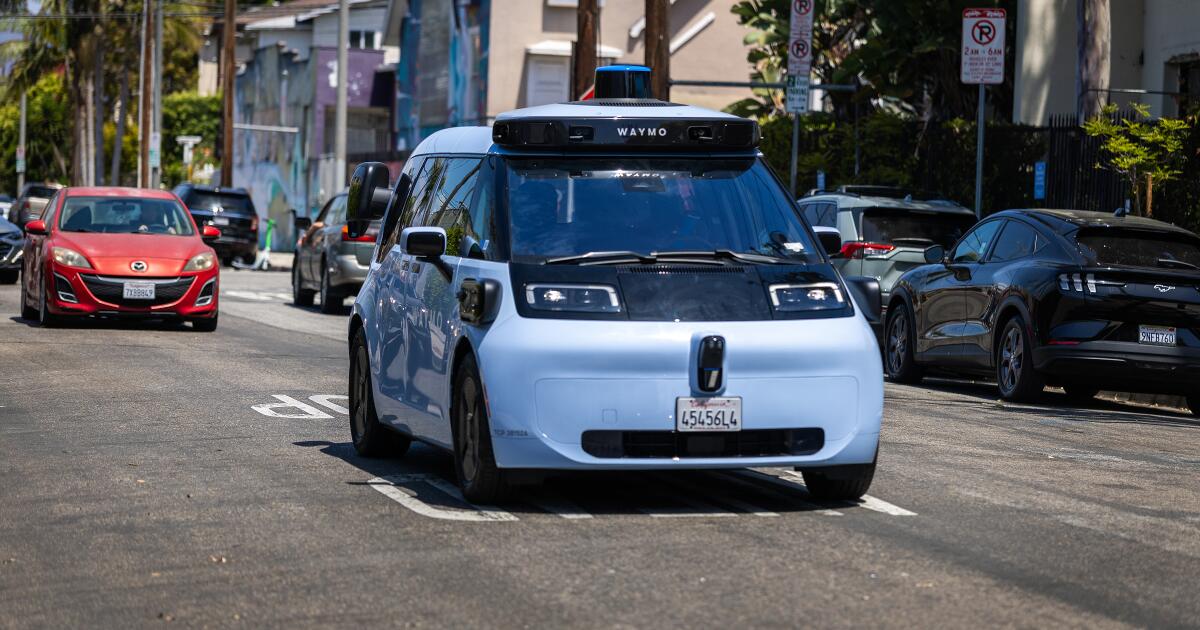
Waymo is starting robotaxi service in San Diego
-
 Entertainment15 minutes ago
‘Children of Blood and Bone’ author won’t see film after feud with star Amandla Stenberg
-
 Lifestyle20 minutes ago
After her son’s death, she found a new purpose. ‘He’s whispering: Mom, this is your path’
-
 Politics27 minutes ago
Iran ceasefire is ‘over,’ Trump says, and orders additional strikes
-
 Science30 minutes ago
Diarrhea-causing cyclosporiasis exceeds 1,000 cases in U.S. What Californians should know
-
 Sports35 minutes ago
Arthur Fery’s fairy-tale Wimbledon run puts British wild card on brink of history
-

 World45 minutes ago
Burnham on course to become next UK PM with backing of 322 Labour MPs

