San Diego, CA
UC San Diego increases long-term campus population estimate to 96,300

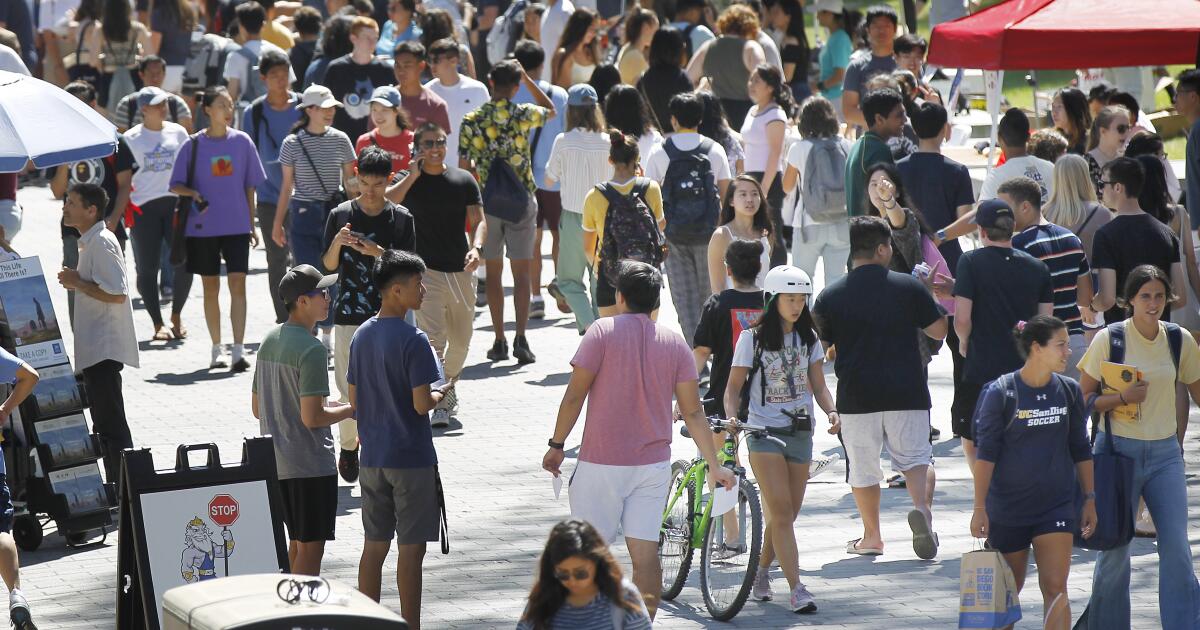
With UC San Diego’s campus population already exceeding projections made for a decade from now and further big increases expected, the university is updating its long-range development plan with an objective of creating more housing for students on the west end of the La Jolla campus.
The current plan, completed in 2018, was projected to take the campus through 2035. The revised plan would go through 2040.
The 2018 plan estimated the 2035 campus population at 65,600, including 42,400 students and 23,200 employees. The revised estimate, based on enrollment and staffing trends, projects a total of 96,300 students and employees by 2040.
However, UCSD’s student enrollment already has reached 43,381 as of last fall, according to a campus profile on the university website, with roughly 40,000 employees, according to the University of California.
UCSD attributes the higher-than-projected growth to “demand for higher education and systemwide priorities to increase enrollment.”
A key driver for the plan update is “expanding access to students seeking a high-quality education” in accord with priorities set by the state, the UC system and UC San Diego over the past decade, according to UCSD spokeswoman Leslie Sepuka.
“It requires ongoing investments in infrastructure, classroom space as well as faculty and staff to enhance the student experience,” she said.
In March, a scoping meeting was held to go over the update and take feedback from residents.
“The university is committed to increasing availability of housing for students,” Sepuka said. “The goal is to provide on-campus housing to up to 65 percent of all students and continue to make progress toward a four-year undergraduate housing guarantee at below market rates for comparable units.”
The campus currently houses a little more than 50 percent of its students with a two-year housing guarantee. Most of the student housing is on the west side, so proposed changes include building additional housing and replacing aging facilities.
The university projects a roughly 30 percent increase in new campus development, including more than 21 million square feet of new buildings on the west campus, a 5 million-square-foot increase from the 2018 plan. The revised plan also lists 567,000 square feet of development “nearby,” meaning not on campus.
No changes are proposed for the associated Scripps Institution of Oceanography.
UCSD says it already has added more than 11,000 new beds for student housing in the past 10 years, which it calls the largest such residential expansion in the country.
According to the university, the UC Board of Regents requires every campus in the UC system to have, and periodically update, a long-range development plan.
The plan “defines how a campus will accommodate anticipated enrollment and the faculty and staff needed to support it. A [long-range development plan] is only a guide; it does not commit the campus to specific projects, as it must provide flexibility for changing conditions.”
Not everyone is convinced the expected changes are good.
Though area resident David Lebowitz said he feels the university “does a tremendous amount of good in terms of its research output and providing so many Californians with a high-quality education … I am also concerned about UC San Diego’s record of failing to complete student housing projects on time, the impact on the student experience of living in an increasingly crowded environment that is a perpetual construction zone, and the impact on traffic from such a dramatic increase in campus population.”
“The growth in staff and faculty is likely more impactful from a traffic standpoint, as nearly all will be commuting,” Lebowitz said. “The traffic impact from student growth is more difficult to predict and could depend in large part on how much on-campus student housing is actually built and what restrictions may be placed on student parking on campus.” ◆



Despite San Diego’s abundant marine life, the region’s commercial fishing industry is in decline.
In 2020, the Scripps Institution of Oceanography started an apprentice program to help reverse the trend — but the program has had mixed results, reports Deborah Brennan at our partner CalMatters.
Globalization is partly to blame for the busted economics of San Diego’s fishing industry. Higher wages and stricter regulations in the U.S. mean that fish caught in other countries are often cheaper. A 2016 report found that just 10 percent of seafood consumed in San Diego is caught locally.
Wages have plummeted for U.S. fishing captains and their crews in the last decade. A deckhand in San Diego can expect to earn between $15,000 and $50,000 per year.
The apprentice program doesn’t just teach people to fish, but to navigate, repair engines and even business skills. It hasn’t been without success — despite a Covid hiatus. Of 11 graduates, 6 are still fishing. But some of the captains who said the program was necessary have also been reluctant to mentor apprentices.
Peter Brownell used to be research director for San Diego’s Center for Policy Initiatives. He studied, incidentally, poverty. Wanting to transition away from a desk job, he entered the program and is now scratching out an existence on the water.
“If you’re entirely reliant on commercial fishing for all your economic needs, that’s a hard puzzle to put all the pieces together to make that work consistently year after year,” he said.
Read the full story here.
Council Considers Junk Fee Ordinance
The San Diego City Council heard details of a proposed “junk fee” ordinance that would cap extra fees for renters and require landlords to disclose fees before a lease is signed.
The proposal, introduced by Councilmembers Sean Elo-Rivera and Henry Foster, would cap fees at no more than five percent of the price of rent. It would also prohibit things like charges for basic building operating expenses, such as pest control.
“What I’ve heard is a general consensus around the transparency components and agreement that people should know what they’re going to be asked to pay,” said Elo-Rivera during a hearing on the fee Tuesday. “They should know that at the beginning of their search and before they sign a lease, not after.”
The Council only heard details on the new proposal. It did not vote on the ordinance.
AI-Powered Humanoid Robots Take Over the Web
It’s always strange when a story you write starts spreading. This week, I’ve been watching it happen with a story we published about a local charter network that spent $500,000 on two ChatGPT-powered humanoid robots.
I wasn’t shocked the story struck a nerve. It had a built-in, WTF factor that seemed guaranteed to draw eyeballs. But more importantly, it comes at a moment when people across the world are grappling with what it means to live alongside technology. It’s playing out in skirmishes over edtech, battles over data centers, and now the question of humanoid robots in the classroom.
The story has moved from the new media food chain. First came news aggregators like the New York Post, then aggregation scavengers you’ve never heard of, and now even AI aggregators, which create something akin to news hot dogs — if hot dogs used an excessive amount of subheads and bullet points.
Underneath that hollow feeding frenzy, though, are real, local news organizations. The reporters and editors report on the communities you love, because they love them too. If you haven’t already, you should consider supporting this one.
Rabbitholed
University Heights’ neon street sign — with its iconic trolley car logo — is set to go dark.
Locals were warned recently that city workers plan to turn off the 30-year-old sign due to wear and tear. Burned-out neon had already left some portions of the sign nonfunctioning.
Members of the University Heights Community Association say the city’s to blame. They allege city officials have drained funds from the neighborhood’s Maintenance Assessment District, which would normally pay for repairs. Now, they’re pressuring the city to pony up for fixes.
But behind the faulty neon is the fascinating, 130-year-plus origin of the sign’s trolley logo. It commemorates a time before the city was carved up by freeways — and instead had a thriving network of streetcars extending from Ocean Beach to La Jolla and Chula Vista. Many of those cars were repaired at a warehouse located at the site of Trolley Barn Park, hence the name – and the sign.
The streetcar network had plenty of ups and downs, like when John Spreckles, the richest man in San Diego at the time and owner of the network, ordered his workers to secretly dig up the tracks under the cover of night due to a dispute with city officials. Here’s an interesting story about how the actual streetcars evolved over the years.
The system ultimately went defunct in 1949.
What’s your take? Do you wish the city still had an urban streetcar system?
In Other News
- Two San Marcos residents say their homeowners association is violating their rights to fly American flags outside their home. But legal experts say people do have the right to fly their flags even in homes subject to rules by homeowners associations. (inewsource)
- Longer meetings are coming to San Diego City Hall. As part of a new set of policies to boost public participation, city officials will allow group presentations during online meetings. (Union-Tribune)
- Speaking of City Hall, the San Diego City Council will soon create an affordable housing preservation fund backed by $8.5 million. Along with other funding sources, the fund will work to preserve affordable housing. (KPBS)
- The former news director of KPBS, Terrence Shepherd, is suing the outlet, alleging he was wrongfully terminated after recommending a reporter be fired because they’d “staged a protest scene” during a television shot. Exactly what Shepherd’s claim of a “staged protest” entails isn’t entirely clear. A spokesperson for KPBS declined to comment on the situation. (Current)
The Morning Report was written by Jakob McWhinney, Mariana Martínez Barba and Will Huntsberry. It was edited by Will Huntsberry.
Related Posts

The U.S. military identified a Minnesota Marine stationed in Southern California who went missing off San Diego last week, and confirmed his death.
Lance Cpl. Armando Ortiz Canseco was declared deceased Saturday. It is believed he was lost at sea after a training exercise.
“On behalf of the Marines and sailors of the 13th Marine Expeditionary Unit, I extend our deepest condolences to the family and loved ones of Lance Cpl. Ortiz Canseco,” Col. Richard Alvarez, the commanding officer of the 13th Marine Expeditionary Unit, said in a statement.
Ortiz Canseco was reported missing from the amphibious transport dock ship USS Anchorage early Thursday morning. His disappearance resulted in an extensive search and rescue operation, with efforts beginning around 1:20 a.m. Thursday.
The search spanned roughly 2,400 square miles and involved officials from the Navy, Marine Corps, Coast Guard and Air Force who used three surface ships and 12 aircraft, according to the military.
The Marine went missing during a training operation involving the 13th Marine Expeditionary Unit and the Makin Island Amphibious Ready Group.
After nearly two full days of searching, the Navy transitioned to recovery operations.
“He earned the title of United States Marine and served his country with honor and commitment,” Alvarez said. “We mourn alongside his family, and we remain committed to bringing him home.”
This incident marks the second time in recent weeks that the U.S. military has searched for missing service members.
The remains of two Army soldiers who went missing while off duty from military exercises in Morocco were recovered in May, according to the Army.
Officials did not initially identify Ortiz Canseco on Thursday or disclose the circumstances surrounding his disappearance, saying his family needed to be notified first.
His death continues to be under investigation.
Ortiz Canseco enlisted in the Marine Corps in April 2023 and reported for training at Marine Corps Recruit Depot San Diego.
His individual awards include the Marine Corps Good Conduct Medal and Sea Service Deployment Ribbon.
Times staff writer Alene Tchekmedyian contributed to this report.

Blink, and you might miss it.
Adobe Falls isn’t Niagara Falls — or anything close — but after winter rains, a seasonal waterfall briefly appears in a narrow Del Cerro canyon, hidden beneath streets, homes, and San Diego State University property.
The waterfall forms along Alvarado Creek, which drains parts of eastern San Diego, including the SDSU area and surrounding neighborhoods. In wet months, runoff moves through a steep canyon and drops over a short rock ledge known locally as Adobe Falls. In dry periods, the flow often fades to a trickle or disappears entirely, leaving exposed sandstone and a shaded canyon bed.
What makes the site stand out is its setting. Above the canyon are Del Cerro residential streets and university property tied to San Diego State. Below it, Alvarado Creek continues west as part of the Mission Valley watershed, eventually feeding into the San Diego River system. Like many urban drainages in San Diego, its flow is shaped by stormwater runoff, paved surfaces, and altered drainage patterns tied to development.

Access is restricted. The canyon sits on a mix of SDSU and city-managed land and has long been closed to the public due to safety concerns, including steep terrain, erosion, and unstable footing after rain. Although widely referenced in maps and online posts, it is not an official trail or recreation site.
The canyon itself pre-dates modern development in Del Cerro. It is part of a broader network of inland waterways and canyon corridors used for thousands of years by the Kumeyaay, whose presence shaped movement and settlement patterns across the region.
In the mid-20th century, as Del Cerro developed, homes and roads were built along canyon rims rather than through them, leaving Alvarado Creek intact as a drainage system. Adobe Falls remained within that corridor even as surrounding hillsides filled with residential and institutional development.
Today, Adobe Falls remains a small but persistent reminder that San Diego’s natural drainage systems still function within a heavily built environment — appearing briefly after storms, then receding back into the canyon until the next rain.
Read more history stories here, and do you have a story to tell? Send an email to DebbieSklar@cox.net.
Sources:
City of San Diego – Stormwater & Watershed Division (Alvarado Creek / Mission Valley watershed)
San Diego State University – planning and environmental impact documentation for adjacent canyon areas
U.S. Geological Survey (USGS) – San Diego County watershed and hydrology mapping (Alvarado Creek / San Diego River system context)
San Diego History Center – Kumeyaay regional land use and inland canyon corridor history
City of San Diego Planning Department – land use records and access restrictions for Adobe Falls area
California State Historic Landmark files – Adobe Falls (Landmark No. 80)
-

 San Diego, CA55 seconds ago
An Apprentice Program for Commercial Fishing
-
Milwaukee, WI6 minutes ago
Connecting Milwaukee teens to summer work
-

 Atlanta, GA13 minutes ago
Conference offers safe space for gay men to unpack the stigmas, challenges of adoption and surrogacy
-

 Minneapolis, MN16 minutes ago
Westbound I-94 reopens in Minneapolis after fatal crash
-

 Indianapolis, IN21 minutes ago
Edwards Checks Out At Indianapolis – SPEED SPORT
-

 Pittsburg, PA22 minutes ago
Analysis: Here’s why the Pittsburgh Symphony’s budget just jumped by $7 million to $42 million
-

 Augusta, GA28 minutes ago
Augusta’s role in the American Revolution: An underdog story 250 years in the making
-

 Washington, D.C31 minutes ago
Looking for indoor July 4 plans in DC? Try these America250 exhibits

