San Diego, CA
Sharp’s new neuroscience hospital runs nearly full two weeks after opening


In its first two weeks of operation, the new neuroscience center at Sharp Grossmont Hospital has averaged an 80% occupancy rate. That number is not terribly surprising, given that the La Mesa medical facility treated the 10th-most acute strokes in the state and handled the largest volume in San Diego County in 2023, according to state data.
Retired New York firefighter Thomas Daniels, 88, was among the first to occupy one of the 50 beds at what is officially called the Sharp Grossmont Hospital for Neuroscience. Admitted to Grossmont’s emergency department after having a stroke on April 29, he was transferred to the new center one day after it opened on May 1.
Thirteen days later, he was still there, feeling significant pain in his face, but able to chuckle over the enthusiastic welcome that occurred when the center’s first patients arrived.
“They were cheering for me and I said, ‘vote for me’ like I was running for governor,” he said. “That’s my way, just having fun.”
His ability to recall those memories made such a short amount of time after suffering a major neurological emergency is the entire point of building this new hospital within a hospital in the first place.
By dedicating space for neurological maladies, and filling that space with nurses, technicians and physicians all specificallytrained to handle brain-related care, the idea is to make it more likely that patients will receive medical interventions they need as quickly as possible.
Especially with stroke, the phrase “time is brain” has been the mantra in neurological care since the 1990s.
The speed and precision with which clot-busting drugs can be administered and surgery performed is literally the difference between full recovery and living the rest of one’s life with severely impaired movement. Or not surviving at all.
California hospitals are graded on their overall stroke mortality rates, a calculation of how many patients diagnosed with strokes die during treatment that is adjusted to account for overall underlying health conditions and other factors. In 2023, the most recent year for which data are available, Grossmont’s state-issued stroke rating was “as expected,” though results have been mixed, with some “below expected” ratings in previous years.
The goal of all hospitals is to consistently achieve a “better” rating, indicating that their risk-adjusted mortality rates are lower than would be expected when compared to similarly sized peers.
While not explicitly referencing state ratings, Dr. Gregory Apel, an emergency medicine specialist and Grossmont’s chief medical officer, said that breaking off neurological care into its own hospital on the larger medical campus, one with its own entrance and its own specially trained staff, will allow care to reach new heights.
Having dedicated space, he said, allows the recruitment of physicians who specialize more deeply. Already, for example, Grossmont has recruited several endovascular neurosurgeons who are able to conduct both minimally invasive brain surgeries and larger “open” procedures that often require larger openings in the skull for access.
“We have specialists here that are coming from the highest institutions and fellowship programs to really provide that level of care that doesn’t exist outside of a neuroscience center,” Apel said.
The physical structure of the new hospital also enables deeper subspecialization. Several rooms in their own set-aside section of the larger facility are designated as an Epilepsy Monitoring Unit and are equipped with special seizure-monitoring equipment. This new feature justifies bringing in a whole new category of subspecialists.

“There is actually a fellowship program for epileptologists who are neurologists who do nothing but seizure-related care,” Apel said. “We are in the process of recruiting to get specifically that specialty for that unit to be able to deal with the most complex seizures.”
It includes its own 16-bed neurological intensive care unit, as well as another 16-bed “progressive” care unit for those whose conditions are not severe enough to need intensive care. And there are 18 additional beds dedicated to rehabilitation, a major function of any neurology program. Those with strokes and other conditions often must spend many hours with physical therapists relearning once routine movements affected by the temporary loss of blood flow in the brain.
Rehabilitation beds are just a short walk from the neuroscience center’s beating heart, a cavernous physical therapy gymnasium filled with specialized exercise equipment designed for the kind of tasks that, with proper guidance, can help re-activate damaged nerve pathways and rebuild atrophied muscle tissue.
It’s an exponential upgrade over Grossmont’s former gym, which filled a single hospital hallway.
Scott Evans, chief strategy officer and market CEO for Sharp HealthCare, pointed out a special “studio apartment” room just off the main gym floor. This space is configured with all of the equipment a person would need to use when they return home after a serious neurological incident, such as a stroke.
“This is where we can simulate the activities of daily living,” Evans said. “They can start practicing doing their own clothes again, washing the dishes, making meals, getting in and out of the bathtub.”

The center treats far more than strokes. Brain and spine tumors, complex spine surgeries, movement disorders such as Parkinson’s disease, and vision problems related to neurological conditions are also services allocated to the neuroscience hospital, which does not have its own dedicated operating rooms. Surgeries will be performed in Grossmont’s Burr Heart and Vascular Center that opened in 2019.
Many who use the new physical therapy gym will be staying in the hospital’s rehabilitation unit, working daily to regain function before they can be discharged home. But the facility is also open to outpatients, those who are already home, but who require ongoing specialized workouts to help them handle neurological conditions.
By 9 a.m. on a recent morning, a dozen people were already using the gym, including AJ Fiume, 27, a La Mesa resident with cerebral palsy. He spent time using a hand bike, then went through a specialized muscle-building session with a physical therapist.

“That was probably the second or third time I’ve been able to get on the bike like that in my life,” he said. “You know, it’s not like you can do this stuff at 24 Hour Fitness.”
There is more to come. An upstairs doctor’s office will be staffed by a full complement of neurological specialists.
The point, stressed Apel, is to put as many neurological services as possible in one centralized location, decreasing the amount of travel necessary to make appointments.
“You will be able to walk in there and see your neurosurgeon, stroke neurologist, rehabilitation physician … I mean, it’s almost a revolving door of what specialties will be available to patients in one location,” Apel said.
For now, stroke patients and others with emergency neurological problems must be pushed through long hospital corridors to get from the ER to the neuroscience hospital, which is on the opposite side of the sprawling medical campus.
But Evans said that there are plans for a much straighter and subterranean path in the future.
“We’re going to dig a tunnel right under there to connect directly with the emergency department,” the executive said, gesturing south toward Grossmont’s emergency entrance closer to Grossmont Center Drive. “That will make it even faster to get over here.
“We want to make it as fast as possible.”



CORONADO, Calif. (KGTV) – Everyone from NASCAR officials to the drivers to those who serve on Naval Base Coronado is beaming with excitement, waiting to kick the tires and light the fires this race weekend for NASCAR San Diego Weekend.
“Fans can expect one incredible time. History is being made this weekend,” Matt Humphrey, Sr. Director of Track Communications for NASCAR, said.
The racing track is up at Naval Base Coronado.
“It’s been amazing from seeing the bones of the track going up to driving the track, going to work in the morning. It’s incredible,” Seaman Naylei Fausto of the U.S. Navy said,
And now it’s time to race.
The NASCAR San Diego weekend is officially underway, with the first event held at an active military base.
“They’re going to be able to see a lot of what NASCAR is about with all the different fan displays, the kids’ zone, all the different activations from our partners around, but most importantly, they’re going to see the United States Navy showcased in the best form possible,” Humphrey said.
One of those sailors, Seaman Fausto, who is a lifelong NASCAR fan, never thought she’d see her station transformed into a NASCAR track, let alone any base.
“Joining the Navy, I thought I was going to be out taking pictures and doing Navy-related things, and now I get to work with NASCAR, which is just amazing and it’s fulfilling my inner child,” Fausto said.
Those behind the wheel say that, in their experience, there’s nothing like this event.
“It’s definitely a once-in-a-lifetime opportunity. I think we’ve had some opportunities. We did the street course in Chicago for the last couple of years,” Cody Ware, NASCAR Driver, said. “But to show up here, getting the opportunity to race on an active military base just for the US Navy and NASCAR to be able to work together to put the show on is really incredible.”
There will be a Truck Series race starting at 4 p.m. on Thursday. On Saturday, that’s when the NASCAR O’Reilly Auto Parts race will be happening. That begins at 2 p.m. This is the second tier of NASCAR races where drivers hone their skills, looking to get into the top level of the NASCAR circuit. Sunday is the main race with the NASCAR Cup Series happening at 1 p.m.
While it’s incredible to host NASCAR at the naval base, NASCAR officials hope people plan ahead to avoid the painful process of getting to the track.
“But if you do not have that government-issued photo ID or passport, you’ll be turned away. So very important that you bring that. But then bring your patients, come early,” Humphrey said. “If you think it’s going to take a half hour to get here, add an extra 30 to 40 to even 60 minutes on top of that; just to give yourself enough time to get over the bridge to make sure you get through the gates, get through security.”
Humphrey added that NASCAR is working together with local, state and federal agencies to make sure traffic is moving smoothly, and everyone is getting into the race and having fun.

San Diego County will be the center of NASCAR nation this weekend, with fans flocking to Naval Base Coronado for three days of events.
This is the first-ever Cup race held in San Diego County and the NASCAR community is also presenting it as its way of celebrating the 250th anniversary of the U.S. Navy.
Tickets are completely sold out, but locals can still get in on the fun at various event and activities taking place across the region.
Here’s what to know about this one-of-a-kind weekend in San Diego. Full coverage of NASCAR San Diego Weekend can be found at sandiegouniontribune.com/tag/nascar.
What is NASCAR San Diego Weekend?
The three-day event begins with Friday’s Craftsman Truck Series race, continues with an O’Reilly Auto Parts series race on Saturday and wraps Sunday with the Anduril 250.
Grandstands with a capacity for 40,000 fans have been erected, with another 10,000 spectators expected to occupy standing areas around the grounds.
Here’s a turn-by-turn look at Naval Base Coronado’s race circuit
When is it taking place?
Parking lots, which are on base, open each day at 7 a.m. and gates open at 9 a.m.
The Craftsman Truck Series takes place Friday at 4 p.m. The O’Reilly Auto Parts series race blasts off at 2 p.m. Saturday. The main event, NASCAR Cup Series Race, happens Sunday at 1 p.m.
A race-by-race look at NASCAR’s San Diego Weekend
Each day will also feature entertainment, driver Q&As and other activities.
Where is it?
Naval Base Coronado will host the weekend’s activities. All fans in attendance must carry a valid government-issued photo ID at all times.
Going to this weekend’s NASCAR races in Coronado? Here’s what you need to know
All event parking will be located on Naval Base Coronado. There is no event parking available within the city of Coronado.
Who is racing?
Shane Van Gisbergen, Tyler Reddick, Mike McDowell, Chase Elliott and Ty Gibbs are just a few of the names to expect this weekend. A full lineup can be found at nascarsandiego.com/nascar-san-diego-mission-lineup.
These 13 Cup racers could all win Sunday’s Anduril 250 in Coronado
How to watch on TV:
Craftsman Trucks Series race: 4 p.m. Friday on Fox Sports 1
O’Reilly Auto Parts Series race: 2 p.m. Saturday on The CW
NASCAR Cup race: Sunday at 1 p.m. on Prime Video
Local events:
San Diegans have a range of options for getting in on the fun of NASCAR weekend in Coronado, including meet and greets with drivers, watch parties and fan zones.
Your guide to fan events during NASCAR San Diego Weekend
More coverage:

CORONADO, Calif. (FOX 5/KUSI) — Final preparations are underway for NASCAR’s historic race weekend at Naval Base Coronado, where stock cars will compete on an active military installation for the first time in the sport’s history.
Crews, race teams, military personnel, first responders and event staff spent Thursday putting the finishing touches on the temporary road course as thousands of fans prepare to descend on the base for the inaugural event.
“The countdown is on,” as organizers work to transform portions of the installation into a race venue unlike any NASCAR has hosted before.
“It’s a very proud moment for NASCAR and myself and my company for being part of it,” said Jordan Litchko, a NASCAR production partner with ignition production. “It’s the America 250, so what a year to celebrate and be here on the naval base.”
Officials say the event marks the first time a NASCAR national series race has been held on a military base, bringing one of America’s most recognizable motorsports directly onto a working military installation.
Unlike traditional oval tracks, competitors will tackle a temporary road course built specifically for the event.
“It’s a road course race, which adds way more excitement, so it’s going to be ultra challenging,” Litchko said.
Thursday’s preparations included long lines of team members, vendors, staff and emergency personnel picking up credentials and completing security and base access requirements ahead of race weekend.
Meanwhile, drivers and crews got their first close look at the unique layout, which winds through portions of the base and presents a challenge far different from a conventional speedway.
With large crowds expected throughout the weekend, organizers are encouraging fans to plan ahead and allow extra travel time. Traffic delays are anticipated around Naval Base Coronado and nearby access points as spectators arrive for the event.
After months of planning and construction, the wait is nearly over.
On Friday, engines will roar to life aboard Naval Base Coronado, marking a milestone moment for NASCAR and creating a new chapter in the sport’s history. By the weekend’s end, fans will witness a race unlike any ever held before — stock cars competing on a military base in the heart of San Diego.
-
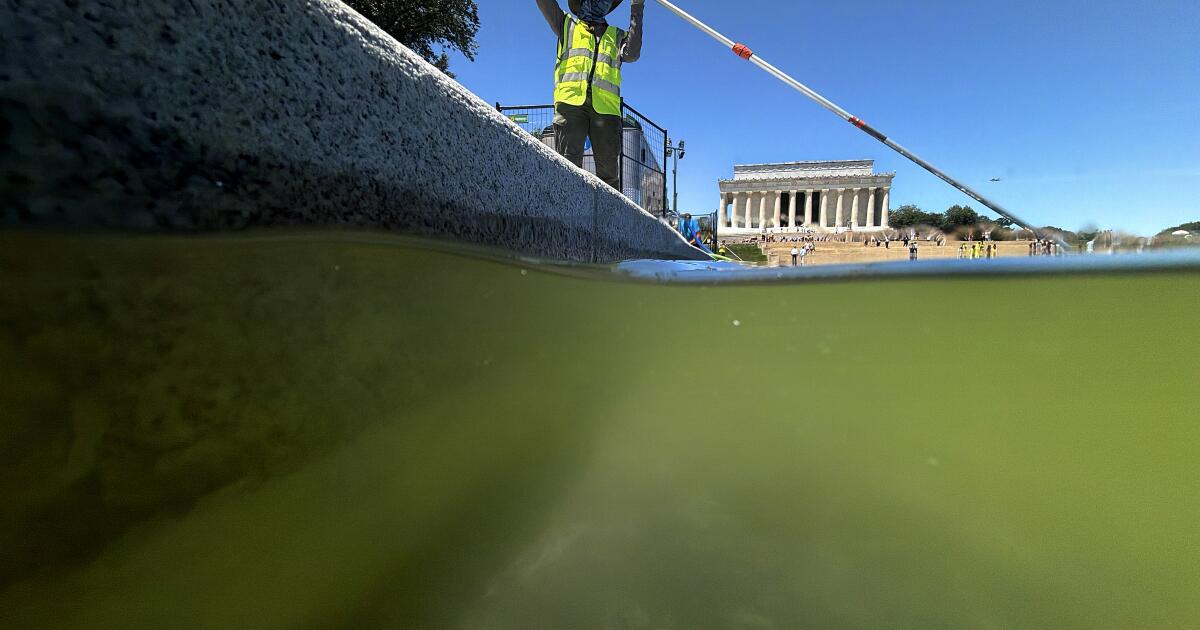 Science4 minutes ago
Here’s why the Lincoln Memorial Reflecting Pool went green so fast
-
 Sports7 minutes ago
Shohei Ohtani out of Dodgers’ lineup vs. Orioles for birth of his second child
-

 World19 minutes ago
Lebanese influencer organises World Cup event amid Israel’s attack on Leban
-
 News42 minutes ago
Air Force One, gifted to Trump from Qatar, arrives at Joint Base Andrews
-

 New York2 hours ago
Video: Fans Show Up to the Parade in Their Best Knicks-Themed Attire
-

 Los Angeles, Ca2 hours ago
Victims sought after man allegedly points gun at passing cars in Santa Clarita Valley
-

 Detroit, MI2 hours ago
Best barbershop in Metro Detroit: Finalists for this year’s Vote 4 The Best
-

 San Francisco, CA3 hours ago
How to watch San Francisco Giants vs. Miami Marlins

