San Diego, CA
Navy jet climbed 8,000 feet after pilots ejected before crashing into San Diego Bay


SAN DIEGO, Calif. — A Navy jet that crashed into San Diego Bay within striking distance of homes, hotels, and restaurants had climbed to about 8,000 feet in the air with no one on board after its pilots ejected following a failed landing in February, Team 10 has learned.
And now documents obtained through a Freedom of Information Act request from the recently completed investigation into the accident are shedding new light on the chaotic moments leading up to the crash of the $67 million EA-18G Growler.
They reveal concerns about runway conditions, a fuel leak midair, and a warning from air traffic control that created confusion in the cockpit.
According to the records, the pilot felt something was wrong with his brakes moments before the mishap.
On the day of the accident, the pilot and the electronic warfare officer in the backseat had to get into a spare jet due to a fuel leak. Capt. Brandon Viets/Premier Sportsfishing via AP
The crew took off from North Island and joined a tanker to refuel midair. They had a “minor leak from the basket” and decided to return to base rather than risking being more than 500 miles off the coast.
As they prepared their descent, the crew was told there was water on the runway at North Island.
The pilot landed but was up against tailwinds and higher-than-normal speeds. He told investigators, “I knew I would have to get on the brakes a bit more.”
He said as he applied them, he noticed the brakes felt “mushy or at least a bit different than normal.”

U.S. Navy
Fearing the jet wouldn’t stop in time, the pilot started a go-around maneuver. Then a tower controller warned, “Not enough runway.”
“This was said in a very concerned voice, which caused some confusion and concern,” the pilot said.
‘Eject! Eject! Eject!’
Retired Air Force accident investigator Rich Martindell said he was surprised the air traffic controller made that warning and thought it was inappropriate.
“The tower wasn’t in a position to really know the aircraft’s speed and what the whole situation was,” he said in an interview.
Martindell, who has flown the F/A-18 Super Hornet fighter jet, a similar aircraft that lacks the Growler’s electronic warfare gear, said the controller couldn’t have known how much runway was left.
“It clouded the issue and caused the crew to have more doubt about the situation.”
The pilot told an investigator moments after having issues with the brakes, “It felt like the jet was not going flying and the water was approaching, so I called for ejection with ‘EJECT, EJECT, EJECT’ and then we pulled the handles,” his witness statement shows.
Jack Fischetti
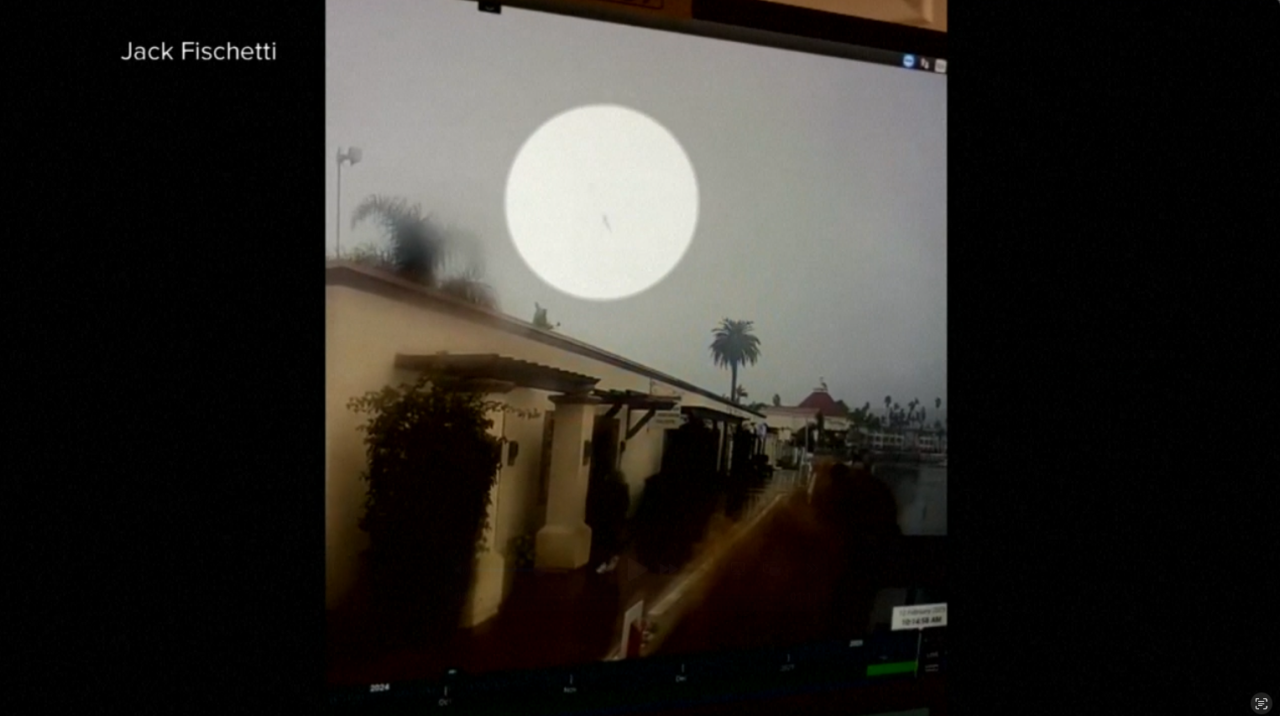
The crew safely parachuted into San Diego Bay and were rescued by a fishing boat.
The jet continued to climb to roughly 8,000 feet before dropping for over a minute and crashing into San Diego Bay near Shelter Island, the Navy investigation found.
“It looks like what it did is stalled. So, it got nose high, ran out of airspeed, came back around, and then the video we see of it going into the water, nose first, just all happened after the ejection,” said Martindell.
Amol Brown/Team 10

The Growler’s chaotic drop from the sky was captured on a resident’s doorbell and nearby surveillance cameras, which showed it nose-diving into the bay.
“If this aircraft had continued on even a second more, it could have hit Shelter Island or flown into a populated neighborhood in Point Loma — very, very close to a tragedy,” retired U.S. Marine Corps Col. Steve Ganyard told ABC News after the crash.
Navy says human error, weather to blame
After Team 10 obtained the documents, the Navy confirmed in October that it had finished the investigation into the mishap and ruled out mechanical failure.
Instead, investigators determined the crash was caused by human error exacerbated by a combination of factors, including adverse weather.
“The aircraft was unable to safely stop on the runway due to wet runway conditions and landing with a tailwind. The investigation determined that the pilot should have instead executed maximum braking techniques,” said Navy Cmdr. Amelia Umayam, a spokesperson for Naval Air Forces, U.S. Pacific Fleet.
The Navy spent weeks recovering debris from the water and said roughly 85% of the aircraft was recovered including significant debris.
“The U.S. Navy has well-established and rigorous programs for crew resource management, adherence to training rules, professionalism and airmanship,” Umayam wrote in a prepared statement.
“In the days and weeks that followed the crash, leadership across the enterprise reinforced to all crews that strict adherence to these programs is critical to safe and effective flight operations.”
Martindell still believes the air traffic controller’s warning was a contributing factor in the mishap and may have altered the pilot’s decision-making in the final moments before the ejection.
“He may have made a different decision I’m sure that that call had some influence on his decision to call for the ejection.”
Team 10 Investigative Reporter Austin Grabish covers military investigations, the Medical Board of California and the U.S.-Mexico border. If you have a story for Austin to investigate, email austin.grabish@10news.com



Shane van Gisbergen earned his sixth career pole and second of the 2026 season on Saturday, rocketing to pole position around NASCAR’s all-new 3.4-mile street course at Naval Base Coronado. He even touched the wall twice on his fast lap, pushing to the absolute limit.
“A little bit (surprised),” said Van Gisbergen, who went out with the first group of qualifiers. “I thought the track would be better, and I thought people would execute a bit better. As I said, it’s just so difficult. There’s three or four corners you’re seeing for the first time of the day, and it’s on your heater. Amazing. The Red Bull Chevy is really good. Thank you to Trackhouse for doing a great job from yesterday, and we just need to get the driver a bit better,” he concluded with a smile.”
Watch: SVG surprised to win Busch Light Pole at San Diego
Van Gisbergen bested Carson Hocevar by 0.0156s with a fast lap of 2:14.788s. Ryan Blaney will start third, Zane Smith fourth, and Todd Gilliland fifth. Blaney was a little bit quicker than SVG for most of his lap, but lost it through the final set of corners.
Daniel Suarez, Ryan Preece, Connor Zilisch, Michael McDowell, and Austin Hill will out the remainder of the top ten on the starting grid.
Project 91 driver Kevin Magnussen qualified 21st for his NASCAR Cup debut. Notably, championship leader Tyler Reddick spun out, but still reached 17th on the grid. Denny Hamlin is just 19 points behind him, and will start 26th.
Watch: Reddick loops it in Turn 2 during qualifying
Some other notable drivers very deep in the field include William Byron in 27th, Chase Elliott 30th, and an injured Christopher Bell 37th. He will have Brent Crews on standby, and may finish the race for Bell on Sunday.
Jimmie Johnson was the first driver to set a time, and showed just how tricky things were as he had to use the runoff area in Turn 2 to avoid an incident. Erik Jones also smacked the wall at the exit of Turn 16, but there were no red flags during the session.
NASCAR Cup San Diego ‘Anduril 250’ Full Starting Lineup
San Diego, CA
Neymar expected to return from right calf injury and play for Brazil in World Cup against Scotland

Neymar is expected to return from a right calf injury and play for Brazil in its final World Cup group match, coach Carlo Ancelotti said Friday night.
Neymar missed Brazil’s first two games of the tournament, including Friday’s 3-0 win over Haiti.
Ancelotti said Neymar would go through individual training on Saturday, train with the team on Monday and “will be available” for Brazil when it closes Group C play against Scotland on Wednesday in Miami Gardens, Florida.
Neymar is Brazil’s career scoring leader with 79 goals in 129 international appearances.
The 34-year-old midfielder has yet to practice in full sessions with the team since reporting to Brazil’s squad while nursing the calf injury.
Looking to play in his fourth World Cup, Neymar had tests on his calf last Monday to determine the progress of the injury that he sustained while playing for Brazilian club Santos on May 17.
There was widespread debate in Brazil over whether Neymar, whose first World Cup was on home soil in 2014, should have been called up for the tournament. He has struggled since returning from tearing the ACL in his left knee in October 2023 in a World Cup qualifier.
Neymar has four goals and two assists in eight matches for Santos this year.

CORONADO, Calif. (KGTV) – Everyone from NASCAR officials to the drivers to those who serve on Naval Base Coronado is beaming with excitement, waiting to kick the tires and light the fires this race weekend for NASCAR San Diego Weekend.
“Fans can expect one incredible time. History is being made this weekend,” Matt Humphrey, Sr. Director of Track Communications for NASCAR, said.
The racing track is up at Naval Base Coronado.
“It’s been amazing from seeing the bones of the track going up to driving the track, going to work in the morning. It’s incredible,” Seaman Naylei Fausto of the U.S. Navy said,
And now it’s time to race.
The NASCAR San Diego weekend is officially underway, with the first event held at an active military base.
“They’re going to be able to see a lot of what NASCAR is about with all the different fan displays, the kids’ zone, all the different activations from our partners around, but most importantly, they’re going to see the United States Navy showcased in the best form possible,” Humphrey said.
One of those sailors, Seaman Fausto, who is a lifelong NASCAR fan, never thought she’d see her station transformed into a NASCAR track, let alone any base.
“Joining the Navy, I thought I was going to be out taking pictures and doing Navy-related things, and now I get to work with NASCAR, which is just amazing and it’s fulfilling my inner child,” Fausto said.
Those behind the wheel say that, in their experience, there’s nothing like this event.
“It’s definitely a once-in-a-lifetime opportunity. I think we’ve had some opportunities. We did the street course in Chicago for the last couple of years,” Cody Ware, NASCAR Driver, said. “But to show up here, getting the opportunity to race on an active military base just for the US Navy and NASCAR to be able to work together to put the show on is really incredible.”
There will be a Truck Series race starting at 4 p.m. on Thursday. On Saturday, that’s when the NASCAR O’Reilly Auto Parts race will be happening. That begins at 2 p.m. This is the second tier of NASCAR races where drivers hone their skills, looking to get into the top level of the NASCAR circuit. Sunday is the main race with the NASCAR Cup Series happening at 1 p.m.
While it’s incredible to host NASCAR at the naval base, NASCAR officials hope people plan ahead to avoid the painful process of getting to the track.
“But if you do not have that government-issued photo ID or passport, you’ll be turned away. So very important that you bring that. But then bring your patients, come early,” Humphrey said. “If you think it’s going to take a half hour to get here, add an extra 30 to 40 to even 60 minutes on top of that; just to give yourself enough time to get over the bridge to make sure you get through the gates, get through security.”
Humphrey added that NASCAR is working together with local, state and federal agencies to make sure traffic is moving smoothly, and everyone is getting into the race and having fun.
-

 Delaware6 minutes ago
Delaware Lottery Powerball, Play 3 Day winning numbers for June 20, 2026
-

 Florida9 minutes ago
Juneteenth in Fort Myers: See photos of the celebration
-
Georgia14 minutes ago
Georgia Lottery Powerball, Cash 3 results for June 20, 2026
-

 Hawaii21 minutes ago
Waianae encampment deadline extended amid pushback from lawmaker, community
-

 Idaho24 minutes ago
One dead, four injured in US 26 crash near Ririe – East Idaho News
-

 Illinois29 minutes ago
Illinois Prison Closure Deepens Small Town’s Fears
-

 Indiana36 minutes ago
Indiana Republicans nominate Max Engling for secretary of state at GOP Convention in Fort Wayne
-

 Iowa39 minutes ago
Why Iowa State Basketball Will Miss Star Potential of Milan Momcilovic

