San Diego, CA
Car sales in San Diego sputtering this year


New car sales in San Diego — as well as California — are stuck in neutral this year, as high sticker prices and burdensome financing costs keep a sizable number of potential customers away.
Registrations in the state for new vehicles through the first nine months of 2024 were down 1.7% compared to the first three quarters of last year, according to data from the California New Car Dealers Association, while national sales figures were up 2.7%.
San Diego County figures were slightly better than statewide numbers, but only slightly — down 0.7% through the first three quarters.
“Looking at our economist’s analysis of a market, it feels like we’ve reached a new sales plateau,” said Brian Maas, president of the car dealers association.
According to Edmunds.com, the average price of a new vehicle in the U.S. as of September climbed to $47,431 and the average price of an all-electric vehicle came to $59,723. Even used cars are not very cheap, with the Edmunds average coming to $27,422.
“You literally cannot buy any vehicle today for the same price that you bought it five or six years ago,” said Ivan Drury, senior manager of auto insights at Edmunds. “And financing is a huge problem now.”
While the Federal Reserve lowered interest rates in September as inflation has cooled, Edmunds data show that as of last month, the average interest rate to finance a new car in the U.S. came to 7.3% and the average monthly payment was $742.
“It’s like consumers are getting hit left and right,” Drury said. According to Edmunds’ analysis, in the third quarter of this year, the average vehicle in the U.S. is on the lot 57 days before it gets purchased, compared to 37 days during the same time last year.
The California New Car Dealers Association anticipates the number of registrations in 2024 will come to about 1.75 million, which is slightly lower than the 1.77 million recorded last year. That’s a far cry from state sales figures that hovered around 2 million registrations per year prior to the pandemic.
The industry hopes that pent-up demand will eventually entice consumers back into a buying mode, especially if interest rates continue to decline.
The third quarter numbers reflected mixed messages for California’s hoped-for transition from gasoline-powered cars and trucks to electric vehicles.
On the positive side, all-electric battery and plug-in hybrid vehicles combined to make up 25.6 percent of the market in new vehicle sales and leases through the first nine months of this year — by far the highest numbers for any state.
But the rate of adoption of battery-electric vehicles, or EVs, has increased just seven-tenths of a percentage point through the third quarter of this year compared to 2023 and the market share of plug-in hybrids was flat — 3.4 percent in 2023 and 3.4 percent through Q3.
Four years ago, Gov. Gavin Newsom issued an executive order mandating the elimination of sales of all new gasoline-powered passenger vehicles in California by 2035. And in fewer than two years, the first of a series of state-imposed targets will start rolling out.
Under standards passed by the Air Resources Board, at least 35 percent of model year 2026 passenger cars and trucks sold in the state must be electric vehicles, plug-in hybrids or hydrogen fuel cell vehicles. The numbers ramp up each year, going to 68% in 2030 and 100% by 2035.
“As the mandates kick in, are there going to be enough customers to support the requirements that the mandate requires?” Maas said. “Sales continue to go up, but they’re not going up by leaps and bounds.”
Under definitions set by state policymakers, battery-electric, plug-in hybrids and hydrogen fuel cell vehicles qualify toward meeting California’s zero-emission target.
Hybrid vehicles that do not have plug-ins have been posting robust sales figures — not only in the Golden State but across the country — but they do not count under the state’s mandate because they use gasoline.
The third-quarter numbers showed the top-selling car across the state is still the all-electric Tesla Model Y. It racked up more than twice the number of registrations than California’s No. 2-selling car, the Toyota RAV4. The Tesla Model 3 finished sixth.
But statewide registrations for all Tesla models are down 12.6% compared to last year.
Analysts have offered a number of possible reasons why — including the potential sales effect of Tesla founder Elon Musk weighing in political issues after buying X (formerly Twitter) and actively campaigning for Donald Trump for president.
But Drury thinks a primary reason is simply because the number of EVs available is expanding, as other carmakers roll out their own models.
“There’s more competition,” he said. “The Model Y is kind of like the default purchase versus the Model 3 when you’re looking at the Tesla lineup, so it’s kind of a cannibalization of sales there.”
Behind the Model Y and Model 3, the Hyundai Ioniq 5 was No. 3 among top-selling zero-emissions vehicles in California through the third quarter with 11,711 registrations. The Ford Mustang Mach-E finished fourth, with 8,013.
Top-selling models in California
(for 2024, through September)
- Tesla Model Y 105,693
- Toyota RAV4 49,810
- Honda Civic 40,741
- Toyota Camry 40,025
- Honda CR-V 37,759
- Tesla Model 3 37,219
- Toyota Corolla 29,341
- Chevy Silverado 28,029
- Ford F-Series 26,753
- Honda Accord 25,240
Sources: California New Car Dealers Association and Experian Automotive



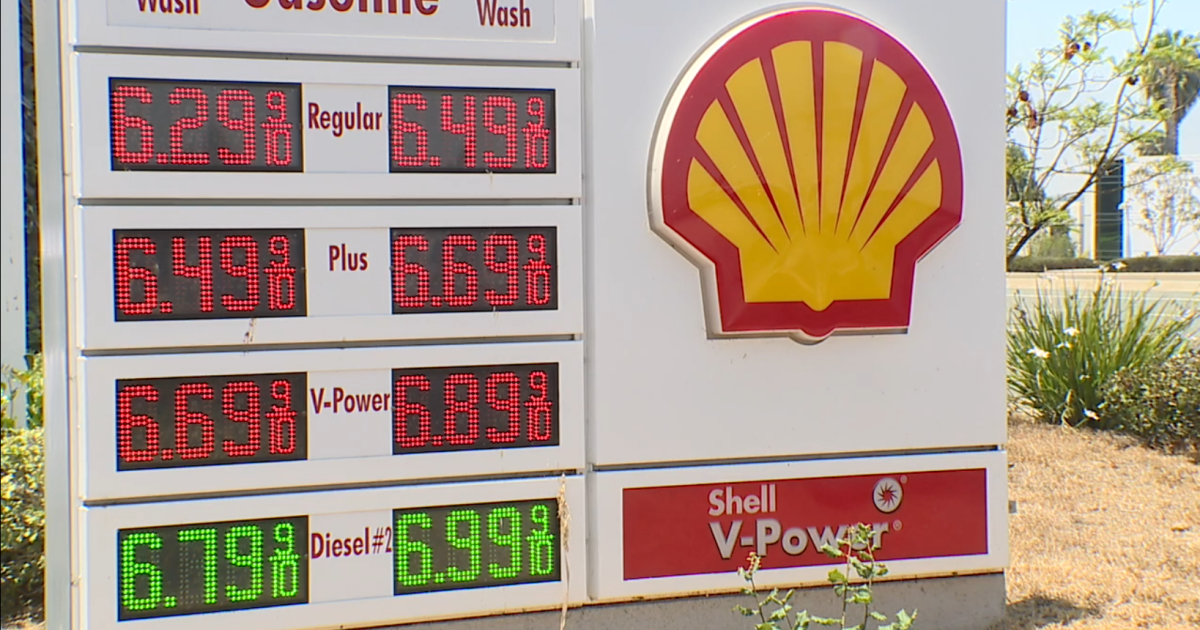
SAN DIEGO (CNS) — The average price of a gallon of self-serve regular gasoline in San Diego County dropped for the 44th time in 45 days today, falling eight-tenths of a cent to $5.42, its lowest amount since March 12. The average price has fallen 74.9 cents over the past 45 days, including eight-tenths of a cent Saturday, according to figures from the AAA and Oil Price Information Service. It is 9.8 cents less than one week ago and 53.2 cents less than one month ago, but 80 cents more than one year ago. The national average price dropped for the 43rd time in 45 days, falling six-tenths of a cent to $3.804, its lowest amount since March 17.
It has decreased 76 cents over the past 45 days, including 1.3 cents Saturday. The national average price is 6.3 cents less than one week ago and 41.6 cents less than one month ago, but 65.6 cents more than one year ago. “Crude oil prices have fallen to their lowest levels in months, dropping to the $60 a barrel range,” the AAA said Thursday. “Overall, gas prices remain the highest they’ve been in 4 years, but the downward trend since late May is welcome news during the busy summer driving season.”
Copyright 2026, City News Service, Inc.


CHULA VISTA (CNS) – The California Highway Patrol activated a Silver Alert today to help locate a 79-year-old woman last seen in Chula Vista.
Evangeline Rodriguez was last seen about 5:55 a.m. Thursday at Wildbrook Place and Woodspring Drive in Chula Vista. She is believed to be driving a white 2018 Honda CRV with California license plate 9JBS786.
Rodriguez is Hispanic, 5 feet, 2 inches tall, 130 pounds, with brown hair and brown eyes, last seen wearing a T-shirt and blue jeans.
Anyone who sees Rodriguez, or knows where she is, is urged to call 911.
The CHP activates a Silver Alert when an elderly or developmentally or cognitively impaired person is missing and determined to be at risk. It is
hoped providing immediate information to the public will aid in their swift
recovery.
Copyright 2026, City News Service, Inc.
-
 Vermont3 minutes ago
The Velomont bike trail is getting more accessible – one trail at a time
-
.jpg?w=400&resize=400,240&ssl=1 "On Virginia’s Crooked Road, the Hills Are Alive—With Bluegrass, Old-Time, and Country Jams")
.jpg?w=80&resize=80,80&ssl=1 "On Virginia’s Crooked Road, the Hills Are Alive—With Bluegrass, Old-Time, and Country Jams") Virginia7 minutes ago
Virginia7 minutes agoOn Virginia’s Crooked Road, the Hills Are Alive—With Bluegrass, Old-Time, and Country Jams
-

 Washington11 minutes ago
Georgia featured at Great American State Fair in Washington, D.C.
-

 Wisconsin19 minutes ago
Wisconsin Lottery Pick 3, Pick 4 results for July 5, 2026
-

 West Virginia21 minutes ago
West Virginia police launch high-visibility speeding enforcement campaign
-

 Wyoming26 minutes ago
WATCH: The 1937 Movie Wings Over Wyoming
-

 Crypto34 minutes ago
Trader Turns $2 Million of ETH Into $14,208 as Lighter Token Rallies 53%
-

 Finance36 minutes ago
MAS moves to rein in autonomous AI agents in finance

