Nevada
Court records: Nevada prison system doesn’t have execution drugs

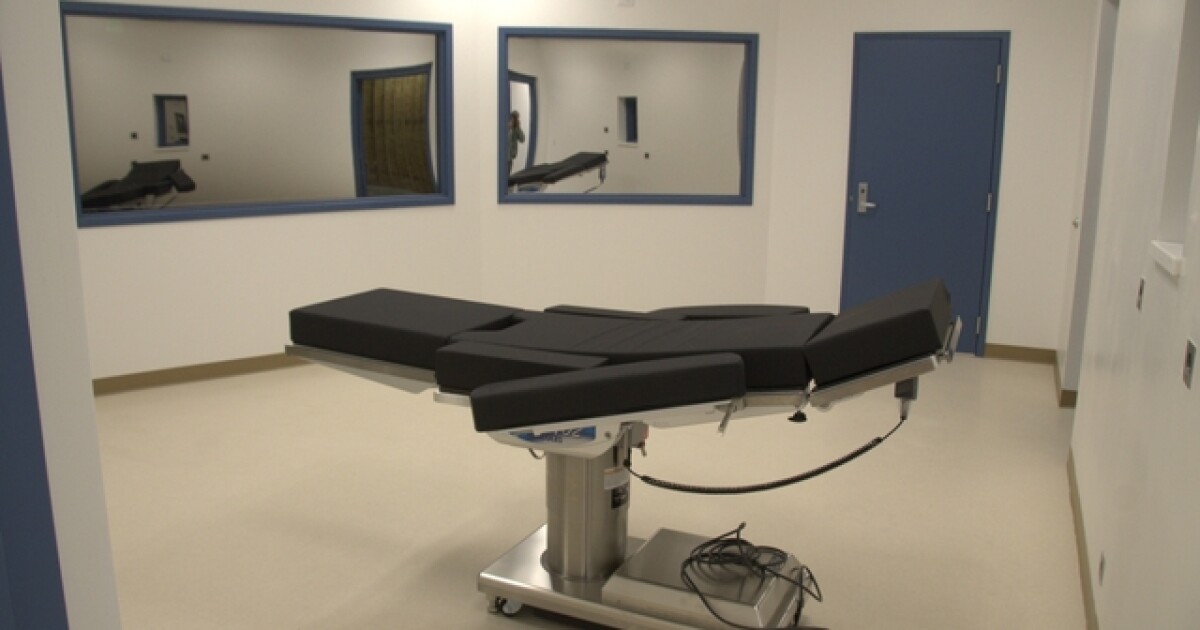
LAS VEGAS (KTNV) — The Nevada Department Of Corrections may not have the drugs needed to carry out several executions.
Last month, Clark County District Attorney Steve Wolfson stated his office plans to seek execution warrants for three inmates who have been on death row for years.
Zane Floyd was convicted and sentenced to death for killing four people and wounding a fifth during an attack at a Las Vegas Albertsons in 1999.
Donald Sherman was convicted and sentenced to death for using a hammer to kill a retired doctor while he slept in 1994.
Sterling Atkins was convicted and sentenced to death for beating, sexually assaulting, and strangling a mother in North Las Vegas in 1994.
When looking at a new federal court filing from Wednesday, attorneys for the NDOC wrote “At the current time, all medications previously obtained through the Cardinal Health portal have expired, NDOC is not in the possess of any unexpired drugs that are contained in the Protocol, and NDOC has confirmed to [attorneys for Floyd, Sherman, and Atkins] that there is no plan to change the protocol to proceed with the use of expired medications.”
According to court records, the NDOC is following protocols that were proposed in 2021, which include a three-drug lethal injection procedure “in which the drugs midazolam, fentanyl and cisatracurium” are used.
When looking at what these drugs are generally used for, the Mayo Clinic says midazolam is “used to produce sleepiness or drowsiness and relieve anxiety before surgery or certain procedures.” Fentanyl injections are “used to relieve severe pain during and after surgery. It is also used with other medicines just before or during an operation to help the anesthetic work better.” Cisatracurium injections are typically “used before and during surgery to provide muscle relaxation.”
When looking at past cases that have used similar drugs, fentanyl has been used only once in an execution protocol. That was in 2018 in Nebraska.
The court filing states attorneys for the three inmates have offered a different protocol that would contain fentanyl, ketamine, and potassium (chloride or acetate) and not include cisatracurium.
Attorneys for the inmates also suggested using pentobarbital, which is typically used as a medical sedative and a medicine that helps with emergency seizure control, as an alternative means of execution.
Ketamine has not been used in an execution. The State of Utah used a protocol of ketamine, fentanyl, and potassium chloride in 2024. However, they changed their systems to a one-drug protocol using pentobarbital.
Why does the medication combo matter?
Advocates say it’s because lethal injections aren’t the most efficient ways to carry out executions.
“Execution is brutal. I think that a lot of the public think these guys are just kind of peacefully going to sleep in the death chamber and we know, from expert witnesses and anesthesiologists who have reviewed hundreds of autopsies, who have witnessed these executions, who know these drugs better than anybody in the world, what they say is to a medical certainty, these people are suffering,” said journalist and author Gianna Toboni, who wrote a book called The Volunteer, which looks at the history of the death penalty in the United States, specifically through the eyes of former inmate Scott Dozier. “I think when we talk about firing squad and nitrogen gas, a lot of people are stunned like ‘Oh my God. We’re going back to these gruesome, brutal methods.’ Guess what? Lethal injection is pretty brutal too. It has the highest rate of botched executions at 7%.”
CHANNEL 13 ARCHIVES: Is the death penalty effective in Nevada?
Is the death penalty effective in Nevada?
When it comes to how the State of Nevada is obtaining the drugs that will be used for the proposed executions, “NDOC takes the position that contemplation of potential alternative sources for procuring medications are, at this time, protected by the deliberate process privilege, and therefore are not discoverable unless and until Director Dzurenda acquires medications to be used in the execution.”
Toboni previously told me that is not unusual because there are several states across the U.S. who keep the processes for how they obtain execution drugs under wraps.
“A lot of states are going to what’s called compounding pharmacies. Typically, these pharmacies are used for people who have allergies but need a specific medication. So they’ll combine different ingredients in order to make a custom drug for somebody. These drugs are not FDA-approved. They’re not in any way regulated by the federal government,” Toboni explained.
Toboni worked with the NDOC a lot while researching her book and says she understands how difficult this process is.
“Now, I understand the challenge that the prison system is up against and James Dzurenda, by no means, had it easy. He was genuinely trying to get the drugs in order to do his job, to carry out that execution, and the fact of the matter is it’s hard to get these drugs.”
As for Nevada, according to the court filing, the Cardinal Health portal “continues to be the primary and preferred source for obtaining medications that may be used in executions”, but “Director Dzurenda notes that he does not feel bound to pursue access to medications through the portal only and may pursue procurement of medications through other lawful channels.”
When looking at the federal court docket, no future hearing dates have been set. However, if one is needed, the court filing says it will be scheduled for June 22, 2026.
Nevada has not carried out an execution since 2006.



Nevada
U. Nevada Reno department merger will study social life via ‘intersectional, decolonial, humanistic’ lens | The College Fix

A ‘place where rigorous social research and critical, decolonial scholarship’ will occur
At the beginning of this month, the University of Nevada Reno merged its sociology department and Department of Gender, Race, and Identity to form the Department of Sociology and Cultural Analysis — dedicated to studying “social life” via “intersectional, decolonial and humanistic” methods.
According Nevada Today, the consolidation “reflects a long-recognized affinity between the two departments. Sociology and GRI share deep commitments to understanding social inequalities, the forces that produce and reproduce them, and the possibilities for transformation.”
The new department will be led by Professors Lydia Huerta (research interests include “critical communication pedagogy” and “feminist, gender and sexuality studies”) and Jared Bok (“globalization and transnationalism,” “religion, culture, organizations”) whom outgoing Dept. of Sociology Chair Marta Elliot (“prejudice, discrimination, stigma and well-being,” “sociology of mental health and illness”) said will “exceptionally well-position” the merger for the future.
The now-former Departments of Sociology and Gender, Race, and Identity taught students “to ask rigorous questions about race, gender, class, migration, health, labor, culture and power,” and the merger won’t change that, according to the report.
Huerta said the new department “will be a place where rigorous social research and critical, decolonial scholarship inform one another and where students graduate equipped to understand and change the world they inherit.”
The Department of Sociology and Cultural Analysis will offer “robust” selection of majors and minors including gender, race and identity, comparative ethnic studies, Indigenous studies, gender and queer studies, and social justice and conflict studies.
College of Liberal Arts Dean Casilde Isabelli said these programs “preserve [both former departments’] unique intellectual traditions while creating new opportunities for collaboration, innovation and student success.”
According to her faculty page, Huerta has written the journal articles “The Exigency of the Anti-Gender Agenda in Latin America: A Transnational Perspective” and “The Impacts of Anti-Genderism on Education in Brazil: Fear and Danger among Professors of Gender” among other publications.
Bok’s offerings include “Religious Exit Costs” and “The Arts in Sacred Spaces: How Religious Conservatism and Cultural Omnivorousness Influence Attitudes about Congregational Involvement in the Arts.”
MORE: U. Nevada Reno language guide warns against using ‘native Nevadan,’ offensive to indigenous people

Summer weather should be in full force this week here in northern Nevada, with sunny, dry, and hot conditions expected in the coming days. Kicking off your work week, Monday’s expected high is 93 degrees, with clear skies and light winds from the west.
Today’s high falls in line with the average high for July 6 at Reno-Tahoe International Airport.
Monday’s forecast for Reno
There is a slight chance of showers early in the day on Monday, but by late morning, we’ll have wall-to-wall sunshine in Reno.

Euro Model for Monday, July 6 at 11:30 a.m. PST
South Lake Tahoe 10-day forecast
Temperatures will slowly heat up over the course of the week, with the potential for triple-digit highs come Friday in Reno. Hope you enjoyed the Fourth of July weekend!
Be sure to stay with News4 for the latest weather information, both on-air and online. Check out the latest forecast with our Weather Authority team here.

MESQUITE (FOX5) — Two people were transported to a hospital after an RV crashed and caught fire on Interstate 15 near the Arizona-Nevada state line, according to Mesquite Police.
Investigators believe the RV, which was traveling southbound, blew a tire, lost control, and entered northbound lanes. The vehicle made contact with the trailer of a semi-truck before bursting into flames.
Condition of those injured
One of the two people transported from the scene was listed in very critical condition. The semi-truck sustained minor damage, and its driver was not reported among those transported.
Investigation ongoing
Mesquite Police are investigating the crash. No additional information about the identities of those involved has been released.
Drivers traveling northbound are advised to use alternate routes. Updated road conditions are available at nvroads.com.
Copyright 2026 KVVU. All rights reserved.
-

 Detroit, MI14 minutes ago
Fans pack Detroit’s Campus Martius for USA-Belgium World Cup match
-

 San Francisco, CA26 minutes ago
Terrified passengers film Waymo autonomous vehicle driving into live fireworks in San Francisco
-

 Dallas, TX29 minutes ago
WATCH: USA vs. Belgium watch party at FIFA Fan Festival Dallas
-

 Miami, FL34 minutes ago
Tim Hardaway Jr. returns home as Miami Heat sign veteran guard:
-

 Boston, MA41 minutes ago
‘Enough is enough’: Weekend violence in Boston sparks calls for change, from more police to community investment – The Boston Globe
-

 Denver, CO42 minutes ago
Kalshi Promo Code DENVER: Trade $10, Get $10 World Cup Bonus for USA-Belgium – Denver Stiffs
-

 Seattle, WA49 minutes ago
Fans take over Seattle for USA-Belgium World Cup match
-

 San Diego, CA50 minutes ago
Elite California city set for mass illegal street vendor expansion as judge issues stunning verdict

