New Mexico
A New Mexico monastery where the silence calls


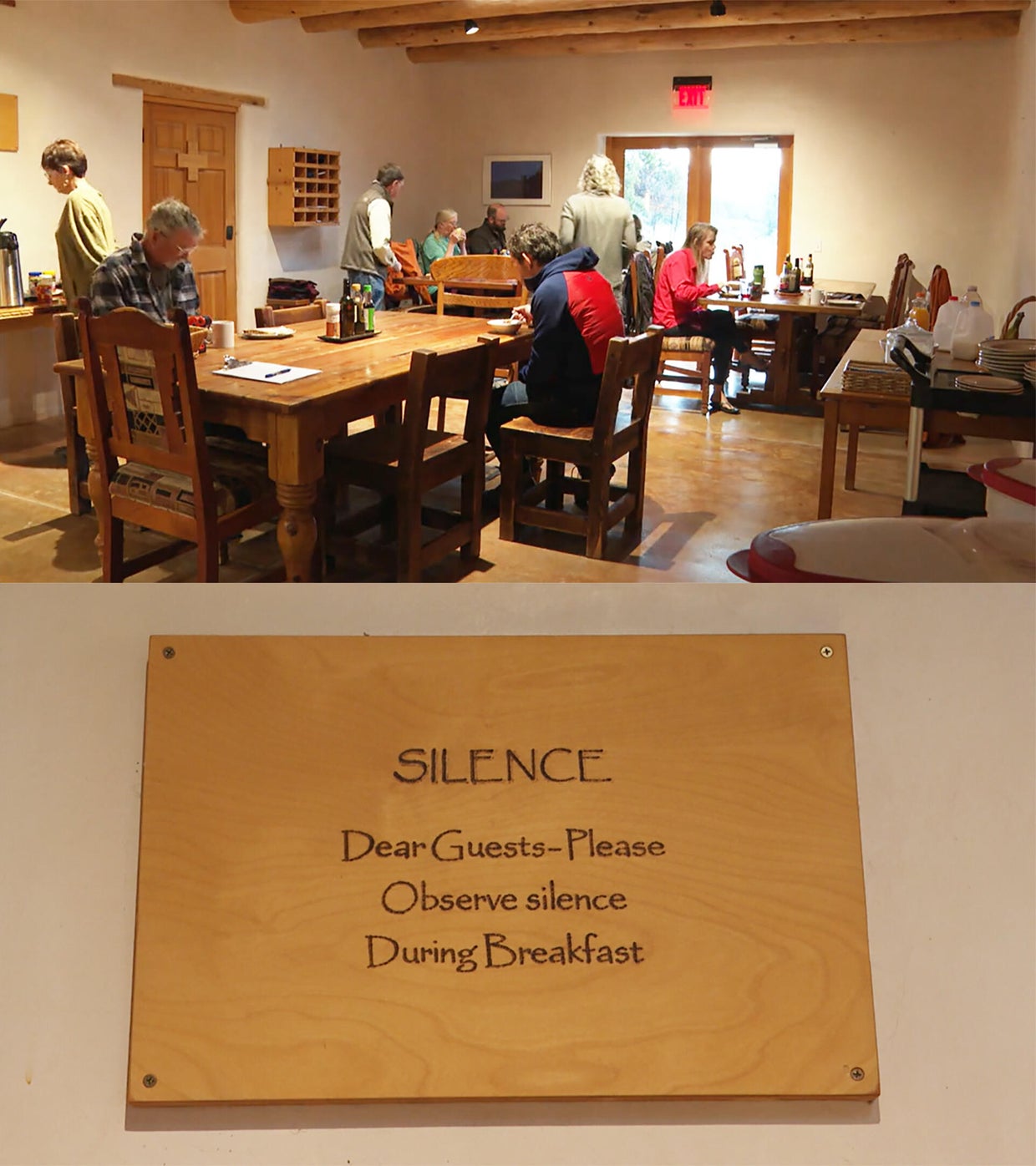
Thirteen miles down an unmarked dirt road quietly sits the Monastery of Christ in the Desert, along the Chama River in Northern New Mexico. The monastery is home to 15 monks, some livestock, and a guesthouse for people looking for a little quiet in this turbulent world.
“The silence here is deafening,” said Brother John Chrysostom. “No sirens. There’s no electrical buzz or anything. You have no cell phone connection here. The silence allows you the opportunity to hear that which you are to hear.”
That is, the sound of bells, and the sound of voices chanting seven times a day.
“When you chant, that is prayer,” Chrysostom said. “And what any monk probably aspires to do is that he doesn’t want to just chant the Psalm, but one day he wants to be the Psalm. He wants it to be a part of who he is as a human being.”
This part of the world has always drawn people seeking. It drew artist Georgia O’Keeffe to settle just down the road, and in 1964 it drew Father Aelred Wall, a monk, to found a Benedictine monastery here. Famed architect and furnituremaker George Nakashima designed its church.

When we visited, Chrysostom was our “guestmaster,” welcoming us among this order of Benedictine monks. “As guestmaster, I keep this rule: basically we were to treat guests as if they are Christ,” he said.
The brother happens to hold an undergraduate degree from MIT, an MBA, three more Master’s degrees, and a Ph.D. in political science. He was a professor, and also: “I was an investment banker for a while,” he said. “That’s not a very peaceful existence even in the best of times!”
But it was on a pilgrimage, the famous Camino de Santiago, that Chrysostom heard a voice calling him here. Anyone can visit, for a suggested donation and a willingness to participate in the silence.
Here the monks follow the Rule of St. Benedict – Ora et Labora, Latin for prayer and, well, work, which of course you’ll find on YouTube, posted by Brother David. Online, he calls himself The Desert Monk.

And his work around the monastery is never done. “The gist of the message is, in everything that you do, the work is for God,” he said.
When Charles Osgood reported on the monastery in the 1990s, the monks had just begun working with a new invention called the Internet – a union of “inner space with cyberspace.”
Watch the 1996 “Sunday Morning” report: A New Mexico monastery meets the internet (Video)
Today, guests Mary and Joseph Roy, from Washington State, have found something here a five-star hotel cannot offer. “Sun on the red rocks and the River Chama flowing by,” Mary said. “It’s a good way to listen to God, to listen to nature.”
Asked what he takes away from his visit there, Joseph said, “For me, being more aware, listening to that of God in each person, as we talk, as I experience their story and their life.”
The monks ask guests to help with the running of the monastery, if they can, and Brother Chrysostom says their guests’ presence is fundamental to the monks’ calling: “We need the world as much as the world needs us,” he said. “Don’t think we’re escaping or moving away from the world because we don’t need the world. We need the world.”
I asked, “Do you need the world because it helps you feel like you’re fulfilling what God wants you to do?”
“I guess it hearkens back to the desert fathers, the early monks who lived in the Egyptian desert,” Chrysostom said. “You had monks living these holy lives praying, and lives of asceticism, and forgoing eating. It was remarked once like, ‘Okay, you’re doing all this. But whose feet will you wash out here in the desert?’ So, you’re doing these things for someone as well, and with someone.”
But the monks ask no questions of those who wish to become their guests. “No, you just show up as you are,” Chrysostom said. “And you’re not required to do anything while you’re here. You’re just required to be. You can pray with us if you want, you can eat with us if you want. Or you can hike. We ask that maybe, if you’ve chosen to come here, that you spend some time with us getting to know the community and the place. But our schedule’s not your schedule!”
Maybe the quiet of places like Christ in the Dessert isn’t an end in and of itself. But by making space for a little silence, you hear your calling … a little louder.
As Chrysostom pointed out, “One thing you’ll notice that we are in a canyon. So, we’re at 6,600 feet above sea level right now. And so, these hills and the cliffs stretch another 1,000 up and everything. These are all false horizons. Basically, when you get up to the top of these hills, or what you think is the top, you’re just beginning to go up. It continues on. So, this is a false horizon. This is not the top; it’s just the beginning of something which is even higher.”
Perhaps a lesson for all of us on our own spiritual journeys.

For more info:
Story produced by Anthony Laudato. Editor: Chad Cardin.



NEW MEXICO (KRQE) – Some call the multi-million-dollar El Camino Real Heritage Center an architectural masterpiece. Others, however, call it one of New Mexico’s most expensive blunders. In 2021, former Speaker of the House Don Tripp weighed in on the project, “As far as benefit, it really didn’t have any benefit to anybody.”
Taxpayers paid more than $4,000,000 to build it, a few million dollars more to operate it and, now, a half million to tear it down.
The El Camino Real Heritage Center is a history museum dedicated to the historic ‘Royal Road of the Interior’. Established by Spanish conquistadores in 1598, the historic byway extended from Mexico City to north of Santa Fe. Armed with $4,000,000 from the state legislature and the Bureau of Land Management, consultants were hired to find the best place to build the new museum. After studying various locations, they chose a remote spot on the prairie 37 miles south of Socorro.

The experts said, ‘build halfway between Socorro and Truth or Consequences,’ and the museum will draw 100,000 visitors a year, bring in $10,000,000 to the region, and create 174 new jobs. Back in 2004, no one raised a red flag about putting a tourist attraction in an out-of-the-way location. It was only after construction was complete that officials learned the so-called experts were dead wrong. The project was doomed to fail before it even opened its doors. “Who the heck thought it was a good idea to build it where they built it?” State Rep. Gail Armstrong told KRQE News 13 last year.
The state’s newest museum opened in 2005. An estimated crowd of 2000 turned out for the dedication ceremony. Socorro Mayor Ravi Bhasker was there. “We had Bill Richardson out there cutting the ribbon, and then we had the Vice President of Spain come down here with his beautiful wife, and we had dignitaries everywhere. It was exciting,” Mayor Bhasker said.
But the excitement was short-lived. Where the historic El Camino Real trail was in use for three centuries, the museum with its namesake lasted just eleven years. The remote location meant few visitors, meager revenue, inadequate staffing, expensive utilities, and maintenance.
In 2016, New Mexico’s Cultural Affairs Department pulled the plug on the El Camino Real Heritage Center, padlocked the doors, and permanently closed the museum. The parking lot is deserted, tourists are gone, artifacts are packed away, display cases vacant, exhibits dismantled, interpretive panels removed, and the gift shop is bare. All there is to show for millions of tax dollars is an abandoned building on the prairie.
“Eleven years is disgraceful. There was a real failure in this particular project,” the late State Senator John Arthur Smith said in a 2021 interview. We asked the retired Senate Finance Committee Chair, when the history of this project is written, what will it say? “They’re going to shake their head and (use this as) another example of government waste,” the retired Senator Smith said in 2021.
So what do you do with a $4,000,000 deserted building in the middle of nowhere? Time and vandals have taken a toll. The museum was closed and boarded up in 2016, and then state officials abandoned the site. Because little effort was made to secure the empty building, it is no longer habitable. Copper wiring has been stolen. There is significant structural damage, mold, a rodent infestation, and no electricity or lights. Most of the HVAC, electrical, plumbing, water, and septic systems are either obsolete or inoperable.
Faced with a whopping $3.5 million repair bill, the Museum of New Mexico’s Board of Regents made the difficult decision last year to demolish the building. Board of Regent’s President, Dr. George Goldstein, calls the building, “A loss, a huge loss.”
“What a complete waste of taxpayer dollars,” says State Rep. Gail Armstrong who’s District 49 includes the museum site. And what did taxpayers get for their $4,000,000 investment? “Nothing. It just cost them a ton of money. Nothing,” Representative Armstrong said.
This week, a state-hired demolition crew began the task of tearing down the museum complex. Tons of concrete, steel, and glass will be hauled away. The parking lot and nearby caretaker’s house will also be ripped out. The prairie will be graded, reseeded with native plants, and returned to the Bureau of Land Management in restored, pristine condition. The demolition project is expected to take four months.
The El Camino Real museum was planned and built during the Governor Bill Richardson administration. All of the State Legislators involved in the funding of the museum project have since left government service.
Soon, the El Camino Real International Heritage Center will be just a bitter memory. All clues to the existence of a pricey government blunder will have been erased. Pay a visit to the remote spot south of Socorro later this fall, and all you will find will be desert creosote, prairie dogs, and a few rattlesnakes.

CLOVIS, New Mexico (KVII) — A baby giraffe was born at the Hillcrest Park Zoo in Clovis.
The city announced a male calf was born around 1 a.m. Thursday to Jerrica, a Rothschild giraffe who has lived at the zoo since she was born there in January 2012.
Zoo officials said Jerrica, a first-time mother, and her calf are doing well.
Baby giraffe born at the Hillcrest Park Zoo in Clovis, New Mexico on July 9, 2026 (Credit: Hillcrest Park Zoo )
The calf will make his public debut from 10 a.m. to noon Saturday.
“This is a once-in-a-lifetime moment you won’t want to miss! Bring your family, your camera, and your excitement as we welcome the zoo’s newest (and tallest!) superstar!” said the zoo.
Because the calf is male, he will eventually be moved from Hillcrest Park Zoo to another zoo or facility, according to the city.
The zoo plans to ask the public to help name the calf in the coming weeks.

-

 North Carolina4 minutes ago
Massive great white shark spotted off NC coast. See where its headed
-

 North Dakota10 minutes ago
Neighbors, not competitors
-

 Ohio16 minutes ago
Former Powell residents indicted in $9.3M Ohio Medicaid fraud scheme
-

 Oklahoma22 minutes ago
J.D. PicKell: ‘Oklahoma is going to be a wagon once again’
-

 Oregon28 minutes ago
Oregon Ducks’ Big Ten Championship Chances Entering Fall Camp
-

 Pennsylvania34 minutes ago
Lawmakers break without addressing unconstitutional murder sentences, leave 1K Pa. lifers in limbo
-

 Rhode Island40 minutes ago
Providence mayor, City Council dispute over RENT fund program
-

 South-Carolina46 minutes ago
Could SC’s election rules shape who decides to run for Graham’s US Senate seat?

