Nevada
Nevada’s hot housing market weighs on US presidential election


The gambling district of Reno, Nevada, on May 9, 2024. Reno, affectionately called “The Biggest Little City in the World, is the seat of Nevadas Washoe County. – The path to the White House this November runs through a handful of swing states, among them Nevada, whose six electoral college votes will be crucial in deciding who gets the keys to the White House. The state’s vast rural hinterlands are solidly Republican and likely to all-but cancel out the Democratic vote in the gambling capital Las Vegas. The state’s final electoral color will depend on Washoe County, a long, thin strip abutting California, whose main city is Reno. (Photo by Robyn BECK / AFP)
Reno, United States — Brittnie Aguirre grew up in Nevada and has always wanted to build her American Dream there: owning a home with her husband and three kids.
But rocketing prices wrought by a years-long real estate boom, have priced her — and many middle-class Americans — out of the market, an issue that could weigh heavily in November’s presidential election.
READ: Kamala Harris vows to be ‘president for all Americans’ in convention climax
“We make the most we’ve ever made in our lives, but we struggle more than we really ever have, just because the cost of living is absolutely through the roof,” Aguirre told AFP.
“It’s not even just housing. I mean, have you seen the price of groceries, of gas?”
The economy
Aguirre, 29, and her 31-year-old husband live and work in Reno, a fast-growing city in the western state of Nevada.
The state, which President Joe Biden won by just 33,000 votes over Donald Trump in 2020, carries a relatively meager six electoral college votes out of the 270 required to win the White House.
But in this year’s knife-edge contest between Kamala Harris and Trump, it is one of a handful of battleground states expected to decide who triumphs.
And American politics is nearly always dominated by the economy, making voters like Aguirre important.
She lived with her in-laws for a year-and-a-half to save for a deposit. But even then — and with property prices continuing to rise — more than half the $71,000 post-tax annual family income would be swallowed by a $3,000 monthly mortgage.
READ: Trump speaks behind bulletproof glass since attempted assassination
Although Aguirre voted for Biden in 2020, disappointment over family finances will play into her decision this year.
“I’ve never really been a political person until this last year where we have just struggled so much with the economy,” she said.
“This time, I want to do more research on the political parties to make a well-informed decision.”
‘Everything’s on sale’ –
Reno — nicknamed “The Biggest Little City in the World” — is must-win territory for Harris.
The glitzy big city of Las Vegas to the south leans Democratic, while the rolling rural areas of the rest of the state are reliably Republican.
With the two blocs largely cancelling each other out, winner-takes-all Nevada could come down to Washoe County, where Reno sits.
The population here has doubled since 1990, swelled in recent years by an influx of tech workers, following tax breaks to lure employers like Tesla, Panasonic and Apple.
Coming from California, swathes of that workforce have been delighted to find how much more they can afford.
The average house price in Cupertino, California — where Apple is headquartered — is over $3 million, according to Zillow.
A single-family home in Washoe, Nevada is $550,000.
For Matt Mireles, who runs an AI start-up, leaving San Francisco for Reno was “a slam dunk.”
At 43, he bought himself a 1,900-square-foot (170-square-meter) apartment, with a view of the river in the heart of Reno, for $635,000.
“When you come from California, everything’s on sale,” he said.
‘Priced out’
But the bulk of first-time buyers in Reno are from out of state, says realtor Sam Britt.
“And the locals are angry,” he adds.
While new arrivals might consider $550,000 reasonable for a home, that figure is double what it used to be a decade ago.
Add to that the fact that interest rates are near 20-year highs — the result of central bank action to curb inflation — and it puts home ownership out of reach for many.
Fellow realtor Sean Burke notes that a seven percent interest rate on a 30-year mortgage is affecting Americans everywhere.
“The middle class has been priced out of a lot of the homes,” he said. “It definitely could weigh on the ballot box.”
In 2022, the median age of first-time buyers in the United States hit 36, a record, according to the National Association of Realtors.
While the White House has no control over interest rates, and little real influence over inflation, voters tend to blame the sitting administration for their economic difficulties.
And having been Biden’s understudy during more than three years that many Americans have seen the promise of home ownership slip out of reach, that might be bad news for Harris.
Andres Villa, who works for Tesla, says he is faced with steep monthly payments for his own home and is tempted by the alternative.
“When Trump was in office, he said a lot of crazy things,” he said.
“But it seemed like the economy was running a little bit better.”
As Election Day approaches, the latest economic indicators, including decreasing inflation and a likely Federal Reserve rate cut, are increasingly positive.
That could bring a few voters like Villa back to Harris — and in a swing state, that’s all she might need.



LAS VEGAS (KSNV) — Nevada Youth Sports is working to keep thousands of young athletes on the field after a fire believed to have been sparked by illegal fireworks caused nearly a quarter of a million dollars in damage to its facility.
The fire broke out late on the night of July 4. Jane Ramos, chief administrative officer for Nevada Youth Sports, said she received a call from the organization’s landlord telling her there had been a fire at the building.
“We got a call from our landlord saying I needed to come out here right away because there had been a fire,” Ramos said. “We didn’t really understand the scope of what had happened until we could hardly open the door because of the fumes, the smoke, and the smell.”
According to Ramos, firefighters responded shortly before midnight after flames were reported on the roof of the building. In the days since, the organization says it has learned the fire is believed to have started when embers from illegal fireworks landed on the roof.
“It’s something that was preventable if it truly was illegal fireworks,” Ramos said.
Early damage assessments estimate nearly $250,000 in structural, electrical and water damage. Ramos said the organization is still working to understand the full financial impact.
“We’re trying to assess where we are financially in all of this,” she said. “It’s really a question mark.”
The damage has forced Nevada Youth Sports to temporarily close its facility, affecting the thousands of athletes and families who rely on the organization for leagues, clinics and training programs.
Nevada Youth Sports serves more than 14,000 athletes and families across the Las Vegas Valley each year. Ramos said the organization’s immediate priority is finding alternate locations so programs can continue with as little disruption as possible.
“We’re definitely allocating our resources toward those efforts,” Ramos said. “Whatever the cost is to continue programming outside of this building, that’s where we’re focusing our efforts right now.”
While investigators continue looking into the cause of the fire, Ramos said the organization hopes whoever is responsible will be held accountable. She said neighboring businesses have provided surveillance video that could help determine exactly what happened.
“I’m hopeful that we can point some accountability somewhere,” Ramos said. “Our commercial neighbors have been very kind to offer their camera footage, so we’re still collecting all of that information before we pursue anything further.”
Despite the damage, Ramos said the organization’s commitment to local families remains unchanged.
“We’ll continue to be steadfast and patient,” she said. “Our mission is being a partner to our athletes and families. We’re here for a bigger purpose than just this building, and we’ll see it through.”
Nevada Youth Sports expects to have a better understanding of the repair timeline by the end of the week. In the meantime, leaders say they’re grateful for the community support they’ve already received as they work to restore operations.
Nevada
U. Nevada Reno department merger will study social life via ‘intersectional, decolonial, humanistic’ lens | The College Fix

A ‘place where rigorous social research and critical, decolonial scholarship’ will occur
At the beginning of this month, the University of Nevada Reno merged its sociology department and Department of Gender, Race, and Identity to form the Department of Sociology and Cultural Analysis — dedicated to studying “social life” via “intersectional, decolonial and humanistic” methods.
According Nevada Today, the consolidation “reflects a long-recognized affinity between the two departments. Sociology and GRI share deep commitments to understanding social inequalities, the forces that produce and reproduce them, and the possibilities for transformation.”
The new department will be led by Professors Lydia Huerta (research interests include “critical communication pedagogy” and “feminist, gender and sexuality studies”) and Jared Bok (“globalization and transnationalism,” “religion, culture, organizations”) whom outgoing Dept. of Sociology Chair Marta Elliot (“prejudice, discrimination, stigma and well-being,” “sociology of mental health and illness”) said will “exceptionally well-position” the merger for the future.
The now-former Departments of Sociology and Gender, Race, and Identity taught students “to ask rigorous questions about race, gender, class, migration, health, labor, culture and power,” and the merger won’t change that, according to the report.
Huerta said the new department “will be a place where rigorous social research and critical, decolonial scholarship inform one another and where students graduate equipped to understand and change the world they inherit.”
The Department of Sociology and Cultural Analysis will offer “robust” selection of majors and minors including gender, race and identity, comparative ethnic studies, Indigenous studies, gender and queer studies, and social justice and conflict studies.
College of Liberal Arts Dean Casilde Isabelli said these programs “preserve [both former departments’] unique intellectual traditions while creating new opportunities for collaboration, innovation and student success.”
According to her faculty page, Huerta has written the journal articles “The Exigency of the Anti-Gender Agenda in Latin America: A Transnational Perspective” and “The Impacts of Anti-Genderism on Education in Brazil: Fear and Danger among Professors of Gender” among other publications.
Bok’s offerings include “Religious Exit Costs” and “The Arts in Sacred Spaces: How Religious Conservatism and Cultural Omnivorousness Influence Attitudes about Congregational Involvement in the Arts.”
MORE: U. Nevada Reno language guide warns against using ‘native Nevadan,’ offensive to indigenous people
-

 Kentucky6 minutes ago
Former Kentucky guard Quade Green joins La Familia
-

 Louisiana9 minutes ago
Looking for a luxurious place to stay? These are Louisiana’s 6 best resorts
-

 Maine14 minutes ago
Leslie Marshall urges Democrat Graham Plattner to exit Maine Senate race amid allegations | Fox News Video
-
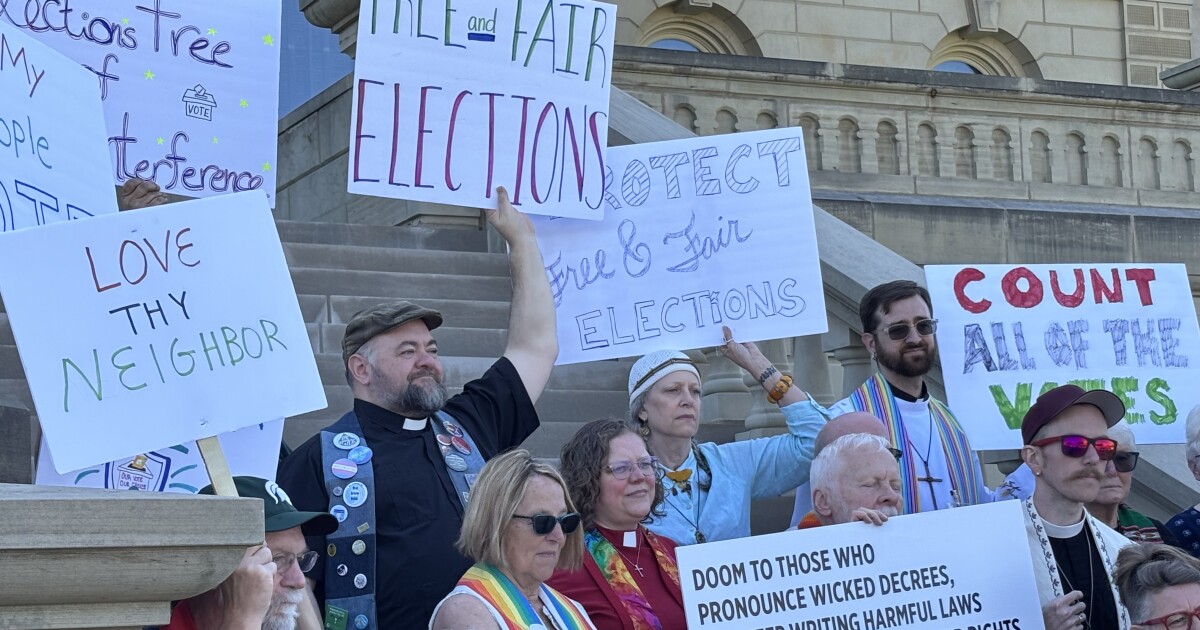 Michigan24 minutes ago
Michigan religious leaders speak against what they say are voter intimidation efforts
-

 Massachusetts29 minutes ago
ICE detentions rise in Massachusetts amid World Cup festivities
-

 Minnesota36 minutes ago
Man accused of attacking woman in Midwest Bank parking lot at gunpoint
-

 Mississippi39 minutes ago
Jabil to invest $119 million in Marshall County, create 2,200 jobs
-

 Missouri51 minutes ago
Explosion reported after Missouri school employee hits firework with lawn mower

