West
NASA re-establishes communication with Voyager 1 interstellar spacecraft that went silent for months

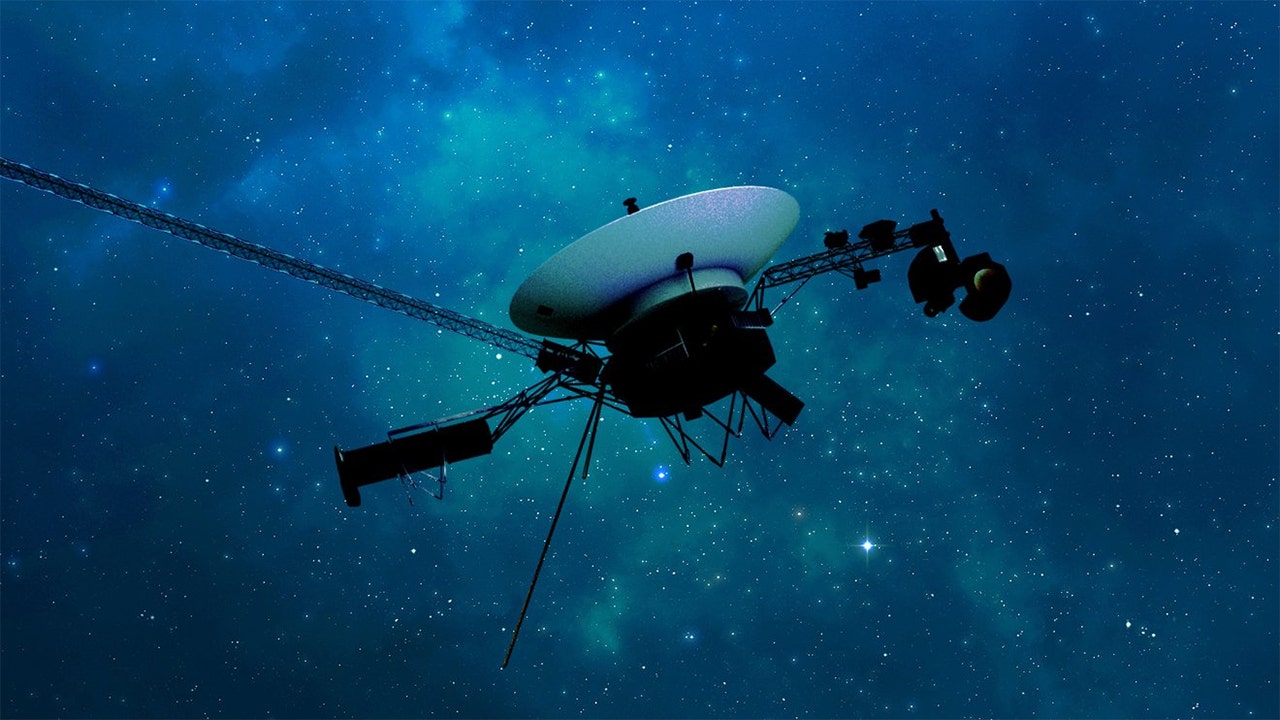
NASA and Voyager 1 are communicating back and forth again, after the most distant human-made object in space stopped sending usable data back to the space agency nearly five months ago.
NASA’s Jet Propulsion Laboratory said Voyager 1, which is more than 15 billion miles away from Earth, stopped sending readable data back to scientists on Nov. 14, 2023, though mission controllers could still see the spacecraft was receiving commands and operating as intended.
The Southern California-based engineering team responsible for Voyager 1 investigated the problem and learned the issue was connected to one of the spacecraft’s three onboard computers, which is called the Flight Data Subsystem (FDS).
The FDS packages the data collected by the spacecraft before sending it back to earth.
RARE STAR EXPLOSION EXPECTED TO BE ‘ONCE-IN-A-LIFETIME VIEWING OPPORTUNITY,’ NASA OFFICIALS SAY
NASA’s Voyager 1 spacecraft is depicted in this artist’s concept of traveling through interstellar space, or the space between stars, which it entered in 2012. (Credit: NASA/JPL-Caltech)
Engineers discovered the chip responsible for storing a portion of the FDS memory was faulty, making the code unusable.
Had the spacecraft been located on Earth, engineers would be able to go in and replace a chip, but because it is in interstellar space, engineers needed to figure out a way to move the affected code somewhere else in the FDS memory.
The code is so large that there is not a single location to store the entire section of the code. So, engineers divided the affected code into sections and planned to move them to various locations in the FDS.
NASA PUBLISHES NEVER-BEFORE-SEEN PHOTOS OF ‘RAVIOLI’ MOON ORBITING SATURN
After receiving data about the health and status of Voyager 1 for the first time in five months, members of the Voyager flight team celebrated in a conference room at NASA’s Jet Propulsion Laboratory on April 20. (Credit: NASA/JPL-Caltech )
Engineers also had to make sure the code worked together as a whole after being moved.
Once the code was reconfigured, engineers transmitted the changes to the FDS memory on April 18.
The signal takes about 22.5 hours to travel through space until it reaches Voyager 1, and then another 22.5 hours for a signal to come back to earth.
VOYAGER 1 DETECTS ‘HUM’ WHILE IN INTERSTELLAR SPACE: REPORT
NASA’s Voyager 1 spacecraft, shown in this illustration, has been exploring our solar system since 1977, along with its twin, Voyager 2. (Credit: NASA/JPL-Caltech)
On April 20, the mission team received a response from Voyager 1 and confirmed the modification worked. As a result, engineers now have the ability to check the health and status of the spacecraft.
In the coming months, the team plans to move and adjust additional portions of the FDS software that was affected, including portions that send scientific data back to mission control.
Voyager 1′s odyssey began in 1977 when the spacecraft and its twin, Voyager 2, were launched on a tour of the gas giant planets of the solar system.
After beaming back dazzling postcard views of Jupiter’s giant red spot and Saturn’s shimmering rings, Voyager 2 hopscotched to Uranus and Neptune. Meanwhile, Voyager 1 used Saturn as a gravitational slingshot to power itself past Pluto.
Read the full article from Here


LAS VEGAS (FOX5) — As the nation marks its 250th anniversary, one chapter of American history was written in the Nevada desert, where the Nevada Test Site became the center of the country’s nuclear testing program during the Cold War.
The National Atomic Testing Museum in Las Vegas preserves that history, telling the story of what happened at the site roughly 65 miles northwest of the city.
From Truman’s order to 928 nuclear tests
President Truman established the Nevada Test Site in 1950. It was formally activated in 1951 at the height of the Cold War and ultimately served as the location for 928 nuclear weapons tests.
Scott Wade, chairman of the board of trustees for the National Atomic Testing Museum, said the program emerged from unanswered questions following the Manhattan Project.
“After the atomic bomb was developed by the Manhattan Project and the two weapons were used in Hiroshima and Nagasaki, there were still questions about how to safely utilize them — even as a weapon of war, this was emerging technology, something that had never been done before,” Wade said.
MORE ON FOX5: Veterans, downwinders demand recognition claiming Cold War radiation exposure
A family legacy tied to the site
Wade’s connection to the site is personal. His father began working there in 1958 and eventually rose through the Atomic Energy Commission, retiring as the Assistant Secretary for Defense Programs in charge of the nation’s nuclear weapons program.
In the 1990s, Wade’s family, along with six other families of former employees, worked with state and federal partners to establish the Atomic Testing Museum.
“There are a lot of feelings about nuclear weapons, and that’s actually the wonder and beauty of a museum,” Wade said.
Impact beyond weapons testing
Supporters of the program argue its influence extended well beyond military strategy. Wade said the testing program advanced scientific research with applications that reach into medicine today.
“I don’t think as a nation, maybe as a world, we would be anywhere near as far as we are with nuclear material separation even for medical uses,” Wade said.
Supporters also argue the program’s greatest impact was helping deter a global nuclear conflict during the Cold War between the U.S. and the Soviet Union.
Nevada’s role continues today
The Nevada Test Site is now known as the Nevada National Security Site and continues to operate. Wade said Nevada’s role in nuclear security remains active.
“Right now, nuclear weapons are still a very big topic. So we’re saying it’s history, but really, Nevada is still playing a very critical role in our everyday lives,” Wade said. “Everything still contributes to making sure that the weapons that are within the stockpile are safe and secure. And because you can’t do an underground nuclear weapons test, you do it with pieces and parts so you understand those pieces and parts.”
The Nevada National Security Site continues to play a role in maintaining the safety, security, and reliability of the U.S. nuclear stockpile.
The National Atomic Testing Museum is open Monday through Saturday from 9 a.m. to 6 p.m. and Sundays from 9 a.m. to 5 p.m.
Copyright 2026 KVVU. All rights reserved.

NEW MEXICO (KRQE) – License plate readers remain a controversial law enforcement tool. During this past legislative session, New Mexico lawmakers passed a bill that puts limits on how police use a controversial piece of technology.
The Driver Privacy and Safety Act implements safeguards on how the data collected by license plate readers is shared. It comes after instances where the technology was found to be used for non-law enforcement reasons, like people seeking abortions and immigration enforcement.
The lawmakers behind the bill said they want to ensure private information remains private. Santa Fe Police Interim Chief Ben Valdez says they are already restricted from sharing data collected from license plate readers, but he says it’s still important to have the law on the books.
“As a state, I think it puts us on the same page, which I think is very helpful. The data is the property of the City of Santa Fe. So if there’s going to be any sharing of that data. It has to be given with the express permission of the City of Santa Fe. It can’t just be used for any purpose, including being sold to a third party,” said Interim Chief Ben Valdez, Santa Fe Police Department.
Chief Valdez also emphasized that the plate readers can only be used in public spaces. “So it’s on a street that is a public road. It may be in a shopping area where that’s again within the public purview. We’re not doing plate reads in private areas that people have an expectation of privacy,” said Chief Valdez.
There are some cases where the license plate reader data would be shared, including homicide investigations that cross state lines or kidnapping. “They’ve been able to find children that were taken either by a custodial parent or another person, or even missing persons where their plate read came back as a missing person,” said Chief Valdez.
Under the new law, agencies are also required to submit annual reports to the Department of Public Safety on how the tech is being used.
In all, 15 new laws went into effect on Wednesday, including shifting “aggravated battery on a peace officer inflicting great bodily harm” from a third-degree felony to second degree and creating an Office of Special Education in the Public Education Department.

PORTLAND, Ore. (KOIN) — A former Oregon corrections officer received a lifetime hunting ban on Wednesday after pleading guilty to several poaching-related charges.
Christopher Mason, 49, of Umatilla, was sentenced in two separate court cases to 24 months of probation and 300 hours of community service. He was also fined over $114,000 and was required to forfeit his firearms.
Oregon State Police said they began investigating Mason in 2024 after receiving information that he had been poaching big game animals.
“In February 2025, OSP served a search warrant, and multiple big game animals and firearms were seized as evidence. Sixty-seven criminal charges were referred for prosecution,” officials said. “The charges spanned multiple counties.”
Mason pleaded guilty to four counts of unlawful take of buck deer and three counts of unlawful take of black bear on June 18. In a separate case on June 26, he pleaded guilty to unlawful possession of a short-barreled rifle, unlawful possession of a silencer, unlawful possession of multiple wildlife and unlawful take of mule deer.
“This is another example of serial poaching which rises to the level of felony conduct based solely on the repeated poaching conduct and impact of one individual on Oregon’s game mammals,” prosecutor Jay Hall said. “The conduct across the several counties amounts to one of the highest damage amounts done to Oregon wildlife by any singular actor.”
-

 Nebraska2 minutes ago
Online sports betting petition heads to Nebraska ballot review as opposition mounts
-

 Nevada5 minutes ago
Nevada Test Site shaped U.S. nuclear history, Southern Nevada’s growth
-

 New Hampshire10 minutes ago
Driver dead, Mass. woman and several children sent to hospital, in 3-vehicle crash in Nashua, N.H. – The Boston Globe
-

 New Jersey17 minutes ago
Empire State Building daredevil couple are New Jersey residents
-

 New Mexico20 minutes ago
Law limiting license plate reader data being shared goes into effect in New Mexico
-

 North Carolina25 minutes ago
Western NC activists push for statewide ban on new data center construction
-

 North Dakota32 minutes ago
Festive atmosphere, heightened security mark Trump’s visit to Medora
-

 Ohio35 minutes ago
Why MS NOW rates Ohio’s Senate race a Toss Up

