Montana
Plan to restore passenger rail service across Montana is chugging along


More passenger rail through Montana isn’t just a hope and a dream, it’s a plan that’s chugging its way to reality, according to a report this week from the Big Sky Rail Authority.
And Secretary of Transportation Pete Buttigieg is on board.
Representatives from the Big Sky Rail Authority updated the Transportation Interim Committee of the Montana Legislature this week shortly after Secretary Buttigieg visited the Treasure State and touted federal investments in infrastructure.
Big Sky Rail Authority Chairperson Dave Strohmaier said a federal rail study identifies two long-distance routes through Montana as preferred, an east-west line connecting Seattle to Chicago and a north-south line to Billings.
“Montana is really the epicenter and the beneficiary of two preferred long-distance routes in this study,” Strohmaier said.
He said getting Montana’s routes selected as preferred ones in the Federal Railroad Administration study was one of two key goals the Big Sky Rail Authority accomplished since it came into existence some three years ago. He said the routes would connect urban and rural communities in the American West.
At a separate event this week at the Missoula Montana Airport, Buttigieg talked about the ripple effects federal dollars for infrastructure have for customers, workers and economic development.
He said the West famously had some of America’s great railroads, but trains have experienced a loss of service, and it’s one reason the federal transportation department has put planning dollars into rail.
In December 2023, the Biden administration announced $8.2 billion in new grants for rail for projects ready to be built and ones in the works, including planning dollars for improved service in Montana.
A couple of weeks ago, Buttigieg said he attended a ground-breaking on a high-speed rail line that will run between Nevada and southern California. He said rail is part of the transit system, and a Corridor Identification Program will lead to a plan for implementing more rail.
“The bottom line is, passenger rail is something we believe in … we’ve done it before in this country, and we’ve done it well, and there’s no reason we can’t do it again,” Buttigieg said.
Strohmaier said a couple of major federal initiatives are underway related to rail, and Montana is in the mix in both. He answered questions by phone and also gave a report to the legislature Wednesday where he shared a map that showed the dearth of service in Montana.
“If folks are wondering about feasibility or not, that train has left the station,” Strohmaier said. “We are no longer debating feasibility. We are in the planning stage as we speak to make this happen.”
The planning is underway with a $500,000 grant from a federal Department of Transportation, he said. However, Rob Stapley, with the Montana Department of Transportation, said federal funds are not currently available for operating restored or new long-distance passenger routes.
Restoration of the North Coast Hiawatha is estimated to generate $271 million in economic benefits to seven states and cost Amtrak $68 million to operate, according to a 2021 report from the Rail Passengers Association. The report said the cost is offset by the collection of $41 million in fares and other customer revenue.
Samantha Beyl, of Rosebud County, told the committee that southeast Montana represents 20% of the state’s population and 26% of its landmass, and it is a place rich in cultural and recreational significance.
However, Beyl said many communities face challenges in accessing services such as health care, and passenger rail could help take people to cities where medical care is available, such as Billings.
In 2023, tourists spent $5.45 billion in Montana, including $1.6 billion on transit, she said, citing the Institute for Tourism and Recreation Research at the University of Montana. In southeast Montana alone, she said, non-residents spent $868 million in 2022.
“This underscores the importance of enhancing transportation infrastructure, such as the passenger rail system, to accommodate the growing demand for tourists,” said Beyl, a Forsyth City Councilor and member of the Big Sky Rail Authority.
The Big Sky Rail Authority is the largest transit district in the state of Montana and a subdivision of state government, Strohmaier said. Leaders include representatives from 20 member counties; three tribal nations, the Crow, Northern Cheyenne, and Confederated Salish and Kootenai Tribes; and Amtrak, the Montana Department of Transportation and BNSF.
First, Strohmaier said, the Federal Railroad Administration’s long-distance study examines the potential to reopen discontinued routes or new ones of 750 miles or more. That study will wrap up soon, and it identifies both the North Coast Hiawatha, connecting Chicago to Seattle through southern Montana, and a north-south line to Billings, from El Paso or Denver, as preferred, he said.
“This is a big deal for the state of Montana and something that has been over four decades in the making,” Strohmaier said.
Additionally, Strohmaier said the North Coast Hiawatha is the only new long-distance route that will be recommended to Congress through another Federal Railroad Administration program, the Corridor Identification Program setting rail priorities.
“This too is a huge win for Montana,” he said.
He said a request for proposals to hire a firm to help get the project into the development pipeline will go out within days. The federal rail programs are part of the Bipartisan Infrastructure Law.
According to the Big Sky Rail Authority, the North Coast Hiawatha was discontinued in 1979, leaving “a vast expanse of the Greater Northwest Region” and some of Montana’s largest cities without passenger rail service.
Next steps for the plan include answering the “burning questions people have asked for so long,” said Strohmaier. Where will the stations be located? What will the schedules look like? What are the necessary infrastructure investments?
“What will the trains themselves be like?” said Strohmaier, also chairperson of the Board of Missoula County Commissioners.
He said a $500,000 federal grant supports the planning process, and a “shovel-ready project” should be ready for implementation in 2.5 to three years.
The collaboration includes the Federal Railroad Administration and eight states including Montana. Strohmaier said he met briefly with Buttigieg this week, and the secretary was aware of efforts in Montana and enthusiastic about them.
One question people have asked is whether a train could run through Butte in the future, but it’s a heavier lift than Helena because of the lack of an active rail line east of Butte, Strohmaier said. However, he said Butte remains in the mix for the long game.
“Short term, let’s just get the doggone train running through southern Montana (and) figure out transit connections through communities that might not initially see a rail stop,” Strohmaier said. “But absolutely, Butte is still in the mix as far as rail connectivity at some point in time.”
He also said infrastructure work near Malta is underway with a $15 million federal DOT grant. He said upgrades near Malta are important because it’s a chokepoint for passengers and freight.
This week, Strohmaier and an Amtrak official were headed to Havre for a meeting focused on the Empire Builder. He said a concern along the Hi-Line is if Montana adds passenger rail elsewhere, it will mean a loss of rail along the Hi-Line.
“Only with a strong Empire Builder can we have a strong and vital and sustainable North Coast Hiawatha,” Strohmaier said.
This story was initially published by The Daily Montanan, a nonprofit news organization and part of the States News network, covering state issues. Read more at www.dailymontanan.com.



A 16,700-acre logging project outside Missoula, Mont. will continue after a federal judge ruled the US Bureau of Land Management adequately reviewed potential impacts to endangered grizzly bears and Canada lynx.
The agency properly calculated road density and the increased traffic through the Garnet Mountain range even if several routes have since become impassible through vegetation growth and will have to be cleared in critical habitat areas, according to an order issued Thursday by the US District Court for the District of Montana.
Judge Dana L Christensen granted summary judgment for the bureau in 2024 lawsuit over its approval of …


BILLINGS— Sponsorship of businesses on Montana highway exit signs have doubled in cost, pricing out some small business owners.
Montana Logos, which manages the signs, renegotiated its contract within the last year with the Montana Department of Transportation (MDT), which resulted in prices doubling for most customers. They refer to the signs as tourist-oriented directional signs (TODS).
Watch the report:
Highway ad sign costs double, pricing out Montana business owners
Transportation officials say they increased the costs to match rising costs. According to Bob Heiser, MDT Right of Way bureau chief, the department and Montana Logos have not increased costs for years.
“The contract was up for renewal this past year. And during that renewal process, we asked them to look at this program. And that’s when we discovered that there hadn’t been any rate changes in at least 21 years,” Heiser told MTN.
Heiser said the increased revenue will fund highway projects and other infrastructure.
“We feel it’s still an affordable way for some of those businesses to have some advertisement along our interstates,” he added.
Some business owners in Big Horn County disagree.
“I just don’t understand how a company can gouge small businesses. That wasn’t in my budget,” said Kristy Mastin, owner of the KOA campground in Hardin.
Vanessa Willardson/Q2
She received an invoice for $4,800 in February to keep her business on the exit signs. She paid $2,400 last year for the same service.
“I was dumbfounded,” said Mastin.
Other campground owners in the county shared Mastin’s shock.
Vanessa Willardson/Q2
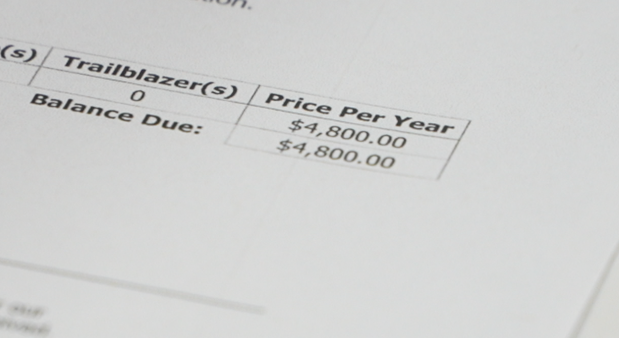
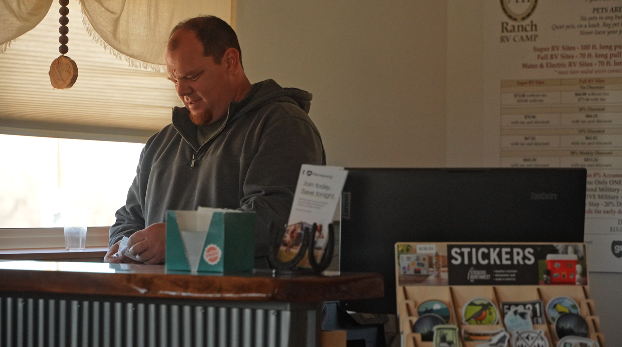
“We can’t afford that as a small business to suddenly have one aspect of our advertising raised that much,” said Jamie Redger, owner of 7th Ranch RV Camp in Garryowen.
His costs quadrupled in a year, increasing from $1,200 to $4,800, after Montana Logos told him he had to pay to be on the signs for a full year. In the past, he had only paid for half the year.
“At this point, I’ve told Montana Logos that I don’t plan to renew with them,” said Redger.
Vanessa Willardson/Q2
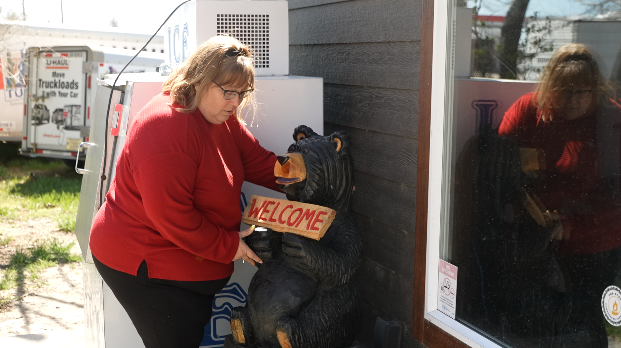
Another campground, Grandview Campground and RV Park, may be disappearing from the signs as well.
“We have to ask ourselves, what can we cut out? And Montana Logo is probably going to be it,” said the campground’s owner, Laurie Tschetter.
She is concerned about how the lack of advertising will affect the tourism industry in her community.
“We are kind of the backbone of bringing a lot of tourism dollars back into this state,” said Tschetter.
Vanessa Willardson/Q2
The business owners are working with the Hardin Chamber of Commerce, in hopes the state will hear their voices and give them a grant.
“I want to support these businesses and our communities and whatever we need to do next, whether it’s a letter or taking it up a little higher. That’s all we can do,” said Alexandria Edwards, with the Hardin Chamber of Commerce.
The community is also starting to consider advertising alternatives.

Vanessa Willardson/Q2
“It would be cheaper just to go get a billboard or put their money into something that would be more fruitful for them,” said Edwards.
“I’ve watched different advertising things go by the wayside. And maybe Montana Logos needs to find that out,” added Tschetter.
Montana Logos did not return multiple calls and messages from MTN News requesting comment.

10 Cheapest Places to Live in South Carolina

Your next can of Coke might have Mount Rushmore on it

New strain of tuberculosis cases in Tennessee is resistant to treatment options

‘It’s solid gold’: Some Texas Republicans ramp up criticisms of Muslims to energize primary voters | CNN Politics

Jazz lose by winning in the ‘Tanking Super Bowl’ — but optimism reigns as team imagines possibilities for next season

Florida High School Football Rankings: Top 25 teams – Oct. 21

How old is Bo Nix? What to know about Oregon quarterback ahead of 2024 NFL Draft

Cleary's 21 help Le Moyne down Central Connecticut State 69-64 in OT

99th annual Pony Swim held in Virginia

Indiana Members Credit Union announced as new anchor tenant at Bottleworks District

Trump adversary running for Senate borrows his filibuster playbook

Russian propaganda unit targets Hungary’s elections

WATCH: Artemis II astronauts splash down on Earth

Swalwell’s former female staffer drops bombshell allegations of sexual assault, exposing himself: report

NASA’s Artemis II prepares for splashdown on Earth
-

 Atlanta, GA6 days ago
1 teenage girl killed, another injured in shooting at Piedmont Park, police say
-

 Education1 week ago
Video: Toy Testing with a Discerning Bodega Cat
-

 Movie Reviews1 week ago
Vaazha 2 first half review: Hashir anchors a lively, chaos-filled teen tale
-

 Georgia4 days ago
Georgia House Special Runoff Election 2026 Live Results
-

 Pennsylvania5 days ago
Parents charged after toddler injured by wolf at Pennsylvania zoo
-

 Arkansas21 hours ago
Arkansas TV meteorologist Melinda Mayo retires after nearly four decades on air
-
 Milwaukee, WI5 days ago
Potawatomi Casino Hotel evacuated after fire breaks out in rooftop HVAC system
-
 Entertainment1 week ago
Inside Ye’s first comeback show at SoFi Stadium