Business
With fires burning again, is California becoming uninsurable?

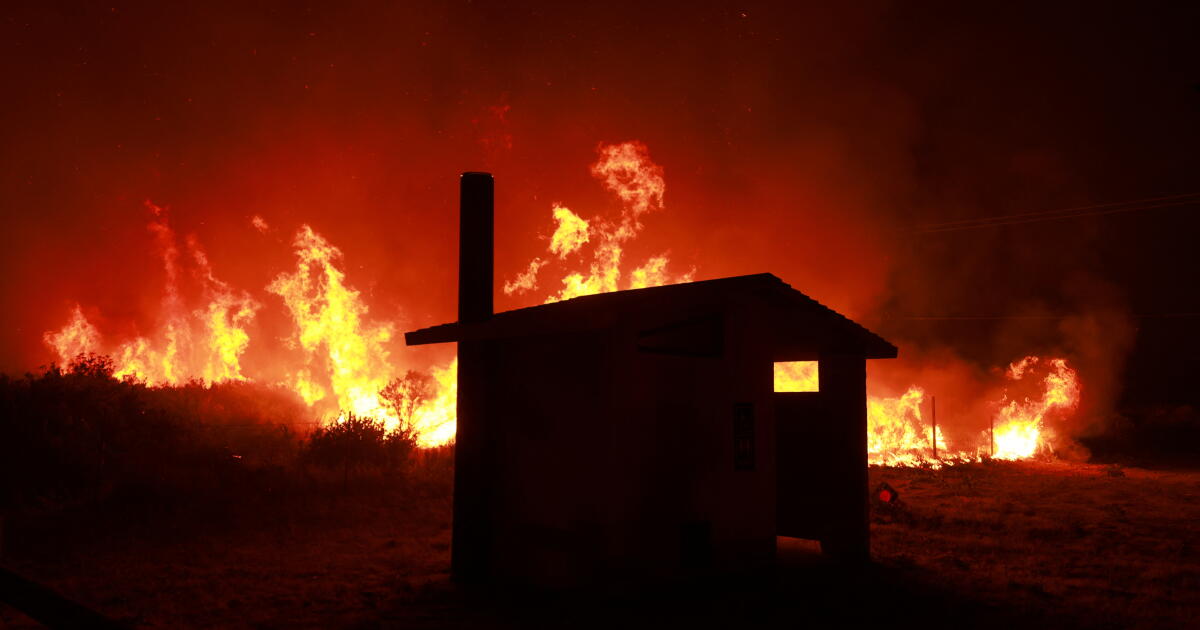
Thursday marks the beginning of summer, but early wildfires have already scorched the outskirts of L.A. and the Bay Area. Many California homeowners find themselves more vulnerable than ever as major insurers abandon areas threatened by climate change-fueled fires. Gov. Gavin Newsom and state Insurance Commissioner Ricardo Lara have responded with efforts to ease regulations and boost coverage.
Insurance industry representative Rex Frazier argues that state leaders have the right idea: Burdensome regulations are making a difficult situation worse. But consumer advocate Jamie Court contends that the state needs to take a harder line by requiring coverage of homeowners who meet fire protection standards.
California’s sclerotic insurance bureaucracy isn’t helping anyone
By Rex Frazier
As the leader of an association of homeowners’ insurers, I frequently hear from anxious Californians who are losing their coverage and wondering whether the situation will get better. My answer is that I am not one of those who believes California is facing an uninsurable future. The problems we face are difficult but solvable.
The insurance challenges the state is facing today have roots in the past. While the giant wildfires of 2017 and 2018 had a huge impact, requiring insurers to pay claims equivalent to more than 20 years of profits, the state’s insurance problems predate the fires. California’s failure to update the old rules governing insurance rates have long prevented insurers from preparing for a hotter, drier future.
California’s laws are a national outlier. The rules for projecting wildfire losses, a crucial aspect of calculating insurance rates, are a case in point. California is the only state in the country that requires property insurers to project future wildfire losses based on average wildfire losses over the last 20 years, regardless of where they plan to do business. Every other state allows insurers to base their rates on where they intend to sell insurance, taking into account the degree of fire risk to the properties they plan to insure.
California is also a national outlier on rate approval in that it’s a “prior approval” state. That means an insurer must receive approval from the California Department of Insurance before it may increase or decrease rates.
While California law promises a 60-day approval period, it often takes six months or more to get permission to change rates. At times of high inflation, slow approvals require insurers to leave the highest-risk areas or face financial ruin.
A less visible but nevertheless critical issue is the financial well-being of the FAIR Plan, a pool of insurers providing last-resort coverage. The FAIR plan is growing well beyond its ability to pay claims for large fires. And if it runs out of money, it will charge insurers, as members of the pool, a fee in addition to claims from their own customers for the same fire. If that fee gets large enough, it could devastate insurers. We must address this.
Fortunately, Insurance Commissioner Ricardo Lara has recognized the need to fix these problems. His Sustainable Insurance Strategy would update California’s rate regulations and approval process while requiring insurers to make commitments to cover high-risk areas. The proposal is far from perfect, but we look forward to working with all the interested parties to increase insurance availability and restore the health of the market.
While state regulations and processes can be changed, we remain vulnerable to forces that are beyond our control. Inflation makes repairing and rebuilding homes much more expensive, driving up rates. Longer dry seasons increase the chances of devastating fires, having the same effect in the short term. We need a system that acknowledges these realities.
But raising rates is not a long-term solution. Reducing them over time will require consensus on how to handle combustible fuels near valuable property.
That will take a lot of time and effort. California homeowners’ insurers are ready to do our part to secure an insurable future for the state.
Rex Frazier is the president of the Personal Insurance Federation of California.

Newsom needs to look out for homeowners, not insurance companies
By Jamie Court
Home insurance companies have put Californians in a bind by refusing to sell new policies or renew many customers, leaving them with few coverage options. That has driven more homeowners into the high-cost, low-benefit FAIR Plan, a pool of insurers required to provide last-resort coverage.
Gov. Gavin Newsom recently announced legislation to allow insurance companies to hike rates more quickly in an effort to woo them back to the state. While that will certainly leave Californians paying higher rates, it’s not likely to get more people covered.
Insurance companies are refusing to write new policies despite substantial recent rate hikes — an average of 20% for State Farm and 37% for Farmers, for example. What has them spooked is greater exposure through the FAIR Plan, which increasingly covers expensive homes in wildfire-prone areas. Insurers are on the hook for FAIR Plan claims, and their exposure increases with market participation, so they limit their participation.
Only freeing people from the FAIR Plan will solve this. The most practical way to do that is to require insurers to cover people who harden their homes against fire. We have mandatory health and auto insurance, so why shouldn’t we have it for homes that meet standards?
Hardening is expensive enough that most homeowners are unlikely to do it without guaranteed coverage. Mandating insurance is therefore the best way to mitigate wildfire risks.
Mitigation efforts are already working, with major claim events dwindling in recent years. Moreover, insurers recovered billions from the utilities responsible for major fire losses in 2017 and 2018.
The current crisis was precipitated not so much by wildfires as by investment losses and rising construction costs. Insurers responded by tightening underwriting and raising rates.
Insurance companies got their hikes, but they refuse to write new business here until they get more. Unfortunately, Newsom and Insurance Commissioner Ricardo Lara are ready to give them what they want.
Last week, Lara proposed regulations attempting to address the crisis. Echoing a legislative proposal that failed last year, they would allow companies to raise rates based on black-box climate models. Florida tried a similar approach, and its rates are now about double California’s. Florida’s insurer of last resort covers 20% of its homeowners, roughly five times the share in California.
The proposed regulations purport to require insurers to increase sales to homeowners in “distressed areas” by 5%. However, they would not require them to charge prices consumers can afford. The requirement to cover these areas could also be waived if an insurer shows it’s “taking reasonable steps to fulfill its insurer commitment.” And the plan gives companies two years to comply but lets them start charging all policyholders higher rates immediately.
Newsom cheered the proposal, essentially arguing that California’s insurance rates are too damn low. He didn’t mention that California insurers’ profits have generally outpaced the national average over the last 20 years.
Newsom’s latest legislative proposal would limit public participation in rate-setting by cutting out so-called intervenors such as Consumer Watchdog, which can challenge unnecessary increases and has saved consumers more than $6 billion over 22 years.
Throwing more money at insurers won’t end the crisis; requiring them to cover responsible homeowners will.
Jamie Court is the president of the nonprofit Consumer Watchdog.


California cardrooms welcomed a court decision to let them continue to allow visitors to bet on blackjack, one of their most lucrative games.
A San Francisco Superior Court judge struck down regulations that would ban cardrooms from offering blackjack in California.
Authorities wanted to close what some consider a legal loophole allowing cardrooms to offer blackjack and games in which players play against the house. Those types of games are supposed to be offered only in Native American casinos, but cardrooms were getting around the restriction by using designated outside dealers.
In the June 30 ruling, Judge Richard Darwin said Atty. Gen. Rob Bonta and the California Bureau of Gambling Control exceeded their authority by introducing the change.
The California Department of Justice officially introduced the proposed regulations in May 2025, and responded to over 1,700 public comments.
The California Office of Administrative Law green-lit the rules in February, and they were set to go into effect on April 1, but in March, the California Gaming Assn. filed a suit to invalidate them.
In May, Darwin filed a preliminary injunction, temporarily blocking the state from imposing the new rules.
There are more than 70 cardrooms across California employing about 20,000 workers, according to the California Gaming Assn. It estimated that the changes could cut the number of cardroom jobs in half and significantly reduce the industry’s positive economic impact.
A 2019 analysis commissioned by the group estimated that tax revenue generated by California cardrooms was roughly $500 million a year.
Kyle Kirkland, the president of the California Gaming Assn. and owner of Club One Casino , said the regulation would have not only affected the cardrooms themselves, but also the cities and communities that rely on the money they generate.
“We give the city of Fresno a million dollars a year in table tax revenue, and they were actively asking me how could they budget for this going forward, given the impact that it’s going to have,” he said.
At Club One, about 60% of revenue comes from blackjack, Kirkland said.
“I can’t survive on the other 40%,” he said.
If the regulations had gone into effect, Kirkland said he would have had to lay off nearly 200 of the cardroom’s 250 employees.
Cardrooms in L.A. County generate more than $2 billion in economic activity and support more than 9,000 jobs.
Kirkland said the regulations would have especially affected cities like Bell Gardens and Hawaiian Gardens, where casinos represent nearly 70% of the general fund.
In the City of Commerce, the Commerce Casino generates 40% of the city’s general fund, and employs 2,200 people. When the regulations were first passed, Mayor Kevin Lainez said the city was “devastated”.
In response to the potential revenue losses, the city declared a state of fiscal emergency, and introduced a higher sales tax.
Lainez said the city would have had to make cuts to senior programs, public safety services and capital improvement projects.
“We’ve responsibly built our budgets and shaped them around the revenue that the cardroom generates, so along with all of the other businesses here in the city, right, and we’ve developed some quality of life services that our community really relies on, and so for this to no longer be hanging over our heads is a relief to our community,” he said.
The ban wouldn’t have affected Native American casinos.
Proposition 1A, passed by California voters in 2000, gave tribes the right to conduct Nevada-style gambling, such as casino-banked card games, on reservations.
Cardrooms have continued to offer blackjack and other banked games such as baccarat by giving players the option to take turns dealing the game and by relying on third-party businesses that employ people to act as bankers.
The Bureau of Gambling Control for years accepted the practice, which attorneys representing cardrooms say is “completely legal” and has been approved by Bonta’s predecessors, but the state’s new rules crack down on the use of these third-party businesses and tighten rules for “player-dealers.”
While the California Gaming Assn.’s suit was successful, Kirkland said he expects the Justice Department to appeal, and said the conflict is far from over.
“There’s not really a lot of celebration,” he said. “It’s concerning that the attorney general would think that that was a valid way of going out and regulating the cardroom industry, so I’m just wondering what’s the next step, what’s coming behind, but at least in this battle, it was a pretty strong and resounding victory.”

In 2016, Walt Disney Co.’s “Moana” became a box office hit, captivating audiences with catchy earworms from Lin-Manuel Miranda and a spunky young heroine who rejected the label of princess.
Now, just 10 years later, it’s the latest Disney animated film to be given the live-action treatment.
Burbank-based Disney has long reached into its vault in search of animated classics to redo in a live-action format. But a decade is the shortest time between one of the company’s original animated movies and the reimagined film. (2025’s “Lilo & Stitch,” which originally debuted in 2002, is the next closest with a gap of 23 years.)
Why go back to “Moana” so soon? The Polynesian wayfarer is extremely popular.
The 2016 animated film grossed more than $643 million at the global box office, then spawned a 2024 sequel that made more than $1 billion worldwide. The original is the most-watched movie in Disney+ history with more than 1.5 billion hours of viewing.
“Every once in a while in Hollywood, we make a film that is more than a film,” actor Dwayne Johnson, who reprises his role as the demigod Maui, said onstage during the movie’s premiere Tuesday at the Hollywood Bowl after a Polynesian dance performance. “I think you could feel it already tonight, with our culture and with what we have represented. But also not only our Polynesian culture … it’s also a shared culture around the world.”
The latest “Moana,” out this weekend, will join a cadre of family films at the multiplex.
That includes Disney and Pixar’s “Toy Story 5,” which has now racked up more than $774 million worldwide, and Universal Pictures and Illumination’s “Minions & Monsters,” which debuted domestically last week to a softer-than-expected opening of $62 million for the five-day Fourth of July holiday weekend.
The weaker haul for “Minions & Monsters” has led to questions about whether there are too many family films in theaters, which could affect the reception for the latest iteration of “Moana.” But as the last of this summer’s trio of major animated films, the runway could be clear for the film to build steam.
“I don’t think two movies make saturation,” said Andrew Cripps, head of theatrical distribution for Walt Disney Studios. “There’s a huge fanbase for the ‘Moana’ franchise.”
But with two “Moana” movies in the last decade, will audiences flock to another film? Analysts are expecting an opening weekend haul of $75 million, though studio estimates are closer to $60 million to $65 million. The film’s production budget is about $250 million.
“When you look at these massive movies that were just incredible — ‘The Lion King,’ ‘Aladdin,’ ‘Beauty and the Beast’ — they were brought back after years and years,” said David A. Gross, who writes the industry newsletter FranchiseRe. “I think there’s an argument that says absence makes the heart grow fonder with some of these. We’ll see.”
Early reviews of the film have been mixed, and “Moana” has so far notched a 37% rating on aggregator Rotten Tomatoes. The movie is a nearly frame-by-frame re-creation of the original.
Disney’s live-action remakes have largely been box-office boons for the company, with a few exceptions.
In the last 16 years, five films have grossed more than $1 billion globally, including 2017’s “Beauty and the Beast” and 2019’s “The Lion King” and “Aladdin.” (Other live-action spin-offs based on classic animated movies, such as 2024’s “Mufasa: The Lion King” and 2014’s “Maleficent,” also had solid performances.)
“It goes back to the original [intellectual property] of these movies,” Cripps said of the importance of live-action films for Disney’s slate. “People grow up with it, they become fans of it, they live with it. When you’ve got IP that resonates so well literally around the world with fans, I just think it’s a clever extension.”
There have been some notable misfires, including last year’s “Snow White,” which cratered at the box office amid a myriad of controversies, including racist backlash to the casting of Rachel Zegler, who is of Colombian descent, as the titular princess, its depiction of little people and its lead actors’ views on the Israel-Hamas war.
In general, live-action retellings have also typically performed well overseas — a marketplace that isn’t always reliable these days.
Across 13 recent live-action films from Disney and other studios, all made more than 60% of their global box office revenue in international markets, Gross said.
By comparison, films across all genres typically bring in about half of their revenue overseas, he said.
“When these movies connect,” Gross said, “they work everywhere.”
Business
Meta discontinues Instagram feature on new AI image generation tool after Hollywood backlash

A new tool that let people take publicly posted Instagram photos and use AI to generate new images from them drew such a big backlash in Hollywood that Meta has discontinued one of the features.
Instagram’s parent company, Meta, on Tuesday rolled out the new AI tool, called Muse Image, which makes it easy to “turn your ideas into high-quality visuals you can download and share anywhere.”
In a promotional video, Meta showed examples like adding a friend into a band photo.
But the tool came under fire from talent agencies, managers and union officials. They noted that many Instagram accounts were opted in by default, allowing users to manipulate the image and likeness of celebrities without their consent.
“I just think it’s wrong again to expect people to opt themselves out of something that literally has been proven to be able to create harm,” said Kyle Hjelmeseth, chief executive of Los Angeles-based influencer talent management firm G&B.
By Friday, Meta said a feature on Muse Image that helps pull photos from public Instagram accounts was no longer available.
“Earlier this week, we announced that one way for people to generate images in Meta AI is by @-mentioning public Instagram accounts that they want to reference,” Meta said in a blog post. “Our intent was to provide a useful creative tool and to give people control over whether their public content could be referenced in this way. We’ve heard the feedback that this feature missed the mark, so it’s no longer available.”
Creative Artists Agency, which raised concerns to Meta on behalf of its clients, commended the tech company for its swift decision.
“Putting individual rights and consent at the forefront is essential to building responsible technology,” the Century City-based talent agency said in a statement. “We look forward to ongoing conversations to ensure creators stay protected as technology evolves.”
Hollywood has long been wary of AI, after a string of deepfakes — videos or images depicting celebrities doing or saying things they never authorized. Jamie Lee Curtis and others have appeared in ads for products they never endorsed. Last year, OpenAI’s Sora 2 video tool drew outrage in Hollywood after users conjured up dead celebrities without their estates’ consent. OpenAI later said it would give rights holders more granular controls.
After Meta rolled out its new tool, there was immediate backlash from Hollywood.
“Anything other than a clear and conspicuous OPT-IN for these types of uses of Instagram users’ images is unacceptable, and an utter miscalculation of public sentiment regarding the obvious dangers and harms inherent in such use,” performers union SAG-AFTRA said in a statement.
United Talent Agency was also critical of Meta, saying it demands opt-in for the use of likeness, image and intellectual property of its clients on any platform.
“The use of such property without OPT-IN consent, credit and compensation is exploitation, not innovation,” the Beverly Hills-based talent agency said.
Meta’s initial response on Wednesday was that users can choose to opt out of having their photos used by Muse Image by changing their settings.
“We built Muse Image with strong controls and safety guardrails from day one,” Meta said in a statement. “Private accounts and those belonging to users under 18 are automatically excluded and adult users with public accounts can opt out with just a couple clicks. We will take action against any content that violates our Community Standards.”
Two days later, Meta removed a key feature from Muse Image, saying it received feedback that it “missed the mark.”
The launch fits a familiar Silicon Valley pattern — ship products first, ask for forgiveness later.
“They leverage their scale to make it easy to use the tools as well as to scale out the content that is available,” said Mickey Maher, chief business officer at Vermillio, which tracks people’s digital likenesses and intellectual property. “It’s not unique to this Meta product.”
Others said opt-out should be the default.
“This dark pattern of AI overreach, where essentially it’s a free-for-all when it comes to your content, information, is something that nobody actually wants,” said Lori Fena, former chair and executive director of the Electronic Frontier Foundation and co-founder of New York-based Personal Digital Spaces. “What we need in this new AI ecosystem is the ability to create trust and to have some sort of understanding and authenticity, and this does exactly the opposite.”
-

 Los Angeles, Ca11 minutes ago
Rare, corpse flower double bloom underway at Huntington Library
-

 Detroit, MI36 minutes ago
Around 400 pairs of shoes intended for charity giveaway stolen from Detroit nonprofit, organization says
-

 San Francisco, CA47 minutes ago
How to watch San Francisco Giants vs. Colorado Rockies
-

 Dallas, TX53 minutes ago
3 unanswered questions before training camp: Dallas Cowboys edition
-

 Miami, FL60 minutes ago
“Love & Hip Hop: Atlanta” star Tommie Lee among 6 arrested during World Cup match in Miami, sheriff says
-

 Boston, MA1 hour ago
‘More than just a cyclist’: Hundreds mourn Boston transit planner killed while biking – The Boston Globe
-

 Denver, CO1 hour ago
Nuggets sign former Denver West basketball player Alpha Diallo out of EuroLeague
-

 Seattle, WA1 hour ago
Portland aims to top Seattle’s 405 e-bikes with 2-mile Guinness record ride and party

