Montana
A Field Guide to Feeling Good in Northwest Montana – Flathead Beacon


When Allie Maloney moved to the Flathead three years ago, she experienced a feeling that many newcomers and outsiders recognize all too well: profound loneliness. Her closest community of family and friends – the ones who understand her deepest self – live out of state, and she strongly felt this distance.
“I came here right before the pandemic, and I was working remotely almost from the very beginning,” Maloney explained. “I don’t have very many friends here; I don’t have very many hiking partners here. It was kind of a lonely existence.”
These past few years, Maloney has branched out into the community, hosting a “Lord of the Rings” themed Halloween get-together, throwing Hanukkah parties, and knocking on neighbors’ doors to sell sourdough and ravioli. Still, in moments when feelings of isloation take root, she turns to the outdoors for a breath of fresh air.
“The more I can go outside, the better,” she said.
However, there’s a distinction between loneliness and solitude, and Maloney’s new book – the 94-page “Northwest Montana Field Journal” – encourages readers to overcome the former and embrace the latter. The book helps readers deepen their sense of place and self by being alone in nature, no matter their outdoor skill level.
“It gives you a way to be by yourself, be outdoors, and have a reason for doing it,” Maloney said. “Whether you’re visiting or you’re a local, you can speed up your connection to nature and develop your sense of place quicker through journaling and doing activities.”
At first sight, the book’s front cover – inky blue with fiery-orange hues of a Montana sunset behind the outline of a looming mountain range – appears mysterious, even unassuming. Inside, the journal features troves of colorful, whimsical depictions of hundreds of living things – from an iconic 400-pound black bear to the often-overlooked Camas wildflower. The drawings are all accompanied with thought-provoking do-it-yourself style reflection exercises.
Maloney has worked as an outdoor education instructor and wilderness guide for years in the Pacific Northwest, so this journal bridges her two biggest loves – art and the outdoors. However, she shared that she’s encountered unexpected challenges with recreating in the Flathead.
“The hard part is finding the motivation to do it alone, or when the weather isn’t great, or when you don’t know where you’re going,” Maloney said. “It’s always hard for me if I haven’t been to a trailhead before and I’m going alone.”
If Maloney feels intimidated to explore new spots on her own, she imagines that the feelings of hesitancy and unfamiliarity are tenfold for those without formal wilderness training. She hopes that the book’s outdoor exercises, along with delightful drawings like a playful yellow-bellied marmot wearing a wizard cape and whimsical rufous hummingbird delivering a letter in its beak, can help bridge that gap to make recreation feel more inviting.
Maloney’s journal also revolves around the assumption that for most people, a blank canvas is not the best vehicle for introspection. In fact, for those hoping to make sense of their thoughts or discover new parts of their inner selves, opening a book to meet the intimidating stare of an empty white page can be discouraging, even isolating.
“The Northwest Montana Field Journal” instead works towards the lofty goal of helping people reflect by giving them exercises to complete, prompts to contemplate, and quotes to consider. It’s intentionally designed so anyone can open the book anytime, to any page they choose and begin their unique journey without the help of a guide or instructor.
“My brain is really good at coming up with ideas, seeing things, asking questions, and then thinking about how to teach them or how to inspire people to ask questions and be creative,” Maloney said. “The journal helps people write in a way that isn’t intimidating, that isn’t the blank page.”

Maloney’s passion for her work and care with which she embarks on every little drawing and exercise shines through in the final product. Page 34 guides readers through the process of writing a letter to their future selves, with a maroon and yellow morning clock butterfly serving as the metaphorical pilot and a carefully chosen William Shakespeare quote becoming a source of inspiration. Page 26 encourages readers to reflect on challenges they’ve faced and how they overcame them; page 42 invites them to take a break from thinking by coloring; page 22 beckons them to memorialize an important moment in their lives while looking at Maloney’s drawing of Crater Lake’s mesmerizing shores. And for those simply looking to learn, pages 58 onwards contain troves of information about the iconic species of animals, plants, and fungi who call Northwest Montana home.
“If visitors buy this field journal, they will be better visitors because woven in is lots of messages about how to be a respectful visitor, understand the history and context of being here, and leave no trace,” Maloney said.
Maloney also considers her journal an antidote to the intensity of Montana hiking culture among locals. To her, being in nature can, and should, mean different things to different audiences.
“The void for locals is understanding that you don’t just need to go to Glacier,” Maloney added. “It doesn’t have to be a big suffer-fest; it doesn’t have to be 100 miles. Even if you just go visit the free Forest Service campgrounds, rental or service cabins, try to find the lakes that are going to be the emptiest or visit the quietest bits of nature all around even if they’re not the most scenic – it helps give us reasons to go out.”
To this end, creating the book helped Maloney deepen her own sense of place and connection to her new home in Northwest Montana. Her process of artistic creation requires both holing up in her den drawing, outlining, and researching as well as getting outside and exploring. This taught her more than she ever expected to learn about the Flathead. She’s been able to take that knowledge to new artistic endeavors – like her most recent poster displaying the Flathead’s poisonous mushrooms.
“I haven’t drawn every species that exists here, but I’ve drawn maybe 50% – if we don’t count insects,” she laughs.
While Maloney’s book itself is full of information about the many species of plants, animals, and fungi in the Flathead, it presents the information in an easily digestible manner. For instance, along with an in-depth description of the bark of the ponderosa pine, also comes a way for someone with no wilderness experience to easily identify it.
“It’s very curated; it’s supposed to be very helpful; it’s supposed to be very unintimidating,” Maloney said. “It’s supposed to get you one level deeper into nature-nerd, without feeling like you have to be able to read a scientific dichotomous key and have a scientific vocabulary.”
Everybody loves and wants to learn more about bears and mountain goats; but Maloney also drew upon her own wilderness experience to educate about the “less exciting” plants and fungi. When writing about the Glacier Lily, rather than delving into the flower’s complicated taxonomy, Maloney chose to highlight its edibleness and the best way to prepare it.
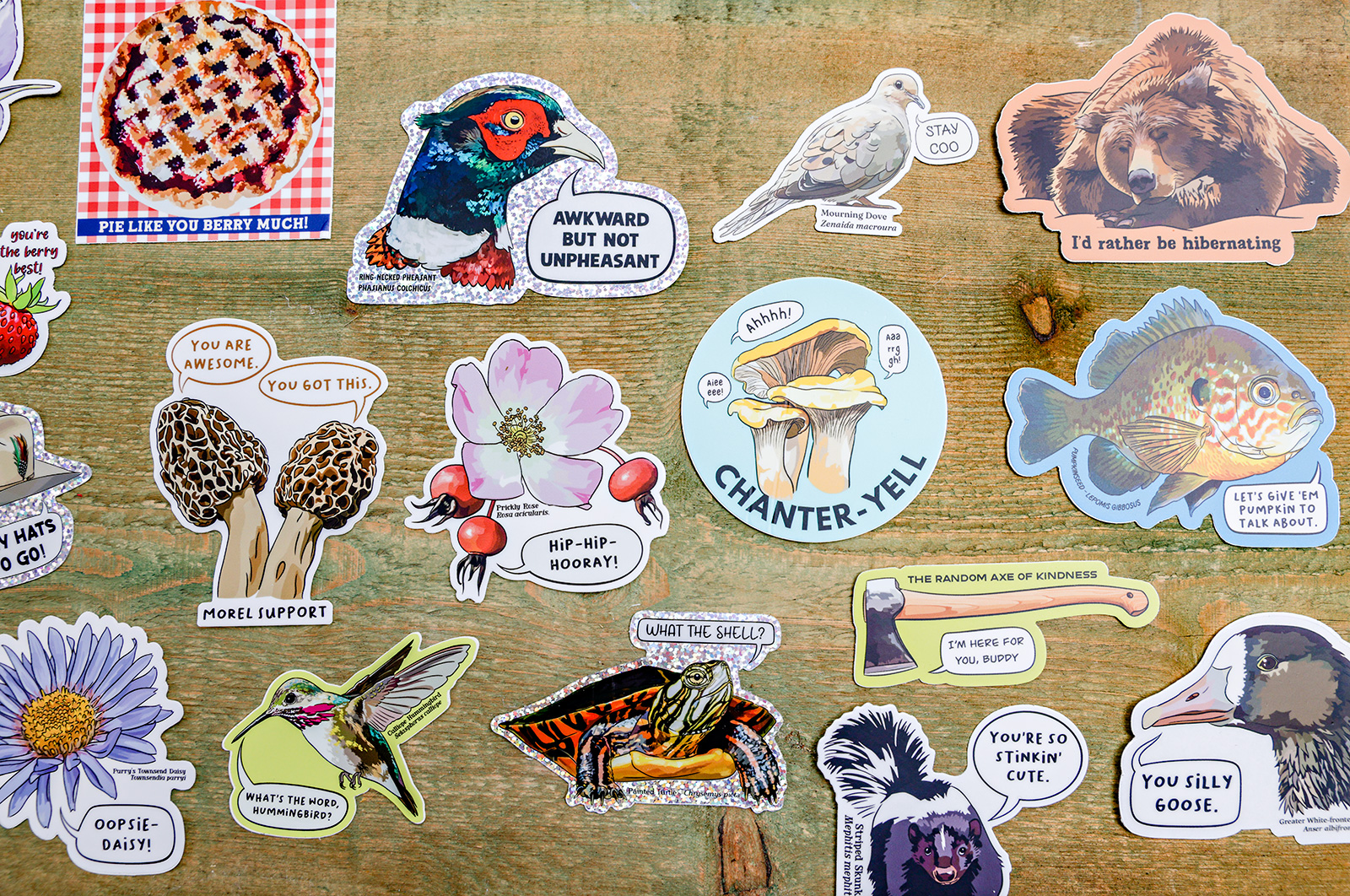
“My specialty within the wilderness community is food and rations and teaching people how to feed themselves and keep themselves going beyond just ‘food for fuel’,” Maloney said. “I love plants, I love foraging, and teaching people what they can eat and what things are called. So that’s a weird thread that ties my outdoor experience with some of the art.”
While creating the art and drawing connections between organisms and people’s daily lives is the most nurturing and inviting part of the book, “Northwest Montana Field Journal” is also deeply rooted in science. The sort of “first rendition” of the book was Maloney’s graduate school thesis, the “Adirondack Field Journal.” The master’s-degree level exercises that Maloney developed years ago made their way into the new book.
“Every page of that journal had to have some scientific basis behind it to prove my thesis, which was that you can connect to nature through journaling,” Maloney said. “We know that sense of place is really good for your mental health and physical health. When you live in a place, your sense of place develops over time. This journal helps you feel more connected to the place you are in.”
“The Northwest Montana Field Journal” has become more than just an homage to Maloney’s new home – it’s been used by crew leaders in organizations like the Bob Marshall Wilderness Foundation as a reference guide for species identification.
While she’s excited that professionals are using her book, Maloney posits that the journal can also serve those who don’t have a relationship with nature at all, as people can use it to cultivate their fondness over time. Maloney herself is proof that being outdoors is not always love at first sight.
“When I was little, I was such a reluctant outdoor child,” Maloney said. “I really didn’t like bugs. And now I do it professionally and I like being outdoors and bugs don’t bother me at all.”
Ultimately, Maloney hopes that the journal can appeal even more broadly, beyond the borders of Montana, to make outdoor experiences more accessible worldwide.
“It’s incredibly universal,” Maloney said. “All of the drawings and information in the back is Northwest Montana, but the actual journaling activities could be done anywhere by anyone and serve the same purpose. My hope is that if you’re a visitor, you could start it while you’re here, but you could keep filling it out and documenting your adventures elsewhere.”
But creating the book was only the first step. Putting this journal (as well as Maloney’s many other products, such as her other book, “A Northwest Montana Alphabet,” and dozens of prints, postcards, stickers, posters, and clothing) out into the world requires tremendous vulnerability. Most of her high moments in this process have arrived when she’s working at craft markets, where she gets to connect with buyers and see the variety of people who feel a connection to her artwork. It’s a simultaneously rewarding and heartbreaking process.
“I really like seeing the dads who get really excited about it,” Maloney said. “I’ve had young dudes and ladies, grandparents, parents, a lot of locals and tourists, and a lot of queer people come and buy it. I think that immediately they notice that it’s accepting and written in an inclusive way.”
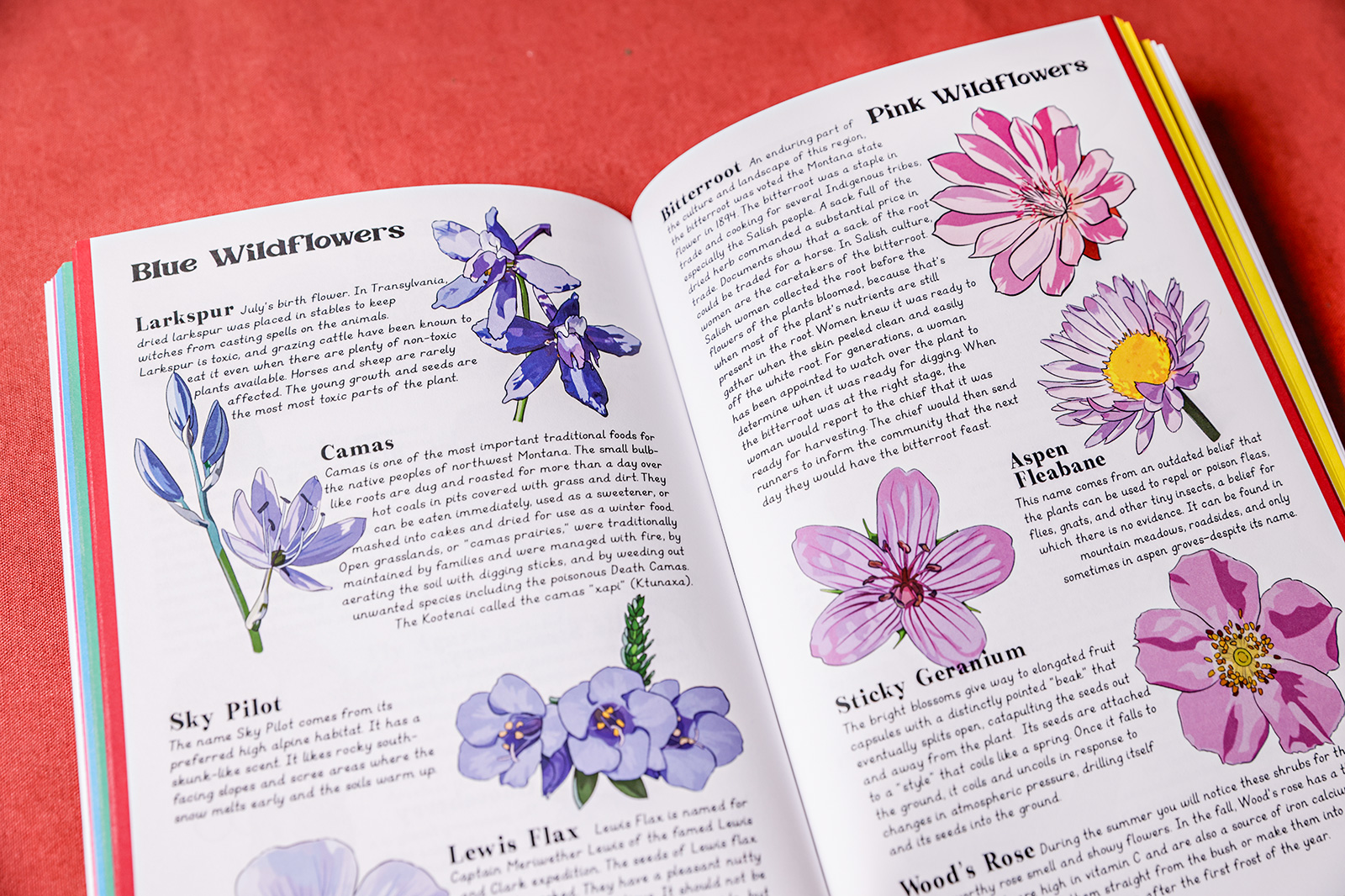
Recently, the Salish Kootenai College bought 50 copies of her book for a course, providing a small but shining spark of encouragement. The lows have been trying to connect with bookstores and shops owners. She said that constantly selling and pitching herself takes an emotional toll.
“It has been pretty discouraging,” Maloney said. “Overall, it’s like you go into a store, you try to find out the buyer or the owner and give them an example of your book. They’re not there, so you come back 20 times, they’re still not there.”
With the many ups and down of selling her products, Maloney is especially appreciative of the stability that comes with the other branch of her work – collaborations with local businesses and nonprofits. Most recently, she completed a project with the Flathead Trails Association to create a comprehensive guide to the Flathead Valley’s recreational opportunities.
The map itself is beautiful and inviting, showcasing colorful depictions of people recreating in a dozen different ways – from biking to hiking to snowboarding. Major Flathead landmarks are clearly designated, and accompanied with simple, one-sentence-long descriptions of their history. Yes, it’s a functional guide, but it’s also so artistic that it could easily find its way framed up on a wall or pasted into a scrapbook.
“The goal was to inspire rather than tell people where all the trails are,” Maloney said. “It’s definitely the hardest thing I’ve ever done, but I love doing these collaborations; and I know immediately it has an end goal and I’m going to send it out into the world.”
Art and work have become increasingly synonymous in Maloney’s life, which for many creative people can be complicated and lead to burnout. However, Maloney has taken care to keep her spark for the outdoors and excitement to create artwork alive in her everyday life.
“I can’t help side questing and trying new things,” Maloney said. “For many years, I’ve tried to learn how to make something new every year. In the past, it’s been felting or mosaics or quilting. This year I’m making bandanas. I don’t have to get good at it, but I do try something new.”
Maloney’s approach to creating new art without the pressure to excel, or even be good at all, mirrors how she hopes readers interact with her journal.
“You don’t need to do anything epic in order to have a really meaningful moment outside. You deserve to be here, be part of this place and there’s always more you can learn.”



Recently, I was asked to talk about what it is like to be a female rancher.
I was flattered to be asked, but I don’t know the answer.
I do know what it is like to be a human rancher and I know that I admire many women who also are ranchers.
In fact, 36 percent of the farmers and ranchers in the U.S. are women and they manage almost half of America’s ag land.
Globally, we produce more than half of all food.
In Montana, we all benefit from amazing female leaders in agriculture.
If you want to know about improving soil health or the rewards of raising sheep, talk to Linda Poole in Malta.
If you want to learn how to organize a grassroots rancher’s organization and effect meaningful change, talk to Maggie Nutter in Sunburst.
Trina Bradley of Dupuyer will look you in the eye and tell you everything you need to know about the impacts of grizzlies on her ranch life.
Colleen Gustafson, on the Two Med, graciously hosts and educates non-ranchers for months at a time without strangling them, all while maintaining every fence, buying every bull and killing every weed on her ranch.
Adele Stenson of Wibaux and Holly Stoltz of Livingston find innovative solutions to ranching challenges and then — even harder — find ways to share these innovations with hard-headed, independent cusses who want to do it our own way.
In fact, I’ve noticed that often women seek novel innovations to deal with a ranching challenge.
If a man happens to be around, she might even run it past him.
It’s rubber band ranching – stretch with an idea, contract to assess it, then stretch again to implement it.
Long ago, my friend Michelle and I promoted the One Good Cow program at the Montana Stockgrowers Association meeting.
We asked cattle producers to donate one cow to ranchers who had lost so many in blizzards and floods that year.
As we stood on stage in a room full of dour, silent men, I remember finding the one person I knew and asking what he thought.
Just as he would bid at a livestock auction, he barely nodded his approval.
We ended up gathering more than 900 cows from across the nation and giving them to 67 producers.
One Good Cow was a good idea.
Now I don’t seek approval for my ideas so sometimes my rubber band doesn’t contract to assess one before I stretch into action.
That’s how I got myself into producing shelf-stable, ready-to-eat meals made with my beef and lamb.
This is a good idea, too.
I hope.
I wonder if it is easier to ranch as a woman in some ways.
Society pressures men to know all of the answers all of the time, but If I mess up, I try to learn from my mistake and move forward.
When Imposter Syndrome hits or we can’t find a solution to an unsolvable problem – the effects of climate change, commodity markets or competing demands from family – secretly faking it until we make it gets lonely.
The downward spiral of loneliness and the pressure to be perfect can lead to suicide.
Male ranchers kill themselves 3.5 times more often than the general public.
Female ranchers kill themselves, too, just a little less often.
I’m fortunate to have good friends who love me even when I’m far from perfect.
We laugh together, they remind me that I have a few good attributes even when I forget, they tolerate my weirdness and celebrate little successes.
They stave off loneliness.
They know all ranchers try our best, we appreciate a little grace, and a warm fire feels good to our cold fingers.
Lisa Schmidt raises grass-fed beef and lamb at the Graham Ranch near Conrad. Lisa can be reached at L.Schmidt@a-land-of-grass-ranch.com.

The hills of the northern Judean Desert will soon turn yellow and dry. For now, they are covered in green bloom, dotted with bursts of purple and yellow wildflowers, butterflies hovering above them. From a hilltop in the Binyamin region, where Ruthy and Haim Mann run their therapeutic horse ranch, the view opens wide: the Moab Mountains to the east, the Binyamin hills to the north, Wadi Qelt plunging dramatically toward the Jordan Valley and the northern Dead Sea. At moments, when the haze lifts, Herod’s winter palace can be seen in the distance on the other side of the wadi.
Biblical history feels at home here. Philistines and Crusaders, Babylonians and Hasmoneans, Assyrians, Byzantines and Seleucids all passed through. Joshua, Saul and Jonathan fought nearby. David hid in these hills. On one of the mountains opposite us, the Good Samaritan once passed, refusing to ignore a wounded man lying by the roadside and bandaging his injuries.
The desert has seen much. But a band of real-life cowboys from Montana, pointed boots, wide-brimmed hats and oversized belt buckles, is new even for this landscape. But a band of cowboys who wear Tzitzit (fringed ritual garment), bless bread with the Hebrew “hamotzi,” keep Shabbat and study the weekly Torah portion, though they are devout Christians, is new for me as well.
They define themselves as Christian Zionists. Not an official denomination, more a small, independent current on the margins. They have no church of their own. “But it’s growing,” said Zach Strain.
When I ask Yoss, short for Yosef, Strain and Jedidiah Ellis why they wear blue Tzitzit attached to their belts, Yoss quotes the Book of Numbers, Chapter 15, Verse 39. “That’s the longest I’ve heard him speak since they got here,” Haim Mann jokes.
4 View gallery

Ruthy and Haim Mann, the ranch owners
(Photo: Alex Kolomoisky)
On a recent Monday morning, the small group of five men and three women is already at work. Bethany Strain and Lily Plucker haul wheelbarrows of stones, Lily’s three-month-old son, Jethro, strapped to her chest. Her husband, John Plucker, the group’s unofficial leader, builds the wooden ceiling of what will soon become a resilience and support center for soldiers coping with PTSD at the edge of the ranch.
Yoss and Jedidiah work on the stone wall of the riding arena. Promise Strain washes laundry by hand facing the desert view. Eliora Ellis saws a wooden beam. Zach, who stands nearly 6-foot-7, reinforces the stable fence. They work in near silence, focused, as if fulfilling a commandment.
By profession, Zach trains horses and riders for the film industry, primarily for Westerns, and has appeared in some of them himself. He worked on the TV series “Yellowstone.” When I try to draw him into Hollywood gossip about Kevin Costner, but since there is a biblical injunction against gossip, all I can get out of him is that the horses on the series were the finest and most expensive available. They are reserved, almost shy. They speak sparingly. They appear unaccustomed to social company. Montana is about 18 times the size of Israel with roughly one-tenth its population. The nearest neighbor can be miles away. In the photos they show me, each home looks like it could have stepped straight out of the cast of “Little House on the Prairie”, except for one detail: a giant Star of David mounted on the Strain family home.
All of them are related. Zach, Yoss and Promise Strain are siblings (the fourth brother, Ezekiel, left yesterday). Jedidiah and Eliora are married. Yoss is married to Bethany, John Plucker’s sister. Plucker is married to Lily. It is their last day in Israel, and they seem determined, more than anything, to make the most of every remaining moment. This is their last day, though not their first visit. For most of them, it is their fourth or fifth trip, and never a vacation. They come to work.
Ruthy and Haim Mann, the ranch owners, are Israeli cowboys in their own right. Boots, hats and wide brims included. Haim, a lawyer by training, also carries a handgun. They live in the settlement of Alon, part of a cluster of three Jewish communities northeast of Jerusalem, which includes mixed, religious and secular residents living side by side. “It works beautifully,” Haim says. The population is largely middle-class.
Indeed, although several flashpoints of the Israeli-Palestinian conflict, including Khan al-Ahmar, lie not far from here, this specific area, located in Area C of the West Bank, is quiet and calm. Not quite Montana, but they manage with what they have.
4 View gallery
Riding against the backdrop of the new treatment center
(Photo: Alex Kolomoisky)
Both are remarried. Together they have two daughters, along with four children from Haim’s previous marriage and two from Ruthy’s, and they are grandparents to five grandchildren. Thirteen years ago, they founded a small therapeutic horse ranch. (“We’ve always loved horses,” they say). Ruthy handles treatment, working with teens with autism, motor and social challenges and trauma. Haim manages the horses. Five years ago, they were told to evacuate their original site. “We gave service to the whole community and got a punch in the stomach in return,” Ruthy said. With assistance from the Settlement Division, they relocated to the current hilltop. Haim closed his law office, Ruthy left her job at the Biblical Zoo in Jerusalem, and they committed fully to the ranch, which officially opened to the public about six months ago. Five dunams, 13 horses and a sweeping biblical landscape. Beyond routine therapy for local youth, the ranch increasingly served teens who had left the ultra-Orthodox community, including girls who were victims of sexual abuse, “even at ages 12 and 13”, sometimes within their own families.
About two years ago, they began hosting a joint Passover Seder for dozens of such teens. “The at-risk girls,” Ruthy says, “taught us a great deal about treating trauma.” That knowledge, regrettably, soon became urgently necessary. When war broke out after the October 7’s Hamas massacre, activity at the ranch halted. Ruthy began treating evacuees from southern Israel housed in Dead Sea hotels. “Everything there was terrible,” she says. At first, the therapy sessions were held in the hotels, without horses, using smaller animals instead. Over time, families began coming to the ranch to ride. “We started with 20 families. Within a month, 150 were coming,” she said.
Soon after, soldiers began arriving, some physically wounded, others psychologically scarred. “It started with soldiers who rode with us as kids,” Haim said. “They enlisted, went to fight and were injured. They came back to us to rehabilitate, to regain control over their lives.”
The need, they say, is immense while the supply is limited. Many soldiers from the West Bank have been killed or wounded, disproportionately to their share of the population. “But in all of the West Bank,” Ruthy says, “there isn’t a single ranch like this. There is a resilience center in Binyamin, but not everyone is suited to sitting in a closed room talking to a therapist about their feelings. It’s also a community that is less inclined to ask for help. Still, many people need precisely this kind of therapy, with horses, out in nature.”
4 View gallery
Building a wooden ceiling on their last day in Israel
(Photo: Alex Kolomoisky)
Demand is surging. “We feel the shockwaves of the psychological injuries from the war starting to hit with tremendous force,” Ruthy said. “It’s not just ripples. It’s a tsunami.” Everything mental health experts warned about during the war, that once it ended and there was no longer anything to suppress or conserve strength for, a major wave of psychological casualties would follow, is unfolding before the Manns’ eyes. “You feel it everywhere,” Haim adds. “In rising divorce rates, in pent-up violence. We know that what isn’t treated today will worsen tomorrow. The country has to confront this by building more resilience centers, otherwise we’ll be carrying it for years. “And it’s not like the trauma of October 7 is going to disappear anytime soon. We’ll be living with it for years.”
“There are other injuries that aren’t being talked about enough,” Ruthy says. “For instance, girls who were already in very difficult circumstances before October 7 and had just started to rebuild their lives, only for the war to shift attention elsewhere and leave them sidelined.” There are also many patients with older wounds and traumas that resurfaced, but there isn’t enough time, enough therapists or enough resources to reach them.” The sound of a bell rings out to announce lunch. The group gathers in the ranch’s main building for a modest meal of white rice and a tough steak. They recite a blessing over the food and eat in silence.
Word of the group’s arrival reached Haim as well. “I wanted to thank them, in my name and on behalf of the Jewish people. I offered them a day of horseback riding in the area. They came here and fell in love. We fell in love with them, too.” The group stayed at the ranch for three months, building everything by hand. “They were like a miracle for us,” Haim says. “We didn’t have a dime.” This latest visit, about a month long, focused entirely on constructing the new center.
Zach first visited Israel in 2014. This is his fourth trip. “It was very important for me to come help, to build and strengthen Israel,” he said. “Israel is the light of the world, maybe even the foundation of the world. I don’t know how to explain it, but when you’re here, you feel it.”
What does it mean to be a Christian Zionist?
“Some people call us that. Maybe it’s accurate,” he said. “We don’t have definitions.”
How do you define yourself?
“We don’t spend much time defining it. We’re somewhat different. We just go by the Bible. We’re not part of any church. It’s not really a movement. Nobody knows us. It started with our family, and people joined.”
I watch a video of a Shabbat meal at the family home in Montana: Kiddush over wine, Sabbath songs and a reading of the weekly Torah portion. They look a bit like the Amish. “We are not evangelicals”, he insisted. “We’re not trying to convert anyone. And I don’t even understand why I would need to convert anyone.” “We’re not evangelicals,” Bethany says as well, “but we’re fairly close to that.”
Zach, have you noticed a change in Israel compared to your previous visits?
“Since the war, I think people have come to see more clearly how deep and destructive evil can be. In America, it’s created a serious division. Many think Israel shouldn’t exist. That’s what’s being taught in schools today. They don’t know what’s happening here.”
That’s what they’re teaching in schools?
“We didn’t attend public schools,” he says. “Our parents pulled us out because they were teaching us lies.”
Zach also refers to John Plucker as the group’s unofficial leader. “I go where John tells me,” he explains. The fact that Plucker is 12 years younger does not seem to matter. The Strain and Plucker families have known each other for years and are closely connected. Two of the Plucker daughters are married to two of the Strain sons.
“‘Unofficial leader’ is a good definition,” agrees John Plucker, 27.
Are you really a cowboy?
“Yes. That’s how I grew up, on a traditional ranch with horses and cattle and everything. Today I’m an independent contractor and run a construction company. There’s not much money in ranching. It’s more of a lifestyle. I want to work a few more years and buy some land.”
Plucker does not define himself as a Christian Zionist. “I’m just a regular Christian,” he says. “But I see Israel the same way they do, and we believe the same things, so maybe I am a Christian Zionist? I don’t know. Honestly, I don’t really care.”
4 View gallery
The cowboys in Montana fields
(Photo: Courtesy)
So why did you come?
“The Strains have been coming for years, and they convinced me. We all love Israel very much. The first time I was here was after COVID, and it was incredible. HaYovel brought us. They believe God gave this place to the Jewish people. Here I learned a lot about redemption. You can see it happening in real time. It’s powerful. You learn much more here than just by reading the Bible.”
The last time he came was in November 2023. “They brought us to work in Shiloh, harvesting olives. The moment I came to the ranch, I fell in love, even though there was nothing here yet. My background is ranching and horses, so this suited me much more than picking olives, which is a pretty strange job, honestly. We didn’t hesitate to return, even though our baby had just been born.
“I see what they’re doing here with the young men and women who come for therapy. They give them purpose. They turn something negative into positive. It really brings redemption into people’s lives. I’m glad to be part of it. I already want to come back again. Staying in one place for a long time, building relationships, that’s a blessing.”
When I ask about politics, the group responds with puzzled looks, as if they had never even heard of Trump.“We’re simple ranchers,” Plucker said. “These things don’t interest us. We’re aligned with conservative views, but I don’t really understand politics. I’m here for the Jewish people. Politics may be important here, but not for us.”
By midday, the horses are released ahead of the afternoon’s therapy sessions. I meet Aviv, Sinai, Negev, Pele, Pazit, Milky and Moshe, a large black horse. I do not ride, but standing beside them, something shifts. A horse is a wonder. Sinai, a horse, or perhaps a mare, I didn’t check, walks toward me and looks straight into my soul. We share a quiet moment.
What is it about horses?
“A horse is a spiritual animal,” Ruthy said from atop Negev. “Every encounter with a horse exposes the soul. The horse immediately senses your frequency. If you’re tense, it’s tense. If you’re calm, it’s calm.”
“What allowed horses to survive for 80 million years is extreme sensitivity,” Haim said. “They are alert to fear, to anxiety. They feel your heartbeat, your breathing. A horse is a perfect mirror for someone living with PTSD. When a person jumps at the sound of a motorcycle and shifts into survival mode, the horse shifts just as quickly. And when you calm down, the horse calms down with you. It forces you to lead, not with force, but with quiet confidence.”
Ruthy sees symbolism as well. “A horse is an open, unburdened space. The entire archetype of the horse is about strength and success, getting back on the horse, being on top of things. That’s also our therapeutic philosophy: to reconnect with that life force, to climb back into the saddle even after the hardest falls. It restores a sense of control to people who have lost all control over their lives.”

ROUNDUP, Mont. —
The Rehder Creek Fire is burning 16 miles southeast of Roundup has grown to about 5,000 acres, prompting evacuation orders for residents in the Bruner Mountain Area/Subdivision.
The fire started Feb. 26, the cause is unknown and containment was at 0%.
Evacuation orders are in effect for all residents in the Bruner Mountain Area/Subdivision. The Musselshell County Sheriff’s Office is coordinating the evacuation orders, and 911 reverse calls have been sent out to advise people in the area.
A shelter is opening at the Roundup Community Center. Residents were told to contact Musselshell County DES for further information.
Firefighter and public safety remain the top priority. The public is asked to avoid the Fattig Creek and Rehder Road area so emergency personnel can safely and effectively perform their work.
Fire resources assigned to the incident include 40 total personnel, 11 engines, one Type 2 helicopter, three tenders and two dozers.

Lock and Dam Park closing to public for a month in Augusta

97-year-old World War II veteran honored virtually at home

Sokolowski’s University Inn co-owner dies

State of the Texas Longhorns: Where UT athletics stands in early 2026

Alabama lawmakers react to U.S. early morning military strike on Iran

Florida High School Football Rankings: Top 25 teams – Oct. 21

Cleary's 21 help Le Moyne down Central Connecticut State 69-64 in OT

How old is Bo Nix? What to know about Oregon quarterback ahead of 2024 NFL Draft

99th annual Pony Swim held in Virginia

Indiana Members Credit Union announced as new anchor tenant at Bottleworks District

2 Survivors Describe the Terror and Tragedy of the Tahoe Avalanche

Iran fires missiles at US bases across Middle East after American strikes on nuclear, IRGC sites

Israel strikes two schools in Iran, killing more than 50 people

Anthropic CEO says he’s sticking to AI “red lines” despite clash with Pentagon

ICE blasts Washington mayor over directive restricting immigration enforcement
-

 World3 days ago
Exclusive: DeepSeek withholds latest AI model from US chipmakers including Nvidia, sources say
-

 Massachusetts3 days ago
Mother and daughter injured in Taunton house explosion
-

 Montana1 week ago
2026 MHSA Montana Wrestling State Championship Brackets And Results – FloWrestling
-

 Louisiana6 days ago
Wildfire near Gum Swamp Road in Livingston Parish now under control; more than 200 acres burned
-

 Denver, CO3 days ago
10 acres charred, 5 injured in Thornton grass fire, evacuation orders lifted
-

 Technology1 week ago
YouTube TV billing scam emails are hitting inboxes
-

 Technology1 week ago
Stellantis is in a crisis of its own making
-

 Politics1 week ago
OpenAI didn’t contact police despite employees flagging mass shooter’s concerning chatbot interactions: REPORT