Montana
A Field Guide to Feeling Good in Northwest Montana – Flathead Beacon


When Allie Maloney moved to the Flathead three years ago, she experienced a feeling that many newcomers and outsiders recognize all too well: profound loneliness. Her closest community of family and friends – the ones who understand her deepest self – live out of state, and she strongly felt this distance.
“I came here right before the pandemic, and I was working remotely almost from the very beginning,” Maloney explained. “I don’t have very many friends here; I don’t have very many hiking partners here. It was kind of a lonely existence.”
These past few years, Maloney has branched out into the community, hosting a “Lord of the Rings” themed Halloween get-together, throwing Hanukkah parties, and knocking on neighbors’ doors to sell sourdough and ravioli. Still, in moments when feelings of isloation take root, she turns to the outdoors for a breath of fresh air.
“The more I can go outside, the better,” she said.
However, there’s a distinction between loneliness and solitude, and Maloney’s new book – the 94-page “Northwest Montana Field Journal” – encourages readers to overcome the former and embrace the latter. The book helps readers deepen their sense of place and self by being alone in nature, no matter their outdoor skill level.
“It gives you a way to be by yourself, be outdoors, and have a reason for doing it,” Maloney said. “Whether you’re visiting or you’re a local, you can speed up your connection to nature and develop your sense of place quicker through journaling and doing activities.”
At first sight, the book’s front cover – inky blue with fiery-orange hues of a Montana sunset behind the outline of a looming mountain range – appears mysterious, even unassuming. Inside, the journal features troves of colorful, whimsical depictions of hundreds of living things – from an iconic 400-pound black bear to the often-overlooked Camas wildflower. The drawings are all accompanied with thought-provoking do-it-yourself style reflection exercises.
Maloney has worked as an outdoor education instructor and wilderness guide for years in the Pacific Northwest, so this journal bridges her two biggest loves – art and the outdoors. However, she shared that she’s encountered unexpected challenges with recreating in the Flathead.
“The hard part is finding the motivation to do it alone, or when the weather isn’t great, or when you don’t know where you’re going,” Maloney said. “It’s always hard for me if I haven’t been to a trailhead before and I’m going alone.”
If Maloney feels intimidated to explore new spots on her own, she imagines that the feelings of hesitancy and unfamiliarity are tenfold for those without formal wilderness training. She hopes that the book’s outdoor exercises, along with delightful drawings like a playful yellow-bellied marmot wearing a wizard cape and whimsical rufous hummingbird delivering a letter in its beak, can help bridge that gap to make recreation feel more inviting.
Maloney’s journal also revolves around the assumption that for most people, a blank canvas is not the best vehicle for introspection. In fact, for those hoping to make sense of their thoughts or discover new parts of their inner selves, opening a book to meet the intimidating stare of an empty white page can be discouraging, even isolating.
“The Northwest Montana Field Journal” instead works towards the lofty goal of helping people reflect by giving them exercises to complete, prompts to contemplate, and quotes to consider. It’s intentionally designed so anyone can open the book anytime, to any page they choose and begin their unique journey without the help of a guide or instructor.
“My brain is really good at coming up with ideas, seeing things, asking questions, and then thinking about how to teach them or how to inspire people to ask questions and be creative,” Maloney said. “The journal helps people write in a way that isn’t intimidating, that isn’t the blank page.”

Maloney’s passion for her work and care with which she embarks on every little drawing and exercise shines through in the final product. Page 34 guides readers through the process of writing a letter to their future selves, with a maroon and yellow morning clock butterfly serving as the metaphorical pilot and a carefully chosen William Shakespeare quote becoming a source of inspiration. Page 26 encourages readers to reflect on challenges they’ve faced and how they overcame them; page 42 invites them to take a break from thinking by coloring; page 22 beckons them to memorialize an important moment in their lives while looking at Maloney’s drawing of Crater Lake’s mesmerizing shores. And for those simply looking to learn, pages 58 onwards contain troves of information about the iconic species of animals, plants, and fungi who call Northwest Montana home.
“If visitors buy this field journal, they will be better visitors because woven in is lots of messages about how to be a respectful visitor, understand the history and context of being here, and leave no trace,” Maloney said.
Maloney also considers her journal an antidote to the intensity of Montana hiking culture among locals. To her, being in nature can, and should, mean different things to different audiences.
“The void for locals is understanding that you don’t just need to go to Glacier,” Maloney added. “It doesn’t have to be a big suffer-fest; it doesn’t have to be 100 miles. Even if you just go visit the free Forest Service campgrounds, rental or service cabins, try to find the lakes that are going to be the emptiest or visit the quietest bits of nature all around even if they’re not the most scenic – it helps give us reasons to go out.”
To this end, creating the book helped Maloney deepen her own sense of place and connection to her new home in Northwest Montana. Her process of artistic creation requires both holing up in her den drawing, outlining, and researching as well as getting outside and exploring. This taught her more than she ever expected to learn about the Flathead. She’s been able to take that knowledge to new artistic endeavors – like her most recent poster displaying the Flathead’s poisonous mushrooms.
“I haven’t drawn every species that exists here, but I’ve drawn maybe 50% – if we don’t count insects,” she laughs.
While Maloney’s book itself is full of information about the many species of plants, animals, and fungi in the Flathead, it presents the information in an easily digestible manner. For instance, along with an in-depth description of the bark of the ponderosa pine, also comes a way for someone with no wilderness experience to easily identify it.
“It’s very curated; it’s supposed to be very helpful; it’s supposed to be very unintimidating,” Maloney said. “It’s supposed to get you one level deeper into nature-nerd, without feeling like you have to be able to read a scientific dichotomous key and have a scientific vocabulary.”
Everybody loves and wants to learn more about bears and mountain goats; but Maloney also drew upon her own wilderness experience to educate about the “less exciting” plants and fungi. When writing about the Glacier Lily, rather than delving into the flower’s complicated taxonomy, Maloney chose to highlight its edibleness and the best way to prepare it.
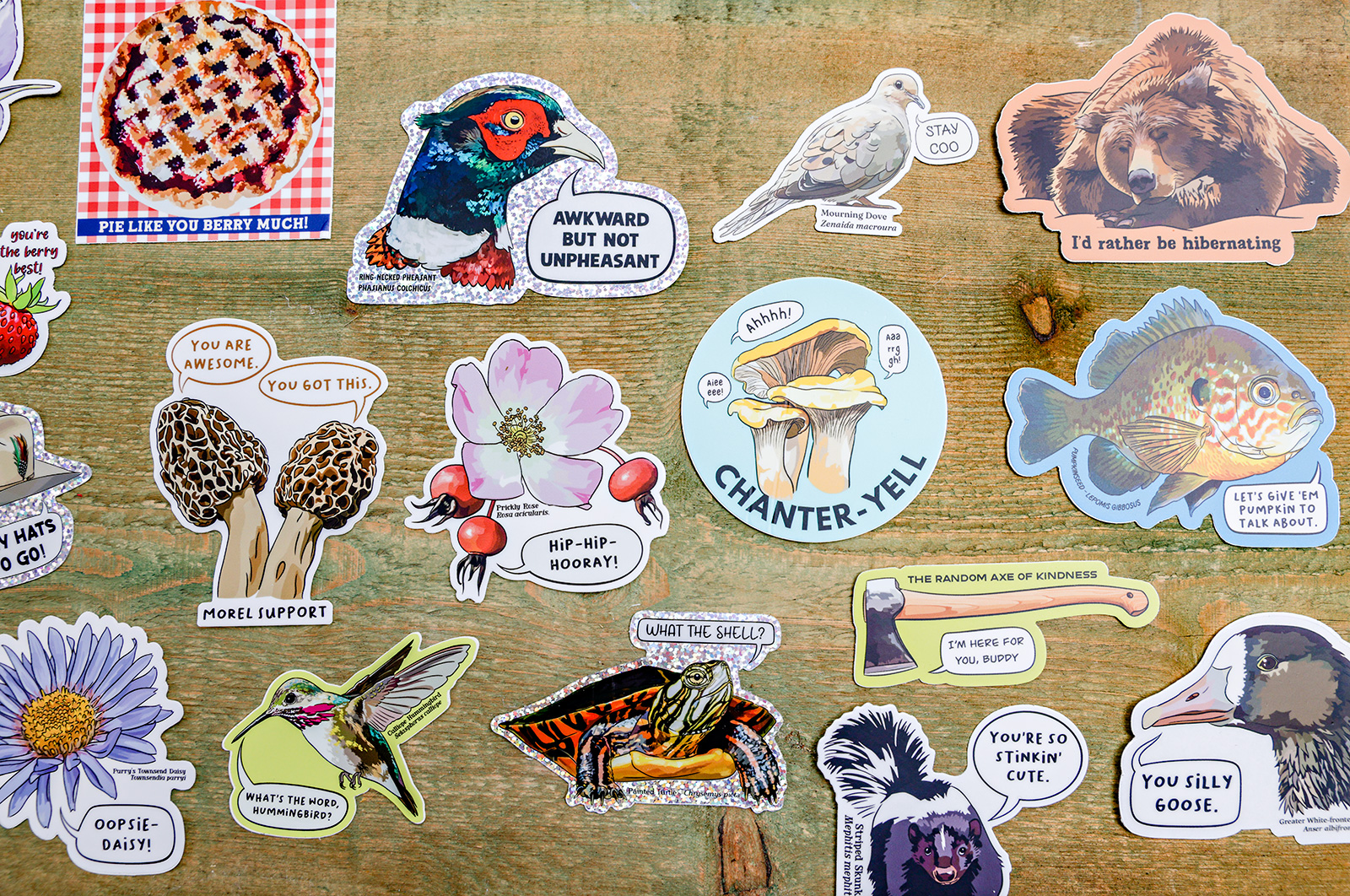
“My specialty within the wilderness community is food and rations and teaching people how to feed themselves and keep themselves going beyond just ‘food for fuel’,” Maloney said. “I love plants, I love foraging, and teaching people what they can eat and what things are called. So that’s a weird thread that ties my outdoor experience with some of the art.”
While creating the art and drawing connections between organisms and people’s daily lives is the most nurturing and inviting part of the book, “Northwest Montana Field Journal” is also deeply rooted in science. The sort of “first rendition” of the book was Maloney’s graduate school thesis, the “Adirondack Field Journal.” The master’s-degree level exercises that Maloney developed years ago made their way into the new book.
“Every page of that journal had to have some scientific basis behind it to prove my thesis, which was that you can connect to nature through journaling,” Maloney said. “We know that sense of place is really good for your mental health and physical health. When you live in a place, your sense of place develops over time. This journal helps you feel more connected to the place you are in.”
“The Northwest Montana Field Journal” has become more than just an homage to Maloney’s new home – it’s been used by crew leaders in organizations like the Bob Marshall Wilderness Foundation as a reference guide for species identification.
While she’s excited that professionals are using her book, Maloney posits that the journal can also serve those who don’t have a relationship with nature at all, as people can use it to cultivate their fondness over time. Maloney herself is proof that being outdoors is not always love at first sight.
“When I was little, I was such a reluctant outdoor child,” Maloney said. “I really didn’t like bugs. And now I do it professionally and I like being outdoors and bugs don’t bother me at all.”
Ultimately, Maloney hopes that the journal can appeal even more broadly, beyond the borders of Montana, to make outdoor experiences more accessible worldwide.
“It’s incredibly universal,” Maloney said. “All of the drawings and information in the back is Northwest Montana, but the actual journaling activities could be done anywhere by anyone and serve the same purpose. My hope is that if you’re a visitor, you could start it while you’re here, but you could keep filling it out and documenting your adventures elsewhere.”
But creating the book was only the first step. Putting this journal (as well as Maloney’s many other products, such as her other book, “A Northwest Montana Alphabet,” and dozens of prints, postcards, stickers, posters, and clothing) out into the world requires tremendous vulnerability. Most of her high moments in this process have arrived when she’s working at craft markets, where she gets to connect with buyers and see the variety of people who feel a connection to her artwork. It’s a simultaneously rewarding and heartbreaking process.
“I really like seeing the dads who get really excited about it,” Maloney said. “I’ve had young dudes and ladies, grandparents, parents, a lot of locals and tourists, and a lot of queer people come and buy it. I think that immediately they notice that it’s accepting and written in an inclusive way.”
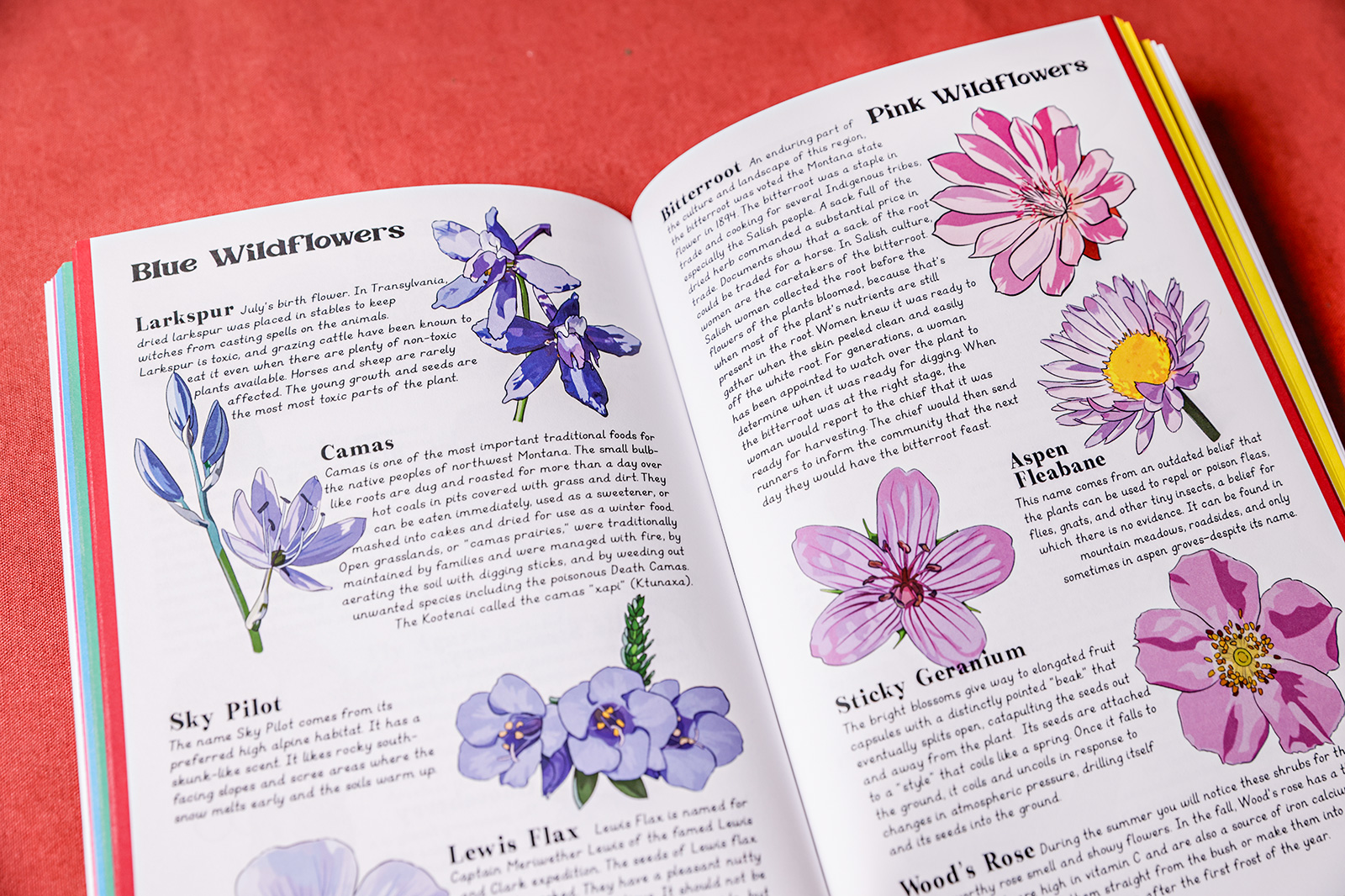
Recently, the Salish Kootenai College bought 50 copies of her book for a course, providing a small but shining spark of encouragement. The lows have been trying to connect with bookstores and shops owners. She said that constantly selling and pitching herself takes an emotional toll.
“It has been pretty discouraging,” Maloney said. “Overall, it’s like you go into a store, you try to find out the buyer or the owner and give them an example of your book. They’re not there, so you come back 20 times, they’re still not there.”
With the many ups and down of selling her products, Maloney is especially appreciative of the stability that comes with the other branch of her work – collaborations with local businesses and nonprofits. Most recently, she completed a project with the Flathead Trails Association to create a comprehensive guide to the Flathead Valley’s recreational opportunities.
The map itself is beautiful and inviting, showcasing colorful depictions of people recreating in a dozen different ways – from biking to hiking to snowboarding. Major Flathead landmarks are clearly designated, and accompanied with simple, one-sentence-long descriptions of their history. Yes, it’s a functional guide, but it’s also so artistic that it could easily find its way framed up on a wall or pasted into a scrapbook.
“The goal was to inspire rather than tell people where all the trails are,” Maloney said. “It’s definitely the hardest thing I’ve ever done, but I love doing these collaborations; and I know immediately it has an end goal and I’m going to send it out into the world.”
Art and work have become increasingly synonymous in Maloney’s life, which for many creative people can be complicated and lead to burnout. However, Maloney has taken care to keep her spark for the outdoors and excitement to create artwork alive in her everyday life.
“I can’t help side questing and trying new things,” Maloney said. “For many years, I’ve tried to learn how to make something new every year. In the past, it’s been felting or mosaics or quilting. This year I’m making bandanas. I don’t have to get good at it, but I do try something new.”
Maloney’s approach to creating new art without the pressure to excel, or even be good at all, mirrors how she hopes readers interact with her journal.
“You don’t need to do anything epic in order to have a really meaningful moment outside. You deserve to be here, be part of this place and there’s always more you can learn.”



French Montana, Rick Ross & Max B Turn the BET Awards Into “
06/28/2026
More

GREAT FALLS — For Staff Sgt. Brianna St. Lawrence-Brody, service does not only happen in uniform.
Outside the gates of the base, she works at Benefis as a nurse, Great Falls Public Schools as a school nurse, and comes home as a wife and mom of four. For the Montana Air National Guard, she serves as a command post controller with the 120th Airlift Wing in Great Falls.
(WATCH: Montana nurse and Guard member earns national Air Force recognition)
Montana nurse and Guard member earns national Air Force recognition
This year, St. Lawrence-Brody was named the U.S. Air National Guard’s Outstanding Airman of the Year in the Non-Commissioned Officer category.
She said the recognition came as a surprise, especially because her path into the Guard started later than others.
“I joined very late in life,” St. Lawrence-Brody said. “I joined the Guard right before I turned 40. So for me, every opportunity that’s presented, I want to take the bull by the horns and just run with it and do the best of my ability.”
During the COVID-19 pandemic, she joined the Guard after finishing nursing school. She said she went straight from nursing school into helping open a COVID unit, while also working at Benefis.
She said that experience was the start of one journey, but not the whole of what she wanted to accomplish.
St. Lawrence-Brody joined the Guard for the opportunities, the challenge and to help build a future for her four children.
“It’s a little bit of a competition for myself,” she said. “Like, if I can do it, why not try my best to achieve it?”
120th Airlift Wing Public Affairs
As a command post controller, she assists in helping move information during emergencies and major events.
“Outside, obviously, I’m a nurse. Inside the Guard, I have nothing to do with the medical field, which is kind of amazing,” St. Lawrence-Brody said. “It keeps me on my toes.”
She explained balancing the Guard, two civilian jobs and four children takes support from her family, her employers and her unit. She said Benefis and GFPS have been supportive of her military service.
Her nomination included her deployment experience, training work overseas and involvement across the wing. St. Lawrence-Brody said she deployed to Ramstein Air Base in Germany, where she worked with an operations center supporting entities connected to Africa.
But, she says this recognition is not the finish line.
“This award, it’s not necessarily a landing pad for me,” St. Lawrence-Brody said. “I want to use it as a springboard.”
120th Airlift Wing Public Affairs

St. Lawrence-Brody hopes her story encourages others to keep taking on new opportunities, even when they feel uncertain.
“Get comfortable with being uncomfortable and be okay with doing things afraid,” she said. “I think when you get to be okay with doing things afraid, that’s where you’re going to find the growth.”
She has already won at the Air National Guard level, but she recently traveled to Washington, D.C., as part of the broader Air Force Outstanding Airman of the Year process, which includes nominees from the Guard, Reserve and major commands across the Air Force.
The Montana Lottery offers multiple draw games for those aiming to win big.
Here’s a look at June 27, 2026, results for each game:
Winning Powerball numbers from June 27 drawing
03-16-28-30-59, Powerball: 11, Power Play: 2
Check Powerball payouts and previous drawings here.
Winning Lotto America numbers from June 27 drawing
03-08-18-22-39, Star Ball: 06, ASB: 02
Check Lotto America payouts and previous drawings here.
Winning Big Sky Bonus numbers from June 27 drawing
05-16-19-27, Bonus: 08
Check Big Sky Bonus payouts and previous drawings here.
Winning Powerball Double Play numbers from June 27 drawing
02-26-34-43-45, Powerball: 15
Check Powerball Double Play payouts and previous drawings here.
Winning Montana Cash numbers from June 27 drawing
05-09-10-15-35
Check Montana Cash payouts and previous drawings here.
Winning Millionaire for Life numbers from June 27 drawing
26-32-38-51-52, Bonus: 05
Check Millionaire for Life payouts and previous drawings here.
Feeling lucky? Explore the latest lottery news & results
When are the Montana Lottery drawings held?
- Powerball: 8:59 p.m. MT on Monday, Wednesday, and Saturday.
- Mega Millions: 9 p.m. MT on Tuesday and Friday.
- Lucky For Life: 8:38 p.m. MT daily.
- Lotto America: 9 p.m. MT on Monday, Wednesday and Saturday.
- Big Sky Bonus: 7:30 p.m. MT daily.
- Powerball Double Play: 8:59 p.m. MT on Monday, Wednesday, and Saturday.
- Montana Cash: 8 p.m. MT on Wednesday and Saturday.
- Millionaire for Life: 9:15 p.m. MT daily.
Missed a draw? Peek at the past week’s winning numbers.
This results page was generated automatically using information from TinBu and a template written and reviewed by a Great Falls Tribune editor. You can send feedback using this form.
-

 Wisconsin7 minutes ago
2027 Wisconsin commit unexpectedly visits with prestigious SEC program
-
West Virginia14 minutes ago
E-News | Suggest topics for Mountain State Conference on Disabilities
-

 Wyoming17 minutes ago
Red Flag Warning issued for northeast Wyoming as high winds increase fire danger
-

 Crypto22 minutes ago
Arthur Hayes Bets $2.2 Million on SYN, Backing Hypercall to Challenge Deribit
-
Finance29 minutes ago
Palestinian Authority pushes electronic payments to combat financial crisis, Israeli restrictions | The Jerusalem Post
-

 Fitness32 minutes ago
Business News: Stock and Share Market News, Economy and Finance News, Sensex, Nifty, Global Market, NSE, BSE Live IPO News – Moneycontrol.com
-

 Movie Reviews44 minutes ago
Movie Review: ‘Supergirl’ – Catholic Review
-

 World52 minutes ago
Clockenflap’s Justin Sweeting and Woozi Studio’s Mia Min Yen on Asia’s Live Music Boom at Golden Melody Festival: ‘No Longer Is a Fan Just Buying a Ticket, But Investing in a Memory’

