West
Ken Buck denies he's leaving Congress early to hurt Lauren Boebert's re-election chances: 'It's ridiculous'

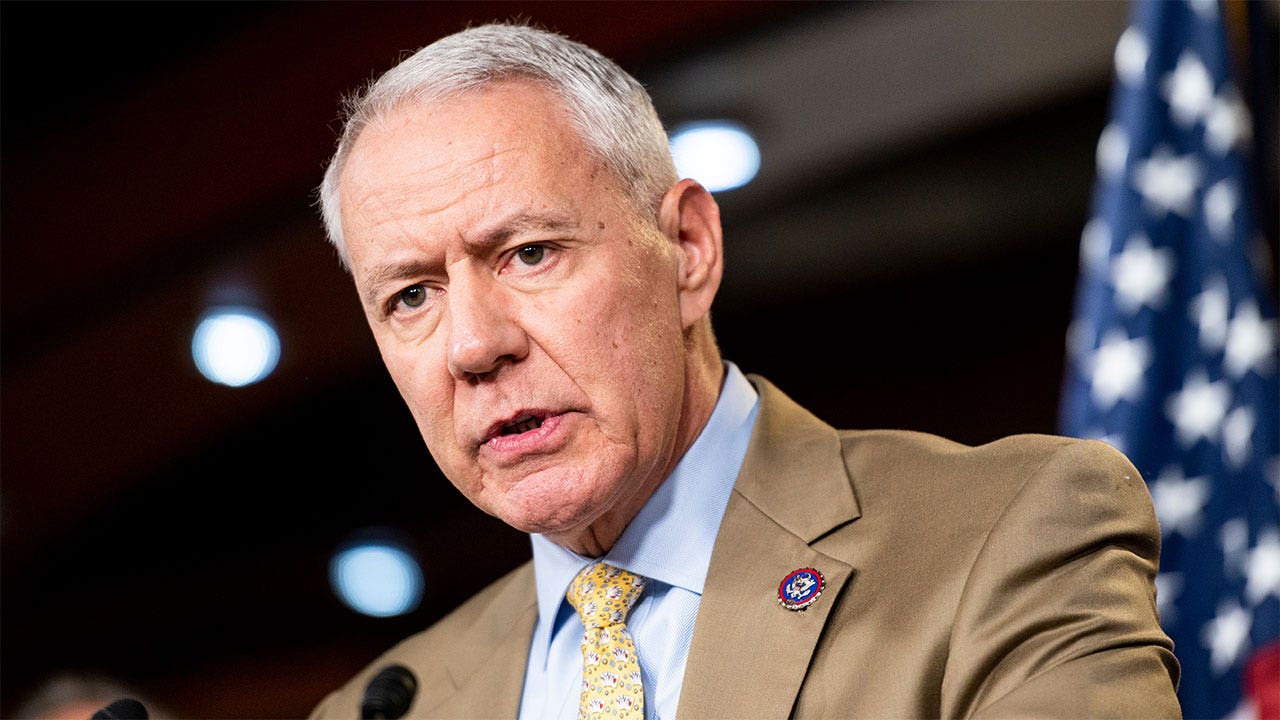
Rep. Ken Buck, R-Colo., on Thursday rejected claims that his decision to resign from Congress early is intended to hurt Representative Lauren Boebert’s chances of winning in Colorado’s 4th Congressional District.
Buck announced earlier this year that his current term would be his last in the House of Representatives. But on Tuesday, he stunned his GOP colleagues by announcing his resignation will be effective on March 22, which will trigger a special election for his seat in the 4th District on June 25 to temporarily fill the vacancy.
Boebert, a Republican, slammed the move as “a gift to the uniparty” and claimed establishment Republicans were attempting to “rig” an election “I’m winning by 25 points.”
Buck responded to those claims in an interview with the Colorado Sun on Friday. “It’s ridiculous,” he said, telling the paper he is not “giving anybody an advantage or disadvantage” in the race for his seat.
LAUREN BOEBERT WON’T ‘FURTHER IMPERIL’ SLIM GOP MAJORITY BY RUNNING IN SPECIAL ELECTION FOR KEN BUCK’S SEAT
Rep. Ken Buck, R-Colo., announced he will leave Congress on March 22, 2024. (Getty Images)
“I have done my very best to stay out of this primary election,” Buck said.
Buck explained that his decision to leave Congress early was based on his growing frustration with gridlock in Congress and desire to campaign for election reforms to improve the quality of candidates who win office, according to the Colorado Sun.
“I want to be a voice for change in our system,” Buck told the outlet.
He also said the timing of his decision was intended to have the special election coincide with Colorado’s June 25 primary, which will save taxpayer dollars.
GOP COLORADO REP KEN BUCK TO RESIGN FROM CONGRESS BY END OF NEXT WEEK
Instead of seeking re-election to Colorado’s 3rd Congressional District, Rep. Lauren Boebert announced in December that she would be running for the House seat that’s being vacated by Rep. Ken Buck, R-Colo., in the state’s 4th District. In a social media video addressing the switch, Boebert insisted that she would be “moving to the fourth” in 2024. (Anna Moneymaker/Getty Images)
“I thought that was really important,” Buck said.
Boebert said Wednesday she will not compete in the special election to fill Buck’s vacancy, as doing so would require her to vacate her own seat.
LAUREN BOEBERT SWITCHES DISTRICTS, ANNOUNCING RUN FOR COLORADO SEAT BEING VACATED BY KEN BUCK
Boebert slammed Buck’s decision to leave Congress early as a “gift to the uniparty” and claimed establishment Republicans were attempting to rig the election against her. (AP Photo/Patrick Semansky, File)
“Forcing an unnecessary Special Election on the same day as the Primary Election will confuse voters, result in a lameduck Congressman on day one, and leave the 4th District with no representation for more than three months. The 4th District deserves better,” Boebert said in a post on X.
“I will not further imperil the already very slim House Republican majority by resigning my current seat and will continue to deliver on my constituents’ priorities while also working hard to earn the votes of the people of Colorado’s 4th District who have made clear they are hungry for a real conservative,” she added.
Boebert currently represents Colorado’s 3rd Congressional District. But earlier this year, she announced her decision to run for re-election in Colorado’s 4th, where more Republicans live.
The move is widely seen as a strategic choice after Democrat Adam Frisch came just 546 votes shy of defeating Boebert in the 2022 midterm election.
Read the full article from Here


SAN FRANCISCO (KGO) — A recent Civil Grand Jury report has identified wildfire risks in San Francisco’s Glen Canyon, warning that vegetation management is needed to reduce the potential for a fire in an area not typically associated with wildfire danger.
The report focuses on the canyon’s large population of Blue Gum eucalyptus trees, an invasive species originally imported from Australia.
Historical photographs show Glen Canyon was largely treeless in the late 1800s, when the land was used primarily as a dairy farm.
The eucalyptus trees were planted after investors believed the fast-growing species could be harvested for timber.
“And these people were so stupid, they didn’t realize they were going to build railroad ties and use the wood for building, and it’s worthless. It warps, it splits. it has no commercial value,” said Rick Carell, a member of the Civil Grand Jury.
While the timber venture failed, the trees remained.
Today, their flammability is a concern for fire safety officials and grand jury members.
MORE: 600 goats graze Poplar Beach in Halfmoon Bay to reduce wildfire risk
“The leaves have a lot of oil in them, and so actually, if it’s very hot, and it’s been very, very dry, they actually explode, because it’s highly flammable. And so, you can see here, look at all the debris right next to this road. So somebody throws a cigarette out into there, and you have a potential fire,” Carell said.
Carell said assessments of the trees have raised additional concerns.
“They evaluated something like 427 eucalyptus trees and 80% of them, back in 2012, were in bad shape,” he said.
Although CAL FIRE has repeatedly rated San Francisco’s wildfire risk as low because of the city’s cool, foggy climate, the grand jury report points to the 2025 Pacific Palisades fire in Los Angeles as an example of how fires can occur in urban areas where vegetation management is inadequate.
The report notes that Glen Canyon has only two fire hydrants, one near the Glen Park Recreation Center and another near a day camp building.
However, San Francisco’s Emergency Firefighting Water System provides additional resources through reservoirs, high-pressure hydrants and underground cisterns.
One nearby cistern at Chenery and Surrey streets can supply 75,000 gallons of water. Based on a fire engine’s typical pumping rate of 1,500 gallons per minute, that amount of water would be exhausted in about 50 minutes. Additional cisterns are located in surrounding neighborhoods.
MORE: CAL FIRE urging Bay Area residents to create defensible space as wildfire season begins
Despite the concerns, the report concluded that removing all eucalyptus trees is not a practical solution because of the canyon’s steep terrain. Large-scale removal could increase the risk of landslides. Instead, the report recommends managing vegetation by clearing brush and fallen debris and removing diseased trees.
“To remove any brush that might be a fire hazard, if something could really ignite quickly. We’re going to raise up the branches, the lower branches of the tree because that’s where a lot of the problem is for the spread of the fire, and if there are any dead trees that are really hazardous or branches that may hang over the roadway, that we can take them out as well,” said Rachel Gordon of the San Francisco Department of Public Works.
Public Works officials are expected to coordinate closely with CAL FIRE on vegetation management efforts.
“CAL FIRE guys, they train in the type of environment, and so what they do, they get their chainsaws out, they eliminate. They limb the trees, they bring out the debris and that sort of stuff so this is an ideal training site for them,” Carell said.
The San Francisco Public Utilities Commission, which manages a small portion of the canyon, has already removed trees on its property to prevent them from falling across O’Shaughnessy Avenue, a potential emergency evacuation route.
The agency has also hired habitat experts to remove non-native vegetation and replace it with fire-resistant native species, including coast live oaks.
“That has all these tannins in the foliage that resist fire. You can put a lighter right under that thing in the middle of the hottest day of the year, and it will not burn like these willows. They will not burn, and so that’s what we want to load our parks with instead of having things like the eucalyptus and the pine — which, as we all know, they just burn like a crazy Christmas tree fire,” said Habitat Specialist Josiah Clark.
The majority of the 66-acre canyon is managed by the San Francisco Recreation and Parks Department, which agrees that improved coordination among city agencies is essential to maintaining fire safety in the area.
Copyright © 2026 KGO-TV. All Rights Reserved.

The Regional Transportation District’s BroncosRide buses, running from Park-n-Ride lots around metro Denver to Broncos football games, will be back this fall after a five-year suspension.
RTD directors this week voted 10-5 to reinstate the service.
The agency suspended the service before the Broncos’ 2020-21 season due to bus driver shortages and agency concerns about public transit equity.
Despite RTD’s current budget crisis, the directors decided that the BroncosRide — which will cost $1.6 million, according to information that agency staff provided to directors — will help boost RTD’s lagging overall ridership and increase the appeal of public transit.
If the buses are full, Director Chris Nicholson said, fare revenues estimated at $497,855 will offset the cost.
“At RTD, we make lives better through connections, and there’s nothing better than seeing (Broncos quarterback) Bo Nix connect for a touchdown,” Nicholson said. “Previous boards didn’t see it as a fundamental part of service. We do.”
Before the Broncos’ Aug. 21 preseason home game against the Green Bay Packers, RTD officials plan to announce detailed plans to run about 92 buses from about 18 locations around metro Denver, including stations near Denver International Airport, East High School, the Highlands Ranch Town Center, Interstate 25/Broadway, Broomfield, Longmont, Littleton and Parker.
Get more Colorado news by signing up for our Mile High Roundup email newsletter.
Seattle, WA
FOLLOWUP: Sound Transit Board finalizes $400+ million spending installment for West Seattle light rail

Two weeks ago, we reported on the Sound Transit Board‘s System Expansion Committee recommending approval of actions to allot $406 million toward West Seattle light rail – the first big commitment after the ST3 plan revision that cemented ST commitment to WS. At this afternoon’s meeting of the full board, the actions all got final approval, as did a much-smaller installment of spending on Ballard light-rail planning.
(Here’s the full slide deck as presented at the committee meeting, also including the current WS light-rail cost estimate of around $5 billion.)
On the horizon, according to the most-recent ST email update, is work to advance the plan for the new cross-Duwamish River light-rail bridge, shown in this rendering:
 (Sound Transit rendering)
That work on the south end of Harbor Island (in a parking lot at 1001 Klickitat, according to city docs) will see crews drill a test bridge shaft approximately 10 feet wide and 250 feet deep to better understand ground conditions,” ST says, to obtain “key information needed to finalize the bridge design.”
-

 Los Angeles, Ca1 minute ago
Jury says it is deadlocked in trial of man accused in Palisades Fire
-

 Detroit, MI21 minutes ago
Scene active as police shoot, kill man on Detroit’s west side
-

 San Francisco, CA31 minutes ago
Civil grand jury report warns of wildfire risk at SF’s Glen Canyon Park
-

 Dallas, TX36 minutes ago
Ivory Coast advances at World Cup, how to buy Ivory Coast tickets
-

 Miami, FL43 minutes ago
Men used fake credentials to enter Brazil vs. Scotland match at Miami Stadium, deputies say
-

 Boston, MA46 minutes ago
3 arrested after trying to break into downtown building, Boston police say – The Boston Globe
-

 Denver, CO58 minutes ago
RTD to bring back BroncosRide bus service after 5-year suspension
-

 Seattle, WA1 hour ago
FOLLOWUP: Sound Transit Board finalizes $400+ million spending installment for West Seattle light rail

