Plus get unlimited access to thousands of articles, videos and more with your free account!
Please enter a valid email address.
NEWYou can now listen to Fox News articles!
It only takes a weekend trip to a wedding two hours outside of a big city to realize this country is nowhere near ready for the Democrats’ clean energy revolution. It’s too bad they’re unwilling to accept reality.
Advertisement
Democrats are pushing us toward an America powered by wind, solar, and other green alternatives to gas, oil, and coal. It makes us more reliant on electricity. But as I detail in my book “What’s Killing America: Inside the Radical Left’s Tragic Destruction of Our Cities”,the eco-reality favored by the Left is lightyears ahead of our reality.
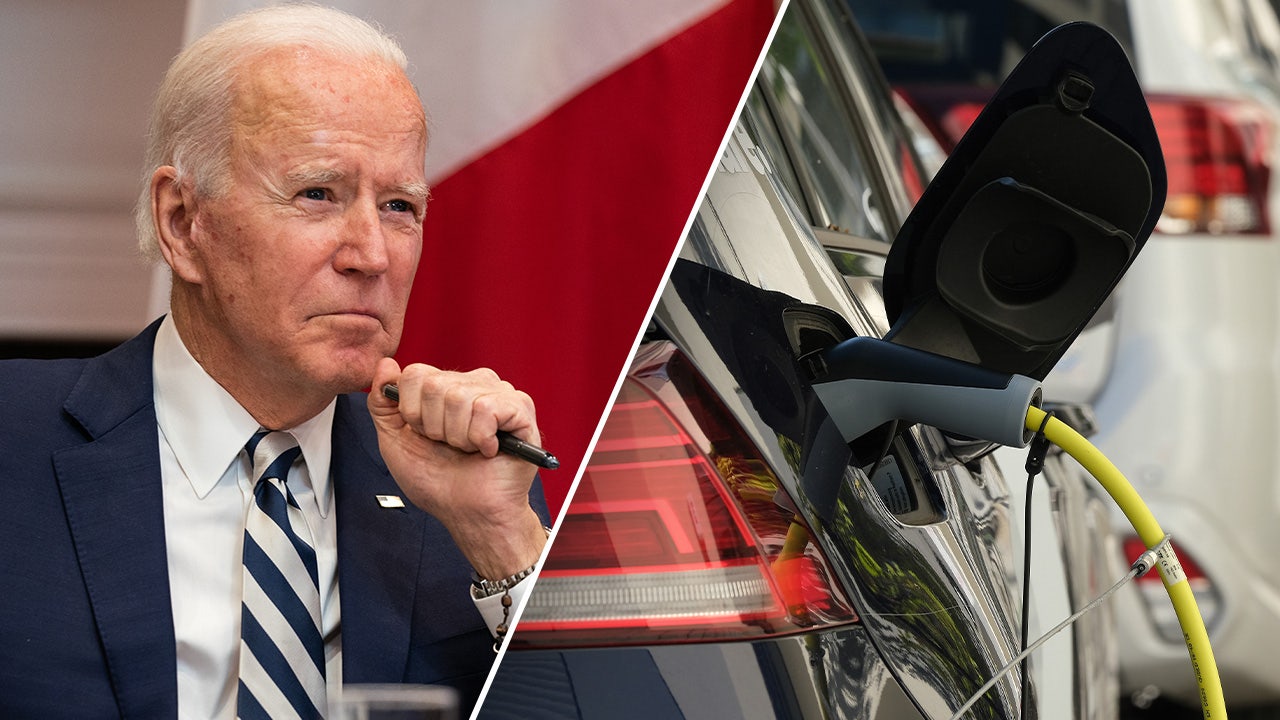
A major piece of the Democrats’ clean energy revolution is a mandate towards electric vehicles (EVs). At least 13 states, including Washington, California, New York, and Virginia, plus D.C., mandate new car sales to be EVs by 2035. The goal is to convert everyone to electric — by force. But to date, the country only has 168,426 charging stations, with a goal of 500,000 by 2025. A lot of good that will do. The International Council on Clean Transportation says the U.S. will require 2.4 million charging stations by 2030 (which includes at-home, public, and workplace) based on EV market trends.
BIDEN’S EV INSANITY JUST GOT EVEN WORSE
Last week, Hertz rental cars made headlines for ditching its EV fleet for more gas-powered vehicles. I lived their reason, learning a harsh lesson about our weak EV infrastructure while driving to a wedding in Cle Elum, 90 minutes east of Seattle.
I don’t own a car, so I rented one from Hertz. I was dubious of the EV they gave me, but I had no choice: they rented out the gas-powered car that I reserved and I was out of options.
Advertisement
As I drove to the wedding venue, I was nearly glued to the dashboard, watching a dwindling battery percentage. Just when I thought everything would be OK, I encountered hills. EV batteries do not like hills.
When I arrived at the venue, my dashboard said the battery would only last 43 more miles. I needed double that to make it back to Seattle. From the vows to the post-ceremony dinner, I was panicked, downloading apps that mapped out the nearest EV power stations, hoping I could make this work.
EVS SIGNIFICANTLY LESS RELIABLE THAN GAS-ENGINE CARS, CONSUMER REPORTS FINDS
There was a nearby EV plug-in location with a dozen open spaces — for Teslas. I wasn’t driving a Tesla. Without a standard EV plug, if you don’t have an adapter, you’re out of luck. The closest location compatible with my car was a diner in the middle of nowhere, 30 miles away.
I nervously headed out, watching the battery react to every hill, and every press of the gas pedal. The car misled me about how far I’d get. After 30 minutes, I had 9.5 miles to the charger and a battery that could handle 17 more miles.
Advertisement
WINTER WEATHER PRESENTING EV OWNERS WITH ‘FRUSTRATING’ CHALLENGES
Pro-tip: when driving an EV, do not make any mistakes — like missing a poorly lit off-ramp to your plug-in station on a highway where the next opportunity to get off and head back is two miles away (and two miles back), when your battery has only about one mile left to give. I was forced to pull over, cruising to a stop in the middle of nowhere. The battery had died as I was pulling off the freeway. Moments later, the lights and heat went out. It was pitch black and about 30 degrees.
I don’t know if you’ve ever tried getting a tow truck to pick you up in the middle of nowhere, but it turns out they will accept your business, quote you $300, and say they’ll pick you up in 20 minutes only to tell you 45 minutes later that they are canceling.
After two hours of mostly yelling at Hertz customer service and cursing the lack of EV infrastructure in the state, I got an Uber after two hours of waiting. A driver named Hussein took pity on me and agreed to pick me up. He couldn’t arrive soon enough. My cell phone battery hit 13%, and, as with my EV, I had nowhere to plug it in.
CLICK HERE FOR MORE FOX NEWS OPINION
Advertisement
When the Uber arrived, I abandoned the EV. It was now Hertz’s problem. I got home, $108.91 later (plus a generous tip). This is your future in the Democrats’ EV world.
In Washington state, relatively straightforward transit projects take years and are always over budget. Does anyone think any state can install the hundreds of thousands of charging stations needed for an hours-long ride? Even the large urban areas with Democrat-controlled government aren’t installing charging stations at large scale. And can we even afford it? Washington State is spending $41 million to install just over 180 charging stations. As of September 23, the state only had 1,820 charging stations. Is the technology advanced enough that the current charging stations, with clunky and heavy plugs, will not need a major upgrade within the next decade?
FILE – Man pushing stranded Tesla in Chicago in frigid winter temperatures (‘Fox & Friends’ screengrab)
We’d better start embracing staycations because road trips are out of the question. Forget long drives to see medical specialists. And you better not forget to plug in each night or you’ll find yourself without a battery juice when driving home from work.
The battery technology isn’t where it needs to be to make EVs worthwhile, and the prices aren’t low enough for most families to comfortably purchase (you can thank Bidenomics for that). Yet Democrats continue to force EVs on us.
Advertisement
Even if the infrastructure existed, our power grids couldn’t handle it.
Temperatures in Washington state hit historic lows this month and our power grid wasn’t prepared. As temperatures dropped to 17 in Seattle, Puget Sound Energy, the state’s largest supplier of electricity and natural gas, asked customers to lower their thermostats and limit the use of hot water to “reduce strain on the grid.”
Our grid couldn’t handle a weekend of below-normal temperatures. But we should expect it’ll handle a near future of EVs? Heaven forbid it get cold when our cars are plugged in.
Recently, I was asked to talk about what it is like to be a female rancher.
I was flattered to be asked, but I don’t know the answer.
I do know what it is like to be a human rancher and I know that I admire many women who also are ranchers.
Advertisement
In fact, 36 percent of the farmers and ranchers in the U.S. are women and they manage almost half of America’s ag land.
Globally, we produce more than half of all food.
In Montana, we all benefit from amazing female leaders in agriculture.
If you want to know about improving soil health or the rewards of raising sheep, talk to Linda Poole in Malta.
If you want to learn how to organize a grassroots rancher’s organization and effect meaningful change, talk to Maggie Nutter in Sunburst.
Advertisement
Trina Bradley of Dupuyer will look you in the eye and tell you everything you need to know about the impacts of grizzlies on her ranch life.
Colleen Gustafson, on the Two Med, graciously hosts and educates non-ranchers for months at a time without strangling them, all while maintaining every fence, buying every bull and killing every weed on her ranch.
Adele Stenson of Wibaux and Holly Stoltz of Livingston find innovative solutions to ranching challenges and then — even harder — find ways to share these innovations with hard-headed, independent cusses who want to do it our own way.
In fact, I’ve noticed that often women seek novel innovations to deal with a ranching challenge.
Advertisement
If a man happens to be around, she might even run it past him.
It’s rubber band ranching – stretch with an idea, contract to assess it, then stretch again to implement it.
Long ago, my friend Michelle and I promoted the One Good Cow program at the Montana Stockgrowers Association meeting.
We asked cattle producers to donate one cow to ranchers who had lost so many in blizzards and floods that year.
As we stood on stage in a room full of dour, silent men, I remember finding the one person I knew and asking what he thought.
Advertisement
Just as he would bid at a livestock auction, he barely nodded his approval.
We ended up gathering more than 900 cows from across the nation and giving them to 67 producers.
One Good Cow was a good idea.
Now I don’t seek approval for my ideas so sometimes my rubber band doesn’t contract to assess one before I stretch into action.
That’s how I got myself into producing shelf-stable, ready-to-eat meals made with my beef and lamb.
Advertisement
This is a good idea, too.
I hope.
I wonder if it is easier to ranch as a woman in some ways.
Society pressures men to know all of the answers all of the time, but If I mess up, I try to learn from my mistake and move forward.
When Imposter Syndrome hits or we can’t find a solution to an unsolvable problem – the effects of climate change, commodity markets or competing demands from family – secretly faking it until we make it gets lonely.
Advertisement
The downward spiral of loneliness and the pressure to be perfect can lead to suicide.
Male ranchers kill themselves 3.5 times more often than the general public.
Female ranchers kill themselves, too, just a little less often.
I’m fortunate to have good friends who love me even when I’m far from perfect.
We laugh together, they remind me that I have a few good attributes even when I forget, they tolerate my weirdness and celebrate little successes.
Advertisement
They stave off loneliness.
They know all ranchers try our best, we appreciate a little grace, and a warm fire feels good to our cold fingers.
Lisa Schmidt raises grass-fed beef and lamb at the Graham Ranch near Conrad. Lisa can be reached at L.Schmidt@a-land-of-grass-ranch.com.
EUREKA COUNTY, Nev. (KOLO) – On Friday, Feb. 27, the Nevada State Police assisted with a cattle crossing on State Route 306 at Interstate 80 in Eureka County.
“While not an everyday part of our job, we like to do our part to assist our local ranchers while keeping traffic from turning into udder chaos,” according to an agency Facebook post. “It was a perfect opportunity to be outside (even if our animal friends were a little moo-dy).”
Expect the offenses to shine when SDSU visits New Mexico in The Pit today, per our college basketball betting picks.
Feb 28, 2026 • 10:23 ET
• 4 min read
Advertisement
Photo By – Reuters Connect. San Diego State Aztecs guard Reese Dixon-Waters.
The San Diego State Aztecs pulled into a tie for first place in the Mountain West Conference with a win over top-seeded Utah State. Now, they try to stay there when they visit a team just below them in the standings in the New Mexico Lobos.
Advertisement
My San Diego State vs. New Mexico predictions and college basketball picks believe the high stakes will translate to a high-scoring affair on Saturday, February 28.
San Diego State vs New Mexico prediction
San Diego State vs New Mexico best bet: Over 148.5 (-116)
The New Mexico Lobos had a three-game win streak snapped with a 67-60 loss at Nevada, their second-lowest point total of the season.
They return home, where they are averaging 92.2 points per game in the last 10.
The San Diego State Aztecs have the fourth-ranked offense in the conference. They hung 89 on Utah State in a 17-point blowout win.
Advertisement
They’ve won seven of 11, including an 89-73 triumph over UNM.
The Lobos have combined with their opponents to score better than 151 points in six straight at home.
Enjoying Covers content? Add us as a preferred source on your Google account
San Diego State vs New Mexico same-game parlay
The Aztecs are coming off their biggest win of the season, and if they can pick up this W at New Mexico, they will be in the drivers’ seat for the Mountain West regular season crown.
SDSU has held its own on the road this year, going 5-3 this season.
San Diego State vs New Mexico SGP
Over 148.5
San Diego State moneyline
San Diego State vs New Mexico odds
Spread: San Diego State +2.5 | New Mexico -2.5
Moneyline: San Diego State +125 | New Mexico -150
Over/Under: Over 149.5 | Under 149.5
San Diego State vs New Mexico betting trend to know
San Diego State has hit the 1H Moneyline in 18 of its last 25 games (+12.40 Units / 9% ROI). Find more college basketball betting trends for San Diego State vs. New Mexico.
How to watch San Diego State vs New Mexico
Location
The Pit, Albuquerque, NM
Date
Saturday, February 28, 2026
Tip-off
2:00 p.m. ET
TV
CBS
San Diego State vs New Mexico key injuries
Odds are correct at the time of publishing and are subject to change. Not intended for use in MA. Affiliate Disclosure: Our team of experts has thoroughly researched and handpicked each product that appears on our website. We may receive compensation if you sign up through our links.
Advertisement
Pages related to this topic
Eric has been involved in sports media in many different capacities since graduating from journalism school in 1999, back when getting your own column in a newspaper was still considered a thing. He doubled down and graduated from broadcast journalism school five years later, which led to a move to Toronto and a career with The Sports Network (TSN). From behind-the-scenes production work, he moved into the digital realm, where he had his own hoops column (At the Buzzer), while regularly live streaming and chatting with fans during broadcasts as the character known as LeBlog James. He was also a key contributor to TSN and CTV’s Olympic programming during the 2012 London Games.
Eric eventually found his way into the sports betting field in 2016 and has been a mainstay ever since. He was tagged on Twitter as a Top 10 NBA sharp during the 2021 season and has been interviewed about basketball and his handicapping process on shows from Vancouver to India. Eric is now a jack-of-all-sports at Covers, where his predictions span the alphabet soup: NFL, NBA, MLB, NHL, F1, WNBA, Euro, and Copa.
When making picks, he focuses on finding value first and foremost, and ensuring readers have all the information they need to make an informed choice.