House and Senate leaders are working through the weekend to see if there is a path to reviving a utility securitization bill.
Lawmakers gave preliminary approval to what is being billed as the biggest tax cut for Hawaii workers in state history on Friday afternoon as the Legislature raced toward a scheduled adjournment next week.
They also approved funding to combat the proliferation of invasive species, and to help put more Native Hawaiians in homes on Hawaiian homelands.
But one major unfinished piece of business remained: What to do about a hotly debated bill to allow Hawaiian Electric Co. to charge a fee to ratepayers so the utility can pay for wildfire mitigation plans.
Advertisement
On Thursday, in a decision that surprised many at the Hawaii State Capitol, Senate Commerce and Consumer Protection Committee Chair Jarrett Keohokalole deferred the so-called securitization measure, Senate Bill 2922, indefinitely. That prompted Gov. Josh Green to intervene directly in the hope of saving a bill he sees as vital to the entire state.
Hawaiian Electric Co. wants authorization to issue bonds and impose a fee of up to 5% of its customers’ monthly bills to finance those bonds to raise money for wildfire mitigation work. (Nathan Eagle/Civil Beat/2023)
Late Friday the governor’s office confirmed that House and Senate leaders will work through the weekend with the administration to hash out a compromise draft of SB 2922.
Green “believes this is an important issue and has committed to working until the end of session, or even after if needed, to find a solution that could provide stability to ratepayers,” the administration said in a written statement.
But Keohokalole does not appear to be backing down. Lawmakers held multiple hearings on the issue and discussed it at length, he said, adding that HECO had the opportunity to present its case to lawmakers during an hourslong informational briefing last week.
“The conclusion I and several of my colleagues came to was we were being asked to approve an unknown allocation of money for an undefined purpose to be paid for by an undetermined fee that our grandchildren will likely still be paying for with no assurance that HECO will remain locally controlled and operated and no protections provided for the local workers at HECO,” Keohokalole said.
Other senators also expressed worry about the HECO employees who belong to the International Brotherhood of Electrical Workers Local 1260.
Advertisement
“Personally, I support the chair’s decision — that is his committee,” said Sen. Lorraine Inouye, referring to Keohokalole. “But I am concerned about the IBEW workers and how their pensions might be impacted, because they are going to be impacted. And I am also concerned that we have already been having rolling blackouts on Oahu and the Big Island, and things could get worse.”
What might happen next is unclear. One possible scenario is that House and Senate leaders call the Legislature back into conference committee on Monday, which is a recess day.
Less likely is that the Senate and House would pull the bill out of committee and to the floor for a vote. Or they could choose to extend the session beyond its scheduled end on May 3.
And there is the possibility that the governor could order the Legislature back into session. But it’s not clear that there is majority support in either chamber for SB 2922, which if passed as currently written would impose a fee of up to 5% on customers’ monthly bills to finance bonds and raise money in a process known as securitization.
Unsaid but understood by nearly everyone is the fact that the primary election is barely three months away. Running for reelection while appearing to bail out a monopoly company may not be palatable to voters who already have among the highest electric bills in the nation.
Advertisement
Help For The Lowest Earners
There were only a few details available Friday on the new income tax cut proposal in House Bill 2404, which was made public by House Finance Committee Chairman Kyle Yamashita shortly after 4 p.m. Friday.
Yamashita told his colleagues the measure eliminates an entire income tax bracket for the lowest-paid state residents and also adjusts the remaining income tax brackets upward in response to the recent increase in the state minimum wage.
House Finance Committee Chair Kyle Yamashita, second from left, briefs his colleagues on the new draft of House Bill 2404. The measure increases standard income tax deductions and adjusts state income tax brackets to offer savings to Hawaii’s lower-income families. (Screenshot/2024)
Hawaii’s minimum wage increased to $14 per hour on Jan. 1, and Yamashita said lawmakers are concerned that additional income will cause low-income residents to pay a larger share of their earnings in state taxes.
“If we don’t adjust the brackets, the people that are earning minimum wage will be pretty much paying middle-income taxes, so we have to keep adjusting these brackets,” Yamashita said. “We’re keeping money in the pockets of people that need to keep the money, so that’s the idea.”
Yamashita said the latest version of the bill would also double the standard state income tax deduction for all Hawaii taxpayers for this year, which will translate into savings when it is time for residents to pay their income taxes next spring.
The standard deduction will then be further increased in a series of steps in 2026, 2028, 2030 and 2031, he said. Yamashita did not say how large those future increases in the standard deduction will be for each of those years, and he was unavailable for comment Friday night.
Advertisement
At the committee hearing, however, he said the new bill would also eliminate the lowest income tax bracket in 2025, and then increase the remaining brackets in a series of steps in 2025, 2027, 2029 and 2031.
“Ultimately, by the time we hit 2031, it will be the biggest tax cut to the working people of the state of Hawaii in state history,” he said.
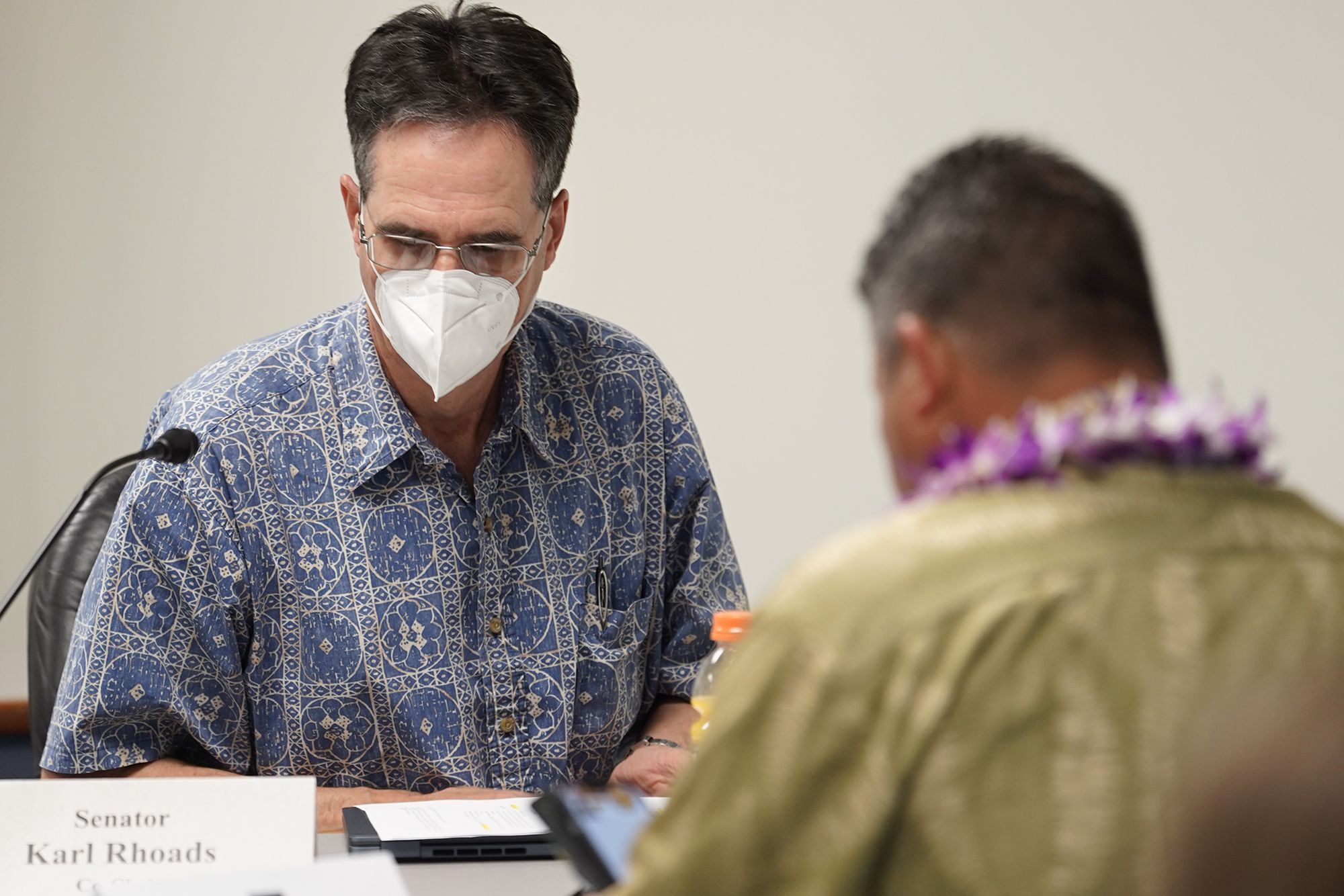
Sen. Karl Rhoads is among lawmakers who did not support the estate tax bill, which he said favored the wealthy. (Kevin Fujii/Civil Beat/2024)
That comment drew a whoop from someone in the hearing room, and Yamashita continued: “I think this is something very big, and both House and Senate have worked hard on this to come up with a compromise.”
House Speaker Scott Saiki has described HB 2404 as “probably the most significant tax bill” of the session.
Meanwhile, Senate Bill 3289 — a much more controversial measure dealing with Hawaii’s estate tax — quietly died for the year.
That measure would have exempted more people from Hawaii’s estate tax. But critics said the measure would only benefit the wealthiest 0.2% of Hawaii residents, and lawmakers rejected it.
Advertisement
DHHL Gets More Time To Spend Funds
Among the many measures that were moved to the last day of conference committee — the final major deadline ahead of session’s end — was Senate Bill 3109, which extends the deadline for the Department of Hawaiian Home Lands to use $600 million in funding approved by lawmakers two years ago.
While the department has encumbered much of the money, it was at risk of losing tens of millions of dollars by June 30. Under SB 3109, though, DHHL will now be allowed to lapse $129 million, which will be placed into a special fund.
“I know the Department of Hawaiian Home Lands has been doing a very good job in encumbering these funds going forward,” said Rep. David Tarnas, the lead House negotiator on SB 3109. “And this will enable them to have the flexibility to carry out our desires to get more Hawaiians on Hawaiian homelands.”
Reps. Scot Matayoshi, from left, Andrew Garrett and Lisa Kitagawa at the conference committee meeting to resolve differences on the UH procurement Friday. (Kevin Fujii/Civil Beat/2024)
Lawmakers also reached agreement on a bill that will give the University of Hawaii’s chief financial officer procurement authority over construction and related professional services.
That authority had long been with the UH president, but in 2013 state senators shifted it to the Hawaii State Procurement Office. Senate Bill 2499 initially sought to permanently reinstate that power with the UH president.
But Sens. Donna Kim and Donovan Dela Cruz changed the bill earlier this month to instead give the procurement power to Brennon Morioka, the dean of the UH College of Engineering. No rationale was provided, and it came after the public comment period on bills had passed.
Advertisement
On Friday, Rep. Scot Matayoshi said that the agreed-upon draft designates the university’s chief financial officer as its chief procurement officer effective June 28 and inserts a four-year sunset date, meaning it will again be revisited in 2028 — an amendment supported by Kim.
The Demise Of A Water Bill
UH will also get $1 million to set up a two-year program to develop a statewide wildfire forecast system using artificial intelligence.
UH supported Senate Bill 2284 and testified that the UH Manoa College of Engineering’s research capabilities in AI would be a key part of the program.
Not making the cut Friday afternoon, however, was a major water bill that was supported by the Office of Hawaiian Affairs, the Board of Water Supply, the grassroots group Lahaina Strong and the Sierra Club but was opposed by the Attorney General’s Office and the Department of Land and Natural Resources.
House Bill 2690 called for setting up a water policy coordinator and other positions within the Commission on Water Resource Management to coordinate the Red Hill Water Alliance Initiative, or Red Hill WAI.
Advertisement
Reps. Gene Ward and Linda Ichiyama in the waning hours of conference committee Friday. The 2024 legislative session is scheduled to end on May 3. (Chad Blair/Civil Beat/2024)
CWRM, as the commission is known, would still be administratively attached to the DLNR but have greater independence. It would also create a Red Hill special fund for the remediation of pollution and appropriate money for it.
The bill was inspired by both the recent Red Hill Bulk Fuel Storage Facility fuel spillage and the Lahaina fires.
Inouye, chair of the Senate Water and Land Committee, said she was “greatly disappointed” that the House would not support the Senate amendments but said the issue would be introduced again next year.
She said there was agreement by both chambers that the bill was “urgently needed and very important — not just for Red Hill, but also for Lahaina,” noting the issue of water rights is all the more important now because of the giant task of rebuilding the West Maui town.
Tax Dollars At Work
One of the final bills to be approved early Friday evening was House Bill 2340, the annual claims-against-the-state bill. Civil Beat reported on several of those claims this year including a $750,000 settlement of a lawsuit over the death of a 3-year-old boy in state foster custody in 2017 on the Big Island.
The claims bill is introduced at the beginning of session in January but lawmakers do not approve the payments until the Attorney General’s Office has finalized them. The bill, which passed easily, contains 41 claims that total $18.8 million.
Advertisement
Since the bill was last amended, two new claims were settled for an additional $71,500.
The claims require the state to pay the Sierra Club $35,000 for attorney fees and costs in a 2022 case involving the Board of Land and Natural Resources regarding stream water diversion, and for the state to pay $35,000 in settlement with a deputy sheriff who was involved in an accidental gun discharge incident in 2020.
And there is a lot of money going toward ridding the state of invasive species. Lawmakers approved Senate Bill 2401, which helps counties pay for feral chicken control programs. Money will also go to the Department of Health for a campaign to educate the public about the importance of not feeding feral animals.
The funding is secured through a measure that passed Thursday that appropriates almost $20 million to help control and eradicate little fire ants, coconut rhinoceros beetles, coqui frogs, rose-ringed parakeets, two-lined spittlebugs and brown tree snakes.
“A major focus this year has been invasive species, and of course, feral chickens are a part of that issue,” said Rep. Cedric Gates, adding that lawmakers are hoping the omnibus bill will help “really get a grip on the invasive species issues that we see statewide.”
Advertisement
Sign up for our FREE morning newsletter and face each day more informed.
HONOLULU (HawaiiNewsNow) – Gov. Josh Green on Thursday announced he has nominated Vladimir Devens to serve as chief justice of the Hawaii Supreme Court.
The chief justice is responsible for administering the statewide court system, including oversight of court operations, judicial assignments, and efforts to improve efficiency and access to justice.
Devens, who has served as an associate justice since 2024, brings more than three decades of legal experience to the role, including extensive work in civil litigation and public service.
Green said Devens “brings something that is essential in this moment — real-world experience, a deep understanding of working people and a grounded, salt-of-the-earth perspective that reflects the values of our communities. At a time when families are focused on affordability, housing and stability, we need continuity and steady leadership in our courts. Justice Devens is the right person to lead with fairness, independence and a clear understanding of how decisions impact everyday people.”
Advertisement
If confirmed by the Hawaii State Senate, Devens will serve as the state’s highest-ranking judicial officer, overseeing the administration of the judiciary and guiding the work of the Supreme Court.
He would succeed Chief Justice Mark Recktenwald, who retired last September after reaching the state’s mandatory retirement age of 70.
“I am deeply honored by Governor Green’s nomination and grateful for the opportunity to continue serving the people of Hawaii,” Devens said. “Throughout my career, I have worked alongside individuals and families navigating real challenges and I carry those experiences with me. If confirmed, I will focus on ensuring our courts remain fair, accessible and responsive to the needs of all communities, while upholding the rule of law and maintaining public trust.”
Devens received a bachelor’s degree in economics, graduating magna cum laude and earning Phi Beta Kappa honors from the University of California, Berkeley. He earned his Juris Doctor from the University of California, Berkeley School of Law (formerly Boalt Hall), where he served as an Associate Editor of the Industrial Relations Law Journal.
Prior to his appointment, Devens worked in private practice for more than 30 years, where he concentrated on civil litigation across multiple practice areas. He also served on the Hawaii State Bar Association board of directors and on various HSBA committees.
Advertisement
Copyright 2026 Hawaii News Now. All rights reserved.
As detections of the highly destructive coconut rhinoceros beetle in West Hawaii continue to climb, two bills making their way through the state Legislature aim to slow the bugs’ spread in markedly different ways.
Senate Bill 2925 establishes a tax income credit for property owners growing coconut palms for food who choose to control CRB through “natural management practices” — language which has drawn opposition from some Department of Agriculture and Biosecurity (DAB) officials because it omits the use of certain pesticides.
The tax credit is meant to offset some of the costs of eradication and management efforts, and beneficiaries would have to certify that no “systemic or prohibited” pesticides have been used. The legislation appropriates funds for two full-time environmental health specialist positions tasked with conducting inspections.
The House Committee on Economic Development and Technology voted unanimously to pass the bill on March 25. From there it was referred to the Finance Committee.
Advertisement
In tandem with the Senate tax bill, House Bill 2207 requires DAB to establish a “Biosecurity Government-Industry Working Group” where education, training, supplies, equipment and pest management programs are provided to private industries, which will in-turn supply labor, surveillance, some treatment equipment and response readiness.
HB 2207 includes legal protections for government workers entering private property to do pest eradication work. It also allows for the sale and distribution in the state of fine mesh nets — currently restricted due to their illegal use in fishing — as an effective CRB control measure. The Senate Committee on Agriculture and Environment passed the measure on March 24 and referred it to the Ways and Means Committee.
Franny Brewer is the program manager at the Big Island Invasive Species Committee, a University of Hawaii partnership working to protect the island from harmful invasive plants and animals. Brewer supports HB 2207’s loosening of restrictions on mesh nets because they offer a poison-free CRB control for homeowners and small-scale farmers.
“They are a good deterrent,” she said. “You can put them in the palm trees, and they’ll provide a barrier to prevent the beetle from actually burrowing in. That’s a great use for people who don’t want to use pesticides. It’s one of the important tools, and I think just being able to have that be legally available to use without running afoul of the rules about fishing nets is very helpful.”
For large-scale CRB eradication, though, she admits that pesticide application — often using drones — called “crown sprays” are still the most cost-effective and least labor-intensive solution.
Advertisement
“Certainly for us in the case of a response, you know if something pops up in a new area, that’s what we’d recommend, that a drone is used,” she said. “If you’re managing a large amount of land, and you need to hit a lot of different trees, I think that’s probably the relatively cheapest way to go. Now, if you’re just a resident, and you have a backyard with a couple of palm trees, you might want to go in a different direction.”
A large armored insect native to South Asia, the beetle has killed or damaged more than a thousand coconut palms across Oahu in the past decade, and also threatens bananas, sugarcane, papayas, sisal and pineapple plants. It was first found on Hawaii Island in the Waikoloa area in October 2023 and — after almost two years of little to no detection — the number of adult and larval beetles tallied in north and central Kailua-Kona began to tick up significantly starting in mid-2025.
An on-site inspection of Keahole Agricultural Park by several different agencies last July uncovered two active breeding sites at a landscape nursery, discovering 110 late-state larvae and three adult beetles. Since then, officials have been steadily finding an average of roughly 30 adult beetles per month along with varying numbers of larvae.
Rep. Kirstin Kahaloa represents Kailua-Kona, Honaunau and Keauhou — areas of the island including or near to CRB hotspots. Kahaloa co-introduced HB 2207 at the beginning of this year.
“I want Hawaii Island to have all the tools in the toolbox,” she told the Tribune-Herald. “And this particular mesh net opportunity was not a tool that Oahu has had as one of the methods for CRB mitigation, and we just want to have all options available.”
Advertisement
She fears that if CRB populations are not contained and eradicated before they spread, areas of Hawaii Island could begin to show the same devastation seen on the first island they infested.
“I’ve been to parts of Oahu where a whole bay area that was lined with coconut trees, there’s only like half of them left, and there’s just dead sticks,” she said. “No fronds. It changes the whole landscape, and it’s really sad.”
Stopping this from happening, she said, is one of the most important efforts of her tenure at the state capitol.
“It took about 10 years for Oahu to kind of be overridden across different parts of the entire island,” she said. “So, I’m trying to make it my calling that that doesn’t happen and that we protect biosecurity, because pretty much any biosecurity threat that has come to Hawaii Island usually has turned into something that is now a part of our community … it tends to not stay regional. It tends to migrate islandwide.”
Kahaloa feels that it will take a “collective effort” by state, county and private entities to get a handle on the problem, which HB 2207 strives to do by establishing the Government-Industry Working Group — something she admits is imperfect.
Advertisement
“It takes a village, and it takes a team,” she said. “There are a lot of different entities doing different things. Everybody is sort of working within the silos and the scope of what they do, and what happens is some things get slowed down. We just need to find a better way.”
Other state bills trying to combat the beetles have either stalled or been deferred.
Senate Bill 2885, which would create mandatory handling and storage rules for CRB host material and establish penalties for breaking them, was deferred by the House Agriculture and Food Systems Committee last month.
House Bill 643, which would establish short-term management initiatives for CRB response by training tree trimmers, arborists and landscapers in “best practices” stalled last April.
Senate Bill 746 sought to establish a pilot program offering bounties on captured CRB specimens, but stalled last year and was carried over to the 2026 legislative session but hasn’t moved since.
Advertisement
Email Stefan Verbano at stefan.verbano@hawaiitribune-herald.com
Hawaiian Electric gave customers a head’s up today that typical residential bills may rise between 20% and 30% over the next several months due to global oil prices driven higher over the last month due to the war in Iran and other geopolitical tensions.
Oahu customers will start seeing higher April bills, followed by Hawaii island and Maui County customers seeing increases in May and June, according to the company.
The utility relies heavily on imported oil to generate electricity, and under state regulatory rules is allowed to pass on much of the higher costs for oil to customers, and likewise lowers bills when oil prices fall.
“As an island state that relies heavily on imported fuel for electricity generation and transportation, Hawaii is particularly sensitive to global fossil fuel price fluctuations,” the company said.
Advertisement
Hawaiian Electric, which has about 474,000 customers, said it will make options available starting Monday for customers to work with service representatives to spread out bill impacts, including through interest-free payment plans for up to six months.
“We’re committed to supporting our communities during times of uncertainty and we’re hopeful this price surge ends quickly,” Rebecca Dayhuff Matsushima, company vice president of customer service, said in a statement. “Providing interest-free payment options is one way we can help customers manage through temporary cost pressures while continuing to meet their energy needs.”
Don’t miss out on what’s happening!
Stay in touch with breaking news, as it happens, conveniently in your email inbox. It’s FREE!