Hawaii
Hawaii Lawmakers Move To Cut Income Tax But HECO Bill Is In Limbo


Lawmakers gave preliminary approval to what is being billed as the biggest tax cut for Hawaii workers in state history on Friday afternoon as the Legislature raced toward a scheduled adjournment next week.
They also approved funding to combat the proliferation of invasive species, and to help put more Native Hawaiians in homes on Hawaiian homelands.
But one major unfinished piece of business remained: What to do about a hotly debated bill to allow Hawaiian Electric Co. to charge a fee to ratepayers so the utility can pay for wildfire mitigation plans.
On Thursday, in a decision that surprised many at the Hawaii State Capitol, Senate Commerce and Consumer Protection Committee Chair Jarrett Keohokalole deferred the so-called securitization measure, Senate Bill 2922, indefinitely. That prompted Gov. Josh Green to intervene directly in the hope of saving a bill he sees as vital to the entire state.

Late Friday the governor’s office confirmed that House and Senate leaders will work through the weekend with the administration to hash out a compromise draft of SB 2922.
Green “believes this is an important issue and has committed to working until the end of session, or even after if needed, to find a solution that could provide stability to ratepayers,” the administration said in a written statement.
But Keohokalole does not appear to be backing down. Lawmakers held multiple hearings on the issue and discussed it at length, he said, adding that HECO had the opportunity to present its case to lawmakers during an hourslong informational briefing last week.
“The conclusion I and several of my colleagues came to was we were being asked to approve an unknown allocation of money for an undefined purpose to be paid for by an undetermined fee that our grandchildren will likely still be paying for with no assurance that HECO will remain locally controlled and operated and no protections provided for the local workers at HECO,” Keohokalole said.
Other senators also expressed worry about the HECO employees who belong to the International Brotherhood of Electrical Workers Local 1260.
“Personally, I support the chair’s decision — that is his committee,” said Sen. Lorraine Inouye, referring to Keohokalole. “But I am concerned about the IBEW workers and how their pensions might be impacted, because they are going to be impacted. And I am also concerned that we have already been having rolling blackouts on Oahu and the Big Island, and things could get worse.”
What might happen next is unclear. One possible scenario is that House and Senate leaders call the Legislature back into conference committee on Monday, which is a recess day.
Less likely is that the Senate and House would pull the bill out of committee and to the floor for a vote. Or they could choose to extend the session beyond its scheduled end on May 3.
And there is the possibility that the governor could order the Legislature back into session. But it’s not clear that there is majority support in either chamber for SB 2922, which if passed as currently written would impose a fee of up to 5% on customers’ monthly bills to finance bonds and raise money in a process known as securitization.
Unsaid but understood by nearly everyone is the fact that the primary election is barely three months away. Running for reelection while appearing to bail out a monopoly company may not be palatable to voters who already have among the highest electric bills in the nation.
Help For The Lowest Earners
There were only a few details available Friday on the new income tax cut proposal in House Bill 2404, which was made public by House Finance Committee Chairman Kyle Yamashita shortly after 4 p.m. Friday.
Yamashita told his colleagues the measure eliminates an entire income tax bracket for the lowest-paid state residents and also adjusts the remaining income tax brackets upward in response to the recent increase in the state minimum wage.


Hawaii’s minimum wage increased to $14 per hour on Jan. 1, and Yamashita said lawmakers are concerned that additional income will cause low-income residents to pay a larger share of their earnings in state taxes.
“If we don’t adjust the brackets, the people that are earning minimum wage will be pretty much paying middle-income taxes, so we have to keep adjusting these brackets,” Yamashita said. “We’re keeping money in the pockets of people that need to keep the money, so that’s the idea.”
Yamashita said the latest version of the bill would also double the standard state income tax deduction for all Hawaii taxpayers for this year, which will translate into savings when it is time for residents to pay their income taxes next spring.
The standard deduction will then be further increased in a series of steps in 2026, 2028, 2030 and 2031, he said. Yamashita did not say how large those future increases in the standard deduction will be for each of those years, and he was unavailable for comment Friday night.
At the committee hearing, however, he said the new bill would also eliminate the lowest income tax bracket in 2025, and then increase the remaining brackets in a series of steps in 2025, 2027, 2029 and 2031.
“Ultimately, by the time we hit 2031, it will be the biggest tax cut to the working people of the state of Hawaii in state history,” he said.

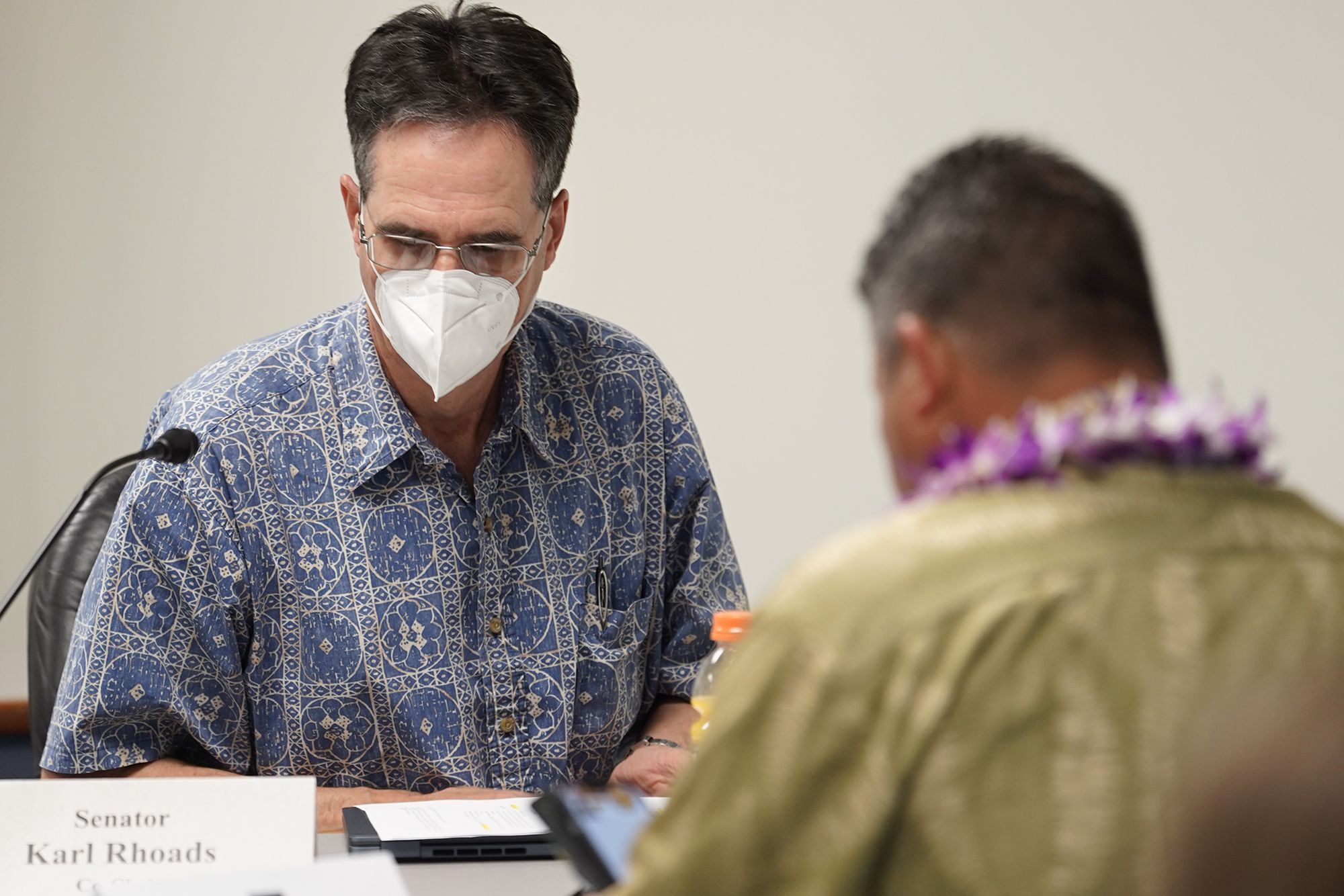
That comment drew a whoop from someone in the hearing room, and Yamashita continued: “I think this is something very big, and both House and Senate have worked hard on this to come up with a compromise.”
House Speaker Scott Saiki has described HB 2404 as “probably the most significant tax bill” of the session.
Meanwhile, Senate Bill 3289 — a much more controversial measure dealing with Hawaii’s estate tax — quietly died for the year.
That measure would have exempted more people from Hawaii’s estate tax. But critics said the measure would only benefit the wealthiest 0.2% of Hawaii residents, and lawmakers rejected it.
DHHL Gets More Time To Spend Funds
Among the many measures that were moved to the last day of conference committee — the final major deadline ahead of session’s end — was Senate Bill 3109, which extends the deadline for the Department of Hawaiian Home Lands to use $600 million in funding approved by lawmakers two years ago.
While the department has encumbered much of the money, it was at risk of losing tens of millions of dollars by June 30. Under SB 3109, though, DHHL will now be allowed to lapse $129 million, which will be placed into a special fund.
“I know the Department of Hawaiian Home Lands has been doing a very good job in encumbering these funds going forward,” said Rep. David Tarnas, the lead House negotiator on SB 3109. “And this will enable them to have the flexibility to carry out our desires to get more Hawaiians on Hawaiian homelands.”


Lawmakers also reached agreement on a bill that will give the University of Hawaii’s chief financial officer procurement authority over construction and related professional services.
That authority had long been with the UH president, but in 2013 state senators shifted it to the Hawaii State Procurement Office. Senate Bill 2499 initially sought to permanently reinstate that power with the UH president.
But Sens. Donna Kim and Donovan Dela Cruz changed the bill earlier this month to instead give the procurement power to Brennon Morioka, the dean of the UH College of Engineering. No rationale was provided, and it came after the public comment period on bills had passed.
On Friday, Rep. Scot Matayoshi said that the agreed-upon draft designates the university’s chief financial officer as its chief procurement officer effective June 28 and inserts a four-year sunset date, meaning it will again be revisited in 2028 — an amendment supported by Kim.
The Demise Of A Water Bill
UH will also get $1 million to set up a two-year program to develop a statewide wildfire forecast system using artificial intelligence.
UH supported Senate Bill 2284 and testified that the UH Manoa College of Engineering’s research capabilities in AI would be a key part of the program.
Not making the cut Friday afternoon, however, was a major water bill that was supported by the Office of Hawaiian Affairs, the Board of Water Supply, the grassroots group Lahaina Strong and the Sierra Club but was opposed by the Attorney General’s Office and the Department of Land and Natural Resources.
House Bill 2690 called for setting up a water policy coordinator and other positions within the Commission on Water Resource Management to coordinate the Red Hill Water Alliance Initiative, or Red Hill WAI.


CWRM, as the commission is known, would still be administratively attached to the DLNR but have greater independence. It would also create a Red Hill special fund for the remediation of pollution and appropriate money for it.
The bill was inspired by both the recent Red Hill Bulk Fuel Storage Facility fuel spillage and the Lahaina fires.
Inouye, chair of the Senate Water and Land Committee, said she was “greatly disappointed” that the House would not support the Senate amendments but said the issue would be introduced again next year.
She said there was agreement by both chambers that the bill was “urgently needed and very important — not just for Red Hill, but also for Lahaina,” noting the issue of water rights is all the more important now because of the giant task of rebuilding the West Maui town.
Tax Dollars At Work
One of the final bills to be approved early Friday evening was House Bill 2340, the annual claims-against-the-state bill. Civil Beat reported on several of those claims this year including a $750,000 settlement of a lawsuit over the death of a 3-year-old boy in state foster custody in 2017 on the Big Island.
The claims bill is introduced at the beginning of session in January but lawmakers do not approve the payments until the Attorney General’s Office has finalized them. The bill, which passed easily, contains 41 claims that total $18.8 million.
Since the bill was last amended, two new claims were settled for an additional $71,500.
The claims require the state to pay the Sierra Club $35,000 for attorney fees and costs in a 2022 case involving the Board of Land and Natural Resources regarding stream water diversion, and for the state to pay $35,000 in settlement with a deputy sheriff who was involved in an accidental gun discharge incident in 2020.
And there is a lot of money going toward ridding the state of invasive species. Lawmakers approved Senate Bill 2401, which helps counties pay for feral chicken control programs. Money will also go to the Department of Health for a campaign to educate the public about the importance of not feeding feral animals.
The funding is secured through a measure that passed Thursday that appropriates almost $20 million to help control and eradicate little fire ants, coconut rhinoceros beetles, coqui frogs, rose-ringed parakeets, two-lined spittlebugs and brown tree snakes.
“A major focus this year has been invasive species, and of course, feral chickens are a part of that issue,” said Rep. Cedric Gates, adding that lawmakers are hoping the omnibus bill will help “really get a grip on the invasive species issues that we see statewide.”

Sign up for our FREE morning newsletter and face each day more informed.


Here’s what you need to know about the University of Arizona
UA was established in 1885, and its main campus is in Tucson. The Wildcats once had a live bobcat named Rufus as a mascot.
The Republic
If point guard JJ Mandaquit’s job at Arizona next season looks tricky and challenging, having to glue together a lineup full of potential NBA draft picks under the pressure of playing for a returning Final Four team, it might be worth considering what his grandfather and father have been up to.
They’ve been running a roofing company … in Hilo, Hawaii. The rainiest city in the country, on the windward side of the Big Island. Where some 130 inches of rain hit buildings every year, creating slick working conditions, and where, even in drier moments, there’s high humidity and trade winds to deal with.
“I had to go on the roof a couple of times,” Mandaquit said, chuckling. “But not in the rain.”
He had other things to do. With his basketball skills overshadowing the local level of play since his elementary school years, Mandaquit left Hilo as a sixth-grader to begin a higher-level basketball journey that put him in Tucson this year.
His family came with him to Oahu, where he transferred to the Iolani School of Honolulu. His father, Jason Sr., commuted back and forth between Oahu and the Big Island while still roofing, though his mother was able to transfer from Hilo to Honolulu within her job at Hawaiian Electric.
Everyone thought that was the plan for a while.
“It was a better opportunity, better education and more opportunity,” Mandaquit said. “When we left from Big Island to Oahu, that was a huge move for my family, a lot of sacrifice that went into it. I’m super grateful to my parents. When we made that move in the sixth grade, we thought that was going to be the move, that it was just going to end there, I’d go to high school there.”
It still wasn’t enough. Mandaquit outgrew the basketball scene again. By ninth grade, he moved on to Real Salt Lake Academy, which turned into Utah Prep.
In Hawaii, he found players have also been kept from high-profile West Coast clubs because of a quirky club-ball residency rule in which players are typically allowed to play only for a club in their state or a bordering one — and Hawaii borders only an ocean. So Mandaquit said he and other locals started their own “Sons of Hawaii” club to play on the “MADE Hoops” circuit.
It still wasn’t enough. Utah was next.
“We felt it was best to get out of Hawaii and chase this dream,” Mandaquit said. “It wasn’t an easy choice to leave home, but we felt looking at the big picture, if I want to play at the high Division I level, we almost felt that it was a necessity to get out of the islands, surround myself with better competition, be somewhere that allows me to be more exposed.”
That move paid off. Mandaquit grew into a high-major prospect at Utah Prep and became a mainstay with USA Basketball junior teams. He won three gold medals at FIBA events: At the 2023 U16 AmeriCup, the 2024 U17 World Cup and, on a team led by UA coach Tommy Lloyd, the 2025 U19 World Cup.
Only a secondary recruiting target of Arizona’s before he committed to Washington in November 2024, Mandaquit jumped out at Lloyd while playing for USA Basketball last summer. Mandaquit averaged 6.1 points and 5.4 assists — with nearly a 4-to-1 assist-turnover ratio — while hitting 6 of 10 3-pointers over USA’s seven-game romp.
“I had only seen him play a few times before (last summer), but I was just so impressed with his character, but also his tenacity and the effort he played with. Just how he impacted winning,” Lloyd said. “So obviously, when we saw his name on the transfer portal, it piqued my interest right away.”
Lloyd said he considered Mandaquit out of high school, but the Wildcats were also pursuing Brayden Burries and had Jaden Bradley projected to stay through last season. Lloyd said he also took a cautious recruiting approach in 2025 because “you just didn’t know” how rev-share and NIL were going to work out, since 2025-26 was the first year schools could pay players.
So Mandaquit chose the Huskies over USC and Creighton. He started the Huskies’ first five games but wound up playing off the bench for most of his 22 appearances, averaging 5.2 points and 2.1 rebounds while shooting 28.2% from 3-point range.
Mandaquit struggled with a foot issue in the preseason and eventually missed the Huskies’ last 11 games because of it, though he has since had corrective surgery and returned to the court at Arizona.
“It was a great learning experience,” Mandaquit said of Washington. “I didn’t have the year that I wanted to have, but just going through that experience is gonna be huge for me and my future. I’ve got one year of college basketball under my belt, and the Big Ten was awesome last year.”
After he left Seattle, SI’s Huskies website wrote that UW coach Danny Sprinkle “has to be reeling by Mandaquit’s departure,” saying Mandaquit’s playing style “seemed to match Sprinkle’s hard-nosed personality.”
Instead, Mandaquit will be playing for the same coach he said he loved playing under last summer in Switzerland. Mandaquit joined a team that included former UA forward Koa Peat, incoming UA freshman Caleb Holt and No. 1 NBA Draft pick A.J. Dybantsa, among others.
They were all stars, forced together to play team ball during the world’s highest-profile junior tournament.
Gold was the expectation.
“What he was able to do with our group in such a short amount of time, I just loved,” Mandaquit said of Lloyd. It was “just the culture that he was able to build. Obviously, it’s not the easiest job as a coach to be able to manage all of the star players and egos that we had. It was just the way that he was able to get everyone to just buy in and focus on a common goal, and ultimately go and reach that goal.
“It was amazing. It was the most fun I ever had playing basketball.”
Despite their bond, Mandaquit said he couldn’t have a recruiting conversation with Lloyd until after he entered the portal this spring. But that might have been a formality anyway.
Both Lloyd and Mandaquit knew plenty about each other at that point.
“This time it was fast,” Lloyd said. “We both knew what we wanted on both sides.”
Lloyd needed a true point guard to join North Carolina transfer Derek Dixon and Holt in a reloaded backcourt that lost NBA Draft picks in Burries and Bradley.
Mandaquit wanted to be under Lloyd for more than a few weeks.
Official elapsed time between Mandaquit’s early April entry into the transfer portal and his commitment to Arizona: Ten days.
“When this opportunity came back around, I couldn’t pass it up,” Mandaquit said. “I knew this is the place that I wanted to be, and I knew I wanted to be coached by Tommy.”
During an interview at McKale Center last month, Mandaquit said he’s since arrived at Arizona to find high-character guys around him, and that coaches are pushing him the way he wants to be pushed.
“I’m loving it so far,” Mandaquit said.
As a bonus, Mandaquit’s first season with the Wildcats will also take him nearly full circle. Not to Hilo and the Big Island, but to the Maui Invitational, the prestigious early-season event that Mandaquit said he routinely watched on television even if the inter-island hop and high ticket prices kept him out of the Lahaina Civic Center to watch in person.
This time, he’ll be in the building — and soaking up the atmosphere outside it. His parents, now living back in Hilo, can make the easy flight over to watch, too.
It probably won’t rain much, if at all, Lahaina being on the leeward side of Maui and all.
But, for Mandaquit, it’s still home.
“Hawaii means everything to me,” Mandaquit said. “I try to get back there as much as possible, and I feel the support of the state behind me. I feel their love, so it pushes me to work harder.”

A 32-year-old Pahoa man on probation for auto theft pleaded not guilty Thursday to sex assault charges.
Hilo Circuit Judge Peter Kubota maintained Brandon K.C. Sanchez’s bail at $108,000 and ordered him to return to court for further proceedings on Oct. 9.
A Hilo grand jury on Wednesday returned a five-count indictment charging Sanchez with second-degree sexual assault and four counts of fourth-degree sexual assault. He was also charged with five counts of violating probation.
According to court documents filed by police, the alleged offenses took place on the evening of June 15 and the victim was a 21-year-old woman.
The woman reportedly told police she had just met Sanchez when he was a customer at the Hilo fast-food restaurant where she worked. She agreed to hang out with him and allowed him to drive her car.
Sanchez drove to Honolii, and at one point told the woman he had recently gotten out of jail and wanted to have sex with her, which led to her telling him no multiple times, according to the documents.
Sanchez allegedly then asked if she’d kiss him, to which she assented under the condition that he stop the pressure to have sex.
On the way back to Hilo, Sanchez reportedly touched the woman’s breast and genitals through her clothing, put his mouth on her breast, and slipped a finger inside her genitals — all against her will.
Documents state that Sanchez admitted to police that he touched the woman’s breast through her clothing once, but denied all other allegations.
Second-degree sexual assault is a Class B felony offense that carries a maximum sentence of 10 years imprisonment. Fourth-degree sexual assault is a misdemeanor that carries a potential one-year jail term.
Sanchez remains in custody at Hawaii Community Correctional Center in lieu of bail.
Email John Burnett at john.burnett@hawaiitribune-herald.com.

HONOLULU (HawaiiNewsNow) – A hiker was rescued after suffering a medical emergency on the Diamond Head Crater Trail Saturday morning.
The Honolulu Fire Department said crews responded at about 10:30 a.m. after a woman in her 30s became unable to descend from the top of the trail.
Firefighters climbed the trail on foot while another crew prepared a nearby landing zone for air operations.
HFD’s Air 1 helicopter inserted rescue personnel to the woman’s location, where they assessed her condition and provided basic life support.
The hiker was then airlifted to the landing zone and transferred to Honolulu Emergency Medical Services shortly after 11 a.m.
No firefighter injuries were reported.
Copyright 2026 Hawaii News Now. All rights reserved.
-

 New Hampshire20 seconds ago
Missing motorcyclist found dead after crash in Shelburne, NH
-

 New Jersey6 minutes ago
New NJ businesses include non-alcoholic liquor store, art school
-

 New Mexico12 minutes ago
As New Mexico’s opioid settlement funds tickle in, they are tough to track
-

 North Carolina18 minutes ago
Town of Pine Knoll Shores announces Ryan Thompson to depart after 18 years
-

 North Dakota24 minutes ago
Wrestling: Yates, Raper excel in North Dakota – Salisbury Post
-

 Ohio30 minutes ago
Can Ohio State Survive Its Own Schedule? Inside the Buckeyes’ 2026 Playoff Math
-

 Oklahoma36 minutes ago
Oklahoma Ford Sports Blitz: July 12, 2026
-

 Oregon42 minutes ago
East Evans Creek Fire grows to 3,154 acres

