Connect with us

Hawaii

Hawaii County Mayor's Race Is Getting Lots Of Cash This Year

Published

on

Hawaii County Mayor's Race Is Getting Lots Of Cash This Year


Most top legislative races have drawn less support from political donors.

Hawaii County Mayor Mitch Roth has raised and spent tens of thousands of dollars more than his opponent, Kimo Alameda, in his bid to win a second term.

But so far that’s been noticeably less than at the same point four years ago, when Roth easily beat Ikaika Marzo, a business owner.

Marzo in 2020 had far fewer campaign resources than Alameda in 2024, who has attracted a broad range of donations in the contest and is considered a more serious rival.

Advertisement

Both candidates have also held several fundraisers in the waning days of the general election, illustrating their need for cash to garner votes on Hawaii’s largest island.

Roth asked for money at Duc’s Bistro in Honolulu and the Hilo Hawaiian Hotel in September, while Alameda held four fundraisers in September — one each at the Kaimana Hotel in Honolulu and at the Kona Elks Club, and two at the Hilo Lagoon Center.

Roth reported more than $330,000 in contributions, including $50,000 from Sept. 17 through Oct. 21, which covers the latest filing period. Alameda received $284,000 in contributions, with $28,000 coming in during the recent reporting period.

Hawaii County Mayor Mitch Roth, left, has a campaign finance edge over challenger Kimo Alameda, but both have proven prodigious raisers of funds. (David Croxford/Civil Beat/2024)

Meanwhile, Roth outspent Alameda by $100,000 — $340,000 to $241,000. Roth is depending heavily on TV advertising. Most of the $109,000 he paid during the recent filing period went to Hamburger Group Creative of Washington, D.C.

For his part, Alameda expended $44,000 during the same period, nearly half of it going to Oahu Publications (it owns newspapers in Hilo and Kailua-Kona) for print ads.

Both candidates have received a number of donations from local sources willing to shell out a minimum $1,000.

Advertisement

For Roth, they include executives with Hilo Auto Sales, Commercial Plumbing and Kona Salt Farm. Groups giving to the mayor include Hawaii Operating Engineers Industry Stabilization, Hilo Opportunity Zone Fund, General Contractors Association of Hawaii and Big Island Federal Credit Union.

Alameda has received similarly sized donations from executives with Big Island Grown, JL Hauling and Dickinson General Contracting. Local Union 1186 IBEW PAC Fund also gave $1,000 in the recent reporting period.

The challenger, a clinic administrator and psychologist, also received $10,000 from executives with businesses in Washington state such as Cedar Grove Electric and Emerald Services.

Senate Races Of Interest

The Roth-Alameda race, which is nonpartisan, is perhaps the most high profile contested election statewide, but there are other competitive, partisan races that have attracted media and donor attention.

They include two races for the state Senate and several in the state House of Representatives.

Advertisement

Republican Sen. Brenton Awa is in his first term representing District 23 (Kaneohe, Kahaluu through Laie, Kahuku to Mokuleia, Schofield Barracks and Kunia Camp) and is one of only two GOP members in the 25-member Senate.

Awa, a former television newscaster, has spoken publicly about his disdain for campaign contributions. He believes donations unduly influence legislators.

To that end, Awa has raised a mere $2,000 and spent just half of it this election cycle. He reported no contributions in his most recent filing and spent nothing on his campaign.

That stands in contrast to his Democratic opponent. And unlike Awa, Ben Shafer faced a primary opponent, former state Sen. Clayton Hee.

Shafer’s latest filing shows that he has a negative cash balance of $1,300, having spent more than the $67,000 he received in contributions.

Advertisement

His most recent contributors include state Sen. Les Ihara, former legislator Pono Chong, Sheetmetal Workers Local Union 293 and AFSCME Local 646.

The District 23 seat has switched parties several times. In an indication of how fluid relations and loyalties can be, a former occupant of the seat, Gil Riviere, sponsored two fundraisers in September for Shafer at Duc’s Bistro. Riviere, a former Republican, narrowly lost his seat to Awa in 2022 as a Democrat.

Another Senate race pits Democrat Cedric Gates against Republican Samantha DeCorte. The District 22 seat (Koolina, Nanakuli, Maili, Waianae, Makaha and Makua) is temporarily occupied by Cross Makani Crabbe, who was appointed to the position this summer to replace Democrat Maile Shimabukuro, who stepped down in May and endorsed Gates.

Gates, a state representative, pulled in $139,000 in contributions and spent $148,000. But he still has $12,000 in cash on hand, thanks in part to funds transferred from his previous House campaigns.

Recent contributors to Gates include Hawaii Gov. Josh Green and state Sen. Jarrett Keohokalole. Gates spent $17,000 during the latest reporting period, including for advertisements in the publication Westside Stories and to pay for postage on mailers.

Advertisement

DeCorte has raised and spent far more modestly — $48,000 and $36,000, respectively. Contributors include businessman Christopher Flaherty. DeCorte’s latest expenditures include paying for graphic design, printing and text messaging.

And In The House

The District 22 race is one of several in the Ewa and Westside regions of Oahu that have seen Republicans make gains in recent elections. They include three House races where GOP incumbents hope to fend off Democratic challengers. Democrats currently hold 45 of the 51 House seats.

In one of those races, Democrat Corey Rosenlee, a former head of the Hawiai State Teachers Association, is challenging Rep. Elijah Pierick for the District 39 seat (Royal Kunia, Village Park, Honouliuli, Hoopili and portions of Waipahu).

Rosenlee has raised $30,000 in donations but has spent $47,000, an amount that includes $20,000 the candidate gave to himself. His contributors include the HGEA Political Contribution Account, the University of Hawaii Professional Assembly, the United Public Workers PAC and state Reps. Della Au Belatti and Sean Quinlan.

The candidate spent $22,000, according to his most recent filing, with most of the money going to pay for mailing campaign postcards.
Advertisement
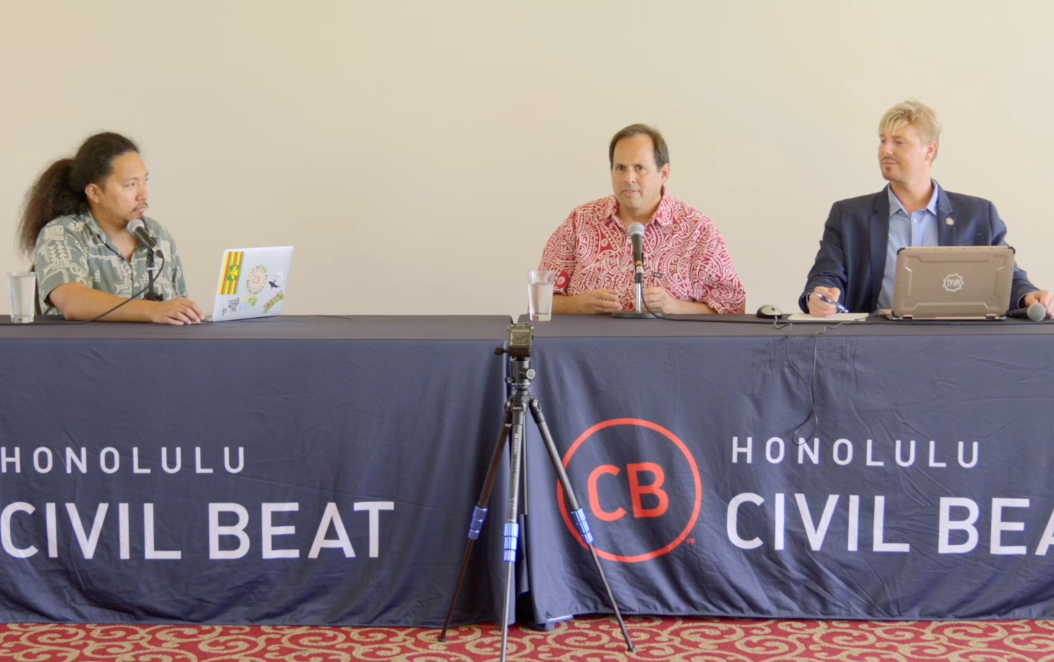
Moderator Blaze Lovell interviewed House District 39 candidates Corey Rosenlee and Elijah Pierick at a recent forum. (Civil Beat/2024)

Pierick reported $40,000 in contributions in the current election cycle but has spent only $17,000. Most of his expenses went to Meta, the company that runs Facebook, Instagram, Threads and WhatsApp.

One of the contributors to Pierick, James Adamson, is listed on Pierick’s filing as having an unknown occupation because, as the representative wrote in his report, “I was sign waving and he gave me a check.”

House and Senate districts are much smaller political divisions than counties, which is why legislative campaigns spend so much money on mailers and postage.

Anthony Makana Paris, a Democrat running against GOP incumbent Diamond Garcia in District 42 (portions of Varona Village, Ewa, and Kapolei, and Fernandez Village), paid Cardinal Services of Honolulu nearly $5,000 for printing and mailing charges in October. Roughly the same amount went to Service Printers of Honolulu for similar services.

Paris has spent $38,440 this election, using up nearly all of the $39,275 he raised. Contributors include Masons Local 630 PAC.

Garcia has raised and spent much less. Contributors include Pono Petroleum of Kapolei, while expenditures include $590 to American Campaign Finance of Honolulu for a database subscription. Garcias also paid Villages of Kapolei magazine $1,397 for an advertisement.

Advertisement

Meanwhile, GOP incumbent David Alcos is up against Democrat John Clark III in the District 41 House seat (portion of Ewa Beach, Ocean Pointe and Barbers Point). Neither had raised much money, nor spent much.

Nevertheless, Alcos paid $1,535 for food and beverage related to his campaign at the Costco Wholesale Corporation Golf Tournament Event, and another $2,940 for events and activities at the Coral Creek Golf Course in Ewa Beach. And Clark paid $1,257 to Reskyu of Honolulu for postcards and $2,717 to Cardinal Mailing Services of Honolulu for postage fees to mail the postcards.


Source link

Hawaii

A Deep Dive into Hawai‘i’s Shell Jewelry Industry – Hawaii Business Magazine

Published

on

A Deep Dive into Hawai‘i’s Shell Jewelry Industry – Hawaii Business Magazine


They adorn casual beachgoers, become treasured accessories for bridal parties and decorate the resplendent elite as they glide among guests at private dinners.

Hawaiʻi is a rich resource for this nascent business sector as demand builds across the Islands and across the globe. Exactly how big a business it has become is something of a mystery, though. State figures actually show the number of licensed sellers has declined in recent years, though officials admit that’s probably due to lack of awareness and noncompliance rather than reflecting reality.

“Shell jewelry has really only exploded in the last seven or eight years,” says Brooke Holt, founder and designer of 21 Degrees North Designs on Oʻahu. “Don’t get me wrong,” she adds, “I love shells. I love shell jewelry. That’s why I first wanted to make it, [but] I’m kind of over it at this point because it’s so oversaturated.”

When Holt started making shell jewelry in the mid-1990s, there weren’t many others creating newer styles of jewelry with Hawaiian shells outside of the revered tradition of Niʻihau shell lei. Now, jewelers selling shell designs are abundant, judging by the availability of choices online and in stores. Accessories such as sunrise shell necklaces, Hebrew cone earrings, and miter and Tahitian pearl bangles have become iconic staples of island style.

Advertisement

While the shell jewelry industry appears to be expanding in tandem with the popularity of this merchandise, it remains a largely under-documented domain, lacking the data necessary to quantify its true size and impact. Strict requirements of state regulations may actually be driving sellers to evade the mandates.

Technically, anyone taking marine life from Hawaiian waters for commercial purposes must hold a Commercial Marine License (CML), according to the state Department of Land and Natural Resources’ Division of Aquatic Resources (DAR). The license, which costs $100 for residents and $250 for non-residents annually, mandates strict monthly harvest reporting.

“It is important to note that because marine life is defined in the rule as including even parts of living organisms, this licensing requirement applies to the commercial collection of live specimens, empty shells, and even shell pieces,” says DAR Aquatic Biologist Bryan Ishida.

Regulation extends down the supply chain. Businesses that purchase marine life — including empty or fragmented shells — directly from CML licensees for commercial resale must obtain a Commercial Marine Dealer License (CMDL), which costs $100 per year and requires weekly reporting.

Ishida says these licensing fees “are vital to maintaining DAR’s objective of protecting aquatic resources for future generations.” By law, these proceeds are directed into the Commercial Fisheries Special Fund to bankroll research, monitoring and the staff that work in commercial fisheries management.

Advertisement

These reports also serve as an economic barometer. “CMDL reports, in particular, provide the ability to track even small changes to market demand, pricing and other trends,” Ishida explains.

However, the department admits licensing and reporting compliance in the shell sector is “likely quite low” compared to the seafood sector. According to their records, commercial participation peaked in 1977 with 44 shell collectors submitting reports; over the last decade, the number of CML holders reporting shell harvests has dwindled to ten or fewer annually.

This decline is primarily attributed to a lack of awareness. “DAR recognizes this and understands that increased outreach and non-enforcement measures are needed to raise compliance,” Ishida says, but the agency must prioritize using “their limited resources on the harvest of live aquatic life,” and most shells harvested for jewelry are thought to be empty shells.

Figaroa’s grandmother Loka Kenemaka Kaohelaulii (center) mentored him in the art of making Niʻihau shell lei, which she and her two companions are pictured wearing. Photo courtesy of Kealoha Figaroa

Honoring a Tradition

Shell jewelry has been an integral part of Hawaiian culture for centuries, with ample evidence indicating Niʻihau shell lei predate the arrival of Captain Cook in 1778. They are made of rare, tiny shells found off the rugged coast of the Forbidden Isle.

Advertisement

According to Kealoha Figaroa, founder of Niʻihau shell jewelry company Pūpū Creations, many of the shell species used to construct Niʻihau shell lei are found on other islands, but ones found on Niʻihau are prized because they “hold their luster” better. He guesses that this is because there’s comparatively less freshwater runoff into the ocean. “My family tells me on Niʻihau, the water is so pristine that you can see about 300 feet down into the bottom of the ocean,” he says. For his family, and many others from the island, the tradition of creating shell leis has been passed on for many generations.

Figaroa recalls memories from childhood spent at a table where elders would dump hundreds of shells for the children to organize. “All our grandparents… they would take all the kids, and they would tell us, ‘Okay, you need to sit here and sort these shells by color, by size, by all that.’ And of course, we hated it. But for the older people, it was very important for us to learn these things, so that when we do see these leis, we have much more appreciation for the leis.”

Once they had mastered the sorting process, the children would learn the delicate art of piercing the shells. Only after proving their proficiency in that skill were they allowed to begin stringing them together, starting with smaller pieces like earrings before eventually advancing to leis.

Still, Figaroa says that gathering shells from the beach is by far the most tedious part of the process. Figaroa explains that collecting a sufficient number of matching shells to create a high-quality, symmetrical lei requires immense patience. “It’s anywhere from two weeks all the way up to three years to make one lei,” he explains. The considerable time and craftsmanship required to create these intricate pieces are reflected in their price tag, which can reach upwards of tens of thousands of dollars.

Figaroa, who lives on Oʻahu, says his cousins frequently send him shells from Niʻihau to create the lei sold by his business, Pūpū Creations. “I allow space for my family members to also have some other items on sale so they can profit from it as well, and not just myself.” He says one reason he loves collaborating with his relatives is that “there’s different family members that have specific styles.”

Advertisement

One of his cousins, for example, specializes in delicate color gradients. And Figaroa, mentored by his grandmother, took after her in specializing in working with momi shells to create three-strand leis and the straight Kui Pololei style.

Jewelry and fashion designer Brooke Holt at work in her Mākaha studio. Photo by Aaron Yoshino

The Evolution of Shell Jewelry

Newer styles of Hawaiian shell jewelry have emerged in recent decades. They often feature cone shells, cowries, drupes and miters not typically found in the Niʻihau shell lei tradition.

One of the contemporary style shell jewelry makers on the scene is Anoʻipua Kaaloa, who started out as a shell collecting hobbyist. Kaaloa says the kinds of shells she finds differ based on whether or not she’s looking on the Windward Side or Leeward Side: On the east side, “I’ll find a lot of abbreviated cones, tumbled pink cones, the endemic Hawaiian golden yellow cones, strombs, Adam’s miters, lettered miters. Then on the other side of the island, I find so many cowries” and rarer shells to come by, “like marble cones, leopard cones.”

She says she saw other people making jewelry with their beach finds and thought, “That looks cool. I think I can do that with my shells.” Her business, ʻAnoʻipūpū Jewelry, sells everything from shell necklaces, earrings, bangles, belly button rings and keychains. She says her favorite pieces to make are resin earrings that contain a bunch of different micro shells because they are one of her more “unique” designs.

Advertisement

When she started selling her pieces in late 2024, Kaaloa says she was motivated to not only create “nice jewelry, but more affordable” merchandise, because a lot of the market is “really expensive.” When figuring out her price points, she says she considered “if I was to buy my own jewelry, what prices would I want to set?”

Like many other shell jewelry businesses, Kaaloa operates without a traditional brick-and-mortar storefront. Instead, she has built a loyal following through markets, appearing as a regular vendor at the Kakaʻako Farmers Market every Saturday and the Kailua Farmers Market on Sundays.

Despite having neither a physical shop nor an e-commerce website, Kaaloa found enough success at the markets that she was able to quit her former job in the food service industry and focus on running her business full-time a little over a year into opening ʻAnoʻipūpū Jewelry. “I’m grateful, that’s for sure,” she says.

Holt, founder and designer at 21 Degrees North Designs, makes jewelry from an array of materials, including coral, pearls, sandalwood beads, neon thread, lauhala, silver, gold and, of course, shells.

Having partially grown up in Mākaha, she’s been frequenting Oʻahu’s west side beaches in search of shells since the 1980s.

Advertisement

“I had different beaches for different shells,” Holt explains. “Some shells you can find up and down the coast, but others you can only find in very specific spots. I started then researching what types of shells grow in what types of reef situations.”

The daughter of a fashion designer mother and a glass blower father, Holt naturally felt inclined to do something creative with the shells she found, which led her to taking up jewelry making.

Holt finds that inspiration can strike from anywhere: “sometimes it’s a color, sometimes it’s a concept, sometimes it’s a place.” For instance, the design for one of her first pair of statement earrings began with a moment of observation while surfing.

Captivated by how “the water and the sun playing on the ripples gives it all those little dancing rings, I wanted to make earrings that represent that, so I made these concentric circle earrings. I like organic shapes and asymmetrical things.”

In an era of viral trends and mimicry, Holt says it’s important that her pieces stand out. That’s “the greatest compliment I can get, and I do hear it a lot at my markets. I want to be different. I don’t want to look like anyone else.”

Advertisement

One concern Holt has is the impact an increase in shelling has on the environment: “You want to encourage entrepreneurship, but again, we’re still perpetuating this culture of, take, take, take…. So, yeah, do we need to start having limits?”

Hawaiʻi’s most venomous cone shells (left to right): the banded marble cone (Conus bandanus), the textile cone (Conus textile), and the Hawaiian striated cone (Conus striatus). Photo: MarinelifePhotography.com

The Ethics of Shelling

It isn’t illegal to take live shells, but Ishida says “DAR requests that commercial collectors do so sparingly and only as demand requires as many species are quite rare” or little is known about their abundance. The agency strongly recommends collecting empty shells rather than live specimens.

“However, DAR asks commercial collectors to remember that shells, even when empty, contribute to the ecosystem, whether providing a home for a hermit crab or over years wearing down into sand and other seafloor substrate,” says Ishida.

For artisans like Figaroa, Kaaloa and Holt, the first rule of the reef is absolute: only take empty shells. They look for signs of life — like a visible body or a sealed operculum — whereas sand and rocks in the aperture indicate the shell is dead. “The only way shells can reproduce plentifully is if the reef system is healthy. If the reef is not healthy, you won’t get your shells,” Figaroa says.

Advertisement

Marine educator Keoki Stender, founder of MarinelifePhotography.com, warns that damage often happens through simple negligence, such as walking on reefs made of mussels and oysters at low tide: “If you trample it, you crush the shells. You kill hundreds at one time. You have to be mindful of what you’re stepping on.”

He also implores beachgoers to return things back to where they originally were when exploring the ocean and tide pools. For example, “If you leave the rock overturned, the sun’s going to fry everything [on the bottom], the fish are going to eat everything that is here and exposed, and then the life that was on the top of the rock is going to die [underneath], and the part of the reef where you turn the rock and put it onto the reef is going to kill everything on that part of the reef too,” he says.

Ishida reminds commercial collectors that as a natural resource, “empty shells are for everyone’s enjoyment. People who want to collect shells for their own personal collection, jewelry making for themselves, or just enjoying seeing them while diving should be able to do so. Accordingly, commercial collectors should think about their impact on not only the environment but others who may want to collect shells for non-commercial purposes.”

Keoki Stender pictured at his studio lab. Photo by Aaron Yoshino

Where Shells Come From and What to Look Out For

The shells used in jewelry come from animals in the mollusk phylum. To protect their vulnerable, soft bodies, many mollusks have evolved to build exoskeletons, a.k.a. shells, by secreting minerals through a specialized organ called the mantle.

Advertisement

Keoki Stender, a marine educator, photographer and founder of MarinelifePhotography.com, says that you can glean a great deal about a mollusk’s lifestyle by examining its shell. Cowries, for instance, are the heavy-duty tanks of the reef. Their domed, “bottom-heavy” shell is engineered for stability. “The ones that are most domic — a humpback, very domed, flat bottom — they would be more likely to be in a high surf environment,” Stender explains. Combined with a foot that provides powerful suction, the humpback cowries’ low center of gravity allows it to “handle the full force of breaking waves” without being swept away.

In contrast, he says, the streamlined, “tapered shape” of miters and augers allows them to easily crawl through sand in search of prey. And the elaborate, spiny architecture of murexes serves as a defense “designed so no one can bite them.”

The diversity of patterns, from the distinctive black markings on Hebrew cones to the vibrant ombré of sunrise shells, is produced by pigment-secreting cells in the mantle. These cells act much like an inkjet printer, depositing color at the growing edge of the shell.

Some specimens in Stender’s extensive shell collection.

Cone snails are predators that hunt using a venomous harpoon-like tooth that shoots out the base of their shell. Their toxicity generally depends on that species’ diet. “The worm eaters are like a bee sting [to humans]. But if you’re allergic to bee sting, that can be really bad,” Stender warns. “The fish eaters are especially bad because if your prey is fast moving, you got to have a potent sting.”

Advertisement

Because specific cone snail species are among the most venomous animals on earth, being familiar with their patterns to discern which are dangerous is extremely important when handling. “The ones that have the worst sting are the tented pattern cones,” says Stender. In Hawaiʻi, textile, banded marble and striated cones possess a sting that is potentially fatal to humans.

Stender explains that lifespan varies significantly across species, noting a direct correlation between shell size and growth rate. “The bigger the shell, generally, the slower it grows,” he says, because the animal must extract a higher volume of minerals from both the water and its food to build its home. While Stender estimates that many micro-shell species live for only six months to a year, some larger mollusks — such as the leopard cone and tiger cowry — can live for a decade or longer.


Source link

Continue Reading

Hawaii

Kanakaʻole, Zane ʻohana transform Hawaiian cultural practices into captivating visual arts | Maui Now

Published

on

Kanakaʻole, Zane ʻohana transform Hawaiian cultural practices into captivating visual arts | Maui Now


Ea Mai ʻEiwa: Patterns of Practice. PC: Bishop Museum

This powerful new exhibition will feature the work of Nālani Kanakaʻole, Sig Zane, and Kūhaʻoʻīmaikalani Zane—a Hilo-based family of artists whose creative practices are deeply rooted in hula ʻaihaʻa.

Hālau O Kekuhi performs at Hoʻike during the 63rd annual Merrie Monarch Festival. (Kelsery Walling/Big Island Now)

Hula ʻaihaʻa is the low-postured, vigorous, bombastic style of hula that Kanakaʻole was known for as kumu hula of Hālau o Kekuhi. The hula springs from the eruptive volcano personas of Pele and her sister Hiʻiaka, characteristic of Hawaiʻi Island’s creative forces.

The Bishop Museum, the State of Hawaiʻi Museum of Natural and Cultural History, on Oʻahu is presenting “Ea Mai ʻEiwa: Patterns of Practice” in the J. M. Long Gallery beginning on Saturday, April 18, 2026.

The exhibition title references “Kūhaʻimoana,” a chant describing the migration of shark gods from Kahiki (ancestral homeland) to Hawaiʻi. “Ea Mai ʻEiwa” reflects the strength, resilience, and environmental knowledge embodied in these ancestral stories.

Advertisement
ARTICLE CONTINUES BELOW AD

Bringing together new and existing works alongside botanical specimens and cultural treasures from Bishop Museum’s collections, the exhibition weaves themes of migration, community resilience, and environmental stewardship—offering insight and inspiration for today.

“This exhibition demonstrates that the gap between historic collections and contemporary art is actually a lot smaller than people think,” said Sarah Kuaiwa, Ph.D., Bishop Museum curator for Hawaiʻi and Pacific Cultural Resources. “Audiences will see how the artists use the same materials as pieces in Bishop Museum collections but in different forms. The resonance between the artist’s work with mea kupuna (ancestors) is what makes ‘Ea Mai ʻEiwa’ a uniquely Bishop Museum exhibition.”

Kuaiwa curated the group exhibitions along with co-curator, kumu hula Kauʻi Kanakaʻole, and Bishop Museum exhibit designer, DeAnne Kennedy.

Ea Mai ʻEiwa: Patterns of Practice. PC: Bishop Museum

The artists’ work across visual and performing arts is continually charged and sustained by hula. From Nālani Kanakaʻole’s art direction and choreography to Sig Zane’s photography and textile design, and Kūhaʻoʻīmaikalani Zane’s graphic design and immersive installations, each artist channels ʻike (knowledge, wisdom) carried through generations.

ARTICLE CONTINUES BELOW AD

“Through repetition, deep study, and consistent practice, mastery is achieved. As practitioners of hula, the artists have continued to deepen their understanding of the natural and spiritual world, which has in turn inspired their art practices,” Kuaiwa said. “They aim to produce art in various visual media not only to educate, but to also be aesthetically celebrated and enjoyed.”

“Patterns of Practice” was suggested by Sig Zane as a way of representing how the artists hone their skills.

Advertisement

“‘Kūhaʻimoana,’ for me, has many layers to it,” Kūhaʻoʻīmaikalani Zane said. “On a first take, it’s a migratory chant that compares migrations to waves of ocean-navigating sharks. That metaphor sets out the tone of connectivity between our natural environment and the beings that inhabit it.”

“‘Kūhaʻimoana’ is an example illustrating metaphorical depth within Hawaiian poetry,” said Sig Zane. “The importance of navigation surfaces in day-to-day cultural practices. This archaic chant reveals nuanced content, giving us a peek into hierarchy, dualities, and familial belief systems.”

From left, Sig Zane, Nālani Kanakaʻole and Kūhaʻoʻīmaikalani Zane (Photo courtesy of ʻOhana Zane)
ARTICLE CONTINUES BELOW AD

Kanakaʻole passed away in January this year, so Kauʻi Kanakaʻole hopes that “Ea Mai ʻEiwa: Patterns of Practice” reflects Kanakaʻole’s philosophy of practice and piques curiosity within people about others’ stories, history, and culture.

ARTICLE CONTINUES BELOW AD

“She intentionally taught hula with depth of language, craft, and art form to encompass a full-on lifestyle commitment,” Kanakaʻole said. “This was her everyday; the way she learned, grew, and inspired.” “I would love for guests to leave (the exhibition) with a mixture of awe, appreciation, and curiosity.”

Ea Mai ʻEiwa: Patterns of Practice. PC: Bishop Museum

Highlights of the “Ea Mai ʻEiwa: Patterns of Practice” exhibition include:

  • Nālani Kanakaʻole’s kite installation, “Kūhaʻimoana,” her last large-scale installation before her passing
  • Botanical specimens from various locations across Hawaiʻi Island, chosen to represent their hula ʻahu (altar) and sources of inspiration the artists frequently draw from
  • Uniquely colored kūpeʻe (sea snails) shells made into adornments, as well as adornments made to look like kūpeʻe shells
  • Kapa (barkcloth) made from the 19th century with dynamic designs
  • ʻAwa (kava, Piper methysticum) cups and kānoa (kava bowl) associated with the aliʻi
  • New and archival sketches and rubylith artworks by Sig Zane from 1990 to present
  • A collection of family photos from the Kanakaʻole ʻOhana
  • Memorabilia and ephemera from the theatrical performance, “Holo Mai Pele” (1995-2000)

“Ea Mai ʻEiwa: Patterns of Practice” will be presented in both ʻŌlelo Hawaiʻi and English, and will be on view until Sept. 20, 2026.

For more information, visit bishopmuseum.org.

Advertisement


Source link

Continue Reading

Hawaii

Large section of Aloha Stadium demolished as project proceeds – West Hawaii Today

Published

on

Large section of Aloha Stadium demolished as project proceeds – West Hawaii Today


The demolition of Aloha Stadium on Oahu took a big step forward Thursday with the first section of seating pulled down from the steel structure.

Half of the elevated deck-level seating on the stadium’s makai side was severed and toppled backward as part of demolition work that began in February.

The other half of the upper makai-side seating is slated to come down Tuesday, followed by similar sections on the mauka side and both end zones, though the concrete foundations for lower-level end-zone seating are being preserved for a new, smaller stadium to rise on the same site.

A private partnership, Aloha Ha­lawa District Partners, led by local developer Stanford Carr, is replacing the 50,000-seat Aloha Stadium, which opened in 1975 and was shuttered in 2020, with a new stadium featuring up to 31,000 seats.

Advertisement

AHDP is using $350 million of state funding toward the cost of the new stadium, which could be $475 million or more, and will operate and maintain the facility on state land for 30 years with a land lease.

The development team also is to redevelop much of the 98-acre stadium property dominated by parking lots with a new mixed-use community that includes at least 4,100 residences, two hotels, an office tower, retail, entertainment attractions and open spaces expected to be delivered in phases over 25 years and costing close to or more than $5 billion or $6 billion.

Earlier parts of stadium demolition work led by Hawaiian Dredging Construction Co. included removing four covered multistory spiral walkways leading to the upper level from the ground, and concourse bridges.

Demolishing the stadium is projected to be done by August, according to Carr.

Building the new facility is expected to be finished in 2029.

Advertisement


Source link

Continue Reading
Advertisement

Trending

