Most top legislative races have drawn less support from political donors.
Hawaii County Mayor Mitch Roth has raised and spent tens of thousands of dollars more than his opponent, Kimo Alameda, in his bid to win a second term.
But so far that’s been noticeably less than at the same point four years ago, when Roth easily beat Ikaika Marzo, a business owner.
Marzo in 2020 had far fewer campaign resources than Alameda in 2024, who has attracted a broad range of donations in the contest and is considered a more serious rival.
Advertisement
Both candidates have also held several fundraisers in the waning days of the general election, illustrating their need for cash to garner votes on Hawaii’s largest island.
Roth asked for money at Duc’s Bistro in Honolulu and the Hilo Hawaiian Hotel in September, while Alameda held four fundraisers in September — one each at the Kaimana Hotel in Honolulu and at the Kona Elks Club, and two at the Hilo Lagoon Center.
Roth reported more than $330,000 in contributions, including $50,000 from Sept. 17 through Oct. 21, which covers the latest filing period. Alameda received $284,000 in contributions, with $28,000 coming in during the recent reporting period.
Hawaii County Mayor Mitch Roth, left, has a campaign finance edge over challenger Kimo Alameda, but both have proven prodigious raisers of funds. (David Croxford/Civil Beat/2024)
Meanwhile, Roth outspent Alameda by $100,000 — $340,000 to $241,000. Roth is depending heavily on TV advertising. Most of the $109,000 he paid during the recent filing period went to Hamburger Group Creative of Washington, D.C.
For his part, Alameda expended $44,000 during the same period, nearly half of it going to Oahu Publications (it owns newspapers in Hilo and Kailua-Kona) for print ads.
Both candidates have received a number of donations from local sources willing to shell out a minimum $1,000.
Advertisement
For Roth, they include executives with Hilo Auto Sales, Commercial Plumbing and Kona Salt Farm. Groups giving to the mayor include Hawaii Operating Engineers Industry Stabilization, Hilo Opportunity Zone Fund, General Contractors Association of Hawaii and Big Island Federal Credit Union.
Alameda has received similarly sized donations from executives with Big Island Grown, JL Hauling and Dickinson General Contracting. Local Union 1186 IBEW PAC Fund also gave $1,000 in the recent reporting period.
The challenger, a clinic administrator and psychologist, also received $10,000 from executives with businesses in Washington state such as Cedar Grove Electric and Emerald Services.
Senate Races Of Interest
The Roth-Alameda race, which is nonpartisan, is perhaps the most high profile contested election statewide, but there are other competitive, partisan races that have attracted media and donor attention.
They include two races for the state Senate and several in the state House of Representatives.
Advertisement
Republican Sen. Brenton Awa is in his first term representing District 23 (Kaneohe, Kahaluu through Laie, Kahuku to Mokuleia, Schofield Barracks and Kunia Camp) and is one of only two GOP members in the 25-member Senate.
Awa, a former television newscaster, has spoken publicly about his disdain for campaign contributions. He believes donations unduly influence legislators.
To that end, Awa has raised a mere $2,000 and spent just half of it this election cycle. He reported no contributions in his most recent filing and spent nothing on his campaign.
That stands in contrast to his Democratic opponent. And unlike Awa, Ben Shafer faced a primary opponent, former state Sen. Clayton Hee.
Shafer’s latest filing shows that he has a negative cash balance of $1,300, having spent more than the $67,000 he received in contributions.
Advertisement
His most recent contributors include state Sen. Les Ihara, former legislator Pono Chong, Sheetmetal Workers Local Union 293 and AFSCME Local 646.
The District 23 seat has switched parties several times. In an indication of how fluid relations and loyalties can be, a former occupant of the seat, Gil Riviere, sponsored two fundraisers in September for Shafer at Duc’s Bistro. Riviere, a former Republican, narrowly lost his seat to Awa in 2022 as a Democrat.
Another Senate race pits Democrat Cedric Gates against Republican Samantha DeCorte. The District 22 seat (Koolina, Nanakuli, Maili, Waianae, Makaha and Makua) is temporarily occupied by Cross Makani Crabbe, who was appointed to the position this summer to replace Democrat Maile Shimabukuro, who stepped down in May and endorsed Gates.
Gates, a state representative, pulled in $139,000 in contributions and spent $148,000. But he still has $12,000 in cash on hand, thanks in part to funds transferred from his previous House campaigns.
Recent contributors to Gates include Hawaii Gov. Josh Green and state Sen. Jarrett Keohokalole. Gates spent $17,000 during the latest reporting period, including for advertisements in the publication Westside Stories and to pay for postage on mailers.
Advertisement
DeCorte has raised and spent far more modestly — $48,000 and $36,000, respectively. Contributors include businessman Christopher Flaherty. DeCorte’s latest expenditures include paying for graphic design, printing and text messaging.
And In The House
The District 22 race is one of several in the Ewa and Westside regions of Oahu that have seen Republicans make gains in recent elections. They include three House races where GOP incumbents hope to fend off Democratic challengers. Democrats currently hold 45 of the 51 House seats.
In one of those races, Democrat Corey Rosenlee, a former head of the Hawiai State Teachers Association, is challenging Rep. Elijah Pierick for the District 39 seat (Royal Kunia, Village Park, Honouliuli, Hoopili and portions of Waipahu).
Rosenlee has raised $30,000 in donations but has spent $47,000, an amount that includes $20,000 the candidate gave to himself. His contributors include the HGEA Political Contribution Account, the University of Hawaii Professional Assembly, the United Public Workers PAC and state Reps. Della Au Belatti and Sean Quinlan.
The candidate spent $22,000, according to his most recent filing, with most of the money going to pay for mailing campaign postcards.
Advertisement
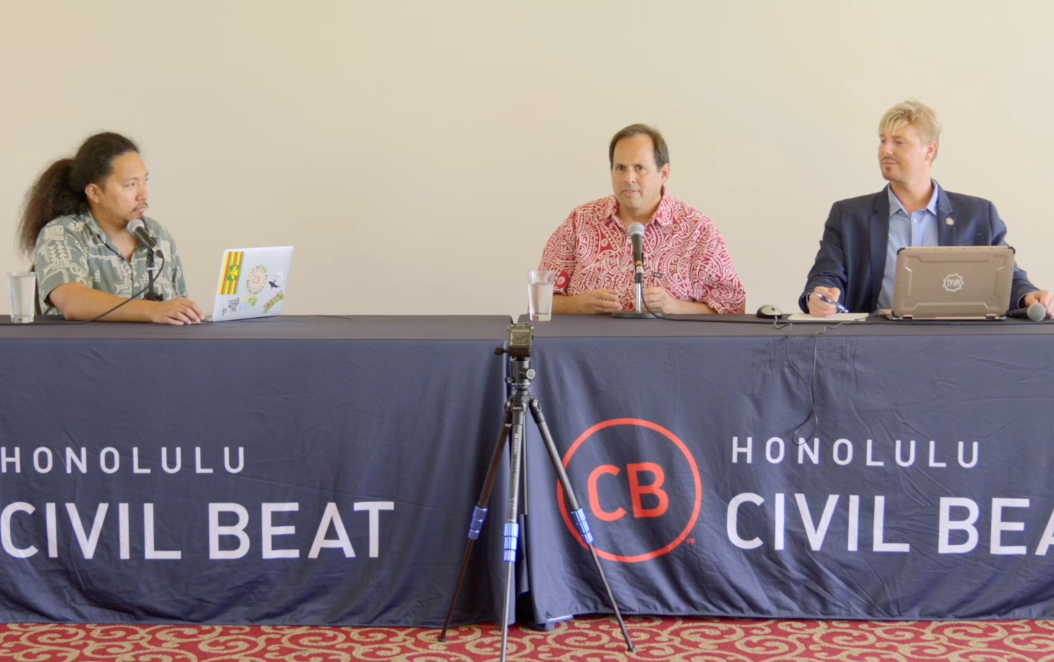
Moderator Blaze Lovell interviewed House District 39 candidates Corey Rosenlee and Elijah Pierick at a recent forum. (Civil Beat/2024)
Pierick reported $40,000 in contributions in the current election cycle but has spent only $17,000. Most of his expenses went to Meta, the company that runs Facebook, Instagram, Threads and WhatsApp.
One of the contributors to Pierick, James Adamson, is listed on Pierick’s filing as having an unknown occupation because, as the representative wrote in his report, “I was sign waving and he gave me a check.”
House and Senate districts are much smaller political divisions than counties, which is why legislative campaigns spend so much money on mailers and postage.
Anthony Makana Paris, a Democrat running against GOP incumbent Diamond Garcia in District 42 (portions of Varona Village, Ewa, and Kapolei, and Fernandez Village), paid Cardinal Services of Honolulu nearly $5,000 for printing and mailing charges in October. Roughly the same amount went to Service Printers of Honolulu for similar services.
Paris has spent $38,440 this election, using up nearly all of the $39,275 he raised. Contributors include Masons Local 630 PAC.
Garcia has raised and spent much less. Contributors include Pono Petroleum of Kapolei, while expenditures include $590 to American Campaign Finance of Honolulu for a database subscription. Garcias also paid Villages of Kapolei magazine $1,397 for an advertisement.
Advertisement
Meanwhile, GOP incumbent David Alcos is up against Democrat John Clark III in the District 41 House seat (portion of Ewa Beach, Ocean Pointe and Barbers Point). Neither had raised much money, nor spent much.
Nevertheless, Alcos paid $1,535 for food and beverage related to his campaign at the Costco Wholesale Corporation Golf Tournament Event, and another $2,940 for events and activities at the Coral Creek Golf Course in Ewa Beach. And Clark paid $1,257 to Reskyu of Honolulu for postcards and $2,717 to Cardinal Mailing Services of Honolulu for postage fees to mail the postcards.
Sign up for our FREE morning newsletter and face each day more informed.
(BIVN) – YAS Fest, aka the Youth Art Series Festival, is returning to Kalākaua Park in Downtown Hilo.
The East Hawaiʻi Cultural Center is hosting the event on Saturday, March 14th from 10 a.m. to 2 p.m. “Keiki and their families will be treated to an exciting array of performances, craft and information booths, and art activities,” a press release promoted.
From event organizers:
YAS Fest brings together local organizations dedicated to providing arts opportunities to keiki and teens from around Hawaiʻi Island. By spotlighting their activities, YAS Fest celebrates the importance of arts education for everyone.
Booths include the Hilo High School Art Club, Hawaiʻi Handweavers’ Hui, Friends of the Palace Theatre, and over a dozen more.
Advertisement
Headlining the performers is HAAStile (a teen rock band from Hawaiʻi Academy of Arts and Sciences, directed by Trever Veilleux). Audiences will also enjoy performances by Big Wave Dance Academy, Aloha Teen Theatre, N2 Dance, Hawaii’s Volcano Circus, Prince Dance Institute, and Kona Dance and Performing Arts.
YAS Fest is made possible by support from County Council District 2 and Coldwell Banker Island Properties. EHCC also thanks KTA Super Stores, Kelsey Ito, and Lō‘ihi Studios for their contributions.
Says YAS Fest organizer Kellie Miyazu, who is EHCC’s Youth Education Director, “Last year we had around 300 visitors to the first YAS Fest. There was a lot of nice feedback from visitors, and also from the organizations who were able to network with each other and the community. We’re expecting an even more successful festival this year.”
Visitors are also encouraged to stop by the EHCC patio across the street to learn more about EHCC’s vision for the year and how community support helps keep EHCC’s unique gallery and keiki programs accessible to all.
For more information, visit EHCC online at ehcc.org, call 961-5711, or visit EHCC at 141 Kalakaua Street. Current gallery and office hours are from 10 a.m. to 4 p.m. Wednesday and Thursday, and Friday noon to 6 p.m.
A boy was killed after being struck by a vehicle today in Hawaii Kai, police said.
At about 11:02 a.m., a 37-year-old woman “was attempting to travel northbound” on Kukuau Place when the vehicle hit a boy who was in the road in front of the vehicle, according to a Honolulu Police Department’s Traffic Division news release. The child was taken to a hospital in critical conition where he was pronounced dead.
The driver remained at the scene and was uninjured, police said.
HPD did not release the boy’s age or say whether speed, drugs or alcohol were possible factors in the collision.
Advertisement
This was Oahu’s ninth fatality in 2026, compared with 15 at the same time last year.
Leaders from Pacific Island nations and territories gathered this week at the East-West Center in Manoa for an inaugural diplomatic and business summit aimed at promoting private sector investments and contracts across island communities in Oceania.
Through Monday and Tuesday the Pacific Agenda summit brought representatives from more than a dozen countries and more than 80 companies, as presidents and prime ministers from across the region rubbed shoulders and held meetings with American corporate executives, investors and experts to discuss everything from infrastructure, energy, tourism, telecommunications and satellite technology.
Among the companies participating were national giants like Salesforce, Boeing, Google, SpaceX and JP Morgan along with local companies like L&L Hawaiian Barbecue, Hawaiian Airlines and Hawaiian Electric.
“Over these past two days, we have listened and shared through the roundtables and dialogues,” said Solomon Islands Prime Minister and Pacific Islands Forum Chair Jeremiah Manele as the summit wrapped up Tuesday evening. “I have noted some candid and frank discussions centered on the topics of this summit. Whilst the past and present may have influenced our perspectives, what we take forward as partners in commercial diplomacy following this summit is critical. Indeed, investment and security are inseparable and critical for prosperity.”
Advertisement
The summit was hosted and co-organized by the East-West Center, U.S. State Department and Oahu-based U.S. Indo-Pacific Command. It’s part of a long effort that is in part aimed at countering China’s growing influence across the Pacific Islands as the U.S. and its allies work to maintain a footing in strategically important island chains.
Many Pacific Island countries have signed onto China’s Belt and Road Initiative, a series of Beijing-funded infrastructure projects aimed at promoting trade with China. Some analysts argue that many of the projects are “dual use” endeavors that also may be supporting Chinese intelligence and military operations in the region.
“We’ve seen other countries coming in the Pacific in quite an aggressive manner,” said U.S. Deputy Secretary of State Christopher Landau. “And in a sense, maybe that’s not a bad thing, and it’s given us a little bit of a kick in the butt to up our game in this region.”
Palauan President Surangel Whipps Jr. told the Honolulu Star-Advertiser that it’s been something he’s brought up frequently with American officials, saying that U.S. government agencies are “helping us build infrastructure, schools, health care facilities, roads. But when it comes to private sector, we don’t see you. You’re absent, but China’s there. So what we want to see is we want to see U.S. investment. We want to see Taiwanese investment. We want to see Japanese investment in our islands. We want to see Australian investment.”
The U.S. military has been investing heavily in Palau on infrastructure to support its operations as it pursues port renovations, building radars and stockpiling weapons and equipment for a potential Pacific conflict.
Advertisement
It also has begun building a new fuel depot in Papua New Guinea to offset effects of the ongoing shutdown of Red Hill and working on airstrips and other facilities across the region.
INDOPACOM Commander Adm. Samuel Paparo told attendees and the summit “we do need you in the private sector to move in and to help us build the vibrant commerce that brings this infrastructure to life. I ask you to work with our partners to develop and connect markets, to lower risk, to enhance transparency and to ensure a level playing field.”
As the summit concluded, the U.S. Trade and Development Agency announced it would fund a “hospital relocation project feasibility study” around Palau’s Belau National Hospital — the only hospital in the small island nation — in hopes of rebuilding and modernizing the aging facility, with local company Architects Hawaii Ltd. taking on the work.
Several other Pacific Island leaders told the Honolulu Star-Advertiser they had reached memorandums of understanding with companies to work on future projects across the region. Manele said top issues for island communities included “whether our child has electricity to study at night and whether farmers can reach markets, whether digital connections allow young people to participate in the global economy.”
Gov. Josh Green, who sits on the EWC’s board of governors, called the summit “an extraordinary success from the East-West Center perspective to gather all of these leaders … a lot of serious business partners that are interested in looking at Hawaii as a potential bridge deep into the Pacific.”
Advertisement
Landau said that he foresees looking to the EWC more to engage with Pacific Island nations, saying “the location here in Hawaii makes it a natural choice.” But he said that it would ultimately take years as deals discussed at the summit actually take shape before anyone can measure the impact of the summit.
“We welcome the realignment of foreign policy, and this is the first step in engaging us,” Tongan Prime Minister Fatafehi Fakafanua told the Star-Advertiser. “I think it’s a smart move to use the private sector to encourage investment into the Pacific. Evidently, there is not that much U.S. investment in the Pacific Islands, and we think this is a great catalyst for us to deepen our relationship.”
During closing remarks, Manele told Landau he would like him to “to help us with the establishment of a Pacific trade investment office in the U.S. similar to those that we have in New Zealand, Australia, China, Japan and in Geneva. It will greatly help our efforts in connecting trade and investment opportunities for us into the future.”
But while Pacific Island leaders welcomed the attention of American officials and companies, many still have deep disagreements with the United States. This month President Donald Trump’s administration rescinded the 2009 Endangerment Finding, which allowed the U.S. Environmental Protection Agency to regulate greenhouse gas emissions that contribute to climate change.
Trump and much of his Cabinet have insisted that climate change is a hoax. The White House has been rolling back environmental regulations while seeking to boost production of fossil fuels, encouraging other countries to import American oil and coal and deriding renewable energy sources.
Advertisement
In a keynote opening the summit, Manele said “climate change remains the greatest security threat impacting our livelihoods, communities and economic prosperity. Rising seas and intensifying disasters erode development gains and strain national budgets. A flooded school or damaged hospital is not only a humanitarian issue, that is strategic one.”
Fakafanua said that during the conference his delegation had conversations with an American company on the prospect of underwater geothermal energy, a renewable source that could help Tonga become less dependent on imported fossil fuels.
“United States administration has prioritized some key areas that they’re focusing on,” Fakafanua said. “But at the same time, it’s a free conversation, and we’re also putting on the table our own priorities.”