West
GOP mocks Gavin Newsom’s ‘brag’ over modest increase in homelessness hike

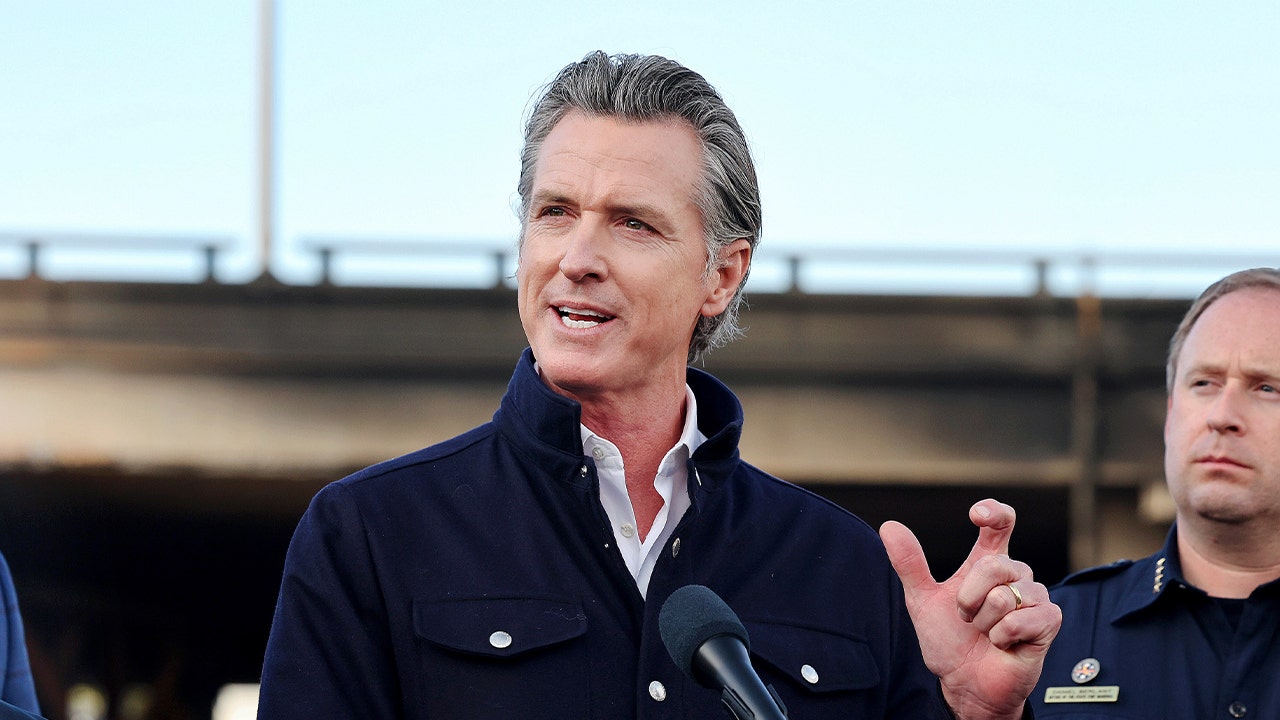
California Republican leaders appeared to mock Gov. Gavin Newsom’s fiery response to a critical analysis of his handling of the Golden State’s homelessness crisis, saying that any increase in homelessness is not admirable.
State Senate Minority Leader Brian Jones criticized Newsom, calling the U.S. Department of Housing and Urban Development’s year-end Homelessness Assessment Report an indictment of his capabilities.
“Gavin Newsom literally lost track of the $27 billion he spent on the homeless crisis,” Jones said, citing the report as listing California first in homelessness, with an increase of 3% to 187,000.
CA VOTERS NARROWLY REJECT $18/HR MINIMUM WAGE
“Today’s HUD report makes it clear that instead of solving the problem, Newsom’s endless spending ‘solution’ has only made it worse,” said Jones, R-San Diego.
In a recent statement, Newsom’s office indicated the state “distributed $24 billion to local governments to address homelessness through numerous state programs.”
“All that money is accounted for,” the statement continued, appearing to reference the funds Jones had claimed were “lost.”
“The audit showed that previously not all state programs required locals to report how those dollars improved homelessness for the most recent years and lacked data to compare the effectiveness of one program versus another. That’s been fixed.
“This administration has added strong accountability and reporting requirements for local governments that receive state funding. Any notion that we don’t know where the money went is preposterous, and that’s not what the audit reported,” the statement said.
The report also cited that Illinois, Wyoming, Hawaii and Colorado were the states where family homelessness doubled or worse.
BRIAN W. JONES: SUPER SANCTUARY IMMIGRATION POLICY THREATENS LIVES AND AIDS VIOLENT CRIMINALS
A statement from the Republican caucus of the California State Assembly keyed into Newsom’s recent thorough defense against an op-ed in the outlet CalMatters that made similar criticisms.
“In case you missed it, Governor Newsom’s office threw a tantrum over a column… that broke down his history of failure on homelessness,” the caucus, led by Assemblyman James Gallagher of Yuba City, collectively wrote.
The CalMatters op-ed claimed Newsom’s handling of the homelessness crisis will be a key point of attack for his prospective 2028 Democratic presidential primary challengers if he chooses to seek higher office then.
The column cited Newsom as saying “what’s happening on the streets has to be a top priority,” and reported he indicated a willingness to hold local officials accountable as well.
“People have to see and feel the progress and the change…” Newsom said, according to the column.
Gallagher’s caucus then cited Newsom’s response to the column, which consisted of a series of pointed posts.
“Given the sheer population size of California, to talk about homelessness without any of the broader context or how this administration’s efforts compare to the prior is a disservice to Californians, plain and simple,” Newsom’s office’s account wrote on X.
ICE DEPORTATIONS CATCH UP TO TRUMP-ERA IN FY 2024 AS BIDEN ADMIN COMES TO A CLOSE
“As the Governor has said many times, the work is far from over and urgency and results at the local level are needed more than ever. It’s why new accountability tools have been put in place, for quicker results. It’s also a longer-term effort — through implementation of Prop 1, CARE Court, conservatorship reform, the just approved BH-Connect waiver all of which are aimed at addressing the systemic issues of homelessness but not yet fully online.”
Newsom’s office also posted that unsheltered homelessness grew four times faster during the waning years of Gov. Edmund “Jerry” Brown’s administration than under his.
“The number of unsheltered homeless increased by 13.83% during the Newsom Administration (2019-2023), compared to an increase of 51.79% in the five-year period prior to the administration (2015-2019),” the post read.
California’s 14% homelessness increase in 2023 also fell below the national increase of 21%, the governor’s office added in the statement released just before this year’s numbers.
In 2024, California saw a homelessness increase of 3%, according to a weekend statement released by Newsom’s office. The rate bests 40 other states, the release said.
Assembly Republicans responded to Newsom’s original comments.
“Since the governor is committed to gaslighting on this issue, we’ll state the obvious: an increase of 20% is not progress,” their statement read.
City of San Francisco workers remove a homeless encampment in the Bayview neighborhood in San Francisco, on Aug. 1. (David Paul Morris/Bloomberg via Getty Images)
Jones, the Senate minority leader, cited Friday that he co-sponsored bipartisan legislation to change California’s homelessness policies and focus on “compassionate enforcement” of encampment violations.
One of his proposals from this past term, which did not make it to Newsom’s desk, focused on existing state law deeming “lodging” in a public or private place without permission to be disorderly conduct.
The bill would have delayed any indictment on that count for 72 hours after first notice and imposed a “state-mandated local program” for homeless individuals in those situations.
In a separate statement, Newsom said no American should be without a place to call home:
“Homelessness continues to rise and increase at ever-higher numbers nationwide, but we are seeing signs of progress in California,” he said.
“We have turned the tide on a decades-long increase in homelessness – but we have more work to do. California‘s plan is ambitious and challenging but the data is proving that it is not impossible: our strategies are making a positive difference.”
Data also showed other large-population states like New York, Florida, Illinois and Texas also suffered a higher growth in unsheltered homelessness than California’s, which the governor’s office said was under one percent.
Read the full article from Here


MISSOULA, Mont. — Amid recent flooding and ahead of wildfire season, Montana State Auditor James Brown is urging homeowners to make sure their homes are properly insured.
Brown said flooding is the leading cause of insurance peril in the nation and can happen year-round in Montana.
He said homeowners should not wait until flooding is imminent to seek coverage because there is typically a 30-day waiting period before flood insurance takes effect.
“Number one, by far the number one source of confusion related to flood insurance is the basic homeowners policy doesn’t cover flood damage, most Montanans may not know that,” said Brown.
Brown said some private flood insurance options exist, but the National Flood Insurance Program remains the main way Montanans can get covered.
He also said wildfire coverage is becoming less common in standard homeowners insurance policies and increasingly expensive.
Brown encouraged homeowners to be careful when shopping for the lowest-cost policy, because cheaper plans may offer less coverage or come with higher deductibles.
“That may not be enough to cover the loss if their house were to burn down, so one of the things we encourage as well is to talk to your agent about what the level of coverage that you have for your home to make sure that it’s fully insured so if you do have a fire or flood or some sort of peril, you’re able to replace your home,” said Brown.
Lower-cost policies may leave homeowners responsible for the first several thousand dollars in losses before insurance coverage begins.
Brown said homeowners should speak with their insurance agents to make sure their policies covers damages if a disaster occurs.

LAS VEGAS (FOX5) — As the nation marks its 250th anniversary, one chapter of American history was written in the Nevada desert, where the Nevada Test Site became the center of the country’s nuclear testing program during the Cold War.
The National Atomic Testing Museum in Las Vegas preserves that history, telling the story of what happened at the site roughly 65 miles northwest of the city.
From Truman’s order to 928 nuclear tests
President Truman established the Nevada Test Site in 1950. It was formally activated in 1951 at the height of the Cold War and ultimately served as the location for 928 nuclear weapons tests.
Scott Wade, chairman of the board of trustees for the National Atomic Testing Museum, said the program emerged from unanswered questions following the Manhattan Project.
“After the atomic bomb was developed by the Manhattan Project and the two weapons were used in Hiroshima and Nagasaki, there were still questions about how to safely utilize them — even as a weapon of war, this was emerging technology, something that had never been done before,” Wade said.
MORE ON FOX5: Veterans, downwinders demand recognition claiming Cold War radiation exposure
A family legacy tied to the site
Wade’s connection to the site is personal. His father began working there in 1958 and eventually rose through the Atomic Energy Commission, retiring as the Assistant Secretary for Defense Programs in charge of the nation’s nuclear weapons program.
In the 1990s, Wade’s family, along with six other families of former employees, worked with state and federal partners to establish the Atomic Testing Museum.
“There are a lot of feelings about nuclear weapons, and that’s actually the wonder and beauty of a museum,” Wade said.
Impact beyond weapons testing
Supporters of the program argue its influence extended well beyond military strategy. Wade said the testing program advanced scientific research with applications that reach into medicine today.
“I don’t think as a nation, maybe as a world, we would be anywhere near as far as we are with nuclear material separation even for medical uses,” Wade said.
Supporters also argue the program’s greatest impact was helping deter a global nuclear conflict during the Cold War between the U.S. and the Soviet Union.
Nevada’s role continues today
The Nevada Test Site is now known as the Nevada National Security Site and continues to operate. Wade said Nevada’s role in nuclear security remains active.
“Right now, nuclear weapons are still a very big topic. So we’re saying it’s history, but really, Nevada is still playing a very critical role in our everyday lives,” Wade said. “Everything still contributes to making sure that the weapons that are within the stockpile are safe and secure. And because you can’t do an underground nuclear weapons test, you do it with pieces and parts so you understand those pieces and parts.”
The Nevada National Security Site continues to play a role in maintaining the safety, security, and reliability of the U.S. nuclear stockpile.
The National Atomic Testing Museum is open Monday through Saturday from 9 a.m. to 6 p.m. and Sundays from 9 a.m. to 5 p.m.
Copyright 2026 KVVU. All rights reserved.

NEW MEXICO (KRQE) – License plate readers remain a controversial law enforcement tool. During this past legislative session, New Mexico lawmakers passed a bill that puts limits on how police use a controversial piece of technology.
The Driver Privacy and Safety Act implements safeguards on how the data collected by license plate readers is shared. It comes after instances where the technology was found to be used for non-law enforcement reasons, like people seeking abortions and immigration enforcement.
The lawmakers behind the bill said they want to ensure private information remains private. Santa Fe Police Interim Chief Ben Valdez says they are already restricted from sharing data collected from license plate readers, but he says it’s still important to have the law on the books.
“As a state, I think it puts us on the same page, which I think is very helpful. The data is the property of the City of Santa Fe. So if there’s going to be any sharing of that data. It has to be given with the express permission of the City of Santa Fe. It can’t just be used for any purpose, including being sold to a third party,” said Interim Chief Ben Valdez, Santa Fe Police Department.
Chief Valdez also emphasized that the plate readers can only be used in public spaces. “So it’s on a street that is a public road. It may be in a shopping area where that’s again within the public purview. We’re not doing plate reads in private areas that people have an expectation of privacy,” said Chief Valdez.
There are some cases where the license plate reader data would be shared, including homicide investigations that cross state lines or kidnapping. “They’ve been able to find children that were taken either by a custodial parent or another person, or even missing persons where their plate read came back as a missing person,” said Chief Valdez.
Under the new law, agencies are also required to submit annual reports to the Department of Public Safety on how the tech is being used.
In all, 15 new laws went into effect on Wednesday, including shifting “aggravated battery on a peace officer inflicting great bodily harm” from a third-degree felony to second degree and creating an Office of Special Education in the Public Education Department.
-

 Louisiana10 minutes ago
Louisiana State Police introduce two new K-9 officers
-

 Maine13 minutes ago
Lil Wayne Apologizes After Failing to Appear at His Own Concert: ‘I’m So Sorry’
-

 Maryland18 minutes ago
Maryland’s $48 million purchase of Laurel Park approved by state’s Board of Public Works
-

 Michigan25 minutes ago
Michigan ‘defined’ by waves of immigration that keep shifting
-

 Massachusetts28 minutes ago
Massachusetts state police use robotic dog and drone in highway standoff
-

 Minnesota33 minutes ago
Luverne, Minnesota’s 65-foot nutcracker, may be the tallest in the world
-

 Mississippi40 minutes ago
Mississippi Lottery Mississippi Match 5, Cash 3 results for July 1, 2026
-
Missouri43 minutes ago
Missouri Lottery Powerball, Pick 3 winning numbers for July 1, 2026

