West
Former Vice President Dick Cheney dead at 84

Dick Cheney dead at 84
Former Vice President Dick Cheney died at 84 surrounded by his family following complications from pneumonia and cardiac and vascular disease.
NEWYou can now listen to Fox News articles!
Former U.S. Vice President Richard Cheney, who went from the plains of Casper, Wyoming to a decades-long public career as a Republican congressman, Defense secretary, White House chief of staff and one of the most powerful American vice presidents ever, has died at age 84, his family announced Tuesday.
“Richard B. Cheney, the 46th Vice President of the United States, died last night, November 3, 2025. He was 84 years old. His beloved wife of 61 years, Lynne, his daughters, Liz and Mary, and other family members were with him as he passed,” his family said in a statement obtained by Fox News. “The former Vice President died due to complications of pneumonia and cardiac and vascular disease.”
“For decades, Dick Cheney served our nation, including as White House Chief of Staff, Wyoming’s Congressman, Secretary of Defense, and Vice President of the United States,” the statement continued.
“Dick Cheney was a great and good man who taught his children and grandchildren to love our country, and to live lives of courage, honor, love, kindness, and fly fishing,” his family said. “We are grateful beyond measure for all Dick Cheney did for our country. And we are blessed beyond measure to have loved and been loved by this noble giant of a man.”
BILL MAHER ADMITS MORE ‘PERSPECTIVE’ ON GEORGE W BUSH DURING INTERVIEW WITH COUSIN BILLY, WANTS HIM ON PODCAST
Vice President Dick Cheney in his West Wing office at the White House, Jan. 25, 2007, in Washington, D.C. (Charles Ommanney/Getty Images)
Cheney had a long history of cardiac problems, including five heart attacks. He received a heart transplant on March 24, 2012, at a Virginia hospital after nearly 21 months on a waiting list.
Cheney, who served as vice president for two terms under President George W. Bush, was one of the most powerful and controversial men ever to hold that position. He was a driving force behind America’s “war on terror,” including the wars in Iraq and Afghanistan, and also known for his penchant for secrecy. A hero to hawkish conservatives, he was a villain to liberals and Democrats. Hillary Clinton once compared him to Darth Vader.
In the wake of the Sept. 11, 2001, terrorist attacks, he never expressed doubt about his support for indefinite detention for alleged terrorist prisoners or even about waterboarding.
“I feel very good about what we did,” he told Fox News in 2008. “If I was faced with those circumstances again, I’d do exactly the same thing.”
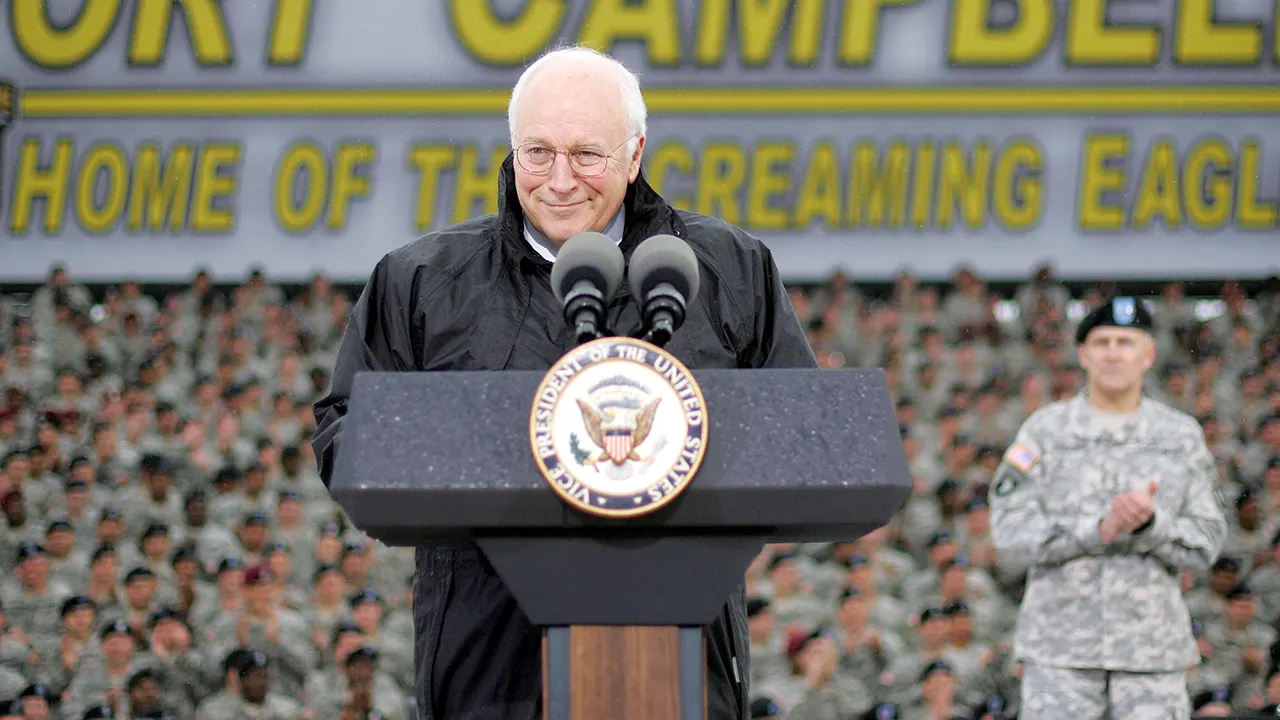
Vice President Dick Cheney makes remarks to 4,000 Army soldiers of the 101st Airborne Division returning from duty in Iraq during a “Welcome Home Rally,” Oct. 16, 2006, at Fort Campbell, Kentucky. (TIM SLOAN/AFP via Getty Images)
In May 2011, after the death of Usama bin Laden, Cheney called it a “very good day” for the U.S. but warned the country was “still at war” with terrorists and should not “let down our vigilance.”
After the election of Democratic President Barack Obama in 2008, Cheney, still a face of his party, became one of the new president’s most prominent critics, attacking his foreign policy and accusing him of being soft on terrorism.
Cheney also actively promoted expanding the powers of the presidency. In August 2011, he released a memoir, “In My Time.”
In addition to his decades-long political career, Cheney also worked in the oil industry as chairman and chief executive officer of the Halliburton Company, from 1995 until he returned to politics in 2000.
A son of the American West, Richard Bruce Cheney was born January 30, 1941, in Lincoln, Nebraska, and grew up in Casper, Wyoming, where he was captain of his high school football team and his future wife was a cheerleader. He received undergraduate and graduate degrees from the University of Wyoming.
In 1968, he moved to Washington as a congressional fellow and in 1969 became a staff assistant in the Richard Nixon administration. From 1975 to 1977, he served as chief of staff for Gerald Ford, Nixon’s successor.
BUSH’S WAR ON TERROR VS TRUMP’S IRAN APPROACH: HOW US MIDDLE EAST STRATEGY EVOLVED
Former President George W. Bush, right, shakes hands with former Vice President Dick Cheney after Cheney introduced Bush during the groundbreaking ceremony for the President George W. Bush Presidential Center in Dallas, Tuesday, Nov. 16, 2010. (AP Photo/LM Otero, file)
In 1978, he was elected to the House of Representatives from Wyoming and served six two-year terms, rising to become minority whip. Cheney was popular in Congress, noted for his integrity and civility.
He next became Secretary of Defense under President George H. W. Bush, with the Senate confirming him unanimously, and served in this role from 1989 to 1993.
After Bush failed to win re-election, Cheney went to the American Enterprise Institute, a conservative think tank, and then to Halliburton.
He was elected vice president in 2000 and 2004 on the ticket with George W. Bush and flourished as one of Bush’s inner circle of advisers on defense and foreign policy.
Secretary of Defense Dick Cheney, left, and Chairman of the Joint Chiefs, Gen. Colin Powell, huddle prior to testifying before the Senate Armed Services Committee, on Thursday, Feb. 21, 1991, on Capitol Hill in Washington. (AP Photo/John Duricka, file)
In a statement Tuesday, Bush said that Cheney’s death was “a loss to the nation” and said that Cheney was “the one I needed” when he became his running mate in 2000.
“Laura and I will remember Dick Cheney for the decent, honorable man that he was,” Bush said in a statement obtained by Fox News. Cheney’s death was announced Tuesday morning.
“History will remember him as among the finest public servants of his generation — a patriot who brought integrity, high intelligence and seriousness of purpose to every position he held,” Bush’s statement reads, in part.
Former Secretary of State Condoleezza Rice said she admired Cheney for “his integrity and his love of our country.”
“I am grateful that I had the chance to serve with him twice — when he was secretary of defense for President George H.W. Bush at the end of the Cold War, a triumphant time for America and its values, and then when, as vice president, he helped chart a course to protect America after the dark days of 9/11,” Rice wrote on X.
Rice called Cheney “an inspiring presence and mentor” who taught her “a great deal about public service.”
Former Vice President Dick Cheney is interviewed for ‘The Presidents’ Gatekeepers’ project about the White House Chiefs of Staff, July 15, 2011, in Jackson, Wyoming. Cheney also served as the White House Chief of Staff under President Gerald Ford and the Secretary of Defense under President George H.W. Bush. (David Hume Kennerly/Getty Images)
Former President Bill Clinton said Cheney’s long public career was defined by conviction and duty.
“Throughout his long career in public service, Dick Cheney was guided by a deep belief that he was doing what was right for America,” Clinton wrote on X. “Though we often disagreed, I always respected his dedication to our country and his unwavering sense of duty. My thoughts are with Lynne and the Cheney family.”
Former Texas Gov. Jeb Bush also offered his condolences.
“RIP Vice President Cheney. A wonderful person and a great patriot,” Jeb Bush wrote on X.
Meanwhile, Former Vice President Mike Pence expressed condolences to Cheney’s family, calling him “a truly good and great man.”
“Throughout his long career, he was an American patriot who championed the men and women in our armed forces and the importance of maintaining a strong national defense for America’s security at home and abroad,” Pence said. “Karen and I will always be grateful for Vice President Cheney’s service and his personal kindness during our time in office.”
Sen. Rick Scott, R-Fla., said that Cheney “dedicated his life to serving our nation.”
“He was known for his love of his family and his country,” Scott said in a post on X. “Ann and I are praying for the Cheney family and all who knew him during this time.”
Cheney is survived by Lynne Vincent, two daughters, Elizabeth and Mary, and seven grandchildren.
Fox News’ Patrick Ward contributed to this report.
Read the full article from Here



Wyoming
A Wyoming mother’s trust in the Catholic Church rattled by her son’s accusations of abuse – WyoFile

Renee Penton-Jones raised her son and daughter mostly as a single mother. Though she is Methodist, her ex-husband and kids were Catholic, and she relied “on the safety” of the Catholic Church for support. The Casper resident enrolled her children in Saint Anthony School and had them take part in church activities. The Christian education and physical activity her children received “meant the world” to Penton-Jones.
Last month, Penton-Jones’ son, James Stress, told her “that there was going to be a discussion with the church” about things that had happened to him as a boy. He didn’t want to talk about it with her then. She “really had no clue” what her son’s words could mean.
On March 31, Stress and two others filed a lawsuit alleging that a former Wyoming youth minister, Doug Hudson, who once worked at Our Lady of Fatima Church, had sexually assaulted them in the 1990s when they were boys. According to the complaint, Hudson had “plied” each of them “with copious amounts of alcohol.”
The lawsuit also named the Diocese of Cheyenne, which oversees parishes throughout Wyoming, and Our Lady of Fatima Church as defendants, stating that they failed to “supervise and control” the youth minister, which allowed for the alleged sexual assaults to occur.
Penton-Jones learned about the allegations last week through a news article that a friend sent to her. She was busy at work preparing for an Easter buffet and initially read only the headline. Then she sat at her desk and read the whole story. “It was just very disturbing, very upsetting, very shocking,” she told WyoFile. She called her son after to see that he was OK. And she wrote a comment on Facebook reacting to the news:
“As a single mother raising two children, I TRUSTED that they were safe within the arms of the Catholic Church. I TRUSTED that my son would be in a loving and caring, Christian environment when he was with the youth counselor hired by the church,” Penton-Jones wrote.
“I couldn’t have been more wrong and I can never undo the pain and suffering inflicted on my child. My heart breaks for him and the others who were subjected to this cruel and inhumane treatment right under the eyes of the church. I pray to God that there will be acknowledgement, apologies and accountability.”
Penton-Jones said she was unsure whether she could look to the church as the same place of safety that it had been to her for so long. “I would have to think about that,” she said. “There’s a lot of emotion. There’s anger. There’s frustration, like I told you, guilt, there are so many things that go through your head. How did I miss it? What didn’t I see?”
A spokesperson for the Diocese of Cheyenne initially declined to comment on the lawsuit, but told WyoFile that the diocese planned to respond publicly to the allegations “in the near future.”
The diocese shared its statement with WyoFile on Tuesday. The message refrains from commenting on the specific accusations in the lawsuit because the matter “is now the subject of active litigation.” At the same time, it expresses the diocese’s “awareness of the seriousness of such claims and its concern for all individuals who may be affected.”
“The Diocese recognizes that allegations of abuse — particularly those involving minors — can cause deep pain and lasting harm,” the message states. “Any person who comes forward with such allegations deserves to be heard with respect and compassion.”
The Diocese of Cheyenne, the statement continues, “remains committed” to protecting children and vulnerable people and upholding policies and procedures “to promote safety, accountability, and compliance with civil and Church law.”
“Out of respect for the legal process and all parties involved, the Diocese will refrain from further public comment while the matter proceeds,” the statement reads.
“All I can say is that I respect that there’s recognition,” Penton-Jones told WyoFile after a reporter read the statement to her.
When the lawsuit was filed, WyoFile attempted to contact Hudson through multiple avenues. None of those attempts were successful. A new court summons for Hudson lists a Kentucky address.
“I trusted him implicitly,” Penton-Jones said of Hudson. “I trusted the church with my children. So it was a huge shock.” If she had the opportunity to say something to Hudson, she would ask him “a lot of whys” and “How could you?”
Local Catholic Church members and others have reached out to Penton-Jones to “express their love and disappointment and prayers for healing and accountability.”
“It’s been a blessing to me,” she said. “To know that there’s so much positive in such a horrible situation, it’s comforting.”
Her “overwhelming thought is that the church be held responsible.”
“An apology would be ideal,” Penton-Jones said. “I can’t answer for my son. Good grief. I don’t know how you recover from that. How it affects your whole life.”

SAN FRANCISCO — The Giants have gone deep only twice over their first 10 home games of the year. Both shots have come off the bat of the same man: Rafael Devers.
Devers flexed his tremendous power by hammering a three-run blast to snap a scoreless deadlock in the sixth
Devers flexed his tremendous power by hammering a three-run blast to snap a scoreless deadlock in the sixth

DENVER (KDVR) — Many remember Montel Williams as the Emmy-winning daytime talk show host from the 90s. Now, he’s on a tour leading discussions about school safety and the first stop is Denver.
On Thursday, Williams will host a free public forum and open discussion as part of a national tour for his “The Only Way Out is Through” project.
Williams has tackled dozens of important topics over the years, including school safety, for decades.
Williams sat down with FOX31 on Wednesday. He said it’s time to get serious about preventing school shootings.
“It’s time for us to get ahead of this, to be proactive. I hate to use an old cliché phrase, but it takes a whole village to raise a child. Well, it takes an entire community to keep a child safe. And unless the community recognizes their role in keeping that child safe. You know, there’s no telling where this is going to end,” said Williams.
Williams then described how he thought about his grandson’s safety during a recent visit to his school.
“And when I walked up to that school, I’m going to tell you something. Knowing that I was doing this this week, it struck me viscerally and emotionally,” said Williams. “I hate to say it this way. I’m in my last quarter. You know what I mean? I’m at that age where, you know, I’m in the last quarter, and I still have an opportunity to hit a home run in the last second of this game. The home run I want to hit is making sure that my grandson is safe.”
The free public forum will be held from 10 a.m. to noon at Shorter Community AME, 3100 Richard Allen Court in Denver.

West Virginia5 minutes ago
E-News | Wowczuk honored for distinguished service

Wyoming11 minutes ago
A Wyoming mother’s trust in the Catholic Church rattled by her son’s accusations of abuse – WyoFile

Crypto17 minutes ago
Crypto ATM Giant Discloses $3.7 Million Bitcoin Theft Following Cyberattack

Finance23 minutes ago
Rebuilding permits in Altadena have picked up, but construction lags and financial woes loom

Fitness29 minutes ago
3 Morning Exercises Build Core Strength Faster Than Planks After 50

Florida1 year ago
Florida High School Football Rankings: Top 25 teams – Oct. 21

Oregon2 years ago
How old is Bo Nix? What to know about Oregon quarterback ahead of 2024 NFL Draft

Connecticut2 years ago
Cleary's 21 help Le Moyne down Central Connecticut State 69-64 in OT

Virginia2 years ago
99th annual Pony Swim held in Virginia

Indiana2 years ago
Indiana Members Credit Union announced as new anchor tenant at Bottleworks District

News59 minutes ago
Video: The Fragile Cease-Fire in Iran

Politics2 hours ago
Spanberger ripped after taking credit for billions in investments secured under GOP predecessor: ‘Pathetic’

World3 hours ago
Newsletter: NATO holds amid fragile Iran ceasefire
News4 hours ago
Jim Whittaker, the first American to summit Mount Everest, dies at 97

News13 hours ago
Video: Military Families Bear the Burden of War, Again
-

 Atlanta, GA4 days ago
1 teenage girl killed, another injured in shooting at Piedmont Park, police say
-

 Culture1 week ago
Do You Know Where These Famous Authors Are Buried?
-

 Movie Reviews1 week ago
Vaazha 2 first half review: Hashir anchors a lively, chaos-filled teen tale
-

 Georgia2 days ago
Georgia House Special Runoff Election 2026 Live Results
-

 Education1 week ago
Video: We Put Dyson’s $600 Vacuum to the Test
-

 Pennsylvania2 days ago
Parents charged after toddler injured by wolf at Pennsylvania zoo
-
 Milwaukee, WI3 days ago
Potawatomi Casino Hotel evacuated after fire breaks out in rooftop HVAC system
-
 Entertainment1 week ago
Inside Ye’s first comeback show at SoFi Stadium