Denver, CO
Denver gave people experiencing homelessness $1,000 a month. A year later, nearly half of participants had housing.


Jarun Laws lived in his car in a restaurant parking lot near downtown Denver. He worked there as a cook until 2020, making about $400 a month. That was barely enough to cover his car payments and child support — and not even close to what he would need for rent.
The 51-year-old occasionally spent part of his paycheck on weekend stays at a cheap hotel, where he could spend time with his children. He struggled to afford food, clothes, and medicine — and he had been experiencing homelessness for nearly a decade.
That changed when Laws enrolled in The Denver Basic Income Project. The pilot program allowed Laws to secure a temporary apartment with furniture, spend more time with his children, and find a better-paying job.
“I had questioned myself: if I was going to be a good father to my children because I was suffering,” Laws previously told Business Insider. “When I got accepted, it changed my life.”
Denver’s basic income pilot — which first started payments in fall 2022 — focused on over 800 Coloradans experiencing homelessness, including people living in cars, temporary shelters, the outdoors, or other non-fixed living situations. Participants like Laws were given direct cash payments, no strings attached, and could spend the money on whatever they needed.
Denver released the project’s one-year report on June 18, showing that 45% of participants secured their own house or apartment after receiving basic income for 10 months. They also experienced fewer emergency room visits, nights spent in a hospital or a temporary shelter, and jail stays. The report estimates that this reduction in public service use saved the city $589,214.
Denver’s program initially lasted one year and was extended in January for another six months. Participants were sorted into random groups: one received $1,000 a month for a year; another got $6,500 upfront, followed by $500 a month; and a third got $50 a month as a control group.
The city of Denver, the Colorado Trust, and an anonymous foundation funded the project and has already provided more than $9.4 million to participants.
Basic income programs like Denver’s have become a popular strategy to reduce poverty in US cities. Compared to traditional social services like SNAP or Medicaid, basic income allows participants to spend the money where they need it most.
“What is fundamentally different about our approach is the way that we start from a place of trust,” Mark Donovan, the project founder and executive director, said at a Tuesday press conference.
Denver’s basic income project helped participants secure housing and jobs
Denver’s report found that basic income primarily helped participants pay for immediate expenses — like transportation, hygiene, clothes, and groceries. Affording recurring bills like rent, healthcare, or debt payments was also a top priority for most families. Participants in each payment group reported increased financial stability and reduced reliance on emergency financial assistance programs.
Basic income puts low-income families on “an equal playing field,” Nick Pacheco, participant engagement coordinator, said at a press conference. He said the cash payments also help participants get the training and resources they need to establish careers.
Individuals who received the lump sum or $1,000 a month payments were more likely to find a stable, full-time job than before they received basic income.
“It’s freedom,” Pacheco said. “It’s freedom from poverty and not being able to reach your goals.”
Participating households also experienced improved mental health and could spend more time with family and friends. Parents were able to better support their children and grandchildren.
These results echo those from the six-month report, which found fewer participants were sleeping on the street, experiencing food insecurity, and feeling unsafe.
Still, participants’ financial outcomes varied based on their payment group. Participants who received the lump sum $6,500 payment in addition to $500 a month could better build savings and make major life changes like signing a new lease or buying a car.
Many families told researchers that they’re anxious about paying bills after the basic income payments end. Some worry they could lose their housing again.
Laws, for example, had to go back to living in his car after his payments stopped.
Being able to pay bills alleviated participants’ financial stress
Denver participants have told BI that basic income was the financial safety net they needed.
Moriah Rodriguez, 38, was working as a youth developer for Denver Public Schools when she got hit by a car and suffered a traumatic brain injury. She lived in public housing with her kids, all of whom have intellectual disabilities, though they were displaced shortly after.
She received monthly Social Security payments, just enough to care for her kids. While staying with a friend, she learned about the pilot program.
Rodriguez used the payments to fix her truck, transport her kids to school and work, buy new clothing, and secure a lifelong public housing voucher. She also used some of the money to pay $400 for rent, $500 on gas, $100 on hygiene, and $100 on her credit card bill. In addition to returning to school to get her GED, she brought her credit score into the 700s.
“The program gave me more time to focus on their education and their mental health,” Rodriguez said, referring to her children, and added that the program’s extension was another lifeline. “I had the space to get them tested and get them diagnosed and connected with the support they need.”
Similarly, Dia Broncucia, 53, and Justin Searls, 45, could also afford essentials like an apartment, a new car, and mental health resources through basic income. They had previously lived in a temporary shelter but could secure a studio apartment for $1,300 a month, along with clothing, hygiene products, and furniture.
Broncucia and Searls said last October that though they had some uncertainties about their future, they felt much stronger and less stressed because of basic income.
“Starting with nothing and then being able to receive a lump sum of money and then get our payments once a month is why we were able to get on track and stay on track,” Broncucia previously told BI.
Basic income pilots can provide poverty solutions
As the basic income pilot continues to be successful in cities like Denver, local leaders and economic security experts are looking to translate pilots into policy. States like California and New Mexico are already proposing basic income programs in the state legislature.
“The lessons from those pilots are infusing the whole ecosystem of support,” Teri Olle, director for Economic Security California, a branch of the nonprofit Economic Security Project, previously told BI. “People are really seeing the power of those pilots, and the power of giving people money and trusting them.”
Denver leaders also hope to extend the city’s basic income for a third year. The project is currently raising the millions of dollars necessary to continue efforts in Colorado.
Donovan said he’s paying close attention to results from basic income programs across the country. It’s a “really exciting time in the movement,” he said.
“If we’re able to move people into housing and out of homelessness at a lower cost and generate better long-term outcomes, why wouldn’t we try to expand and build upon that?” Donovan said.
Have you benefited from a guaranteed basic income program? Are you willing to share how you spent the money? Reach out to these reporters at allisonkelly@businessinsider.com and nsheidlower@businessinsider.com



Denver, CO
Victor Marx wins GOP primary for Colorado governor, defeating veteran lawmaker after unorthodox campaign

Victor Marx, a first-time candidate and nonprofit leader with a controversial personal history that’s drawn intense scrutiny, has edged out his more establishment opponent and will be Colorado Republicans’ gubernatorial nominee in November.
The Associated Press called the race for Marx late Thursday afternoon, nearly nine days after polls closed. He led the runner-up, state Sen. Barb Kirkmeyer, 39.9% to 39.4%, with 99% of ballots counted, according to the AP.
Marx had taken his first narrow lead over Kirkmeyer the day after the June 30 primary, and though the race remained close, he never lost the advantage. While outstanding deficient and overseas ballots helped delay a final call on the race, those votes only served to expand Marx’s margin. He led by 2,524 votes at 5:30 p.m. Thursday, out of about 522,000 ballots cast.
State Rep. Scott Bottoms was a distant third, with 20.8% of the vote.
A veteran lawmaker and former Weld County commissioner, Kirkmeyer had jumped to an early advantage on the strength of early ballot returns. But as votes returned on Election Day began to filter in, her lead thinned and collapsed. Within 48 hours of polls closing, and with few ballots left to count in Kirkmeyer’s Front Range strongholds, her path to retake the lead had all but vanished.
Marx will next face Democratic Attorney General Phil Weiser in November. No Republican has been elected to the governor’s office in more than 20 years. Four months out, Weiser appears to be heavily favored to continue Democrats’ electoral dominance.
In an email to supporters after the race was called, Marx said he was humbled to be the nominee and that the victory was “the starting line.”
“My team and I have put together this special message that I want every Coloradan to hear — Republicans, independents, unaffiliated voters, and Democrats who are open to a better way,” he said. “Because what we’re building now is bigger than a primary victory.”
In a video, he appealed to Coloradans who are frustrated with the status quo and don’t think things can change — citing his victory as proof they can.
“Now Phil Weiser, he’s a smart fella — but he represents the current system, because he is part of it,” Marx said. “And that current system has made Colorado more expensive, less safe and harder for regular families to trust government.”
In a separate statement, Kirkmeyer said she was proud of the race that she had run and the “clear vision” she had laid out for the Republican Party here.
“While we came up short in what appears to be the closest Republican gubernatorial primary in Colorado history, I’m grateful for every voter who placed their trust in us,” she wrote.
Echoing the pledge she’d made before Election Day, she pointedly did not endorse Marx. She said only that she hoped voters “choose the path that is best for Colorado” in November.
Kirkmeyer also threw a final jab at Marx, who declined in late May to tell 9News how many people he’d killed as an adult.
Kirkmeyer wrote that, “for the record, I still haven’t killed anyone.”
First-time candidate shrugged off questions
Marx’s primary win is a remarkable result for the embattled Colorado GOP and for Marx, a former Marine, martial arts instructor and nonprofit leader whose extensive and much-scrutinized personal history had drawn national headlines. It’s also attracted sharp criticism from other Republicans.
In his video, Marx appealed to Republican primary voters, saying there was room in his campaign for those who supported his opponents.
Marx had entered the fray last fall with no political profile and no experience as a political candidate. But by the time voters began receiving ballots last month, he’d ridden an atypical — if thoroughly modern — campaign to fundraising dominance and front-runner status.
Kirkmeyer’s support largely flowed from northern Front Range counties, nudging her ahead initially. But Marx picked up bigger margins among Election Day voters — meaning those more conservative voters skeptical of mail-in balloting.
He also won ruby-red El Paso County while racking up smaller wins in rural counties and grabbing enough in the Front Range to edge Kirkmeyer.
Map: Where did the votes come from in the Colorado primary races for governor?
In a pitch reminiscent of President Donald Trump, the arch-dealmaker, Marx has cast himself as a solutions-focused negotiator disinterested in partisan squabbles. In 2003, he founded All Things Possible Ministries, a Christian nonprofit that has provided stuffed animals and trauma support to people. It has also done work in conflict areas in Syria and Iraq, where Marx primarily worked away from the front lines as a funder and facilitator.
By 2024, the nonprofit’s annual revenue had surpassed $7.5 million, and Marx has said the group — from which he has resigned — now primarily works to help law enforcement.
Despite his outsider status, Marx was considered the likely winner in the weeks before Election Day. His narrow victory, then, came as something of a surprise, and, on election night, he speculated that Bottoms — a conservative pastor from Colorado Springs — had pulled votes from him. In El Paso County, Bottoms earned more than 20,000 votes, or 24% of the county’s Republican total.
Though Marx out-raised and out-spent both Kirkmeyer and Bottoms, it was Kirkmeyer who had been perceived as the expected nominee when she entered the race last year. Marx had never run for office before, and the stories he’s told about his life — that he’d killed a man at age 7, been involved in “high-risk humanitarian” operations across the globe and could free people from demonic possession — drew intense scrutiny and national punchlines.
But he repeatedly shrugged off questions about his background and said he stood by all that he had said and written.
Through his personality-heavy, direct-to-voter campaign, he encouraged Colorado Republicans to shrug it off, too. He spent heavily on direct mailers, which provided a boost to both his fundraising and name recognition.
Marx eschewed policy discussions and skipped nearly every debate. When he did participate in one, he spent part of the event leaning on the lectern, with his dog at his feet. Rather than deliver a closing statement, he prayed.

Campaigning his own way
Though he leaned into his outsider status, the aw-shucks appeal belied a careful campaign shaped by Marx’s emergence from a political environment forged by Trump: He skipped one debate after a moderator pressed him about his background, and he held a rally instead; his campaign later highlighted how many more people attended the rally than the debate.
His media operation was led by a former Turning Points USA staffer, and his campaign touted its social media posts’ views at Marx’s watch party last week. He was comfortable as a podcast guest, regularly released videos of himself and repeatedly assured voters that he was no politician.
Though Marx had little backing — or trust — from institutional Republican forces, the PAC that supported his campaign was established by a former senior official from Gov. Bill Owens’ administration. Marx also was endorsed by U.S. Rep. Lauren Boebert, the most nationally visible Colorado Republican.
His approach proved to be enough for Colorado Republicans to back him. But his next task will be far harder.
In November, he will face a surging Weiser, who last week dismantled U.S. Sen. Michael Bennet on his way to the Democratic nomination. Weiser proved an adept fundraiser and campaigner with statewide appeal, and he will look to lead a restless Democratic base that elected progressive candidates up and down the ballot.
In a statement Thursday, Weiser said Marx’s “views and style are far out of step with Coloradans, and his nomination for governor is a threat to our state’s values and our future.”
Republicans’ last statewide win was in a University of Colorado at-large regent’s race in 2016. The state GOP has had four elected party chairs since the last Republican gubernatorial bid in 2022, which ended with a culture war-focused Heidi Ganahl — who had won that at-large regent seat — losing by nearly 20 percentage points to Gov. Jared Polis.
Simultaneously, Marx may also have to contend with an independent candidacy from Greg Lopez, a former Republican congressman and gubernatorial candidate who is gathering signatures to make the fall ballot.
Stay up-to-date with Colorado Politics by signing up for our weekly newsletter, The Spot.

If you use Santa Fe Drive as a part of your daily commute, you will notice full closures this weekend on a popular section, from Florida Avenue to Evans Avenue, for the installation of a pedestrian bridge.
Once the 370-foot pedestrian bridge is completed, it will connect the east and west portions of Denver’s Overland neighborhood. This bridge will be used by pedestrians and bicyclists.
The Denver Department of Transportation and Infrastructure says this closure is needed to keep the traveling public safe. Large cranes will be used to set the two spans in place. Each one weighs about 215,000 pounds and is 180 feet long.
Once the bridge is completed in 2027, it will create a safer connection for pedestrians and bicyclists. It will link neighborhoods to trails, transit, parks, and local businesses without requiring residents to cross heavy traffic.
“Our neighborhood is quartered by transportation routes, so having a safe pedestrian bridge that can take people from one side to the other is an amazing development that neighbors have been asking for for years,” Jenn Greiving, President, Overland Park Neighborhood Association, said.
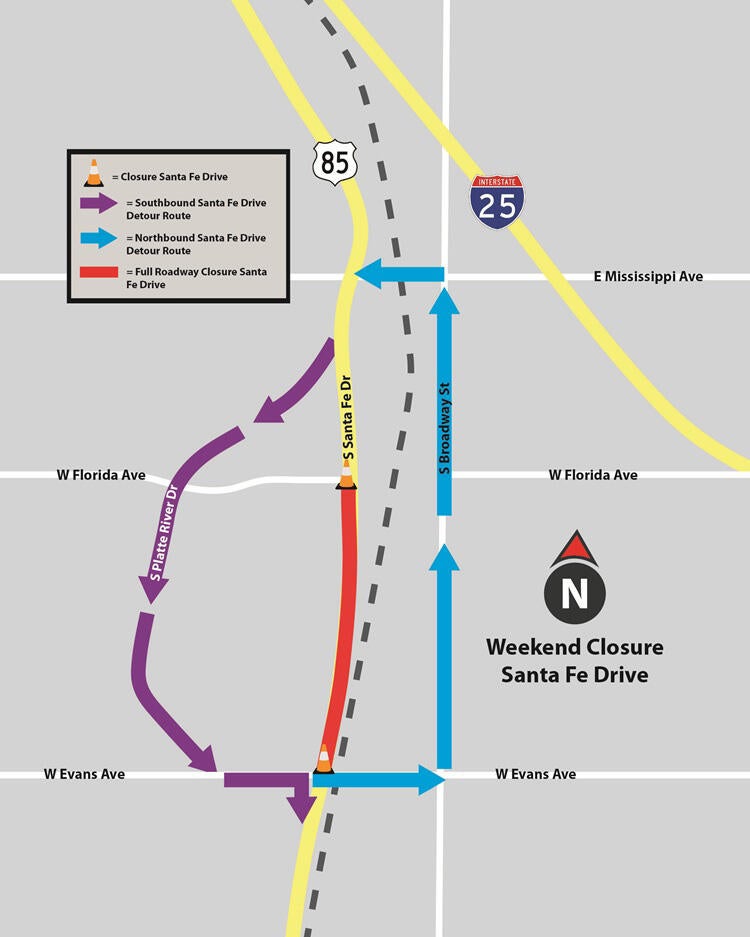
The Santa Fe Drive closure will begin at midnight on Saturday, July 11, and end on Monday, July 13, at 5 a.m. There will be detours in place. This includes:
- Southbound Santa Fe Drive Detour: Traffic will be routed to Platte River Drive to reenter southbound Santa Fe Drive at the West Evans Avenue on-ramp.
- Northbound Santa Fe Drive Detour: Access to northbound Santa Fe Drive will be at Mississippi Avenue via South Broadway Street.
- On-Ramp Closure: The West Evans Avenue on-ramp to northbound Santa Fe Drive will close at noon on Friday, July 10, to prepare for the full weekend closure and will remain closed until 5 a.m. on Monday, July 13. Traffic will be detoured to South Broadway Street to re-enter northbound Santa Fe Drive via Mississippi Avenue.
- Off-Ramp Closure: The southbound Santa Fe Drive off-ramp to West Evans Avenue will close for the full weekend period and remain closed until Friday, Sept. 11, while crews build new sidewalks and perform other concrete work at the southwest corner of the project. Detours will be posted to West Florida Avenue, West Dartmouth Avenue or West Hampden Avenue to bypass the ramp closure
During this closure, DOTI will reopen the underpass on Iowa Avenue. This is a new ADA accessible pathway that will be available between Santa Fe Drive and Acoma Street.

DENVER (KDVR) — Two officers, one now formerly of the Denver Police Department, face multiple charges relating to separate incidents in the past two months.
According to a release, now-former Denver Police Officer Gabriel Lucero was issued a citation for third-degree assault, official misconduct and false reporting, while Officer Javon Leach was cited for reckless driving and eluding.
The incident involving Lucero reportedly occurred on May 22 just before 1 a.m. in the 500 block of 16th Street. According to a release, Lucero was involved in an assault at a business, as he allegedly assaulted a person and walked away as others continued to assault the victim.
Security guards and an off-duty officer escorted him and the group out; however, Lucero reportedly identified himself as a Denver police officer and attempted to re-enter by using his police badge.
Lucero reportedly provided a false name without any other information, and further investigation verified Lucero as the person involved. Lucero was hired in 2025 and, due to his current probationary status, was fired as of Wednesday.
The incident involving Leach occurred around 1:41 a.m. on June 21, when Leach was reportedly pulling out of a parking lot on Larimer Street, attempting to drive against traffic.
Leach reportedly refused commands to stop as he left the area. Officials said he was found just seven minutes later, traveling at high speeds northbound on Park Avenue West.
He reportedly fled a traffic stop and continued to drive away, and officials deemed Leach to be the suspect following an investigation. He was placed in an off-line assignment while the case progresses, as they are considered misdemeanors.
“The Denver Police Department’s administrative review of Leach’s incident will begin once the criminal case is adjudicated, and that process includes the Denver Department of Safety and the Office of the Independent Monitor, a civilian oversight agency,” the release said.
-

 Indianapolis, IN2 minutes ago
Unsettled Friday and Saturday, then summer heat returns early next week | July 10, 2026
-

 Pittsburg, PA5 minutes ago
Buying Here: Modern home with backyard pool in Lawrenceville priced at $949,900
-

 Augusta, GA10 minutes ago
South Augusta community raises concern over Family Y on Tobacco Road
-

 Washington, D.C17 minutes ago
About 120 Iowa National Guard soldiers leave today for D.C. deployment – Radio Iowa
-

 Cleveland, OH20 minutes ago
Wanted: Sex offender on the run after crimes against a child
-

 Austin, TX25 minutes ago
Austin: Community Vigil for Lorenzo Salgado Araujo
-

 Alabama32 minutes ago
University of Alabama police officer's family leans on law enforcement community after his death
-

 Alaska35 minutes ago
Black bear breaks into Alaskan mall, eats a peach and relieves itself on floor before leaving: video

