West
Dems secure $600M in federal taxpayer funds to fight homelessness, but some are skeptical it will help

California Democratic senators Alex Padilla and Laphonza Butler announced just over $600 million in federal dollars to curb the spiraling homelessness crisis in the state, as officials struggle to get a handle on the problem exacerbated by drug addiction and mental illness.
“As we continue our statewide count of people experiencing homelessness, one thing remains clear: We need significantly more federal investment to address this humanitarian crisis,” Padilla said in a Jan. 29 statement.
Butler said in a statement the funds would be “especially important to our youth experiencing homelessness, including unaccompanied and pregnant or parenting youth who will now have more access to programs aimed at preventing homelessness.”
The funding is part of a $3.16 billion investment from the Biden administration to support nonprofit organizations, housing authorities and local governments struggling to reduce homelessness nationwide.
NEWSOM SENDING 120 CALIFORNIA HIGHWAY PATROL OFFICERS TO OAKLAND TO CRACK DOWN ON ‘ALARMING’ CRIME SURGE
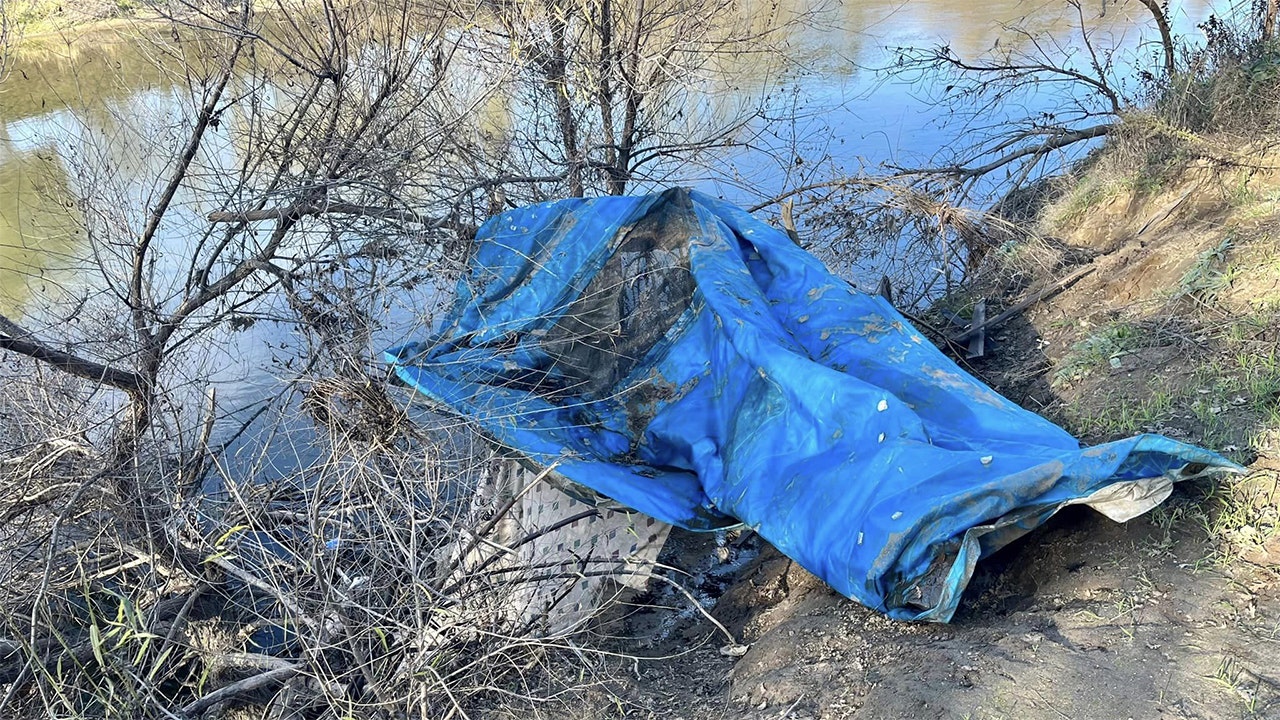
A tarp and trash belonging to homeless people encamped by the Tuolumne River in Modesto, Calif., Jan. 23, 2024. (Modesto Police Department)
Despite more taxpayer dollars at work, the homeless population continues to skyrocket in the Golden State. It’s up 6% compared to last year and boasts the highest number of homeless people living outdoors in the country. About 181,000 people were considered homeless in the state’s 2023 count, and most are suffering from drug addiction or mental illnesses.
According to a University of San Francisco study last year, 82% of homeless people statewide said they had a mental health condition or abused substances in their lifetime.
Chris Moore, a candidate for Alameda County supervisor and a board member with Bay Rental Housing Association, thinks the earmarked money “is good,” but that the state “isn’t using best practices.”
NEWSOM RECALLS SEEING BRAZEN THEFT, REFUSES PHOTO AND ASKS FOR MANAGER WHEN WORKER BLAMES HIM: LEAKED VIDEO
“And I think with more money, it’s great, but we need to start looking at best practices,” Moore told Fox News Digital. “And looking at what they’re doing there in Houston and start solving the problem rather than enabling the problem.”
Houston cut its homeless population by 64% over the last 12 years and 17% last year through collaboration between various organizations despite minimal financial investment. Texas has spent significantly less money on homelessness compared to California — $806 versus $10,786 per homeless person.
Homeless men on a sidewalk in San Francisco Sept. 2, 2023. (Tayfun Coskun/Anadolu Agency via Getty Images)
California has dipped its toes in some of the country’s most controversial practices to confront its growing homelessness problem.
The state has spent roughly $20 billion on homelessness in the last five years since Gov. Gavin Newsom took office under what’s called the “housing first” solution. It’s the belief that homelessness is solved through first putting people in apartments, motels, hotels or “tiny homes,” rather than mandating rehabilitation for drug addiction or mental health treatment.
NEWSOM ADMIN DELIVERS TEPID RESPONSE TO SPIRALING PROSTITUTION, PIMPS CONTROLLING CALIFORNIA NEIGHBORHOODS
Some say this strategy doesn’t work, as most government-run housing programs don’t require “wraparound” services, a holistic care model that includes drug rehabilitation and mental illness treatment.
Instead, the “harm reduction” model has been adopted by the state’s Department of Health, which focuses on reducing the consequences of drug use through offering clean syringes, naxolone and other materials to “meet people where they’re at” and make drug use “safer.”
Rev. Andy Bales, the former CEO of Union Rescue Mission, one of Los Angeles’ largest faith-based nonprofit organizations that does not rely on government funding, told Fox News Digital that more people will become homeless under the strategy.
California Gov. Gavin Newsom speaks at a news conference in Sacramento, Calif., March 16, 2023. (AP Photo/Rich Pedroncelli)
“Housing First, specifically with the Harm Reduction rules, which really translates to the free flow of hard drugs and alcohol, has been an utter failure,” Bales said. “And there’s a reason why we’ve made absolutely no progress after California has spent $22 billion in the last six years. And yet homelessness has skyrocketed.”
Bales retired in 2023 from the nonprofit after 20 years. He said he continues to study the state’s homeless policies and population trends.
“California alone represents 50% of all street homelessness because they have doubled down on the policy of housing first and harm reduction, and so if it continues to be spent, like it has been, we won’t see much positivity or improvement because it’s a failed policy,” he said. “There’s so much evidence to show that the numbers don’t lie.
“It’s a mistake to only fund one strategy,” he added. “You know, multiple strategies could make a difference.”
Homeless housing programs that use this approach can be identified through the National Harm Reduction Coalition’s interactive map.
“Harm reduction is a set of practical strategies and ideas aimed at reducing negative consequences associated with drug use,” the National Harm Reduction Coalition website states. “Harm eduction is also a movement for social justice built on a belief in, and respect for, the rights of people who use drugs.”
Newsom is facing pressure by voters to curtail the issue at its root. In March, residents will vote on Newsom’s proposed $6.4 billion bond aimed at adding approximately 25,000 psychiatric and addiction treatment beds across California, a move aimed to be a “course corrective” action from when California dumped thousands of people from psychiatric centers onto the streets.
“There was a righteousness in the 60s, with Democrats and Republicans saying, ‘We have to move away from these locked institutions,’” Newsom said last year before signing several mental health bills. “We were supposed to replicate that with community-based care, and there was no accountability — there was no obligation either way.”
Read the full article from Here


It’s 10 a.m. sharp, and Abby Kurtz gets her first assignment of the day. She’s received a time, a location in San Francisco and a target.
Her weapon of choice: an iPhone.
“Being a social agent is really the coolest thing ever,” she said.
Kurtz is a content creator working through an app called Social Agent, part of an expanding gig economy where more and more workers are trading stability for flexibility. Work that once required connections, planning, and a big budget can now be booked with a tap —extending the on-demand model from rides and meals to storytelling itself.
Just make a request, and someone like Kurtz can arrive within 30 minutes, camera-ready.
“What I look for when I’m shooting events is very crisp and clean content,” she said.
Her mission this time took her to Sutro Nursery, a nonprofit dedicated to growing native plants and that is hoping to grow its volunteer base, too. Board member Maryann Rainey said booking a Social Agent is a lot cheaper than hiring someone to do their social media full-time.
“I know I can’t do it myself, and I was certainly hoping that these young people would know how to do a good film,” Rainey said.
A typical job runs about $200, with same-day delivery. Agents earn around $50 an hour, plus tips. And if clients already have footage, they can upload it and have it turned into a finished piece.
The service is currently available in New York, Los Angeles, and Miami, with a slower rollout now underway in other cities.
Lisa Jammal, the company’s CEO, said the idea is simple: Let someone else do the shooting.
“We all are missing those beautiful moments because we’re always behind the phone,” she said.
As for Kurtz, after the shoot, she headed straight to a nearby coffee shop, where the clock started ticking. She had just over an hour to shape her raw material into a polished final cut.
“I think I’m going to give this reel a really peaceful, calming feel, but also informative and inviting,” she said.


Ted Land had almost given up on being a homeowner.
When he moved to the Pacific Northwest in 2014, he was an award-winning television journalist, having lived and reported in Indiana and Alaska before arriving in Seattle to work for a local station, King 5. At first, he rented a studio apartment in the Capitol Hill neighborhood.
[Did you recently buy a home? We want to hear from you. Email: thehunt@nytimes.com. Sign up here to have The Hunt delivered to your inbox every week.]
“It’s very walkable, with lots of transit, very L.G.B.T. friendly, great restaurants, nightlife, parks,” said Mr. Land, 40. “It has everything I like in a neighborhood.”
His journalism career had been fraught with unexpected transitions, so it didn’t seem sensible to buy a home. “I thought I was going to move up and be a reporter in New York City or L.A. or D.C.,” he said. “I had my sights set on that. It really wasn’t even on my mind. Buying a house seemed so out of reach for me.”
As the years passed and he bounced from rental to rental, the hustle of TV news began to wear him out. Finally, in 2022, he grabbed an opportunity to move into corporate communications. With that choice came a higher income and a more stable future in Seattle with expanded living options.
“I kept signing lease after lease, not wanting to confront the daunting process of purchasing, and increasingly frustrated with the fact that I didn’t lock in a low interest rate during Covid like so many of my peers did,” Mr. Land said.
He had up to about $620,000 to spend, but as a single-income buyer, he was vexed by the down payment. “Everyone says that you’ve got to put down 20 percent. It’s like, ‘Where am I going to get $100,000? Does anyone know? Can you please tell me that?’”
With help from his broker, Mark Chavez of Windermere Real Estate, Mr. Land arranged to structure a purchase with 10 percent down using a mortgage insurance that costs him less than $100 per month, with his payments reducing in size until they total 20 percent of the home price. “I mean, $50,000 is a lot easier to save for than $100,000,” he said.
But even with that cushion, options were limited in pricey Seattle, especially for the kind of home he wanted. “Apartments are noisy places,” Mr. Land said. “They just are. And that kind of gets old after a while. I was looking for something a little quieter where I’m not hearing neighbors all the time.”
Most of Mr. Chavez’s clients want single-family homes, the broker said, but “it’s a bigger expense and there’s more to take care of, like the landscape. It used to be that to get into a condo, the entry point was more affordable. However, with many homeowner associations underfunded for future expenses, it is becoming more challenging to buy into a condominium.”
The middle ground? Townhouses. But every square foot needed to count, and location was critical. Mr. Land loved Capitol Hill, but felt he couldn’t afford to buy there. “I just really like being in the central part of the city,” he said. “The more I looked, the more I realized that walkability is a really important attribute for me.”
Find out what happened next by answering these two questions:

Latest California-based gig work app lets people book content creators, editors

Study says the real value of a $100K salary in Dallas is…less than that

Miami’s own Marcello Hernandez delivers special tribute to former teacher on SNL

When did Southie get richy-rich? – The Boston Globe

Denver area events for March 5

Florida High School Football Rankings: Top 25 teams – Oct. 21

Cleary's 21 help Le Moyne down Central Connecticut State 69-64 in OT

How old is Bo Nix? What to know about Oregon quarterback ahead of 2024 NFL Draft

99th annual Pony Swim held in Virginia

Indiana Members Credit Union announced as new anchor tenant at Bottleworks District

DHS defends McLaughlin against allegations husband’s company profited millions from ad contracts: ‘Baseless’

Sánchez defies Trump in political gamble as Madrid say no to war

Satellite images show Iran school strike hit more buildings than earlier reported

US submarine sinks Iranian warship by torpedo in a first since World War II

Which oil and gas facilities in the Gulf have been attacked?
-

 World1 week ago
Exclusive: DeepSeek withholds latest AI model from US chipmakers including Nvidia, sources say
-

 Massachusetts1 week ago
Mother and daughter injured in Taunton house explosion
-

 Wisconsin3 days ago
Setting sail on iceboats across a frozen lake in Wisconsin
-

 Maryland4 days ago
AM showers Sunday in Maryland
-

 Denver, CO1 week ago
10 acres charred, 5 injured in Thornton grass fire, evacuation orders lifted
-

 Florida4 days ago
Florida man rescued after being stuck in shoulder-deep mud for days
-

 Oregon6 days ago
2026 OSAA Oregon Wrestling State Championship Results And Brackets – FloWrestling
-

 Massachusetts2 days ago
Massachusetts man awaits word from family in Iran after attacks