West
Crop-rich California region may fall under state monitoring to preserve groundwater flow

California might step in to regulate groundwater use in part of the crop-rich San Joaquin Valley, which would be a first-of-its-kind move that comes a decade after lawmakers tasked local communities with carefully managing the precious but often overused resource.
At issue is control over a farming-dependent area where state officials say local water agencies haven’t come up with a strong enough plan to keep the water flowing sustainably into the future. The State Water Resources Control Board will hold a hearing Tuesday to decide whether to place the region under monitoring, which would mean state, not local, officials would temporarily watch over and limit how much water could be pumped from the ground.
CALIFORNIA CONSIDERS ADDING TREATED WASTEWATER TO DRINKING SUPPLY THROUGH NEW PROPOSAL
“It’s a huge deal,” said Dusty Ference, executive director of the Kings County Farm Bureau, which represents regional farmers. “What you gain in having local control is the ability to build groundwater recharge projects and some flexibility with how water is used and moved and traded or not.”
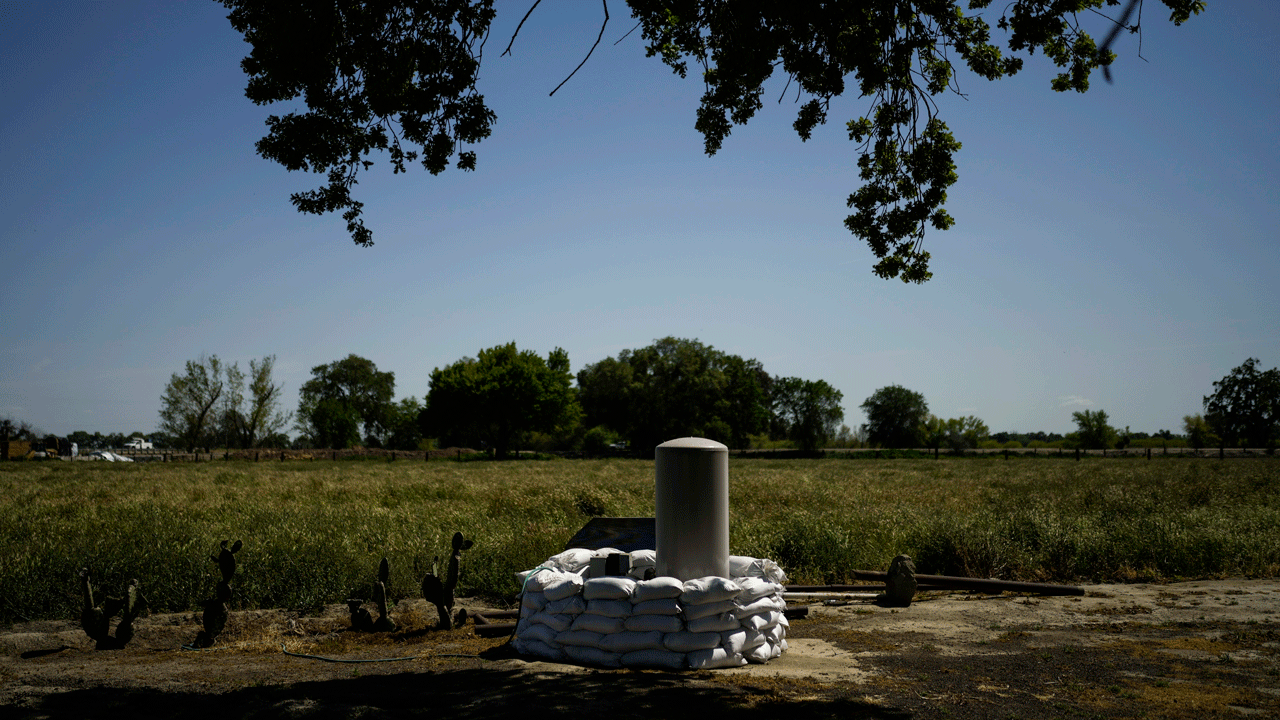
Sandbags are stacked around a well in anticipation of flooding of the Kings River in the Island District of Lemoore, Calif., April 19, 2023. California officials are considering whether to take over monitoring groundwater use in the fertile San Joaquin Valley under a landmark law aimed at protecting water flow to homes and farms. The Tuesday, April 16, 2024, hearing before the State Water Resources Control Board is the first of its kind since California passed a groundwater management law a decade ago. (AP Photo/Jae C. Hong)
Ference said the state board wouldn’t have the local expertise or staff to do this.
“It will just be, ‘Here’s the pumping amount we authorize. Do with it what you can.’”
The hearing is seen as a test of how California’s groundwater rules are working 10 years after lawmakers passed them. The limits came after years of overpumping and drought led to a host of problems ranging from residential wells running dry to sinking land. The goal was to make the most critically overdrafted groundwater basins sustainable.
Communities have since formed groundwater sustainability agencies and drafted management plans. In the Tulare Lake Subbasin, five local agencies worked on a single proposal, only to see it rejected last year by the state Department of Water Resources over concerns about lowering groundwater levels, sinking land and degrading groundwater quality.
If the state water board steps in after Tuesday’s hearing, officials could require anyone who extracts more than a minimal amount of groundwater to report how much they take and pay fees for it. The state could also require larger pumpers to install and use meters that measure water use.
The Tulare Lake Subbasin covers a stretch of Kings County, which is home to about 150,000 people halfway between Los Angeles and San Francisco. The county is a major producer of milk, pistachios, cotton and processed tomatoes, according to a county agricultural report.
It’s also home to Tulare Lake, a large, dry basin that fills with water in rainy years. The lake most recently reappeared in 2023 after intense winter downpours that flooded farms and roads.
Doug Freitas, an almond grower who owns property in areas governed by three different groundwater agencies, said each agency has been talking about what to do next. He said he knew about the state’s groundwater law, but like most small farmers, he was so busy trying to make ends meet that he couldn’t foresee the impact.
“As a farmer, my opinion is we need more time,” Freitas said. “I would like to go to that meeting and beg for mercy and ask for them to let us come back to the table.”
One of the agencies, the Mid-Kings River Groundwater Sustainability Agency, proposed an April 23 vote on charging landowners fees and limiting pumping. The move has met with some resistance, and agency director Dennis Mills recently told residents something must be done if they want to try to keep the state from stepping in.
“They will not accept more promises at this point,” Mills said. “Just a revised plan is not good enough. They need to see concrete steps as to how we’re addressing these things.”
Then there are people like Joaquin Contente, a longtime dairy farmer in Kings County, who said pumping fees and caps spell trouble for him, whether they are imposed by local or state officials. He relies on groundwater to grow the alfalfa he feeds his 800 cattle.
“I know there’s a lot of people losing sleep over it, because I am one of them,” Contente said.
Ference, the farm bureau director, said he supports local control so that farmers can have a say in what happens and communities can invest in local recharge projects.
“This is a community, countywide issue that, if it’s not managed properly, will be catastrophic,” he said.
Read the full article from Here


Fairbanks, Alaska (KTUU/KTVF) – On Wednesday, Gov. Mike Dunleavy, Alaska Attorney General Stephen Cox and Lee Zeldin, the administrator for the Environmental Protection Agency (EPA), spoke to press at the University of Alaska Fairbanks power plant.
During their time at the university, the federal and state leaders spoke about developing resources such as coal, oil, gas and critical minerals in the 49th state.
During his 24-hour trip to Fairbanks, Zeldin said he has spoke to business and state leaders about environmental regulations impacting operations in Alaska, saying the EPA needs to consider whether regulations are solving problems or are solutions in search of a problem.
He also discussed the concept of “cooperative federalism,” where the EPA takes its cues from state leaders to determine where regulations and help are needed.
“We’re here at the University of Alaska’s coal plant, and the most modern coal plant in the United States of America,” Dunleavy said.
Zeldin said visiting Fairbanks in winter helps inform decisions the agency is considering.
“There are a lot of decisions right now in front of this agency that the first-hand perspective of being here on the ground helps inform our agency to make the right decision,” he said.
Zeldin also said the agency is hearing concerns from Alaska truckers about diesel exhaust rules in extreme cold.
“We then met with truckers who have been dealing with unique cold weather concerns with the implementation of EPA regulations related to diesel exhaust fluid system,” he said.
When asked about PFAS in drinking water, Zeldin said the EPA is not rolling back the standards.
“So the PFAS standards are not being rolled back at all,” he said.
On Fairbanks air quality and PM2.5 regulations, Zeldin said the agency wants to work with the state.
“We want, at the EPA, to help the Fairbanks community be able to be in attainment on PM 2.5. We want to make it work,” he said.
Dunleavy said energy costs and heating needs remain a major factor in Interior air quality discussions.
“People have to be able to live. They’ve got to be able to afford to live,” he said.
Zeldin said EPA is considering further changes to diesel regulations and urged Alaskans to participate in the rulemaking process.
“We need Alaskans to participate in that public comment period,” he said.
See a spelling or grammar error? Report it to web@ktuu.com
Copyright 2026 KTUU. All rights reserved.

FLORENCE, AZ (AP) — A Haitian man confined at an Arizona immigration detention center for months died at a hospital Monday after a tooth infection was left untreated, the man’s brother said Wednesday.
Emmanuel Damas, 56, told medical personnel at the Florence Correctional Center that he had a toothache in mid-February, but he was not sent to a dentist, said Damas’ brother, Presly Nelson.
Nelson believes the staff at the facility did not take his brother’s complaints seriously, even though it was a treatable condition. Nelson said he would expect such a death in countries with less access to health care, but not in the United States.
“As a country — I’m an American now — I think we can do better than that,” Nelson said.
Damas is among at least nine people who have died in Immigration and Customs Enforcement custody this year.
The Department of Homeland Security did not immediately respond to emails seeking comment. ICE had said it hoped to issue a news release Wednesday.
Earlier Wednesday, ICE officials announced the death of Mexican national Alberto Gutierrez-Reyes, who had been in a California ICE detention center and died in the hospital Feb. 27 after reporting chest pain and shortness of breath.
Chandler City Council member Christine Ellis, a Haitian American who is a registered nurse, said she was contacted by Damas’ family after his death.
“As a medical person, I am absolutely appalled that there were medical-licensed people that were working there and allowed those things to happen,” Ellis said. “It does not make sense to me.”
A report from the Maricopa County Medical Examiner’s Office listed Damas’ cause of death as “pending” as of Wednesday.
Damas was taken into ICE custody in September and was soon transferred to the medium-security Florence Correctional Center, where he was held for several months, including after his asylum application was denied, Ellis said.
CoreCivic, a for-profit corrections company that runs the Florence facility, did not respond to emails seeking comment.
See a spelling or grammatical error in our story? Please click here to report it.
Do you have a photo or video of a breaking news story? Send it to us here with a brief description.
Copyright 2026 The Associated Press. All rights reserved.
California
Republican governor candidate Chad Bianco says he’s the ‘antithesis to California state government’

We are counting down to the California governor’s race. Chad Bianco, the sheriff of Riverside County, is one of the two biggest names running on the Republican ticket.
In a one-on-one interview with Eyewitness News political reporter Josh Haskell, Riverside County Sheriff Chad Bianco said, “I am the antithesis to California state government because I am going to take a nuclear bomb into that building and absolutely destroy everything that they do to us behind closed doors.”
Although he’s been elected by the voters twice, Bianco says he’s not a politician — which is why he believes his campaign for California governor is resonating, as reflected in the polls.
“President Trump, in one year, from 2025 when he took over, until now, did absolutely nothing to harm California. What’s harming California is 30 years of Democrat one-party rule that have created an environment here that no one can live in anymore. They’ve only been successful here in California because we vote D no matter what. You vote D or die. I mean, that’s it. Charles Manson would be elected in California if he was the only Democrat on the ballot,” Bianco said.
Bianco isn’t the only conservative Republican running for governor, and according to polling, he’s neck-and-neck with former Fox News host Steve Hilton.
SEE ALSO: CA governor candidate Steve Hilton says ‘everybody supports’ Trump’s immigration policies
Leading in some polls in the wide-open California Governor’s race as the June primary creeps closer is Republican and former Fox News host Steve Hilton.
“Steve has no chance of winning in November. The Democrats know that I’m going to win in November, and so they have to do everything they can to keep me out of that,” Bianco said.
When asked about the affordability crisis in the state, Bianco said, “Almost the entire issue of affordability in California is because of regulation, excessive regulation imposed by government. Every single regulation can be signed away with the governor’s signature.”
“It is a drug and alcohol addiction problem that, and a mental health problem,” he said about the homelessness crisis. “Every single bit of money that is going to these nonprofits that say ‘homeless,’ zero money. You’re getting absolutely nothing. I can’t tell you that we would end what we see in the homeless situation within a year, but I guarantee you we would never see it again after two years.”
When challenged on that prediction, pointing to how the state doesn’t have the facilities to treat the number of people living on our streets, Bianco responded, “We have been conditioned to believe that buildings take five years to build. It takes 90 days or less to build a house, but in California, it takes three to five years because the government won’t allow it. The regulations that are destroying this state are going to be removed with me as the governor.”
Bianco also said California jails shouldn’t have to play the role of treatment facilities.
Although he says he supports the Trump administration and wants the president’s endorsement, Bianco has been traveling the state — meeting not just with Republicans, but Democrats and independents as well. He says all of our state government officials have failed.
The primary election is June 2.
No clear front-runner in race for California governor, new poll shows
A new poll shows there’s still no clear front-runner in the race to replace Gov. Gavin Newsom.
Copyright © 2026 KABC Television, LLC. All rights reserved.

Abercrombie’s Career-High 33 Lifts Augusta Past Middle Georgia in PBC Tournament Quarterfinals – Augusta University

Storm Team4 Forecast: Thick fog to clear before storms, rain Thursday night

Several Ohio schools placed under lockdown after threat

Texas Plans Second Execution of the Year

Alabama Baseball Ties Stolen Base Record In Win Over Hornets

Florida High School Football Rankings: Top 25 teams – Oct. 21

Cleary's 21 help Le Moyne down Central Connecticut State 69-64 in OT

How old is Bo Nix? What to know about Oregon quarterback ahead of 2024 NFL Draft

99th annual Pony Swim held in Virginia

Indiana Members Credit Union announced as new anchor tenant at Bottleworks District

DHS defends McLaughlin against allegations husband’s company profited millions from ad contracts: ‘Baseless’

Sánchez defies Trump in political gamble as Madrid say no to war

Satellite images show Iran school strike hit more buildings than earlier reported

US submarine sinks Iranian warship by torpedo in a first since World War II

Which oil and gas facilities in the Gulf have been attacked?
-

 World1 week ago
Exclusive: DeepSeek withholds latest AI model from US chipmakers including Nvidia, sources say
-

 Massachusetts1 week ago
Mother and daughter injured in Taunton house explosion
-

 Wisconsin3 days ago
Setting sail on iceboats across a frozen lake in Wisconsin
-

 Maryland4 days ago
AM showers Sunday in Maryland
-

 Denver, CO1 week ago
10 acres charred, 5 injured in Thornton grass fire, evacuation orders lifted
-

 Florida4 days ago
Florida man rescued after being stuck in shoulder-deep mud for days
-

 Oregon6 days ago
2026 OSAA Oregon Wrestling State Championship Results And Brackets – FloWrestling
-

 Massachusetts2 days ago
Massachusetts man awaits word from family in Iran after attacks