Colorado
It may take decades to close all the abandoned gold rush mines.


Mere feet from a prospect pit where miners dug for gold in the second half of the 19th century, bikers whizzed by on the Maryland Mountain trail system west of Denver.
“This one is 15-to-16-feet deep with vertical walls. You wouldn’t have an easy time getting out of it,” said Jeremy Reineke, a project manager with the Colorado Division of Reclamation, Mining and Safety. “You can see how close it is to the trail if a biker decided to take off and miss a corner or decide to go off trail, you could get on this really fast.”
Reineke oversees the closure of mines and prospect pits like this one near Central City, Colorado. The town was situated on what was once considered the richest square mile on Earth because of the gold mining that was a boon to the region’s economy. At that time, the digging involved shovels, picks and mules. And after that hard labor, sometimes there wasn’t enough ore to move forward.
Reineke said there are “thousands and thousands” of unmapped prospect pits.

Soon, the prospect pit near the bike trail will be covered by a metal grate so trailgoers don’t fall in.
It’s critical public safety work, especially as hiking and bike paths are created in former mining areas, said Jeff Graves, director of the state’s Inactive Mine Reclamation Program.
“There have been instances of fatalities in Colorado associated with folks in abandoned mines,” Graves said. “A child fell into a mine shaft just outside of Central City. And so that prioritized a lot of the work here within Gilpin County.”
That was in 1989.

But in a state where mining was fundamental to its early economy, the quiet work of closing up these mines will likely go on for decades.
Around 13,500 mine features have been closed so far, including shafts, adits, stopes, pits, highwalls and hazardous facilities, according to Graves. The state has the capacity to safeguard about 300 each year.
“Maybe we’re halfway through the total, hopefully,” he said. “But likely, we still have at least that many more within the state that need some type of physical safety, closure constructed on them.”
The program addresses hazards that predate Colorado statehood. “Without the mining, Gilpin County would not exist. Probably Colorado as we know it would not exist,” said David Forsyth, director of the Gilpin Historical Society.
He said it’s hard to overstate the importance of mining to the area.
“It was really [miner] John Gregory’s discovery of lode gold up here in May of 1859 that kind of made Colorado’s gold rush permanent,” Forsyth said.

He said news of that discovery drew thousands of miners within weeks.
“The country was still really recovering from the Panic of 1857,” Forsyth said. “And so, a lot of people were still really hurting financially. And easy gold, ‘Hey, I can go out to Gregory Diggings in Colorado and get rich.’”
Few actually made it rich — but the mining did provide jobs.
Forsyth said miners earned around $2 to $3 per day, and houses, stores, schools and theaters were built as the mines operated. But by the early 20th century, mining activity had slowed significantly and halted during World War I and World War II.
“It was not a wartime necessity, and it never really came back after that,” Forsyth said. “A lot of people who had mines up here just parked their equipment inside, shut the door, said, ‘We’ll be back when the war is over.’ And then they weren’t.”
Until folks from the Inactive Mine Reclamation Program came around many decades later — in some cases welding mines closed with old equipment still inside.
“It’s reminiscent of what the miners are doing to some extent, trying to find that original gold,” Graves said. “We’re trying to find what they were looking for and what they caused, what they left in their wake.”
The lack of regulation at the time allowed these mines to be abandoned — and not just in Colorado.

The U.S. Government Accountability Office estimates there are some 140,000 known abandoned hard-rock mining features on federal lands, and hundreds of thousands more may be unaccounted for.
Graves said Colorado’s program benefits from both state and federal funds. Additional money from the Bipartisan Infrastructure Law will help by freeing up state funds previously used for coal mines.
Even so, Graves said, efforts to close abandoned hard-rock mines are “certainly underfunded.”
“When you look at the magnitude of the problem, even in Colorado it would take us decades to address [it] at the current funding rates,” he said.
It looks like state governments, as well as the feds, will be paying to clean up after the 19th century gold diggers well into the 21st century.
There’s a lot happening in the world. Through it all, Marketplace is here for you.
You rely on Marketplace to break down the world’s events and tell you how it affects you in a fact-based, approachable way. We rely on your financial support to keep making that possible.
Your donation today powers the independent journalism that you rely on. For just $5/month, you can help sustain Marketplace so we can keep reporting on the things that matter to you.



Colorado
Suddenly hazy skies in Denver prompt some residents concerned about wildfire smoke to call 911

Some people who live in the Denver metro area on Thursday afternoon were making calls to 911 after skies became noticeably hazy and winds kicked up. It was due to smoke from wildfires in Nebraska moving into Colorado. A cold front also was moving through the Front Range, and there is dust in the air.
The poor air conditions led to reduced visibility downtown after 3 p.m. Several of CBS Colorado’s City Cams showed dust or smoke in the air.
Temperatures were expected to drop by as much as 20 to 30 degrees with the cold front.
The suddenly dusty skies prompted at least one fire agency to put out a plea to residents to please only call 911 “if you see flames.” That warning was put out by South Metro Fire Rescue, which shared a photo on X of an office building with haze visible outside.
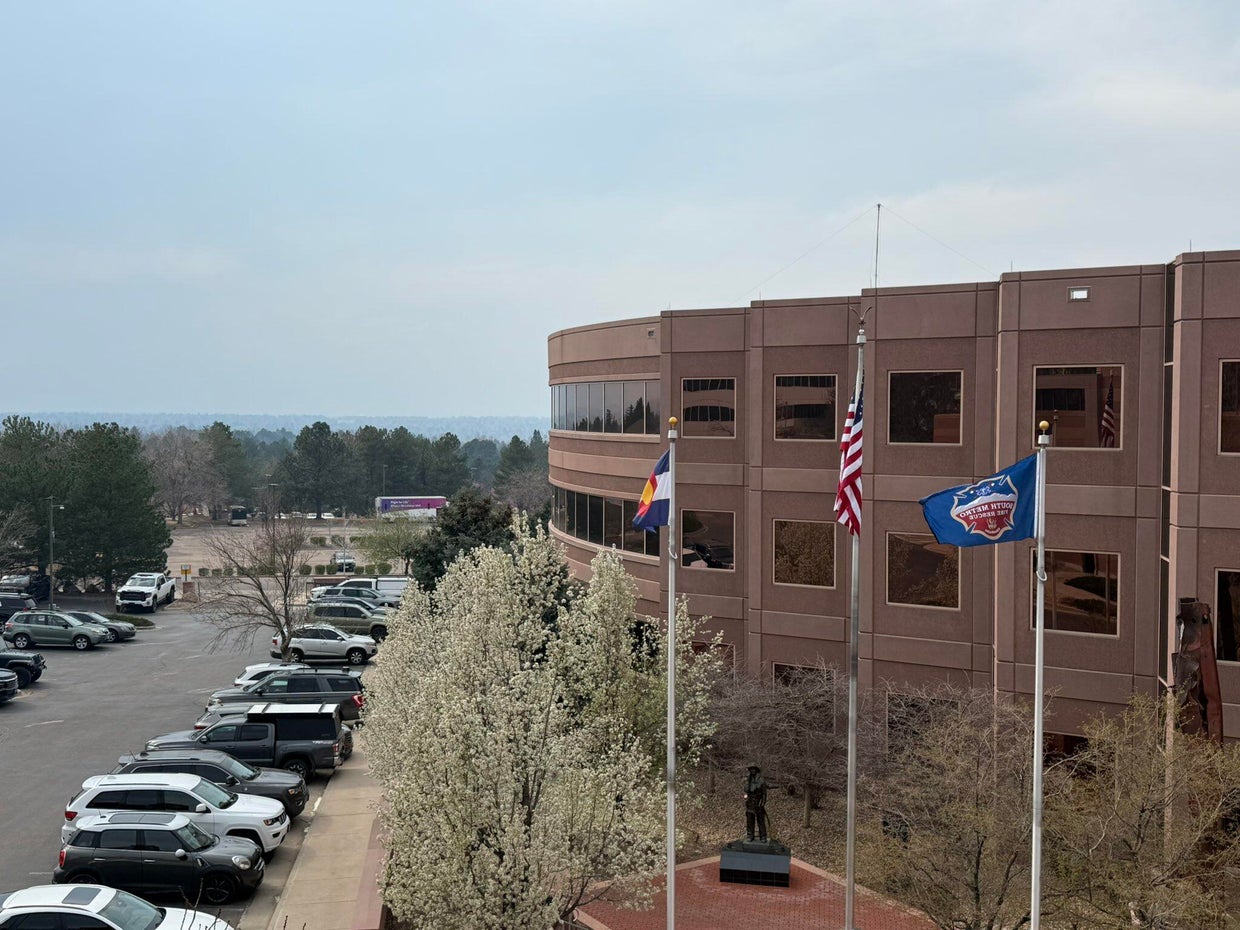
South Metro Fire Rescue said in their post that the smoke is from Colorado’s neighbor to the east. They called it a “significant haze” in the air.
Earlier this month, the Morrill Fire and the Cottonwood Fire burned a significant amount of Nebraska grassland and ranchland. They have mostly been contained by firefighters. Nebraska Gov. Jim Pillen said those two fires combined with several others have burned approximately 800,000 acres of land. On Thursday, Pillen announced that he is signing several executive actions intended to ease the burden caused by the fires.
There were no wildfires burning in the Denver metro area on Thursday afternoon.

ARAPAHOE COUNTY, Colo. (KKTV) – A homicide suspect based out of Colorado, wanted in a fentanyl-related death, is back in the state after being captured in Colombia.
The Arapahoe County Sheriff’s Office (ACSO) said 33-year-old Max Arsenault had been on the run since January 17.
Deputies said this stemmed from an incident in May 2023, where deputies responded to a call for a man named Nicholas Dorotik, who was found unresponsive.
ACSO said the cause of death was a mixed drug overdose involving meth and fentanyl, having about three times the lethal amount of fentanyl in his system.
One year later, Arsenault was arrested. He was scheduled for trial in January 2026 when deputies said he fled the country while on bond three days before the trial was set to start.
He was caught in Medellin, Colombia, on March 4, following a two-month international investigation. He has since been extradited back to Denver, where he is facing charges and awaiting trial.
Copyright 2026 KKTV. All rights reserved.


Metro Detroit weather forecast, March 26, 2026 — 11 p.m. Update

Man convicted in the deadly 2021 assault of a Thai grandfather in San Francisco avoids prison

Dallas Mayor Eric Johnson is confident about cost estimates to repair, rehab City Hall and insists the process has been transparent

Miami Gardens community rallies to help retired teacher rebuild after a fire tore through his home

Boston police searching for gunman after ‘juvenile’ shot in Allston – Boston News, Weather, Sports | WHDH 7News

Florida High School Football Rankings: Top 25 teams – Oct. 21

How old is Bo Nix? What to know about Oregon quarterback ahead of 2024 NFL Draft

Cleary's 21 help Le Moyne down Central Connecticut State 69-64 in OT

99th annual Pony Swim held in Virginia

Indiana Members Credit Union announced as new anchor tenant at Bottleworks District

Video: Savannah Guthrie Says She Believes Her Mother Was Taken for Ransom

Stefanik grills University of Michigan leader on lack of audit after string of Chinese national arrests

Photos: More than one million displaced by Israel’s evacuations in Lebanon

DHS shutdown live updates as Senate holds test vote on funding bill

Video: Jury Rules Against Meta and YouTube for Addictive Features
-

 Detroit, MI1 week ago
Drummer Brian Pastoria, longtime Detroit music advocate, dies at 68
-

 Science1 week ago
How a Melting Glacier in Antarctica Could Affect Tens of Millions Around the Globe
-

 Movie Reviews1 week ago
‘Youth’ Twitter review: Ken Karunaas impresses audiences; Suraj Venjaramoodu adds charm; music wins praise | – The Times of India
-
 Science1 week ago
I had to man up and get a mammogram
-

 Sports5 days ago
IOC addresses execution of 19-year-old Iranian wrestler Saleh Mohammadi
-

 New Mexico4 days ago
Clovis shooting leaves one dead, four injured
-

 Texas7 days ago
How to buy Houston vs. Texas A&M 2026 March Madness tickets
-

 Tennessee3 days ago
Tennessee Police Investigating Alleged Assault Involving ‘Reacher’ Star Alan Ritchson